
US LNG Terminal Forging Requirements: Cryogenic Grade Components from India
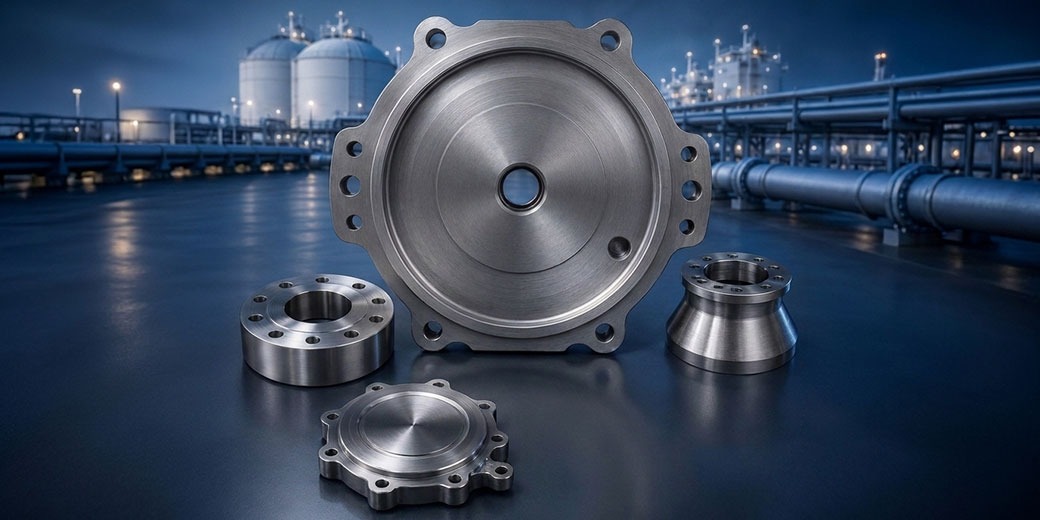
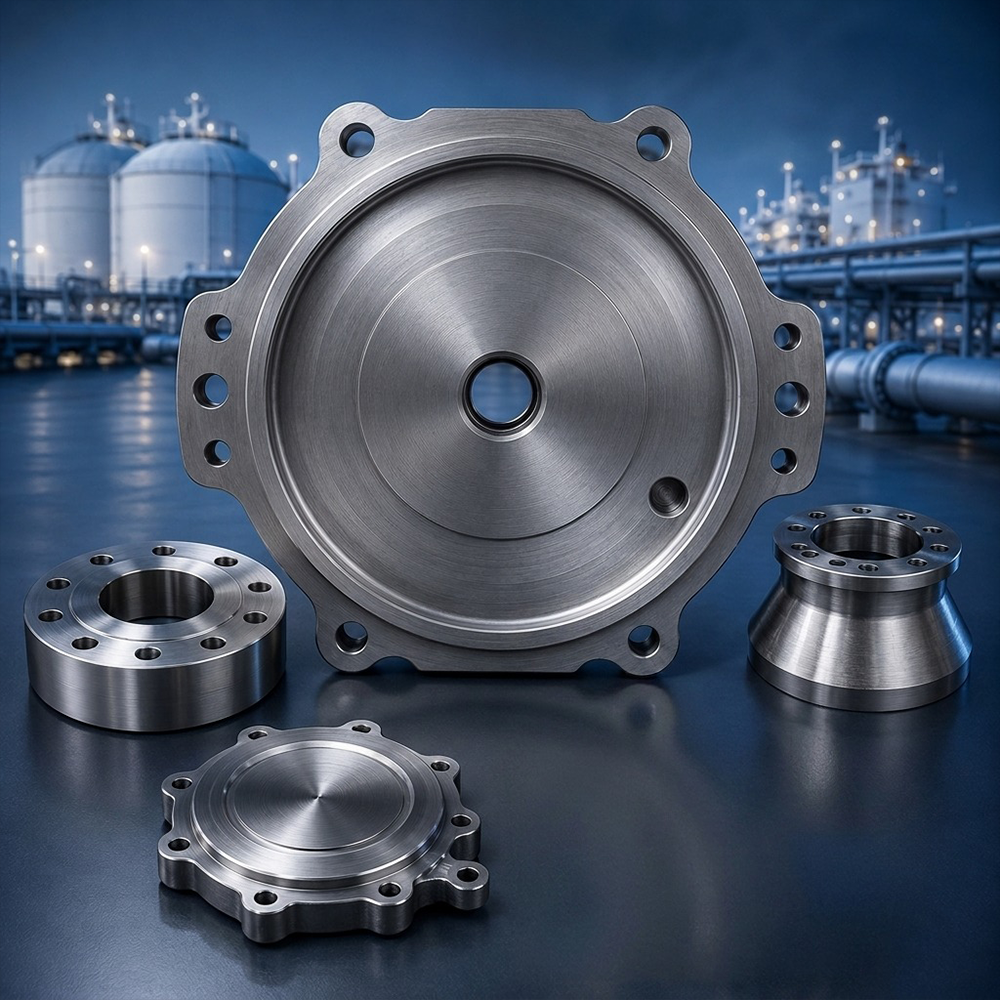
The United States has become the world’s largest LNG exporter, and the infrastructure buildout supporting that position — export terminals, import facilities, peak shaving plants, and the expanding LNG-as-fuel distribution network — represents one of the largest single concentrations of cryogenic forging demand in the world. Sabine Pass, Freeport LNG, Corpus Christi LNG, Cameron LNG, Cove Point, and the terminals under construction and development along the Gulf Coast and East Coast collectively require millions of forged cryogenic-grade components — flanges, valve bodies, nozzle forgings, pressure vessel closures, and pump casings — that must maintain structural integrity and leak-tight sealing at -162°C, the boiling point of liquefied natural gas at atmospheric pressure. Indian forging manufacturers with NABL-accredited low-temperature Charpy impact testing capability, validated cryogenic heat treatment procedures, and AS9100D quality systems are qualified to supply this market.
At a Glance : US LNG Terminal Forging Material Requirements
| Service Zone | Temperature | Material | Standard | Critical Test |
| LNG storage tank nozzles | -162°C | 9% Nickel steel | ASTM A522 | Charpy at -196°C |
| Direct LNG contact piping | -162°C | ASTM A182 F304L / F316L | ASME B31.3 | No Charpy required (austenitic) |
| Cold box and send-out | -46°C to -100°C | ASTM A350 LF2 / LF3 | ASME B31.3 | Charpy at -50°F (-46°C) |
| LNG pump casings | -162°C | ASTM A182 F304L | ASME B73.3 | Cryogenic function test |
| Compressor nozzles | -46°C | ASTM A350 LF2 | ASME VIII Div 1 | Charpy at -50°F |
| Vaporiser piping | Ambient to +120°C | ASTM A105 / A182 F316 | ASME B31.3 | Standard |
| High pressure send-out | Ambient | ASTM A694 F70 | ASME B31.3 | Standard |
The US LNG Export Boom : Why Forging Demand Is Accelerating
The United States crossed a milestone in 2023 — it became the world’s largest LNG exporter, surpassing Qatar and Australia. US LNG export capacity reached 14 billion cubic feet per day (Bcf/d) and is expanding rapidly. The facilities driving this expansion represent billions of dollars of capital investment in cryogenic infrastructure — and cryogenic-grade forged components are a significant portion of that capital cost.
Active US LNG export terminals requiring ongoing forging supply:
Sabine Pass LNG (Cheniere Energy, Louisiana) — the first and largest US LNG export terminal, with six liquefaction trains producing 30 MTPA. Train 1 through 6 are operational. Ongoing maintenance and the planned Train 7 expansion continue to generate forging demand.
Corpus Christi LNG (Cheniere Energy, Texas) — three operational trains plus Stage 3 expansion (seven mid-scale trains) under construction. Stage 3 represents the largest single LNG expansion project in the western hemisphere.
Freeport LNG (Texas) — three trains operational. Return to service after the 2022 explosion and fire required extensive replacement of cryogenic piping components including flanges, valve bodies, and nozzle forgings.
Cameron LNG (McDermott/TotalEnergies/Sempra, Louisiana) — three operational trains with expansion under development.
Cove Point LNG (Berkshire Hathaway Energy, Maryland) — one operational train. East Coast location serving European markets.
Under construction and development:
- Plaquemines LNG (Venture Global, Louisiana) — 20 MTPA capacity
- Port Arthur LNG (Sempra, Texas) — 13.5 MTPA
- Rio Grande LNG (NextDecade, Texas) — 17.6 MTPA planned
- Lake Charles LNG (Energy Transfer, Louisiana) — under development
- Commonwealth LNG (Louisiana) — under development
The combined construction and maintenance forging demand from these facilities — all requiring cryogenic-grade A350 LF2, F304L, F316L, and 9% nickel steel components — makes the US LNG sector one of the most sustained forging markets available to Indian manufacturers with validated cryogenic capability.
US LNG Terminal Design Codes and Applicable Standards
US LNG terminals are engineered to a specific set of design codes that differ from the API-dominated oil and gas forging world. Understanding which codes apply to which system is the starting point for any forging supplier serving this market.
ASME B31.3 – Process Piping
The primary piping design code for LNG terminal process piping. ASME B31.3 Chapter M covers metal temperatures below -29°C and defines impact testing requirements by material type and design temperature.
For cryogenic LNG service:
Impact testing under ASME B31.3 :
- Carbon steel materials at temperatures below -29°C require impact testing per ASME requirements
- A350 LF2 is tested at -50°F (-46°C) — mandatory
- A350 LF3 is tested at -150°F (-101°C) — for colder applications
- Austenitic stainless steels (F304L, F316L) are exempt from mandatory impact testing — they do not undergo ductile-brittle transition
- 9% nickel steel (A522) is tested at -196°C per ASME special low-temperature rules
ASME Section VIII Division 1 — Pressure Vessels
For LNG vaporisers, heat exchangers, and pressure vessels within the LNG terminal. UCS-66 defines the impact testing requirements and the permitted materials for various design temperatures. For LNG service at -162°C, only austenitic stainless and 9% nickel steel satisfy the ASME impact requirements without special testing provisions.
NFPA 59A – Production, Storage, and Handling of LNG
The National Fire Protection Association standard governing LNG facility design and operation in the United States. NFPA 59A references ASME B31.3 for piping and ASME Section VIII for pressure vessels but adds specific material requirements for components in direct LNG service.
BS 7777 — Flat-Bottomed LNG Storage Tanks
Many US LNG storage tanks are designed to British Standard BS 7777 — the internationally accepted standard for full-containment LNG storage tanks. BS 7777 references specific material and Charpy impact requirements for tank nozzle forgings and structural connections. Even for US-located LNG terminals, EPC contractors (Chart Industries, McDermott, Samsung Heavy Industries, Technip) often apply BS 7777 for tank design as it is the most widely accepted international standard for LNG storage.
Cryogenic Materials for US LNG Terminal Forgings
ASTM A350 LF2 — The Standard Cryogenic Carbon Steel
A350 LF2 is the most widely specified carbon steel forging material for US LNG terminal piping flanges, valve bodies, and fittings in the temperature range from ambient down to -46°C. The key difference from standard ASTM A105 is mandatory Charpy V-notch impact testing at -50°F (-46°C).
Why Charpy impact testing at -46°C matters for LNG terminals: Standard carbon steel undergoes a ductile-brittle transition as temperature decreases. A105 flanges that are ductile and tough at room temperature become brittle at cryogenic temperatures — they can fracture under a pressure transient or thermal shock without prior warning. This is the failure mechanism that has caused several serious LNG facility incidents — brittle fracture of carbon steel components that had not been specified or tested to low-temperature requirements.
A350 LF2 is specifically manufactured to ensure adequate impact toughness at -46°C :
- Minimum average Charpy energy: 27 J (20 ft-lb) at -46°C
- Minimum individual specimen energy: 16 J (12 ft-lb)
- Fine grain practice mandatory — grain size ASTM 6 or finer
- Normalise and temper heat treatment — tempering above 593°C per ASTM A350
US LNG terminal EPC contractors verify the Charpy impact test results on every lot of A350 LF2 forgings. A lot with even one specimen below the minimum individual energy of 16 J is rejected regardless of the average and regardless of all other test results.
ASTM A182 F304L and F316L — Austenitic Stainless for Direct LNG Contact
Austenitic stainless steels — 304L and 316L — do not undergo the ductile-brittle transition that makes carbon steel unsuitable for LNG-temperature service. Their face-centred cubic crystal structure remains ductile at -162°C and below. They are the preferred materials for:
- Pipeline components in direct LNG contact at -162°C
- LNG pump casing forgings
- Cold box piping flanges and fittings
- Transfer line flanges between LNG storage and liquefaction
- Vaporiser inlet piping and associated fittings
Why F304L and F316L rather than standard F304 and F316: The “L” designation (low carbon — maximum 0.030% carbon versus 0.080% for standard grades) minimises carbide precipitation during welding. Carbide precipitation in the heat-affected zone of welds depletes chromium from the adjacent matrix — causing sensitisation and intergranular corrosion. LNG terminal piping is extensively welded during construction and maintenance, and sensitised welds are a corrosion risk in the trace moisture environments of LNG systems.
Heat treatment for F304L and F316L forgings: Solution annealing at 1,040–1,120°C followed by rapid quench. The rapid quench prevents carbide precipitation during cooling. For large-section forgings (above 150mm equivalent thickness), the quench must be to water — air cooling of thick-section austenitic stainless does not achieve adequate cooling rate through the sensitisation temperature range.
9% Nickel Steel — ASTM A522 for LNG Storage Structures
9% nickel steel (approximately 9% nickel content) is the standard material for LNG storage tank shells and for nozzle forgings and structural connections on LNG storage tanks operating at full cryogenic temperature (-162°C). The 9% nickel content stabilises the austenite phase and maintains high impact toughness at LNG temperatures.
Charpy impact testing for 9Ni steel: Testing at -196°C (liquid nitrogen temperature) — below the -162°C LNG service temperature — provides a conservative margin. Minimum Charpy energy requirements are specified in ASTM A522 and BS 7777. These requirements are more demanding than standard cryogenic carbon steel and require NABL-accredited laboratory capability to test at -196°C.
Heat treatment for A522 9Ni steel forgings: Double normalise and temper (most common) — normalise at 800–870°C, air cool; second normalise at 790–810°C, air cool; temper at 550–590°C. The double normalising cycle refines grain structure twice, producing the very fine grain required for -196°C toughness. Alternatively, quench and temper from a single austenitising temperature.
Specific Forging Requirements for US LNG Terminal Systems
LNG Storage Tank Nozzle Forgings
LNG storage tanks at US export terminals — typically double-wall full-containment tanks with outer concrete wall and inner 9% nickel steel inner tank — have nozzle forgings at every penetration point: fill nozzles, send-out nozzles, vapour return nozzles, instrument connections, and emergency pressure relief connections.
These nozzle forgings are in direct LNG contact, at -162°C, under the full hydrostatic pressure of the LNG column plus the operating vapour pressure. The consequences of a nozzle forging failure — LNG release from a full tank — are catastrophic. This is why the 9% nickel steel specification, double normalise and temper heat treatment, and Charpy testing at -196°C are mandatory without exception.
Dimensional requirements for LNG tank nozzles: The nozzle forging must provide the transition from the inner tank shell (9Ni plate) to the attached piping. The bore must be concentric with the attached piping. The weld preparation geometry — both at the tank shell end and the piping end — must match the design drawings precisely, as the field welding of these nozzles during construction occurs at completed tanks where rework access is extremely limited.
LNG Transfer Line Flanges
The transfer lines that move LNG from storage tanks to the liquefaction trains (for export terminals) or from the jetty to storage (for import terminals) operate at -162°C and contain large volumes of LNG under pressure. Flanged connections in these lines — every flange pair is a potential leak point — must be produced in austenitic stainless (F304L or F316L) with ring-type joint (RTJ) face configurations.
RTJ flanges for LNG service must be machined to ASME B16.20 dimensional tolerances for ring groove geometry. The ring groove finish must meet the specified Ra values — a groove that is too rough will not seal reliably against the metal-to-metal RTJ gasket at cryogenic temperatures where thermal contraction changes gasket loading.
US LNG terminals typically specify 150# through 1500# class flanges in the transfer line piping. Large bore flanges — DN600 (24 inch) to DN900 (36 inch) — for the main transfer lines are ring-rolled rather than closed die forged, providing circumferential grain flow around the flange ring that maximises resistance to the hoop stress of internal pressure.
LNG Pump Casing Forgings
LNG submersible pumps — the pumps that circulate LNG within storage tanks and pump it through send-out lines to the vaporisation system — use forged casings in F304L austenitic stainless.
The pump casing must:
- Maintain dimensional stability at -162°C — austenitic stainless contracts significantly from ambient to LNG temperature (approximately 3mm per metre of length), and the pump casing geometry must account for this thermal contraction in the design of internal clearances
- Provide adequate wall thickness for the combined internal pressure and external hydrostatic pressure of the LNG column above the pump
- Allow for the casting-free, porosity-free construction that only forging provides — a leaked pump casing in a full LNG storage tank is not accessible for repair
LNG Vaporiser and Heat Exchanger Nozzle Forgings
Open rack vaporisers (ORV) and submerged combustion vaporisers (SCV) at US LNG terminals convert LNG from liquid to gas for distribution into the US gas pipeline network. The inlet nozzles of these vaporisers receive LNG at -162°C; the outlet nozzles discharge natural gas at ambient temperature. This cryogenic-to-ambient temperature transition creates significant thermal stress that the nozzle forging design must accommodate.
ORV inlet nozzles — in F316L stainless — must be designed for the thermal shock of LNG flowing from storage temperature (-162°C) into the vaporiser system. The bore surface experiences rapid temperature cycling during start-up and shutdown sequences. This thermal fatigue requirement drives specific minimum wall thickness and bore geometry requirements that must be achieved in the forging and maintained through machining.
EPC Contractor Requirements for US LNG Terminal Forging
Bechtel
Bechtel is the EPC contractor for several US LNG export projects including Sabine Pass expansion and Corpus Christi Stage 3. Bechtel’s material specifications for cryogenic forging procurement include:
- A350 LF2 Charpy results reported on Bechtel-format material test certificates
- Low-temperature testing conducted by a laboratory with demonstrated and documented cryogenic test capability (not just standard Charpy capability)
- Solution anneal heat treatment records with cooling rate documentation for F316L and F304L forgings
- Third-party inspection by a Bechtel-approved inspection company (Bureau Veritas, SGS, Intertek)
McDermott
McDermott has executed LNG liquefaction projects globally and has US LNG experience at Cameron and international projects. McDermott’s specifications for cryogenic forgings are based on ASME B31.3 with additional requirements including:
- Material certifications in English with ASTM-standard property reporting
- Positive material identification (PMI) by XRF on 100% of stainless steel components
- Weld procedure qualification in cryogenic materials for attachment welds on forging nozzles
Technip Energies
Technip Energies applies their SPE (Standard Piping Engineering) material specifications for LNG terminal forging procurement. European-based EPC contractors applying to US projects may reference EN material equivalents alongside ASTM specifications — requiring Indian forging manufacturers to demonstrate equivalency between their ASTM A350 LF2 production and EN 10222-3 P280GH or equivalent.
NABL Accreditation for Low-Temperature Charpy Testing
The most common failure point for Indian forging manufacturers seeking to supply US LNG terminal projects is the inability to demonstrate NABL-accredited low-temperature Charpy impact testing capability at -46°C and below.
Standard NABL accreditation for mechanical testing covers Charpy impact at room temperature and at moderately elevated temperatures.
Low-temperature Charpy testing — at -46°C, -101°C, or -196°C — requires:
- A cryogenic cooling bath capable of maintaining the specified test temperature with ±2°C accuracy throughout the conditioning period
- Temperature measurement calibrated to the specified accuracy
- Transfer of the conditioned specimen from the cooling bath to the anvil and striking of the specimen within 5 seconds (per ASTM A370 requirements for low-temperature Charpy)
- NABL accreditation scope explicitly listing Charpy impact testing at the specific low temperatures to be tested
US LNG terminal EPC contractors and their material engineers verify the NABL scope certificate for the testing laboratory before accepting test results. NABL accreditation for standard Charpy does not extend to -46°C testing unless the scope explicitly states this.
Vinir Engineering’s Capability for US LNG Terminal Forging
Vinir Engineering provides cryogenic-grade forgings for US LNG terminal applications with NABL-accredited in-house low-temperature Charpy impact testing as standard.
ASTM A350 LF2 forgings — normalise and temper with tempering above 593°C per ASTM A350. Charpy V-notch testing at -50°F (-46°C) from the NABL-accredited in-house laboratory. NABL scope covers low-temperature impact testing at -20°C, -29°C, -46°C, and -101°C. Test results on Bechtel, McDermott, or EPC-standard certificate formats.
ASTM A182 F316L and F304L forgings — solution annealed at 1,040–1,120°C with rapid water quench. Large-section forgings quenched to water — not air cooled. PMI by in-house XRF on all stainless components as standard.
Closed die forging — flanges, valve bodies, nozzle forgings, and pump casing components in the 10–1,400 kg range.
Open die forging — heavy pressure vessel nozzle forgings in the 1,400–15,000 kg range.
Ring rolling — large-diameter transfer line flanges and structural rings to Ø4,500mm in F316L and A350 LF2.
TPI coordination — Bureau Veritas, SGS, and Intertek for US LNG EPC contractor-specified inspection. Documentation packages in ASME-standard format with low-temperature test reports prominently included.
Frequently Asked Questions — US LNG Terminal Forging Requirements
Why can’t standard carbon steel (ASTM A105) be used for LNG terminal piping flanges?
ASTM A105 is carbon steel for ambient and moderately elevated temperature service — no mandatory low-temperature impact testing is required. At LNG temperatures (-162°C) and in the cold zones of LNG terminals (typically -46°C to -100°C), A105 may be in the brittle regime of its ductile-brittle transition curve. Brittle fracture of a carbon steel flange under internal pressure or thermal shock at these temperatures is a catastrophic failure mode — the flange fractures without prior warning or deformation. ASTM A350 LF2, tested at -46°C, is specified to ensure the material is in the ductile regime at the design temperature with an adequate safety margin.
What is the difference between ASTM A350 LF2 and LF3 for LNG applications?
Both are carbon-manganese low-temperature steel forgings, but with different mandatory Charpy impact test temperatures. LF2 is tested at -50°F (-46°C) and is the standard for most US LNG terminal piping in the temperature range from -29°C to -46°C — the cold zones of the terminal but not the direct LNG contact systems. LF3 is tested at -150°F (-101°C) and is used for components that may reach colder temperatures in transient conditions. For direct LNG contact at -162°C, neither LF2 nor LF3 is used — austenitic stainless (F304L, F316L) or 9% nickel steel (A522) is required.
Why do US LNG terminals specify BS 7777 for storage tank design when the facility is in the United States?
BS 7777 is the internationally accepted standard for full-containment LNG storage tanks, developed by the British Standards Institution with input from the global LNG industry. US regulatory authorities (PHMSA, FERC) accept facilities designed to BS 7777 for US LNG terminal permits. EPC contractors with global LNG experience — Technip, McDermott, Samsung — use BS 7777 as their standard tank design code regardless of the project’s location because it represents the most comprehensive and internationally tested set of LNG tank design requirements. The NFPA 59A US standard references BS 7777 for tank design in some provisions.
Does NABL accreditation for standard Charpy impact testing cover low-temperature testing at -46°C?
Not automatically. Standard NABL accreditation for mechanical testing covers Charpy impact at ambient temperature. Low-temperature testing at -46°C, -101°C, or -196°C requires a separate NABL accreditation scope that explicitly includes these temperatures. US LNG EPC contractors verify the NABL scope certificate before accepting low-temperature Charpy results. An Indian forging manufacturer whose NABL scope covers only ambient Charpy cannot supply tested cryogenic forgings for US LNG terminal programmes without additional accreditation. Buyers should verify the specific temperatures listed on the NABL scope certificate — not just confirm that NABL accreditation exists.
What documentation package does a US LNG terminal EPC contractor require for cryogenic forging lots?
A complete documentation package for US LNG cryogenic forging procurement includes: mill test report to applicable ASTM specification with all required mechanical and chemical properties; independent chemical analysis from a NABL-accredited laboratory including heat-specific carbon equivalent; low-temperature Charpy impact test report showing test temperature, individual specimen results (all three specimens), and average — from a NABL-accredited laboratory with scope covering the specified test temperature; heat treatment record including procedure reference, furnace chart showing the complete thermal cycle, and tempering temperature verification; PMI results by component identifier for stainless steel components; dimensional inspection report; TPI release certificate from the EPC contractor-approved inspection company; and certificate of conformance referencing the ASTM specification, the design code (ASME B31.3 or equivalent), and all applicable purchase order supplement requirements.