
API Certification for Forgings: API 20B vs API 20C and What Each Covers
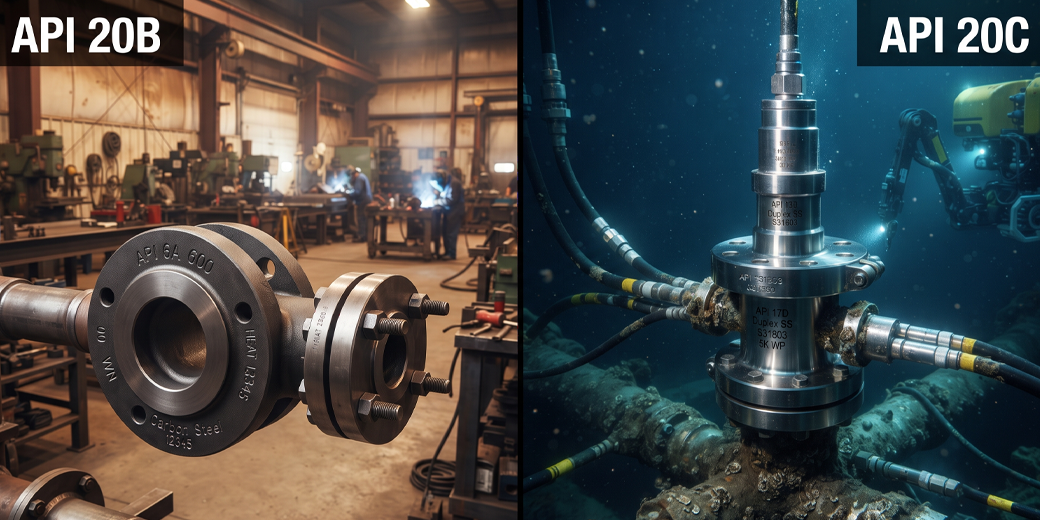
API forging certification refers to the manufacturer qualification requirements defined by the American Petroleum Institute for forged components used in oil and gas pressure-retaining applications. Two primary standards govern forging manufacture for the oil and gas industry — API 20B for carbon and low alloy steel forgings and API 20C for corrosion-resistant alloy forgings. Understanding the difference between these standards, what each requires, and when each applies is essential for oil and gas procurement teams specifying forgings and for forging manufacturers building their certification portfolio for the oil and gas market.
At a Glance: API 20B vs API 20C
| Parameter | API 20B | API 20C |
| Full title | Wrought Seamless Carbon and Low Alloy Steel Forgings for Oil & Gas | Corrosion-Resistant Alloy Seamless Forgings for Oil & Gas |
| Material scope | Carbon steel, low alloy steel | Stainless steel, duplex, super duplex, Inconel, titanium |
| ASTM specifications covered | A105, A182 F1/F2/F5/F9/F11/F12, A350 LF1/LF2/LF3 | A182 F304/316/F51/F53/F55/F60/F61, Inconel grades |
| PSL levels | PSL 1, 2, 3, 4 | PSL 1, 2, 3 |
| Primary application | General pressure service, wellhead, pipeline, structural | Corrosive service, subsea, sour service CRA, offshore |
| Sour service relevance | Hardness limits per NACE MR0175 apply | Specific CRA grades qualified for sour service |
| Charpy impact testing | PSL 2 and above | All PSL levels for austenitic — not required for some duplex |
| 100% UT threshold | PSL 3 — all forgings above 4.5 kg | PSL 3 — all forgings above 4.5 kg |
| Typical Indian market use | ONGC, HPCL, BPCL, pipeline systems | ONGC offshore, Reliance KG-D6, subsea systems |
API 20B: Carbon and Low Alloy Steel Forgings
What API 20B Covers
API 20B governs the manufacture of wrought seamless forgings in carbon steel and low alloy steel for use in petroleum and natural gas industry pressure-retaining applications. The standard covers the full production sequence — material procurement, melting practice, forging, heat treatment, NDE, dimensional inspection, and documentation.
Materials within API 20B scope:
Carbon steels — ASTM A105 for ambient temperature flanges, fittings, and valve bodies. The most widely used oil and gas forging material globally. Available from virtually all steel mills. Well-characterised heat treatment response.
Low temperature carbon steels — ASTM A350 LF1 (tested to -20°F/-29°C), LF2 (tested to -50°F/-46°C), LF3 (tested to -150°F/-101°C). Used for LNG terminals, cold climate installations, and cryogenic applications where standard A105 lacks the required toughness at low temperature.
Low alloy steels — ASTM A182 Grade F1, F2, F5, F9, F11, F12, F22, F91. Chromium and molybdenum alloy additions provide elevated temperature strength and creep resistance. Used for high-temperature process piping in refineries, petrochemical plants, and power generation.
API 20B Heat Treatment Requirements
All API 20B forgings must be heat treated.
The heat treatment requirement varies by material grade:
ASTM A105 carbon steel — normalising (air cool from austenitising temperature) or normalising and tempering. Quench and temper is not required but is permitted and provides better toughness for some applications.
Low alloy grades F11, F22 — normalise and temper. The chromium and molybdenum additions require controlled tempering to achieve the specified combination of elevated temperature strength and toughness.
High alloy grades F5, F9, F91 — quench and temper or normalise and temper depending on grade. F91 (9Cr-1Mo-V) requires a specific heat treatment sequence — normalise at 1,040–1,080°C and temper at 730–800°C minimum — to achieve the creep properties that make it valuable for high-temperature service.
API 20B Sour Service — NACE MR0175 Compliance
For forgings intended for H₂S service (sour service), API 20B PSL 2 and above includes specific requirements aligned with NACE MR0175/ISO 15156.
The key controls:
Maximum hardness — 22 HRC (approximately 237 HBW Brinell) maximum for carbon and low alloy steels. This limit exists because harder steels are more susceptible to sulphide stress cracking — the hydrogen embrittlement mechanism active in H₂S environments.
Carbon equivalent — limits on the carbon equivalent formula (CE = C + Mn/6 + (Cr+Mo+V)/5 + (Ni+Cu)/15) to control hardenability and susceptibility to hydrogen damage.
Hardness verification — every component for sour service must be hardness tested at multiple locations to confirm maximum hardness is not exceeded at any point. A component that meets minimum strength requirements but has a localised hard zone above 22 HRC — from inadequate tempering, from a quench anomaly, or from surface work-hardening — is rejected for sour service.
API 20C: Corrosion-Resistant Alloy Forgings
What API 20C Covers
API 20C governs the manufacture of corrosion-resistant alloy (CRA) forgings — stainless steels, duplex stainless steels, and nickel alloys — for oil and gas applications where standard carbon and low alloy steels do not provide adequate corrosion resistance.
The standard applies to materials that resist corrosion through their inherent alloy composition rather than through applied coatings or cathodic protection — which is why they are called corrosion-resistant alloys rather than simply stainless or high-alloy steels.
Materials within API 20C scope:
Austenitic stainless steels — ASTM A182 F304, F304L, F316, F316L. The most common stainless grades. Good corrosion resistance in atmospheric and mild aqueous environments. Not suitable for chloride stress corrosion cracking environments — the primary reason more advanced CRA grades are specified for offshore and sour service.
Duplex stainless steels — ASTM A182 F51 (duplex 2205, UNS S31803/S32205), F60 (duplex 2507 super duplex, UNS S32750), F61 (25Cr super duplex, UNS S32760). Superior to austenitic stainless in chloride environments, pitting resistance, and stress corrosion cracking resistance. The standard for offshore and subsea oil and gas service where seawater contact and chloride-bearing production fluids are present.
Nickel alloys — Inconel 625 (UNS N06625), Inconel 718 (UNS N07718), Alloy 28 (UNS N08028). For the most aggressive corrosive environments — HPHT wells with high H₂S, CO₂, and chloride concentrations where even super duplex stainless steel does not provide adequate resistance.
Martensitic stainless steels — ASTM A182 F6a (13Cr), ASTM A182 F6NM (13Cr-4Ni). Used for valve trim components and downhole equipment in moderate corrosion environments. Hardenable by heat treatment — can achieve high strength alongside corrosion resistance.
API 20C Heat Treatment: The Critical Difference from Carbon Steel
The heat treatment of CRA materials under API 20C differs fundamentally from carbon and low alloy steel heat treatment — and the consequences of incorrect heat treatment are more severe for CRAs because the corrosion resistance itself depends on the heat treatment being correct.
Austenitic stainless (304, 316) — solution annealing at 1,040–1,150°C followed by rapid quench. The rapid quench is mandatory — slow cooling through the sensitisation temperature range (425–870°C) causes chromium carbide precipitation at grain boundaries, depleting chromium from the adjacent matrix and creating intergranular corrosion susceptibility. A 316L forging that appears metallurgically sound and meets mechanical property requirements can be severely sensitised and will fail in corrosive service if the quench was inadequate.
Duplex stainless (2205, 2507) — solution annealing at 1,020–1,100°C for 2205, 1,050–1,100°C for 2507, followed by rapid water quench. The heat treatment objective is to achieve the target austenite-ferrite phase balance (40–60% ferrite) and to dissolve any sigma phase, chi phase, or secondary austenite that formed during forging. Ferrite content is verified after annealing by ferritescope measurement or metallographic point count.
The cooling rate between the annealing temperature and the quench is as critical as the annealing temperature itself. Sigma phase forms rapidly in duplex steels between 600–900°C — a forging that is allowed to air cool through this range before quenching will have sigma phase regardless of whether the annealing temperature was correct.
Inconel 625 — solution annealing at 1,093–1,204°C, rapid quench. Inconel 625 achieves its properties through solid solution strengthening rather than precipitation hardening — no ageing treatment is required. The solution anneal dissolves any deleterious phases (delta phase, Laves phase) that may have formed during forging or slow cooling.
Inconel 718 — solution anneal plus double ageing (718°C / 8 hours, furnace cool to 621°C, then 621°C / 8 hours). Unlike Inconel 625, Inconel 718 is precipitation hardened — the two-stage ageing develops the gamma double prime and gamma prime precipitates that give the alloy its high strength. The ageing procedure is temperature and time sensitive — deviation of ±15°C from the specified ageing temperature measurably affects properties.
API 20C NDE Requirements
CRA materials present specific NDE challenges:
Austenitic and duplex stainless — no MT possible — these are non-ferromagnetic materials. Magnetic particle inspection cannot be applied. Fluorescent penetrant inspection (FPI) is the surface inspection method for all austenitic and duplex stainless steel forgings under API 20C.
Duplex UT challenges — duplex stainless steels have a coarser and more anisotropic microstructure than fine-grain carbon steel. This produces higher UT background noise that can mask defect indications if the UT parameters (frequency, probe type, reference standard material) are not selected for the specific duplex grade being inspected. A carbon steel reference standard cannot be used for duplex forging UT calibration — the acoustic properties are different.
Inconel UT challenges — Inconel alloys have high acoustic attenuation compared to steel. Higher frequency probes (5–10 MHz) are required to achieve adequate sensitivity. The reference standard must be from the same Inconel alloy as the production forging. As with duplex, grain noise in Inconel can mask defect signals if the process is not controlled — and grain size control in Inconel forging is therefore both a mechanical property requirement and an NDE inspectability requirement simultaneously.
When to Specify API 20B vs API 20C
Specify API 20B When:
- The service fluid is non-corrosive or mildly corrosive — oil or gas without significant H₂S, CO₂, or chloride
- The operating temperature is within the range where alloy steel maintains adequate properties (typically below 540°C for standard grades)
- The application is a general service flange, structural forging, or pressure-retaining fitting in standard service
- NACE MR0175 hardness compliance is required but the base material family (carbon or low alloy steel) is acceptable
Specify API 20C When:
- The service fluid contains chlorides, H₂S, CO₂, or other corrosives that carbon steel cannot resist
- The application is subsea or offshore where seawater contact occurs
- The operating temperature exceeds the oxidation or creep limit of alloy steel
- The design requires corrosion resistance without external coating (downhole, internal piping surfaces)
- The application requires resistance to Microbiologically Influenced Corrosion (MIC) — common in water injection systems
Specify Both When:
Many oil and gas systems use both carbon/low alloy steel and CRA components in the same assembly. A wellhead tree may use F22 alloy steel for the pressure-containing body (API 20B) and Inconel 625 or super duplex for the internal bore sealing surfaces and flow control trim components (API 20C). The procurement specification must identify which standard applies to each component based on its function and service environment.
The Manufacturer’s Perspective: Building API 20B and 20C Capability
For an Indian forging manufacturer building an oil and gas certification portfolio, API 20B and API 20C represent different capability investments:
API 20B is the foundation — carbon and low alloy steel forging is the core capability of most established Indian forging manufacturers. The additional investment for API 20B is primarily in quality system development, documentation, furnace calibration to API-equivalent pyrometry standards, NDE capability, and the API 20B license audit. The physical manufacturing capability is largely present in any established forging facility.
API 20C requires additional process capability — solution annealing of duplex and super duplex at 1,050–1,100°C with rapid water quench requires furnaces with high-temperature capability and an adequately agitated quench tank. Ferrite measurement capability (ferritescope) is required. FPI capability replaces MT for surface inspection. UT calibration standards in duplex and Inconel must be available. For Inconel 718, the double ageing furnace must achieve precise temperature control at the ageing temperatures.
The most common gap Indian forging manufacturers have when pursuing API 20C is the quench system for duplex materials. A large duplex forging in a quench tank with inadequate water agitation effectively air-cools through the sigma phase precipitation temperature range — producing a forging that appears sound but has degraded corrosion resistance. This is not detectable by room-temperature mechanical testing — it only becomes apparent in corrosion testing or in service.
API 20B and 20C in the Context of Other Oil & Gas Standards
API 20B and 20C are manufacturer qualification standards — they qualify the manufacturer to produce forgings to defined quality levels. They sit within a broader framework of oil and gas standards that define the application requirements:
ASME B16.5 and B16.47 — flange dimensional standards. Define the pressure-temperature ratings, dimensions, and material specifications for flanges. API 20B covers the forging quality requirements; B16.5 or B16.47 defines the dimensional requirements.
API 6A — specification for wellhead and tree equipment. The quality requirements for forgings used in wellhead equipment reference API 20B as the baseline for forging quality. API 6A defines additional requirements specific to wellhead service.
NACE MR0175 / ISO 15156 — material selection standard for sour service. Specifies which materials are acceptable for use in H₂S-containing environments and what hardness limits apply. API 20B and 20C forgings intended for sour service must comply with the applicable NACE MR0175 requirements for their material grade.
ISO 15614-1 — welding procedure qualification. Relevant where forgings will be welded into assemblies — the welding procedure and welder qualifications must be compatible with the forging material specification.
Vinir Engineering’s API Certification Portfolio
Vinir Engineering holds API 20B certification covering carbon steel, low alloy steel, stainless steel, and nickel alloy forgings across all four manufacturing units in Bangalore and Hosur. The certification covers PSL 1 through PSL 3 — the range required for general service, offshore structural, and subsea critical applications.
Materials within Vinir’s API-certified scope:
- Carbon steel: ASTM A105, A350 LF2
- Low alloy steel: ASTM A182 F11, F22
- Stainless and duplex: ASTM A182 F316L, F51 (2205), F53 (2507)
- Nickel alloy: Inconel 625
Solution annealing with rapid water quench for duplex and super duplex. Ferrite content verification by ferritescope in the NABL-accredited in-house lab. FPI to AMS 2647 equivalent for stainless and duplex components. UT with duplex and Inconel-specific reference standards.
Frequently Asked Questions – API 20B vs API 20C Forging
Does a manufacturer need both API 20B and API 20C licenses to supply oil and gas forgings?
It depends on the material scope of the forgings being supplied. A manufacturer supplying only carbon and low alloy steel forgings (A105, A182 F11, F22) needs only API 20B. A manufacturer supplying only CRA forgings (duplex 2205, super duplex 2507, Inconel 625) needs only API 20C. A manufacturer supplying both — which is common since many oil and gas systems use both material families — needs both licenses. Each license requires a separate API audit covering the specific materials and processes within its scope.
What is the PSL system in API 20B and how does a buyer choose the right level?
PSL (Product Specification Level) in API 20B defines incremental quality requirements. PSL 1 is the baseline — standard heat treatment, dimensional inspection, basic NDE. PSL 2 adds mandatory Charpy impact testing and tighter chemistry controls. PSL 3 adds 100% UT for all forgings above 4.5 kg, wet fluorescent MT, and hardness testing of every component. PSL 4 adds HIC and SSC testing for sour service. Buyers choose PSL based on application criticality — general service forgings are PSL 1 or 2, subsea and sour service critical components are PSL 3 or 4. The PSL must be explicitly stated in the purchase order.
Why can’t magnetic particle inspection be used for duplex stainless steel forgings?
Magnetic particle inspection requires the material to be ferromagnetic — to be attracted to a magnetic field. Austenitic stainless steels (304, 316) are non-ferromagnetic. Duplex stainless steels are partially ferromagnetic — the ferrite phase is ferromagnetic but the austenite phase is not — meaning MT produces inconsistent and unreliable results. For API 20C duplex and austenitic stainless forgings, fluorescent penetrant inspection (FPI) is the specified surface inspection method, providing reliable surface defect detection regardless of ferromagnetic behaviour.
What is ferrite content and why is it measured for duplex stainless steel forgings?
Ferrite content is the volume percentage of the ferrite phase in the duplex stainless steel microstructure — the remainder being austenite. Duplex steels are designed for a target of approximately 40–60% ferrite (40–60% austenite). Deviation from this balance degrades either the corrosion resistance (too much ferrite or sigma phase formation) or the toughness (too little ferrite). Ferrite content is measured after solution annealing by a calibrated ferritescope (magnetic measurement) or by metallographic point count on a polished cross-section. API 20C requires ferrite content measurement and reporting for all duplex stainless steel forgings.
What is the maximum hardness limit for sour service forgings under NACE MR0175?
For carbon and low alloy steels under NACE MR0175/ISO 15156, the maximum hardness is 22 HRC, which corresponds to approximately 237 HBW (Brinell) or 250 HV10 (Vickers). This limit applies at any location in the forging — surface, mid-section, or weld heat-affected zone where applicable. For duplex and super duplex stainless steels, the maximum hardness is 310 HV10 in the base metal. For nickel alloys qualified under NACE MR0175, specific hardness limits are defined for each alloy grade. Forgings exceeding the hardness limit for the specified service are rejected for sour service regardless of meeting all other requirements.