
Valve Body Forgings for Oil & Gas in India: Materials, Tolerances, and API Compliance
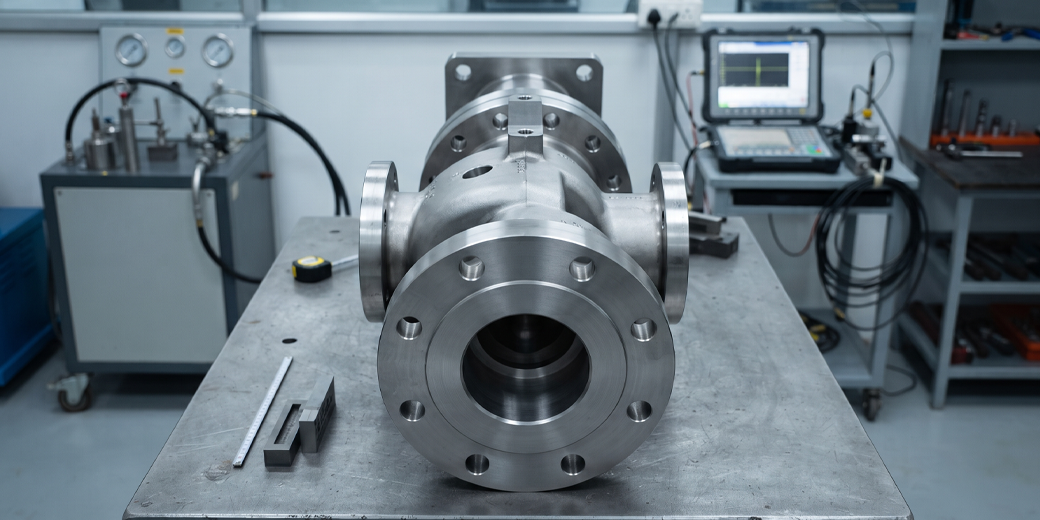
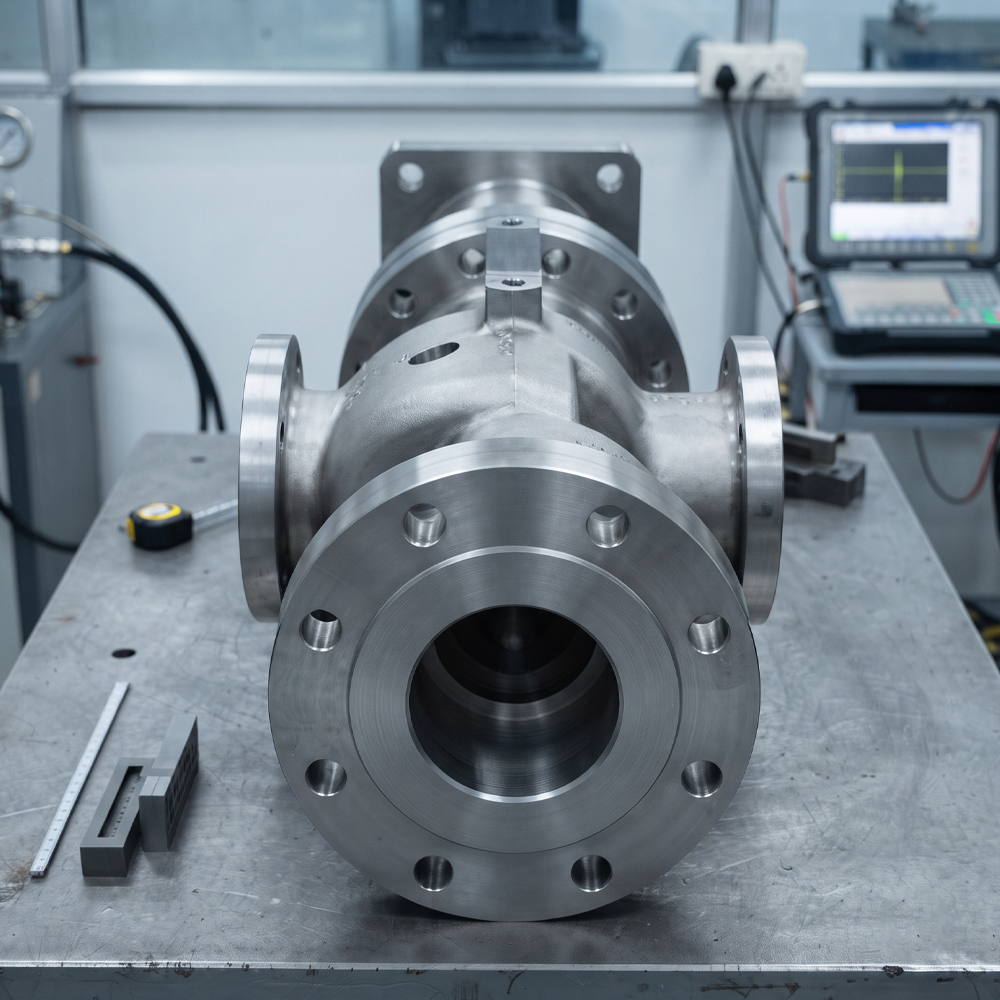
Valve body forgings are pressure-retaining forged components that form the structural envelope of gate valves, ball valves, check valves, globe valves, and choke valves used throughout oil and gas production, processing, and transmission systems. The valve body must contain the full working pressure of the system without leakage or structural failure across the valve’s service life — which in oil and gas applications may span 20–30 years at pressures up to 20,000 psi in environments ranging from Arctic cold to deepwater subsea to H₂S-bearing sour service. Vinir Engineering manufactures API certified valve body forgings in Bangalore and Hosur, holding API 20B, AS9100D, IBR, and ABS certifications across four manufacturing units.
At a Glance: Valve Body Forging Requirements for Oil & Gas
| Parameter | Requirement |
| Quality standard | API 20B (carbon/alloy steel), API 20C (CRA grades) |
| Primary valve standards | API 6A (wellhead), API 6D (pipeline), API 600 (gate valves) |
| Pressure rating | Class 150 to Class 2500 (ASME B16.34); 2,000 to 20,000 psi (API 6A) |
| Material traceability | Heat number to finished forging |
| NDE | UT + MT/PT mandatory; radiography where specified |
| Pressure test | Hydrostatic shell test mandatory |
| Key materials | ASTM A105, A182 F316L, A182 F51, A182 F53, Inconel 625 |
| Weight range (Vinir) | 10 kg – 1,400 kg closed die |
Why Valve Bodies Are Forged, Not Cast
The majority of oil and gas valve bodies in critical service are produced by forging rather than casting.
The technical justification is consistent :
No porosity — casting solidification introduces shrinkage porosity, gas porosity, and hot tears that are difficult to detect by NDT and impossible to eliminate without extensive remediation. A forged valve body is dense and homogeneous throughout — the forging process closes porosity from the original billet.
Superior mechanical properties — forged valve bodies achieve higher tensile strength, yield strength, and Charpy impact toughness than equivalent castings in the same material. For high-pressure Class 2500 and API 6A 10,000–20,000 psi valve bodies, the mechanical property advantage of forging is critical.
Better ductility at low temperature — for Arctic service and LNG applications where Charpy impact at -46°C or colder is specified, forged ASTM A350 LF2 or F316L stainless achieves consistent low-temperature toughness that cast equivalents struggle to match.
Grain flow — the forging process orients grain flow to follow the geometry of the component. In a valve body, the critical stress directions are circumferential (hoop stress from internal pressure) and axial (pressure end load at closures). Forging die design that orients grain flow in these directions maximises the component’s resistance to the primary failure modes.
Valve Body Forging: Key Categories in Oil & Gas
Gate Valve Bodies
Gate valves are the most common isolation valve in oil and gas — used for line isolation, maintenance isolation, and emergency shut-off across wellheads, pipelines, and process facilities. Gate valve bodies in carbon steel (ASTM A105, A216 WCB) handle general service. Stainless, duplex, and Inconel grades handle corrosive and sour service.
The gate valve body is a complex forging — it must accommodate the gate, seats, stem, bonnet connection, and two end connections (flanged, butt-weld, or threaded) in a single integral body. The bore must be accurately centred to the end connections. The bonnet flange face must be flat and perpendicular to the bore axis. These geometric requirements make gate valve body forgings among the more dimensionally demanding components in the oil and gas forging supply chain.
Applicable standards: API 600 for steel gate valves. Body material to ASTM A105 for carbon steel or ASTM A182 for alloy and stainless grades.
Ball Valve Bodies
Ball valve bodies for oil and gas are produced in two common configurations — one-piece bodies (split-body or end-entry) for smaller sizes, and three-piece bodies for larger sizes where the body halves are bolted together around the ball. Forged ball valve bodies are specified for high-pressure service (Class 600 and above) and for corrosive service where casting porosity presents a risk.
Applicable standards: API 6D for pipeline ball valves. ASME B16.34 for pressure-temperature ratings.
Choke Valve Bodies
Choke valves control flow from oil and gas wells — regulating the flow rate from the wellbore to the surface production system. Choke bodies operate at the highest pressures in the production system and are in contact with the most erosive flow conditions — high-velocity multiphase flow containing sand, scale, and corrosive production fluids.
Choke body forgings are specified in hardened alloy steel (AISI 4130, 4140 at high hardness) or in erosion-resistant Inconel alloys for the most aggressive service. The internal geometry of the choke body is complex — an accurately machined bore with replaceable choke trim seats whose sealing surfaces must be machined to close tolerances.
Applicable standards: API 6A for wellhead and Christmas tree choke valves. Working pressures up to 20,000 psi.
Wellhead and Christmas Tree Valve Bodies
Wellhead valves — master valves, wing valves, swab valves on Christmas trees — are the highest criticality oil and gas valve applications. They must control well flow at maximum wellbore pressure, must function reliably after years of exposure to production fluids, and in sour service must comply fully with NACE MR0175 for H₂S resistance.
API 6A governs wellhead equipment. Body forgings are produced in AISI 4130 (the standard API 6A material for general service), in 4130 modified with restricted chemistry for sour service, or in Inconel 625 for the most aggressive HPHT and sour environments.
Materials for Oil & Gas Valve Body Forgings
AISI 4130 / ASTM A182 F1 — General Service
The standard material for API 6A wellhead valve bodies in general (non-sour) service. Chromium-molybdenum alloy steel with good strength, toughness, and hardenability. Quenched and tempered to achieve API 6A required mechanical properties — minimum yield strength 75,000 psi (517 MPa) for standard service.
For sour service, 4130 must be heat treated to achieve maximum hardness of 22 HRC (250 HBW) in compliance with NACE MR0175. This constrains the heat treatment — the tempering temperature must be high enough to reduce hardness to the NACE limit while maintaining minimum yield strength. The combination of strength floor and hardness ceiling defines a narrow heat treatment window that must be validated during qualification.
ASTM A105 — Standard Pipeline Service
Carbon steel for ambient temperature pressure flanges, valve bodies, and fittings. The standard material for API 6D pipeline valve bodies and ASME B16.34 Class 150–600 general service valves. Less alloy content than 4130 — simpler heat treatment (normalise or normalise and temper), lower cost, well-characterised properties.
ASTM A350 LF2 — Low Temperature Service
For LNG terminals, Arctic pipelines, and cold climate valve service where the design temperature is -46°C (-50°F). A350 LF2 is carbon-manganese steel with Charpy impact testing mandatory at -46°C. Minimum Charpy energy requirements ensure the material will not brittle fracture at the minimum design temperature.
ASTM A182 F316L — Austenitic Stainless
For corrosive service where chlorides, acids, or mild H₂S makes carbon steel inadequate but the corrosion severity does not justify duplex. F316L (low carbon, minimising sensitisation risk) is the standard austenitic stainless for valve bodies in water injection systems, produced water handling, and mildly corrosive process service.
Limitations: susceptible to chloride stress corrosion cracking at elevated temperature in high-chloride environments. This is why offshore and subsea valve bodies have largely migrated to duplex grades.
ASTM A182 F51 — Duplex 2205
The current standard for offshore and subsea valve bodies where seawater or high-chloride production fluid is present. Superior to 316L in chloride stress corrosion cracking resistance, pitting resistance, and strength — allowing thinner walls and lighter valve bodies at equivalent pressure rating.
Solution annealing with rapid water quench is mandatory. Sigma phase formed by slow cooling destroys both corrosion resistance and impact toughness. Ferrite content verification (target 40–60%) after heat treatment confirms correct phase balance.
ASTM A182 F53 — Super Duplex 2507
For the most aggressive offshore and subsea environments — high chloride, elevated temperature, combined pitting and crevice corrosion risk. PREN above 40 provides seawater pitting resistance without localised attack. Used for deepwater Christmas tree bodies, subsea manifold valve bodies, and high-chloride produced water handling valves.
Inconel 625 — HPHT and Extreme Sour Service
For High Pressure High Temperature (HPHT) wells and extreme sour service where both temperature capability and corrosion resistance beyond duplex are required. Inconel 625 retains strength to above 800°C and is immune to chloride stress corrosion cracking. Used for downhole safety valve bodies, HPHT wellhead components, and acidising system valve bodies where concentrated HCl contact occurs.
Dimensional Requirements for Valve Body Forgings
Bore Concentricity and Straightness
The valve bore — the flow path through the valve body — must be concentric with the end connections (flanges, butt-weld ends) to within tolerances defined by the applicable valve standard. For API 6A wellhead valves, bore concentricity tolerances are tighter than ASME B16.34 general service. A bore that is eccentric or non-straight causes uneven seal loading, premature seat wear, and potential leakage.
Bore concentricity is achieved through careful die design that ensures the forging parting plane is symmetric relative to the bore axis, and through machining sequence that references the bore from a datum that will be maintained throughout the machining operation.
End Connection Face Squareness
The flange faces or butt-weld end preparations must be square to the bore axis and parallel to each other within the tolerances of ASME B16.5 (for flanged valves) or ASME B16.25 (for butt-weld end preparations). Out-of-square end connections cause misalignment in the pipeline system and uneven gasket loading that compromises the flange joint integrity.
Body Wall Thickness
Minimum wall thickness is calculated from the pressure rating, the material allowable stress, and the applicable code (ASME B16.34 or API 6A). The forging must achieve minimum wall thickness at every cross-section — the thinnest section governs the pressure rating. Dimensional inspection of the forging before machining verifies that adequate wall stock exists throughout.
NDE Requirements for Oil & Gas Valve Body Forgings
Ultrasonic Testing
UT of valve body forgings detects internal discontinuities — voids, inclusions, laminations — that would compromise the pressure-containing envelope. For API 20B PSL 2 and above, UT is mandatory for forgings above 4.5 kg. 100% volume coverage is achieved by scanning from multiple directions to access all zones of the complex valve body geometry.
Acceptance criteria reference ASTM A388 for carbon and alloy steel valve body forgings. For Inconel valve bodies, AMS 2154 equivalent criteria apply — with specific reference standards made from the same Inconel alloy as the production forging.
Magnetic Particle and Penetrant Inspection
MT is applied to all carbon and alloy steel valve body forgings after final heat treatment and, where applicable, after final machining. The sealing surfaces, bore, and pressure-retaining wall sections are the critical inspection zones.
PT replaces MT for austenitic stainless, duplex, and Inconel valve body forgings — these materials are non-ferromagnetic. For duplex and Inconel, FPI using fluorescent penetrant provides higher sensitivity than visible dye penetrant.
Hydrostatic Shell Test
Every completed valve — including the body casting or forging — must pass a hydrostatic shell test at 1.5 times the rated working pressure before shipment. For valve body forgings supplied as semi-finished forgings (before valve assembly), the hydrostatic test is conducted by the valve manufacturer after assembly. For finished machined bodies, some operators specify hydrostatic testing of the body alone before assembly.
The Forging Process for Valve Bodies
Closed Die Forging — the Preferred Process
The majority of oil and gas valve bodies are produced by closed die forging. The die set defines the external geometry of the valve body — the body shape, end connection bosses, bonnet flange boss, and drain connection bosses. The internal bore is machined after forging.
Die design for valve body forgings requires careful attention to:
Draft angles — the die must allow the forging to be extracted without galling or tearing. Valve body geometry with near-vertical walls requires minimum draft angles that balance extractability against minimising machining stock.
Flash design — the flash land and gutter geometry controls how metal flows at the die parting line. For valve bodies with tight symmetry requirements between the two halves of the body (relative to the bore axis), the flash design must ensure balanced metal flow.
Parting line selection — for valve bodies, the parting line is typically through the bore axis, splitting the forging along its length. This orientation places the maximum material at the bore and end connection bosses where wall thickness is critical.
Heat Treatment After Forging
All valve body forgings for oil and gas are heat treated. The heat treatment sequence depends on material:
- AISI 4130, A105: Quench and temper to achieve specified yield strength range and NACE MR0175 hardness compliance
- A350 LF2: Normalise and temper with mandatory Charpy impact verification at -46°C
- F316L: Solution anneal at 1,040–1,120°C, rapid quench — no ageing required
- F51 duplex: Solution anneal at 1,020–1,080°C, mandatory rapid water quench — ferrite content verified
- F53 super duplex: Solution anneal at 1,050–1,100°C, mandatory rapid water quench — PREN above 40 verified by chemistry
- Inconel 625: Solution anneal at 1,093–1,204°C, rapid quench
How Vinir Engineering Manufactures Valve Body Forgings
Vinir Engineering produces valve body forgings in the full range of oil and gas materials — from standard ASTM A105 carbon steel for pipeline service through AISI 4130 for API 6A wellhead valves, duplex 2205 and super duplex 2507 for offshore service, and Inconel 625 for HPHT and extreme sour environments.
Closed die forging capability (10–1,400 kg on the 3000T press and 1T–12T hammers) covers the complete weight range for valve body forgings — from small 2-inch Class 150 valve bodies at 10–15 kg through to large 24-inch Class 2500 valve bodies at 800–1,200 kg.
In-house heat treatment covers all valve body material families — quench and temper with hardness verification for carbon and alloy steel, rapid-quench solution annealing for duplex and Inconel, with ferrite content verification for duplex grades in the NABL-accredited in-house lab.
UT and MT/PT NDE performed in-house by ASNT Level II certified operators to API 20B PSL 2 and PSL 3 acceptance criteria. Third-party inspection coordination with Bureau Veritas, DNV, SGS, and Intertek for international oil and gas operator requirements.
API 20B certification covers carbon steel and alloy steel valve body forgings. Full material traceability from mill certificate to finished forging. Complete documentation package with every delivery.
Frequently Asked Questions – Valve Body Forgings Oil & Gas India
Why are valve bodies forged rather than cast for high-pressure oil and gas service?
Forged valve bodies achieve higher mechanical properties, eliminate the casting porosity that causes leakage failures in pressure service, and provide grain flow oriented to the principal stress directions. For high-pressure Class 600 and above, API 6A rated, and all sour service valve bodies, forging is specified because the superior density and mechanical properties directly translate to reliability and service life. Casting is used for lower-pressure general service valves where the mechanical property advantage of forging is not required.
What is the difference between API 6A and API 6D valve body forgings?
API 6A governs wellhead and Christmas tree equipment — the valves that control flow directly from the wellbore. These operate at the highest pressures (up to 20,000 psi working pressure) and must comply with NACE MR0175 for sour service. API 6D governs pipeline valves — isolation and check valves in transmission and distribution pipelines, typically at lower pressures (up to Class 2500, approximately 6,250 psi at ambient temperature). The material specifications, pressure testing requirements, and documentation requirements differ between the two standards.
What is NACE MR0175 and how does it affect valve body forging material selection?
NACE MR0175 (ISO 15156) governs material selection for equipment in H₂S-containing service. For carbon and alloy steel valve bodies (including AISI 4130 and ASTM A105), it limits maximum hardness to 22 HRC (250 HBW) to prevent sulphide stress cracking. This hardness limit constrains the heat treatment — the tempering temperature must be sufficient to reduce hardness below the limit while maintaining minimum yield strength. For Inconel 625 and qualified duplex stainless grades, separate NACE MR0175 Part 3 requirements apply with different hardness limits.
What documentation package accompanies an oil and gas valve body forging delivery?
A complete oil and gas valve body forging documentation package includes: original mill test report (chemistry and mechanical properties to ASTM specification), independent chemical analysis from a NABL-accredited lab, mechanical test report (tensile, Charpy impact, hardness) from witness coupons forged in the same heat, heat treatment record (furnace charts, hardness results), UT report, MT or PT report, dimensional inspection report, positive material identification (PMI) results where specified, and certificate of conformance to API 20B and the applicable ASTM material standard. Third-party inspection release note where TPI is specified by the buyer.
Can Indian valve body forging manufacturers supply to Saudi Aramco or ADNOC approved vendor lists?
Yes, provided the manufacturer holds API 20B certification (PSL level covering the specified application), demonstrates compliance with SAMSS-012 or equivalent ADNOC supplementary requirements, and passes the operator’s vendor qualification audit. Saudi Aramco and ADNOC additionally require positive material identification on all deliveries, tighter sulphur and phosphorus limits than standard ASTM specifications, and third-party inspection by an Aramco or ADNOC approved inspection company. Indian API 20B certified manufacturers with the quality system maturity and track record to pass these audits can access these programmes directly.