
Aluminium Forging Supplier for US Aerospace and Defence Structures
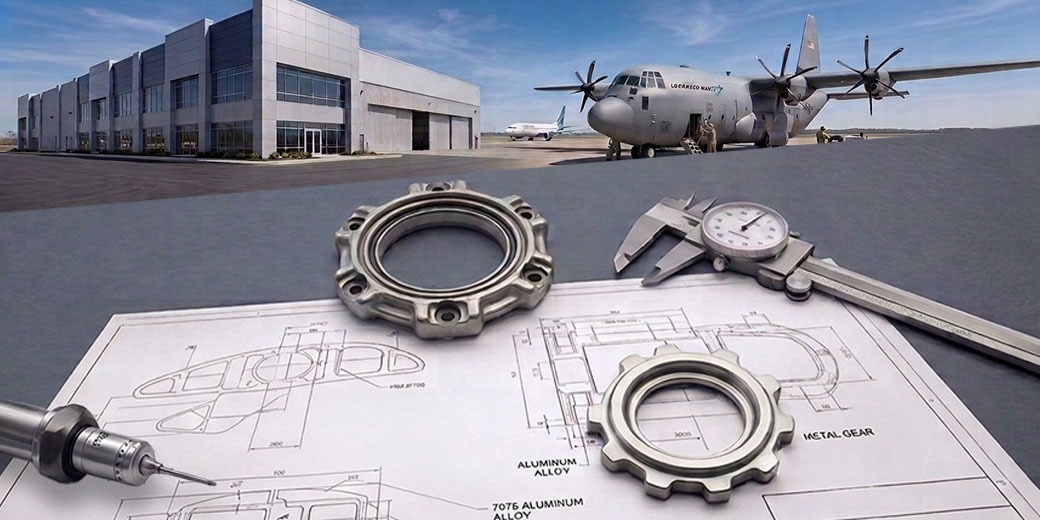
Aluminium forgings are the highest-volume forging category in US commercial aviation more aircraft structural forgings by piece count are produced in aluminium than in titanium, steel, and nickel alloys combined. A single commercial aircraft contains hundreds of aluminium forgings across the airframe wing ribs, fuselage frames, seat tracks, floor beam fittings, door frames, access panel fittings, and structural brackets. US defence platforms including the F-35, C-130J, P-8 Poseidon, and the V-22 Osprey use aluminium forgings extensively for secondary structure and equipment mounting. Indian forging manufacturers with AS9100D certification, demonstrated 7075-T6 and 7075-T73 production history, AMS 2770 heat treatment capability, AMS 2647 FPI, and CMM dimensional capability are qualified to supply US aerospace and defence aluminium forging programmes at competitive cost with domestic US and European suppliers.
At a Glance: Aluminium Aerospace Forging Requirements for US Programmes
| Alloy | Temper | AMS Spec | Tensile (min) | Primary US Application |
| 7075 | T6 | AMS 4108 | 503 MPa (73,000 psi) | Primary structure, fittings, brackets |
| 7075 | T73 | AMS 4045 | 435 MPa (63,000 psi) | SCC-resistant structure, thick sections |
| 7075 | T7352 | AMS 4044 | 400 MPa (58,000 psi) | Plate and thick section forgings |
| 2024 | T4 | AMS 4112 | 427 MPa (62,000 psi) | Fuselage structure, fatigue-critical |
| 6061 | T6 | AMS 4127 | 260 MPa (38,000 psi) | Non-structural, equipment mounts |
| 7050 | T7452 | AMS 4108 | 490 MPa (71,000 psi) | Thick section wing structure |
| 2219 | T851 | — | 345 MPa (50,000 psi) | Cryogenic structure (space launch) |
Why Aluminium Dominates Commercial Aviation Structure
The commercial aviation structural design philosophy maximising payload-carrying efficiency while minimising structural weight drives aluminium’s dominance in airframe structure. Aluminium alloys provide:
High specific strength: 7075-T6 aluminium achieves tensile strength of 503 MPa at a density of 2.80 g/cm³ a specific strength comparable to many steels at 28% of steel’s density. For aircraft structural members where weight reduction directly reduces fuel burn and increases payload, this specific strength makes aluminium the default structural material for all but the highest-load applications.
Excellent machinability: Aluminium removes material easily and quickly compared to titanium or steel. For the complex geometries required in aerospace structural fittings with pockets, flanges, lugs, and attachment holes the machining cost of finishing an aluminium forging to final dimensions is significantly lower than for titanium at equivalent structural performance.
Established supply chain: Aluminium aerospace alloys (7075, 2024, 7050) have been produced to AMS specifications by recognised mills (Arconic, Kaiser Aluminium, Novelis, Aleris) for decades. The supply chain for aerospace-quality aluminium billet is well-established, multiple-sourced, and globally accessible unlike titanium, which has a more concentrated production base.
Recyclability: Aluminium’s high recyclability is increasingly valued by US aerospace OEMs pursuing sustainability commitments. Aluminium scrap from machining aerospace forgings which can be 60–80% of the input billet weight for complex structural fittings has significant scrap value and is recyclable into new aerospace-grade billet.
The US Aerospace Aluminium Forging Market Structure
Commercial Aviation Demand
Boeing commercial programmes:
- 737 MAX: approximately 800 aluminium forgings per aircraft
- 787 Dreamliner: approximately 450 primary aluminium structural forgings (fewer than older aircraft due to composite content, but still significant)
- 777X: approximately 650 aluminium forgings per aircraft
- 767 (production and freighter conversion): ongoing production and modification demand
Airbus US-manufactured content: While Airbus aircraft are assembled in Europe and Airbus’s Mobile, Alabama facility, significant Airbus structural content is manufactured by US aerospace suppliers including wing components and fuselage sections for the A220 (formerly Bombardier C Series) assembled at the Mobile facility.
Business aviation: Gulfstream (General Dynamics), Bombardier (Learjet and Challenger series in US operations), Cessna (Textron), Embraer Executive Jets all use aluminium forgings for airframe structure. Business aviation tends toward smaller quantities per part number with more complex geometries.
US Military Aviation Demand
F-35 Lightning II: The F-35 uses approximately 900 aluminium forgings per aircraft for secondary structure equipment mounting brackets, access panel frames, avionics bay structural fittings, and non-primary-structure airframe members. At the planned 3,000+ aircraft production run, F-35 aluminium forging demand is substantial.
C-130J Super Hercules (Lockheed Martin): The C-130J uses aluminium forgings throughout the airframe wing spar attachments, fuselage structural fittings, and cargo floor structural members. Ongoing production plus a large installed fleet requiring spare parts generates continuing aluminium forging demand.
P-8 Poseidon (Boeing): US Navy’s maritime patrol aircraft based on the Boeing 737 platform. Modified airframe with additional structural reinforcement for low-altitude maritime patrol mission uses aluminium structural forgings throughout.
MH-60 Seahawk, UH-60 Black Hawk (Sikorsky): Helicopter structural aluminium forgings rotor head fittings, transmission mounting structure, fuselage frames, and door frames.
Aluminium Alloy Families for US Aerospace Forging
7000 Series – The Primary Aerospace Structural Alloys
The 7000 series aluminium alloys zinc-magnesium-copper alloys achieve the highest strength levels available in aluminium alloys through precipitation hardening. 7075 and 7050 are the primary structural aerospace alloys.
7075-T6: The most widely used high-strength aerospace aluminium alloy. Solution treated at 465–480°C and artificially aged at 120°C – 24 hours (T6 temper). Achieves minimum tensile strength of 503 MPa (73,000 psi). Excellent strength-to-weight ratio. The T6 temper is susceptible to stress corrosion cracking (SCC) in highly stressed thick sections and in chloride-containing environments which is why T73 temper was developed.
7075-T73: The same alloy as 7075-T6 but with an additional over-ageing treatment that reduces strength slightly (minimum 435 MPa versus 503 MPa for T6) while dramatically improving SCC resistance. T73 temper is specified for applications where:
- The forging section thickness exceeds approximately 40mm (thick sections have higher SCC susceptibility in T6)
- The service environment includes moisture and chloride exposure (airframe exterior surfaces, unpressurised zones)
- The design requires high stress levels in the short-transverse grain direction
7050: A newer alloy developed specifically to overcome the SCC susceptibility of 7075 in thick sections while maintaining near-T6 strength levels. 7050 contains lower copper and higher zirconium compared to 7075 the zirconium provides grain size control that reduces SCC susceptibility without requiring over-ageing. 7050-T7452 is the standard for thick wing spar and structural member forgings in modern commercial aircraft (Boeing 777X, 787).
2000 Series – The Fatigue-Critical Alloys
2024-T4: Aluminium-copper alloy with excellent fatigue resistance the key property that distinguishes it from 7000 series for fuselage structure. Fuselage skin, frames, and structural members are subjected to pressurisation cycling every flight hundreds of thousands of pressure cycles over the aircraft’s service life. 2024’s superior fatigue crack propagation resistance (it is “damage tolerant” cracks grow more slowly and are detectable before reaching critical length) makes it the standard for pressurised fuselage structure.
2024-T42: Same alloy, different heat treatment (solution treated and naturally aged). Lower strength than T4 but higher corrosion resistance. Used where corrosion resistance is more important than maximum strength.
6000 Series – The Weldable Structural Alloys
6061-T6: Aluminium-magnesium-silicon alloy. Lower strength than 7075 or 2024 but excellent weldability 6061 is the aluminium alloy used where the forging will be welded in the final assembly. Applications: structural fittings that are welded to adjacent structure, equipment mounting brackets with welded attachment features, some helicopter structural members.
AMS 2770: The Heat Treatment Standard for Aluminium Aerospace Forgings
What AMS 2770 Requires
AMS 2770 – Heat Treatment of Wrought Aluminium Alloy Parts is the governing specification for heat treatment of aluminium aerospace forgings. US aerospace buyers verify AMS 2770 compliance in detail because aluminium heat treatment is more sensitive to process deviations than many other alloy families.
Solution treatment (W temper the intermediate condition before ageing):
Solution treatment for 7075 is performed at 465–480°C (870–895°F). The temperature window is narrow below 460°C, the alloying elements (zinc, magnesium, copper) do not dissolve completely into solution; above 490°C, incipient melting of grain boundary phases occurs, causing microstructural damage that appears as dark “burn” spots on the polished cross-section and dramatically reduces properties.
Quench rate the most critical parameter:
After solution treatment, the aluminium forging must be quenched rapidly typically by immersion in water at 15–35°C. The quench must occur within 5–15 seconds of removing the forging from the furnace the maximum permissible transfer time varies by alloy and section thickness per AMS 2770. A slow quench because the forging was large, or the quench tank was far from the furnace, or the quench medium was too warm allows precipitation of coarse grain boundary phases during cooling, reducing both strength and SCC resistance.
Quench temperature control: Water temperature in the quench tank must be controlled within AMS 2770 specified limits (typically 15–35°C for most aluminium alloys). Hot quench water above 35°C quenches too slowly for thick sections. Cold quench water below 15°C may cause quench distortion in complex-geometry forgings.
Artificial ageing (T6 or T73 temper):
For T6: Age at 120°C ± 5°C for 24 hours (7075-T6). For T73: First age at 107°C ± 5°C for 6–8 hours, then age at 163°C ± 5°C for 14–16 hours (two-step over-ageing). The temperature tolerances are tighter than many standard commercial heat treatment operations ±5°C throughout the furnace working zone at the ageing temperature, per AMS 2750.
The AMS 2770 / AMS 2750 interaction: AMS 2770 references AMS 2750 (pyrometry) for furnace calibration requirements. The solution treatment furnace and the ageing furnace must both be AMS 2750 compliant with current TUS records at the solution treatment temperature (465–480°C for 7075) and the ageing temperature (120°C and 163°C for T73). US aerospace buyers often specifically request TUS records at the ageing temperatures not just at the solution treatment temperature.
Common Aluminium Heat Treatment Failures and US Buyer Concerns
Quench delay: The most common aluminium heat treatment failure is quench delay the forging cooling too slowly between furnace exit and quench immersion. Quench delay causes precipitation of coarse MgZn₂ (eta phase) and Al₂CuMg (S phase) at grain boundaries. These grain boundary precipitates reduce tensile strength and dramatically reduce SCC resistance.
Over-ageing: Ageing for too long or at too high a temperature produces an over-aged microstructure with reduced tensile strength. This is most commonly caused by: temperature uniformity problems in the ageing furnace (hot spots), thermocouple calibration drift, or simple errors in setting the ageing timer.
Under-ageing: Ageing for too short a time or at too low a temperature leaves the alloy under-strengthened. Under-aged forgings may meet the minimum strength requirement marginally but will have inferior fatigue resistance and SCC resistance compared to properly aged material.
Quench distortion: Rapid quenching of complex-geometry aluminium forgings introduces thermal stresses that can cause dimensional distortion. For tight-tolerance aerospace fittings, this distortion may take the forging outside the machining stock allowances requiring straightening or scrapping the forging. US aerospace buyers evaluate whether the Indian supplier has experience with managing quench distortion for complex geometry forgings specifically, whether they use controlled quench rates (higher water temperature, spray quench) for distortion-sensitive geometries while maintaining adequate quench rate for property development.
Specific Aluminium Forging Categories for US Aerospace Supply
Wing Rib and Spar Attachment Forgings
Wing ribs the spanwise structural members that define the wing cross-section profile and spar attachments the fittings that connect the main spar to the fuselage are primary structural aluminium forgings in commercial aviation.
7050-T7452 for wing spar attachments: Modern commercial aircraft (Boeing 787, 777X) use 7050-T7452 for main spar attachment fittings. 7050 provides near-7075-T6 strength with significantly better SCC resistance in thick sections the spar attachment fitting may be 100–200mm in the short-transverse direction where SCC is most damaging. Section thickness in this direction exceeds the threshold where 7075-T6 would have unacceptable SCC susceptibility.
Die design for complex spar fittings: Wing spar attachment fittings are among the more geometrically complex aluminium aerospace forgings multiple lug ears, pin holes, web sections, and attachment flanges in a single forging. US buyers evaluating Indian suppliers for these forgings specifically assess die design capability: does the supplier use FEM simulation for die design, and can they demonstrate that metal fill in the lugs and web sections is predicted to be complete at the required forging parameters?
Fuselage Frame Forgings
Fuselage frames the circumferential structural members that maintain the fuselage cross-section under pressurisation loads are high-cycle fatigue forgings. Every pressurisation cycle (one per flight) applies tensile loading to the frame at the skin attachment points. Over 30,000 flights in a commercial aircraft’s service life, the fatigue loading accumulates to 30,000 cycles every forging flaw that could initiate a fatigue crack is a potential service life limiter.
2024-T4 for fuselage frames: The fatigue crack growth resistance of 2024 makes it the preferred alloy for pressurised fuselage structure. The lower static strength compared to 7075 is acceptable because the fatigue load is the governing design criterion, not ultimate tensile strength.
Grain flow orientation for fatigue: Fuselage frame forgings should be produced with grain flow oriented along the frame circumference the direction of principal fatigue loading. Closed die forging achieves this naturally for frame geometries where the die design directs metal flow circumferentially. US aerospace buyers who understand grain flow verify that the Indian supplier’s die design orients grain flow appropriately for the frame geometry.
Helicopter Structural Forgings
US military and commercial helicopter programmes – Sikorsky UH-60/MH-60, Bell V-22, Bell 407/429, MD Helicopters use aluminium forgings extensively for airframe structure, rotor head fittings, and transmission mounting.
Helicopter-specific requirements:
- High fatigue cycle loading from rotor vibration much higher frequency fatigue than fixed-wing aircraft
- Complex 3D geometry with thin webs and closely spaced features
- Tight weight budgets helicopter structural weight directly impacts useful load
- Mix of 7075-T6 (primary structure) and 6061-T6 (weldable secondary structure)
Quantities: Helicopter programmes are lower-volume than commercial transport aircraft a military helicopter programme may produce 50–200 aircraft per year versus 400–600 for a commercial narrowbody. Indian suppliers for helicopter aluminium forgings must be able to handle high-mix, low-volume production multiple different part numbers in small quantities per lot.
Seat Track and Floor Beam Forgings
Aircraft passenger cabin seat tracks the extruded and forged aluminium rails into which passenger seat attachments are locked are not primary structure but are safety-critical in cabin emergency loading scenarios. Floor beam forgings support the cabin floor above the cargo hold.
7075-T6 seat track forgings: Produced in high quantities a narrow-body commercial aircraft has 12–20 metres of seat track. The geometry is relatively simple (compared to structural fittings) but dimensional accuracy is critical the seat attachment interfaces must engage the seat attachment fittings precisely.
This category is well-suited to Indian forging supply for US commercial aviation programmes. The simple geometry, standardised dimensions, and large quantities per aircraft and per programme match Indian forge shop strengths in high-volume consistent production.
Quality Control for US Aerospace Aluminium Forgings
Mechanical Testing Regime
Tensile testing per AMS 4108 (7075-T6) or AMS 4045 (7075-T73):
- Longitudinal, long-transverse, and short-transverse tensile specimens where section size permits
- Yield strength, ultimate tensile strength, elongation, and reduction of area
- Minimum properties specified by AMS the short-transverse properties are the most challenging to achieve and are the most critical for SCC resistance verification
Hardness testing: Brinell or Vickers hardness on every forging or on representative samples per the approved inspection plan. Hardness is the fastest check of heat treatment adequacy a forging that missed the ageing cycle (under-aged or quenched too slowly) will show hardness below the expected range. This provides a lot-by-lot check that more expensive tensile testing cannot practically cover 100%.
Stress Corrosion Cracking testing (where specified): For 7075-T73 forgings in programmes where SCC resistance is the primary reason for specifying T73, some US buyers require stress corrosion cracking testing per ASTM G47 or equivalent tensile specimens immersed in a salt solution under applied stress. This directly verifies the SCC resistance that T73 temper is selected for.
NDE for Aluminium Aerospace Forgings
Fluorescent Penetrant Inspection (FPI): All aluminium aerospace forgings are FPI inspected after final heat treatment. FPI detects surface-breaking defects forging laps, cold shuts, seams, machining-induced surface cracks, and quench cracks (a specific failure mode where rapid quenching of complex-geometry aluminium forgings causes surface cracking from thermal stresses).
For US aerospace aluminium forgings, FPI sensitivity level is specified by the drawing typically AMS 2647 sensitivity level 3 or 4 for primary structure. Indian suppliers must have AMS 2647-equivalent FPI system qualification documentation penetrant type, sensitivity level qualification records, UV lamp intensity verification before each inspection session.
Ultrasonic Testing: UT of aluminium aerospace forgings is less universally mandatory than for titanium or Inconel – aluminium’s lower density and good UT transmission properties mean internal defects above a certain size are reliably detected. However, for primary structural forgings and for thick-section forgings where the forging billet quality cannot be completely verified at the billet stage, UT is specified.
Calibration reference standards for aluminium UT must be in the same aluminium alloy as the production forging aluminium has different acoustic velocity and impedance characteristics from steel.
Cost Advantage of Indian Aluminium Aerospace Forgings for US Buyers
The Cost Structure
Raw material: Aluminium billet for aerospace forgings (AMS 4928 equivalent aluminium standards) is priced on the London Metal Exchange plus a conversion premium for aerospace-grade specification. The raw material cost is globally set Indian forging manufacturers buy from the same international mills (Arconic, Kaiser, Novelis) at comparable prices to US manufacturers. No systematic raw material cost advantage.
Manufacturing: Indian forge shop labour costs are 60–75% lower than US equivalents for equivalent skill levels. Aluminium forging which requires lower forging forces than titanium or Inconel can typically be performed on smaller presses that are more common and less capital-intensive in Indian forge shops.
Die cost: Die design and manufacture for aluminium aerospace forgings in India typically costs 40–60% less than equivalent US die cost. For programmes with 3–5 year production runs, the die investment economics strongly favour Indian sourcing.
Heat treatment: Aluminium heat treatment is less energy-intensive than titanium or nickel alloy heat treatment lower temperatures, shorter cycles. Energy cost difference between India and the US is not the primary cost driver.
Landed cost advantage: For standard 7075-T6 or T73 aluminium structural forgings in quantities of 50–500 pieces per lot, the typical landed cost advantage of Indian supply over domestic US supply after ocean freight, insurance, customs clearance, and inland transport is 20–35%.
Where the Advantage Is Strongest
Complex geometry structural fittings: Die and setup costs are amortised over many units the higher the part count, the better the Indian cost advantage relative to domestic US supply.
Long-run programmes: Commercial aviation programmes with 10–20 year production runs allow Indian die investment to be fully amortised, delivering maximum cost benefit.
Secondary structure in high volumes: Seat tracks, floor fittings, and equipment mounting brackets high-volume components with relatively simple geometry that do not require the most advanced forging capability.
Vinir Engineering’s Aluminium Aerospace Forging Capability for US Buyers
Vinir Engineering produces aluminium aerospace forgings in 7075-T6, 7075-T73, 7050-T7452, 2024-T4, and 6061-T6 under AS9100D certification.
Closed die forging: 7075, 7050, 2024, and 6061 in the 0.5–400 kg weight range on the 1T–12T hammer bank and 3000T press. FEM die design simulation available for complex geometry structural fittings with multiple lugs and thin webs.
Heat treatment per AMS 2770: Solution treatment furnace calibrated per AMS 2750 with TUS current at solution treatment temperatures (465–480°C for 7075). Quench tank within 5 metres of furnace exit controlled quench delay measurement. Water temperature monitoring and control in quench tank. Ageing furnace AMS 2750 calibrated with TUS at ageing temperatures (120°C for T6, 107°C and 163°C for T73 two-step).
FPI: AMS 2647 equivalent sensitivity levels. In-house fluorescent penetrant inspection by ASNT Level II certified operators. UV lamp intensity verified and recorded before each inspection session. System qualification documentation available for US buyer review.
NABL-accredited testing: OES chemical analysis to AMS aluminium alloy specifications. Tensile testing longitudinal and transverse to ASTM E8. Brinell and Vickers hardness. All NABL-accredited.
CMM dimensional inspection: Key characteristic dimensional inspection by CMM for all primary structure aluminium aerospace forgings. CMM programme controlled documents at current drawing revision.
AS9102 FAIR: Complete FAIR packages assembled for new aluminium aerospace part numbers. All 21 applicable AS9102 forms completed. Sample FAIRs available for US buyer review.