
Duplex and Super Duplex Forgings for Offshore and Oil & Gas Applications in India
Duplex and super duplex forgings are forged components manufactured from two-phase stainless steels — containing approximately equal proportions of austenite and ferrite — specifically designed for offshore and oil and gas applications where standard austenitic stainless steels fail due to chloride stress corrosion cracking, pitting, or inadequate strength. India’s growing offshore oil and gas sector, combined with Indian forging manufacturers serving international Middle East, North Sea, and Gulf of Mexico operators, has created significant demand for duplex and super duplex forging capability that meets API 20B, API 20C, and NORSOK standards.
At a Glance: Duplex vs Super Duplex Forgings
| Parameter | Duplex 2205 | Super Duplex 2507 |
| UNS designation | S31803 / S32205 | S32750 |
| ASTM forging grade | A182 F51 | A182 F53 / F55 |
| Chromium content | 22% | 25% |
| Molybdenum content | 3% | 4% |
| PREN (pitting resistance) | 34–36 | 40–43 |
| Yield strength (min) | 450 MPa | 550 MPa |
| Tensile strength (min) | 620 MPa | 795 MPa |
| Max service temperature | 250°C continuous | 250°C continuous |
| Chloride SCC resistance | Excellent | Superior |
| Seawater pitting threshold | Up to 35°C | Up to 50°C+ |
| Typical application | Offshore structural, seawater valves | Subsea, deepwater, HPHT |
| NACE MR0175 Part 3 | Qualified | Qualified |
Why Duplex Steels Were Developed for Offshore Oil and Gas
The failure mode that drove the development of duplex stainless steels was chloride stress corrosion cracking (SCC) of austenitic stainless steels — specifically type 316L — in offshore seawater environments. The failure mechanism is insidious: 316L stainless appears intact visually but develops transgranular cracks under the combination of:
- Chloride ions — present in seawater at approximately 19,000 ppm
- Tensile stress — either applied (from operating loads) or residual (from welding or cold work)
- Temperature — SCC rate increases significantly above 40–50°C
A 316L stainless seawater valve that performs without incident for 10 years in a cold-water North Sea installation may fail by SCC within 18 months in a warm-water Middle East or Gulf of Mexico application where seawater temperature exceeds 40°C.
Duplex stainless steels are highly resistant to chloride SCC. The duplex microstructure — approximately 50% ferrite, 50% austenite — creates a grain structure that arrests crack propagation across the phase boundaries. The higher chromium and molybdenum content provides superior passive film stability in chloride environments.
The Duplex Microstructure: Why Phase Balance Matters
The properties of duplex stainless steel depend critically on maintaining the correct phase balance — approximately 40–60% ferrite and 40–60% austenite. Deviation from this balance in either direction degrades performance:
Too much ferrite (above 65–70%): Reduced toughness, reduced corrosion resistance in some environments, embrittlement risk at temperatures above 300°C due to sigma phase precipitation from the ferrite phase.
Too much austenite (below 30% ferrite): Loss of the duplex-specific properties — corrosion resistance and strength approach those of austenitic stainless, losing the duplex advantage.
Sigma phase: The most damaging microstructural constituent. Sigma phase (FeCr intermetallic) forms when duplex steels are held in the 600–900°C temperature range — either during slow cooling from annealing or during welding heat cycles. Sigma phase is brittle (essentially zero toughness), and its formation depletes chromium from the surrounding matrix, destroying corrosion resistance simultaneously with toughness.
This is why rapid quenching from the solution annealing temperature is not optional for duplex forgings — it is the process control that prevents sigma phase and preserves the properties that make duplex valuable.
Critical Process Requirements for Duplex Forging
Forging Temperature Range
Duplex 2205 is forged in the temperature range 950–1,200°C. Below 950°C the ferritic phase becomes increasingly hard and prone to cracking under the forging loads. Above 1,200°C excessive grain growth occurs and the austenite-ferrite balance shifts toward high ferrite content.
For super duplex 2507, the forging temperature range is slightly tighter — the higher alloy content makes the material more sensitive to microstructural changes at temperature extremes. The forging plan must account for the billet cooling that occurs during transfer from furnace to press and between successive forging passes, and must specify maximum number of passes before reheating.
Solution Annealing — The Most Critical Heat Treatment Step
After forging, all duplex and super duplex components must be solution annealed. The annealing dissolves carbides and any intermetallic phases (sigma, chi, Laves phase) that formed during forging and re-establishes the correct austenite-ferrite balance.
2205 duplex: Anneal at 1,020–1,080°C, hold for a minimum time proportional to section thickness, then rapid quench. The annealing temperature must be above 1,020°C — below this, complete sigma phase dissolution may not be achieved. Above 1,080°C, the ferrite fraction increases excessively.
2507 super duplex: Anneal at 1,060–1,120°C, hold for sufficient time to ensure temperature uniformity throughout the section, then immediate rapid water quench. The higher annealing temperature compared to 2205 reflects the higher alloy content and the need for complete dissolution of the more stable intermetallic phases.
The Quench — Why Speed Is Everything
The cooling rate from the annealing temperature through the sigma phase formation range (600–900°C) determines whether the forging achieves its specified properties. Cooling must be fast enough to pass through this range without allowing sigma phase to nucleate and grow.
For thin sections (below approximately 25mm), air cooling may be adequate. For all practical offshore and oil and gas forging sections — valve bodies, flanges, structural fittings — water quench is mandatory.
The quench system must be adequate for the forging weight and geometry. A large valve body at 300–500 kg in a quench tank with inadequate water volume or insufficient agitation will have a slow effective cooling rate through the sigma phase range despite being submerged in water. Adequate quench tank capacity, water temperature control, and mechanical agitation are process parameters that must be specified and verified.
Ferrite Content Verification
After solution annealing and quench, ferrite content is measured on every forging or on representative samples per the quality plan. Measurement methods:
Ferritescope (magnetic measurement): A hand-held instrument that measures magnetic permeability, which is proportional to ferrite content. Fast and non-destructive. Calibrated against certified reference standards. Readings are taken at multiple locations across the forging surface to detect any localised variation.
Metallographic point count: A destructive method on a sample cross-section. Polished and etched metallographic section is examined under the microscope and ferrite phase percentage is counted at defined grid points. More accurate than ferritescope but requires sectioning a representative piece.
Acceptance range: 40–60% ferrite is the standard acceptance range for duplex 2205 and super duplex 2507 forgings.
Pitting Resistance Equivalent Number (PREN)
PREN is a calculated index that predicts the pitting corrosion resistance of a stainless steel in chloride environments:
PREN = %Cr + 3.3 × %Mo + 16 × %N
Higher PREN indicates better resistance to chloride-induced pitting.
The threshold values:
- PREN above 25 — suitable for most atmospheric and mild aqueous environments
- PREN above 32 — suitable for seawater and offshore atmospheric environments
- PREN above 40 — required for continuous seawater immersion service, particularly at elevated temperatures
Duplex 2205 achieves PREN of 34–36 — adequate for most offshore structural and topside service but borderline for warm seawater immersion above approximately 35°C. Super duplex 2507 achieves PREN of 40–43 — suitable for continuous seawater immersion service including deepwater subsea applications.
PREN is verified from the actual chemical analysis of each heat — not assumed from the nominal composition. The heat-specific PREN must meet the minimum specified in the quality plan.
Applications of Duplex and Super Duplex Forgings in Offshore Oil and Gas
Seawater Valve and Flange Forgings
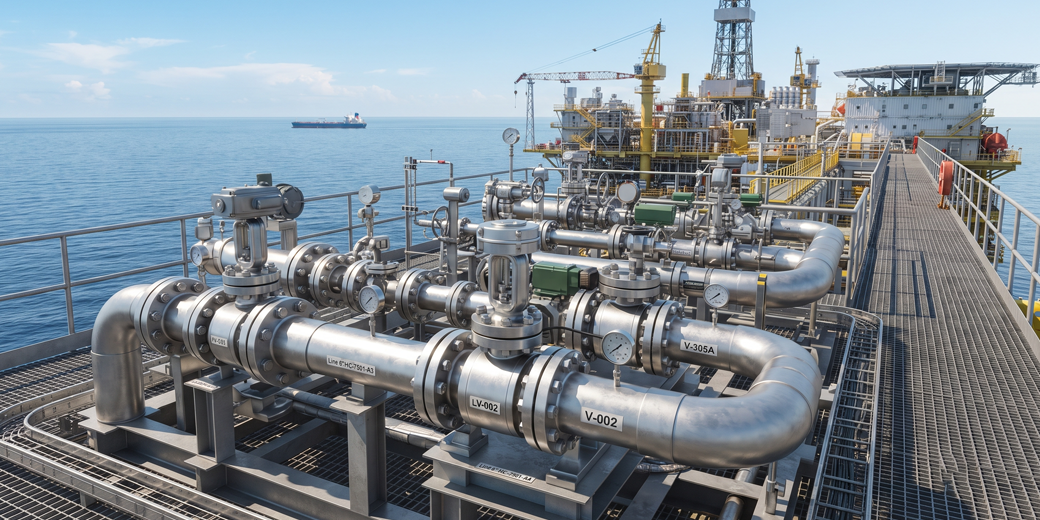
The largest volume application for duplex and super duplex forgings in offshore oil and gas is seawater service — valves, flanges, and fittings in the seawater lift, seawater injection, and firewater systems that are critical to platform operations.
Seawater systems handle large volumes of raw seawater at ambient temperature. Duplex 2205 is the standard material for these applications — it provides the chloride SCC resistance that 316L lacks and the strength to handle the line pressures without the wall thickness that would be required in a lower-strength material.
Super duplex 2507 is specified for seawater service at elevated temperatures — heat exchangers where the seawater is heated by process fluids, desalination unit components, and any seawater service above approximately 35°C where duplex 2205’s pitting resistance is marginal.
Subsea Tree and Manifold Forgings
Subsea Christmas trees — the wellhead equipment installed on the seabed — are among the most demanding applications for duplex and super duplex forgings. Operating conditions include:
- Continuous seawater immersion at depth
- Ambient temperature of 2–4°C at deepwater depths — requiring adequate low-temperature Charpy impact toughness
- Internal fluids that may contain H₂S, CO₂, chlorides, and sand
- Design service life of 20–25 years without planned maintenance intervention
Super duplex 2507 is the standard material for subsea tree bodies, manifold valve bodies, and structural connector forgings in deepwater subsea systems. NACE MR0175 Part 3 compliance must be verified — super duplex is approved for sour service provided hardness does not exceed 310 HV10.
Offshore Structural Ring Forgings
Large-diameter ring-rolled forgings in duplex stainless are used for offshore platform structural connections — riser clamps, conductor casing connections, and structural nodes where seawater corrosion resistance is required alongside structural load-bearing capability.
Ring rolling of duplex 2205 to diameters of Ø500mm to Ø3,000mm produces seamless structural rings with circumferential grain flow and uniform ferrite content around the ring circumference.
Produced Water Handling Forgings
Produced water — the water co-produced with oil and gas from the reservoir — is typically highly saline, contains dissolved CO₂ and H₂S, and is hot (50–120°C at surface). These conditions — high chloride, acidic pH, elevated temperature, H₂S — represent the most corrosive internal service environment for production valves and fittings.
Duplex 2205 is the minimum specification for produced water handling at moderate temperatures. Super duplex 2507 or Inconel 625 is specified for the most aggressive produced water compositions — high temperature, high H₂S partial pressure, or very high chloride concentration.
NORSOK Standard Applications
NORSOK (Norwegian offshore standards) are widely applied in North Sea oil and gas and are increasingly referenced by operators in other regions for deepwater and harsh environment applications. NORSOK M-630 covers material requirements for equipment in subsea service — duplex and super duplex forgings to NORSOK M-630 requirements must additionally satisfy specific chemistry, mechanical property, and corrosion testing requirements beyond API 20C baseline.
NDT for Duplex and Super Duplex Forgings
Ultrasonic Testing Challenges
UT of duplex and super duplex forgings requires specific attention to material characteristics that differ from carbon steel. The duplex microstructure — coarser grain and higher acoustic attenuation than fine-grain carbon steel — produces higher background noise that can mask defect signals if standard carbon steel UT parameters are used.
Reference standards for duplex forging UT must be made from the same duplex alloy as the production forging — a carbon steel reference block cannot be used. Probe frequency selection must balance penetration (favouring lower frequencies) against sensitivity to small defects (favouring higher frequencies) for the specific duplex grade and section size.
Penetrant Testing — MT Not Applicable
Duplex and super duplex stainless steels are partially ferromagnetic — the ferrite phase responds to magnetic fields but the austenite phase does not. This mixed magnetic response produces inconsistent and unreliable results with MT. Fluorescent penetrant inspection (FPI) is the specified surface inspection method for all duplex and super duplex forgings.
FPI sensitivity for duplex surface defects is high — tight forging laps, cold shuts, and machining-induced surface cracks are reliably detected. AMS 2647 equivalent FPI requirements are applied for critical offshore oil and gas service.
Intergranular Corrosion Testing
For super duplex 2507 forgings intended for the most critical subsea and HPHT service, intergranular corrosion testing (ASTM A923 Method C — copper-copper sulphate-sulphuric acid test) is sometimes specified to verify that harmful intermetallic phases have been completely dissolved by the solution annealing treatment. A forging that fails A923 testing has sigma phase or chi phase remaining — indicating inadequate annealing temperature or insufficient quench rate.
Vinir Engineering’s Duplex and Super Duplex Forging Capability
Vinir Engineering produces duplex 2205 (ASTM A182 F51) and super duplex 2507 (ASTM A182 F53) forgings for offshore and oil and gas applications from AMS-equivalent certified billet sourced from approved international mills.
Closed die forging — valve bodies, flanges, fittings, and structural components in the 10–1,400 kg range. The 3000T hydraulic press provides adequate forging load for duplex and super duplex grades, which require higher forging forces than equivalent carbon steel sections.
Ring rolling — seamless rings in duplex and super duplex to Ø200mm–4,500mm for offshore structural applications, riser clamps, and large-diameter flange rings.
Solution annealing — in-house furnaces calibrated to AMS 2750 equivalent pyrometry standards. Annealing at 1,020–1,100°C for 2205 and 1,060–1,120°C for 2507. Rapid water quench with adequate agitation for section sizes up to 400mm equivalent diameter.
Ferrite content verification — ferritescope measurement at multiple locations and metallographic examination in the NABL-accredited in-house lab. Results reported on the inspection certificate with every delivery.
FPI — in-house fluorescent penetrant inspection by ASNT Level II certified operators.
NABL-accredited mechanical testing — tensile, Charpy impact (including at low temperatures where specified), hardness, and chemical analysis including PREN calculation from actual heat chemistry.
API 20B and AS9100D certifications cover duplex and super duplex forgings within the full forge-to-finish scope. Full material traceability from mill certificate to finished forging with complete documentation package.
Frequently Asked Questions — Duplex and Super Duplex Forgings
What is the difference between duplex 2205 and super duplex 2507 for offshore applications?
Duplex 2205 (UNS S31803/S32205) has a PREN of 34–36 — sufficient for most offshore topside and structural seawater service up to approximately 35°C. Super duplex 2507 (UNS S32750) has a PREN of 40–43 — required for continuous seawater immersion at elevated temperatures, deepwater subsea applications, and the most aggressive produced water service. Super duplex also has higher yield strength (550 MPa versus 450 MPa minimum) allowing thinner walls at equivalent pressure rating. The cost premium of super duplex over duplex is typically 30–50% in raw material and processing.
Why is rapid quenching mandatory after solution annealing of duplex forgings?
Sigma phase — a brittle chromium-iron intermetallic — forms in duplex steels when cooled slowly through the 600–900°C temperature range. Sigma phase formation simultaneously reduces impact toughness to near zero and destroys corrosion resistance by depleting chromium from the surrounding matrix. Rapid water quenching through this temperature range prevents sigma phase nucleation. A duplex forging quenched inadequately may pass room-temperature tensile and hardness testing but fail Charpy impact testing at operating temperature and fail corrosion testing in seawater service. The quench is not a finishing step — it is the critical process control that preserves the properties the material is selected for.
What is PREN and what value is required for subsea seawater service?
PREN (Pitting Resistance Equivalent Number) is calculated as: PREN = %Cr + 3.3 × %Mo + 16 × %N. It predicts chloride pitting resistance — higher values indicate better resistance. For continuous seawater immersion service (subsea, offshore seawater lift, firewater systems), a minimum PREN of 40 is required — which is why super duplex 2507 is specified for these applications while duplex 2205 (PREN 34–36) is limited to topside and lower-temperature seawater service.
Can duplex stainless steel forgings be used in H₂S sour service?
Yes. Duplex 2205 and super duplex 2507 are listed in NACE MR0175 (ISO 15156) Part 3 as materials acceptable for use in H₂S-containing environments, subject to hardness limits — maximum 310 HV10 for duplex and super duplex in the base metal. These hardness limits are met by properly solution-annealed duplex forgings. Duplex steels provide both the sour service H₂S resistance required by NACE MR0175 and the chloride stress corrosion cracking resistance that carbon steel lacks — making them the preferred material for offshore wells producing sour and high-chloride fluids simultaneously.
What is the ferrite content requirement for duplex forging and why does it matter?
Ferrite content in duplex stainless forgings is specified at 40–60% — the balance being austenite. This phase balance delivers the combination of properties that makes duplex valuable: corrosion resistance from the chromium-rich austenite, strength and chloride SCC resistance from the ferrite, and toughness from the mixed microstructure. Too much ferrite (above 65–70%) reduces toughness and corrosion resistance. Too little ferrite (below 30%) loses the duplex advantage over austenitic stainless. Ferrite content is measured after solution annealing by ferritescope or metallographic examination and reported on the inspection certificate. It is a mandatory quality control step — not an optional additional test.