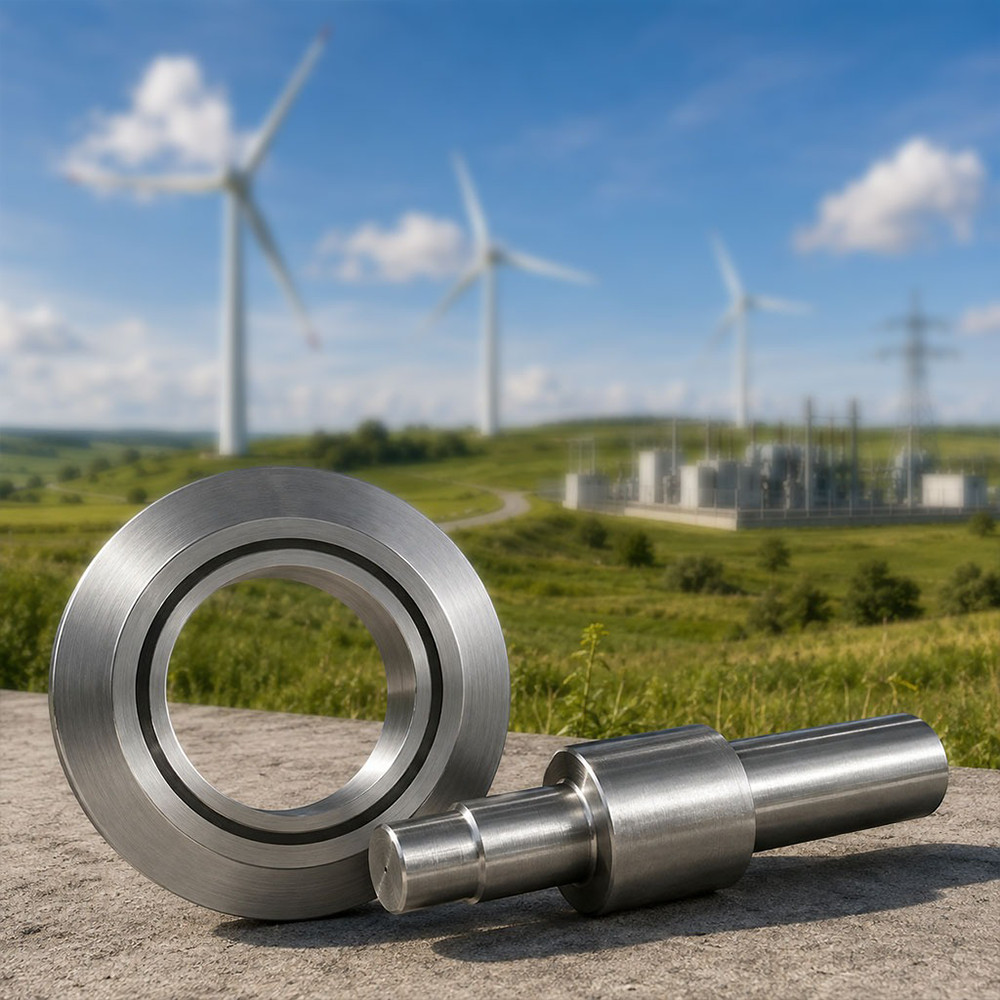
Germany operates the largest installed wind energy capacity in Europe 70+ GW onshore and growing offshore. Nordex SE (Hamburg), Enercon GmbH (Aurich), Siemens Gamesa Germany (Hamburg), and Vestas Deutschland collectively manufacture hundreds of wind turbines annually for the German and European markets. Tower flange forgings in S355NL, main bearing and pitch bearing ring forgings in 42CrMo4, and generator structural ring forgings are the primary forging categories. Indian ring rolling manufacturers with NABL-accredited Charpy impact testing at -20°C are positioned to supply the German wind energy forging market.
OEM
Turbine Class
Key Forging
Diameter Range
Nordex SE
N163/5.X, N175/6.X
Tower base and intermediate flanges
Ø2,800–4,200mm
Enercon GmbH
E-126 EP5, E-175 EP5
Tower flanges, generator rotor rings
Ø3,000–4,500mm
Siemens Gamesa
SG 5.0-145, SG 6.6-170
Tower flanges, main bearing rings
Ø2,500–4,000mm
Vestas Deutschland
V162-6.2 MW
Tower flanges, pitch bearing rings
Ø2,800–4,000mm
Nordex SE — headquartered in Hamburg with nacelle assembly in Rostock is Germany’s primary onshore wind turbine manufacturer. The N163/5.X and N175/6.X platforms for the German market use tower base flanges of Ø3,000–4,200mm in S355NL. Nordex’s tower supplier network includes European steel tower manufacturers (Max Bögl Wind, Theuer) who purchase flanges from qualified ring rolling manufacturers globally.
Enercon — the Aurich-based pioneer of gearless direct-drive wind turbines uses large-diameter generator rotor rings and stator rings that are unique to direct-drive architecture. The generator rotor ring for an Enercon E-175 EP5 may be Ø4,000–4,500mm in structural steel or mild steel alloy within Vinir’s ring rolling mill capability. Enercon is known for its supplier qualification conservatism it has historically preferred European suppliers but has expanded its supply chain to India for several component categories as part of cost reduction programmes.
Germany’s offshore wind expansion — Baltic Sea and North Sea installations uses larger turbine platforms (8–14 MW) with correspondingly larger tower flanges (Ø4,500–6,000mm). Siemens Gamesa’s SG 11-200 DD offshore platform uses tower base flanges approaching Ø5,000mm. For flanges in this diameter range, Vinir’s Ø4,500mm mill covers most SG 11-200 applications; the larger SG 14-236 DD requires flanges above Ø5,000mm, which is beyond current capacity.
German wind energy procurement follows EN material standards: S355NL per EN 10025-3 for tower flanges, and 42CrMo4 per EN 10083-3 for bearing rings. Indian forging manufacturers must provide material certificates referencing these EN specifications — not just ASTM equivalents. The Charpy test requirement (27 J at -20°C per EN 10025-3) must be referenced to EN 10025-3 in the certificate, as German wind OEM incoming inspection teams verify compliance to the EN standard citation.
Wagner and Banning radial-axial ring rolling mill to Ø4,500mm.
S355NL tower flanges with EN 10025-3 material certification.
NABL Charpy at -20°C with EN standard reference.
42CrMo4 bearing ring blanks through-hardened to 28–34 HRC.
Face flatness ≤1mm by CMM.
TPI by Bureau Veritas or DNV per OEM specification.
Ocean freight Chennai to Hamburg: 22–28 days.
Frequently Asked Questions
1.What EN standard governs S355NL tower flange material certification for German wind OEMs?+–
EN 10025-3 (Hot rolled products of structural steels Technical delivery conditions for normalized/normalized rolled weldable fine grain structural steels) governs S355NL. The designation S355NL means: S = structural steel, 355 = minimum yield strength 355 MPa at 16mm thickness, N = normalized or normalized rolled, L = guaranteed low-temperature Charpy impact at -20°C with minimum 27 J average. German wind OEM material certificates must reference EN 10025-3 S355NL not ASTM A572 Grade 50 (which is the approximate US equivalent) because the EN standard citation is what their incoming inspection teams are trained to verify.
2.Why does Enercon’s direct-drive architecture create unique forging requirements compared to geared turbines?+–
Conventional geared wind turbines use a gearbox to connect the slow-rotating rotor hub to the fast-rotating generator. The generator is relatively small and does not require large-diameter structural rings. Enercon’s direct-drive architecture eliminates the gearbox the generator is directly connected to the rotor and rotates at the same slow speed (5–15 rpm). This requires a very large-diameter generator the E-175’s generator diameter approaches 5 metres with correspondingly large structural rings for the rotor and stator. These generator structural rings are not standard wind turbine forging categories; they are unique to direct-drive architecture and represent a specific Enercon forging opportunity not found in geared turbine OEM supply chains.
3.What is the German Renewable Energy Sources Act (EEG) and how does it affect wind turbine forging demand?+–
The EEG (Erneuerbare-Energien-Gesetz) is Germany’s feed-in tariff and auction system for renewable energy. It provides fixed revenue guarantees for wind energy projects that win capacity auctions, creating the economic certainty that drives wind turbine investment. Germany has auctioned 5–8 GW of new onshore wind capacity annually under the EEG system in recent years. Each GW of onshore wind represents approximately 250 turbines at 4 MW each approximately 3,000 ring-rolled forgings per GW. The EEG’s predictable auction schedule allows wind turbine OEMs and their forging suppliers to plan production capacity and procurement schedules 18–24 months ahead.
4.How does the North Sea offshore wind expansion affect German tower flange demand and what diameters are involved?+–
Germany’s North Sea offshore wind expansion targeting 40 GW offshore by 2035 uses turbines in the 10–15 MW class (Siemens Gamesa SG 11-200 DD and SG 14-236 DD, Vestas V236-15 MW). Tower base flanges for these turbines are Ø4,500–6,000mm. Vinir’s ring rolling mill at Ø4,500mm covers the SG 11-200 DD flange range but is at the boundary for SG 14-236 DD. The offshore expansion creates strong demand for large-diameter tower flanges, driving investment in larger ring rolling capacity across the global supply chain including in India, where a Ø6,000mm mill investment would serve the German and broader European offshore wind market.
5.Can Indian ring rolling manufacturers compete with Turkish and Polish suppliers for German wind forging supply?+–
Turkish and Polish ring rolling manufacturers have established supply relationships with German wind OEMs they have geographic proximity (shorter lead times to Germany) and in some cases existing EN material certification infrastructure. The Indian cost advantage versus Turkish and Polish suppliers is typically 15–25% on equivalent products meaningful but smaller than the 30–40% advantage versus Western European supply. The Indian competitive position is strongest for: large-diameter flanges (above Ø3,500mm) where fewer global suppliers exist, CRA and alloy steel bearing rings where Indian metallurgical capability is competitive, and programmes where 10–15 week ocean transit lead times can be accommodated in the OEM’s procurement schedule.