
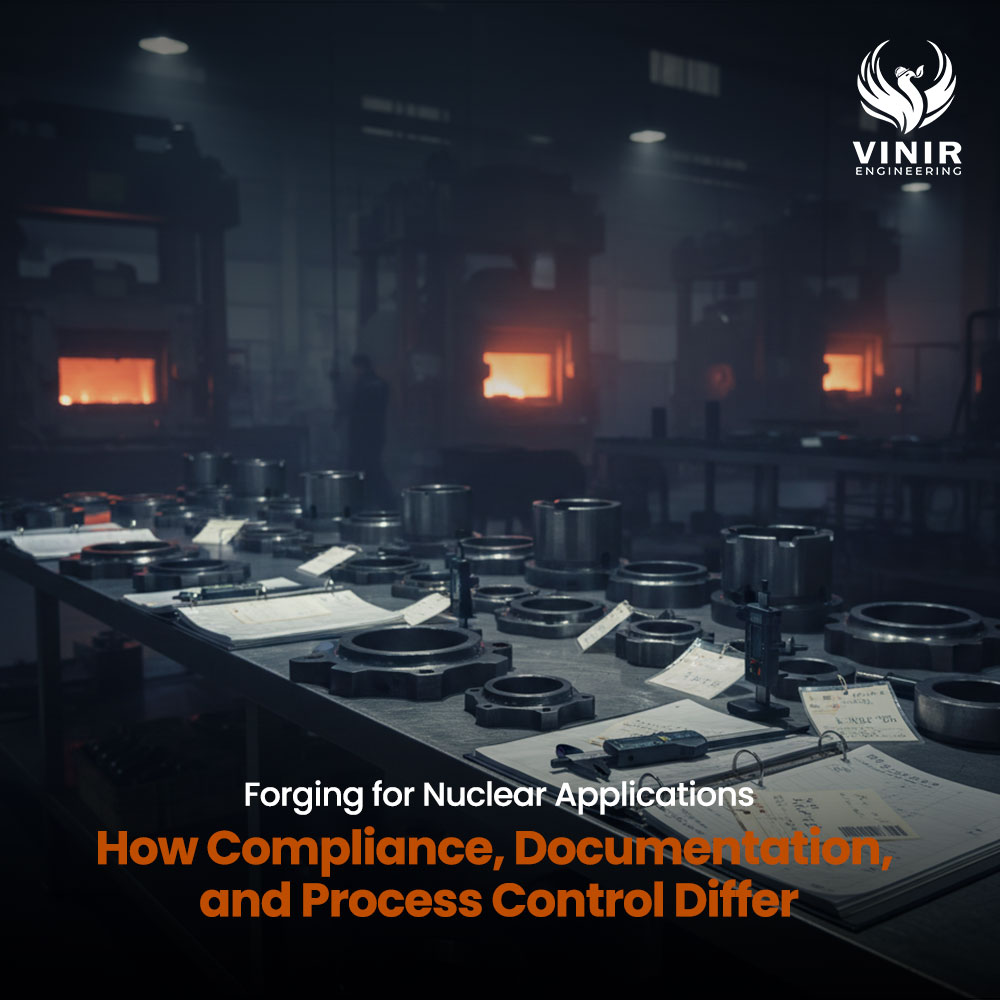
Forging for nuclear applications: how compliance, documentation, and process control differ
Why Nuclear Forging Is Treated as a Separate Class Entirely
In nuclear programs, failure is not an option, not technically, not procedurally, and not administratively.
Unlike other critical industries, nuclear buyers assume:
- Components may never be replaced once installed
- Inspection access after commissioning is limited or impossible
- Documentation may be reviewed decades later
- Regulatory bodies may intervene at any stage
As a result, forging for nuclear applications operates under a different risk philosophy: Prevent uncertainty, even at the cost of efficiency.
How Nuclear Buyers Define “Compliance”
In nuclear supply chains, compliance is not limited to certifications.
It includes:
- Absolute traceability of material and processes
- Documented justification for every manufacturing decision
- Conservative interpretation of standards
- Proven repeatability under low-volume conditions
A supplier can be technically capable and still fail nuclear qualification due to compliance behavior.
1. Documentation Is a Product, Not a By-Product
In nuclear forging, documentation is treated as deliverable equal to the component itself.
Buyers expect:
- Heat-level material certificates
- Forging route sheets and process records
- Heat treatment cycle charts
- Inspection and NDT report
- Deviation records and approvals
Missing or reconstructed documents are often grounds for rejection, regardless of part quality.
2. Traceability Is Absolute and Non-Negotiable
Nuclear traceability requirements exceed those of most industries.
Suppliers must demonstrate:
- Continuous heat and batch identity
- Physical marking or tagging linked to records
- Zero mixing of material lots
- Controlled handling during every operation
Auditors physically trace components step-by-step. Any ambiguity invalidates compliance.
3. Process Control Is Conservative by Design
Nuclear forging favors:
- Proven processes over novel optimization
- Stable parameters over aggressive efficiency
- Conservative reduction ratios and margins
Buyers expect suppliers to justify:
- Billet sizing
- Forging sequences
- Deformation adequacy
- Heat treatment choices
Processes that rely on “experience” rather than documented logic are rejected.
4. Special Processes Face Extreme Scrutiny
Heat treatment and NDT are treated as approval gates, not routine operations.
Auditors review:
- Furnace calibration and uniformity surveys
- Load configuration discipline
- Operator qualification continuity
- NDT sensitivity and acceptance criteria
In nuclear programs, a single undocumented furnace load can invalidate an entire batch.
5. Inspection Depth Is Driven by Consequence, Not Probability
Unlike statistical inspection models, nuclear inspection is risk-driven.
Buyers often require:
- 100% UT on pressure-boundary components
- Enhanced surface and volumetric inspection
- Independent or third-party verification
Inspection is expected to detect the unexpected, not confirm assumptions.
6. Deviation Handling Is Highly Formalized
Nuclear buyers have low tolerance for informal deviation handling.
They expect:
- Immediate deviation reporting
- Formal concession requests
- Customer and regulatory approval before continuation
- Clear documentation of disposition
Unauthorized rework is treated as a major breach, not a corrective action.
7. Record Retention Extends Beyond Commercial Norms
Nuclear programs commonly require:
- Record retention for 20–30 years or longer
- Secure archival systems
- Retrieval capability long after delivery
Suppliers unable to guarantee long-term record integrity are considered high-risk.
Why Many Capable Forging Suppliers Fail Nuclear Qualification
Common failure reasons include:
- Treating nuclear like aerospace or oil & gas
- Incomplete documentation discipline
- Overconfidence in technical capability
- Weak deviation control
- Underestimating audit depth
Nuclear qualification failures are usually behavioral, not technical.
How Nuclear Buyers Evaluate Supplier Maturity
Buyers look for evidence of:
- Conservative decision-making
- Consistency over time
- Audit confidence without defensiveness
- Willingness to stop production when uncertain
These traits signal a supplier who understands nuclear risk culture.
How Vinir Aligns with Nuclear Forging Expectations
Vinir approaches nuclear forging with a compliance-first mindset, supported by:
- Engineering-led, conservative process planning
- Heat-level traceability across forge-to-finish operations
- Validated special processes
- Risk-aligned inspection regimes
- Long-term documentation and audit readiness
This enables Vinir to support nuclear programs where process discipline outweighs speed or scale.
FAQ
Is nuclear forging governed by different standards than aerospace?
Yes. Nuclear programs often impose additional customer-specific and regulatory requirements beyond general standards.
Can nuclear forgings be produced in high volumes?
Rarely. Most nuclear forgings are low-volume, high-criticality components.
Are deviations ever allowed in nuclear forging?
Only through formal, approved concession processes.
Why is documentation treated so strictly?
Because documentation may be reviewed long after installation, often during regulatory or safety investigations.