
Challenges in large diameter forgings: structural uniformity, cooling control, and inspection complexity
Large Diameter Forgings Are Structurally Different — Not Just Bigger
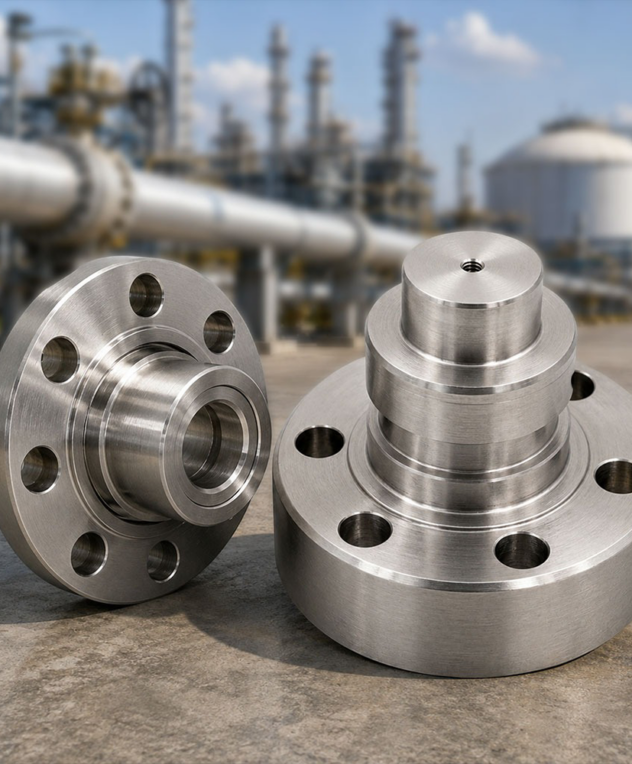
Large diameter forgings — including heavy rings, thick discs, large flanges, turbine components, and structural hubs — present challenges that do not scale linearly from smaller parts.
As section size increases, new variables emerge:
- Non-uniform deformation across cross-sections
- Slower heat dissipation
- Microstructural gradients
- Residual stress accumulation
- Inspection limitations
A forging that performs reliably at smaller diameters may behave very differently when scaled to heavy sections.
Large diameter forgings require distinct metallurgical planning, not just larger equipment.
Deformation Uniformity Across Thick Sections
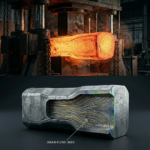
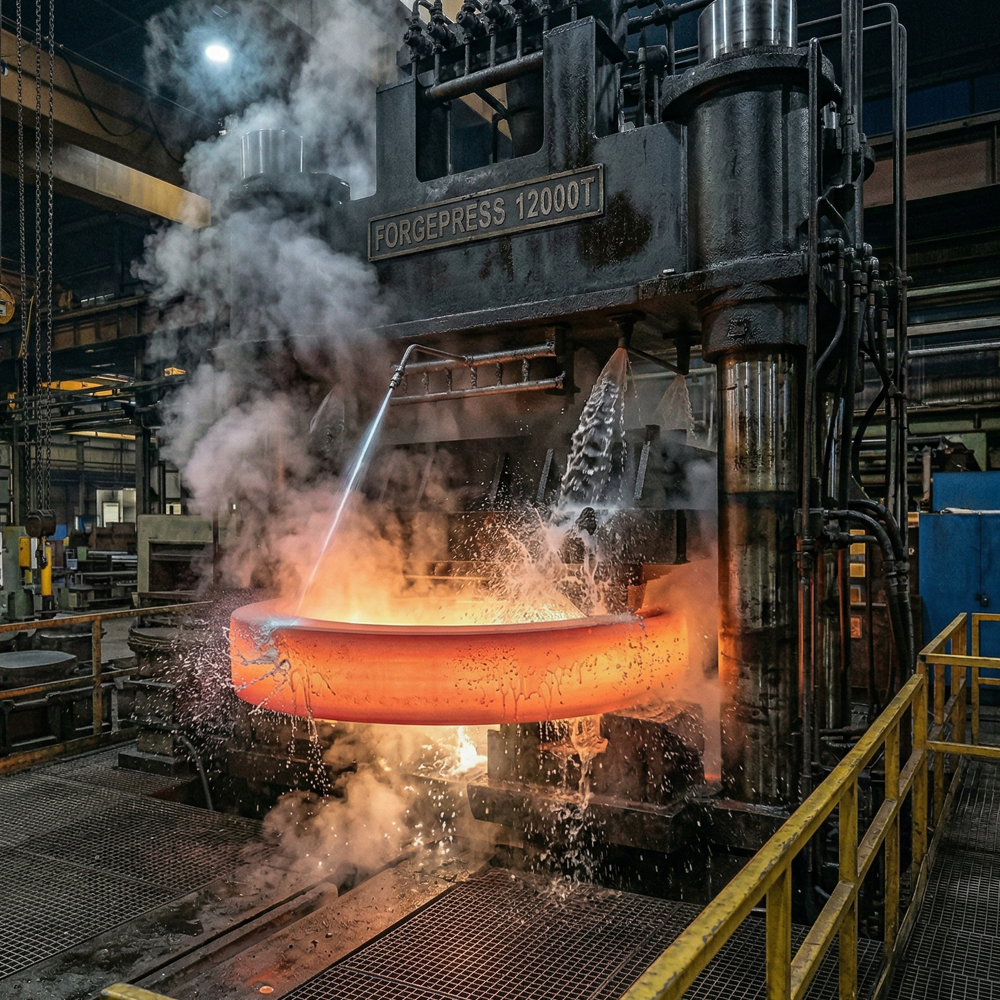
During forging, deformation must penetrate the entire cross-section to eliminate internal discontinuities and refine grain structure.
In heavy sections, this becomes difficult.
The outer zones may experience sufficient deformation, while the core remains comparatively underworked.
This creates risks such as:
- Central segregation persistence
- Coarse grain structure at the core
- Incomplete void closure
- Structural heterogeneity
If reduction ratio is calculated only at the surface level without considering true volumetric deformation, internal structural weaknesses may remain hidden.
For pressure-retaining or fatigue-critical components, such inconsistencies can become long-term failure origins.
Cooling Rate Control and Microstructure Gradients
Large diameter forgings cool at different rates across their thickness.
The outer surface cools faster than the core, leading to:
- Hardness variation
- Microstructural imbalance
- Differential phase transformation
- Residual stress gradients
In alloy steels and duplex materials, improper cooling can promote:
- Intermetallic phase formation
- Temper embrittlement
- Uneven martensitic transformation
- Reduced toughness at the core
Thermal uniformity becomes more difficult as section thickness increases.
Heat treatment cycles must be engineered specifically for heavy sections rather than scaled versions of smaller-part parameters.
Residual Stress and Distortion Risks
Large forgings accumulate higher internal stresses during forging and quenching.
If stress relief is not properly managed, this may result in:
- Distortion during machining
- Warping
- Surface cracking
- Reduced fatigue life
Residual tensile stress is particularly concerning in cyclically loaded components.
In large flanges, rings, and hubs, distortion may not become visible until final machining stages — leading to rework or rejection.
Stress-relief cycles and controlled quenching strategies are essential in large diameter forgings.
Grain Size Control in Heavy Forgings
Grain growth is more difficult to control in large forgings due to prolonged thermal exposure.
Excessive austenitizing temperature or extended soaking time can lead to:
- Coarse grain structure
- Reduced impact toughness
- Lower fatigue resistance
Fine, uniform grain is more challenging to achieve in thick cross-sections.
Forging temperature control and deformation sequencing must be optimized to refine grain uniformly from surface to core.
Grain size consistency directly impacts mechanical reliability in large components.
Ultrasonic Testing Challenges in Large Sections
Inspection complexity increases significantly with section thickness.
Ultrasonic testing of large diameter forgings faces challenges such as:
- Signal attenuation
- Back-wall echo limitations
- Detection sensitivity reduction at depth
- Difficulty distinguishing between harmless reflectors and critical discontinuities
The probability of detecting small internal discontinuities decreases as section thickness increases.
Proper probe selection, calibration, and operator expertise become critical.
Inspection procedures for heavy forgings must be more rigorous than for smaller components.
Machining Allowance and Dimensional Stability
Large diameter forgings require careful coordination between forging geometry and final machining.
Excess material allowance may:
- Increase machining time
- Expose internal structural gradients
- Reveal core hardness variation
Insufficient allowance may:
- Compromise dimensional correction capability
- Limit distortion compensation
Integrated forge-to-finish planning is particularly important in heavy forgings to maintain dimensional integrity and grain flow alignment.
Material Segregation Risks in Large Billets
Large forgings begin with large billets or ingots.
Segregation of alloying elements within the original material may become amplified if deformation is insufficient.
Central segregation bands may:
- Reduce toughness
- Increase crack susceptibility
- Affect hardness uniformity
Proper billet selection and adequate deformation are necessary to break up and redistribute segregated zones.
Material cleanliness becomes more critical as section size increases.
Service Risks Unique to Large Diameter Components
Large diameter forgings are commonly used in:
- Power generation rotors
- Heavy flanges in pressure systems
- Marine propulsion systems
- Large gear blanks
- Energy sector hubs
These components often experience:
- High rotational stress
- Thermal cycling
- Pressure variation
- Long service lifetimes
Failure in large sections is particularly severe due to stored energy and system dependence.
Structural uniformity is not optional — it is fundamental.
Why Large Diameter Forgings Require Specialized Process Discipline
Manufacturing heavy forgings demands:
- Higher deformation control
- Customized heat treatment cycles
- Enhanced inspection protocols
- Stress-relief planning
- Deep metallurgical oversight
High-volume production models optimized for smaller components may not automatically translate to heavy-section reliability.
Large diameter forgings are an engineering challenge, not merely a scaling exercise.
Large Diameter Forgings at Vinir Engineering
Vinir Engineering manufactures large diameter and heavy-section forged components within a high-mix, non-automotive forging framework.
Our systems emphasize:
- Engineered reduction ratio planning for volumetric deformation
- Controlled forging temperature management
- Customized heat treatment cycles for thick sections
- Residual stress mitigation strategies
- Enhanced ultrasonic inspection discipline
- Integrated machining coordination
- Continuous material traceability
Serving energy, marine, oil & gas, railway, heavy equipment, and critical industrial sectors requires structural control across entire cross-sections — not just surface conformity.
If your application involves heavy rings, large flanges, turbine components, hubs, or thick structural forgings, Vinir’s engineering team can support technical evaluation and deformation planning discussions.
Connect with Vinir Engineering to discuss large diameter forging requirements.