
Forging Reduction Ratio and Grain Flow Explained
Why Reduction Ratio Is One of the Most Misunderstood Parameters in Forging
In forging manufacturing, press tonnage often receives more attention than deformation science.
Yet for critical industrial components, reduction ratio — not equipment size — determines structural integrity.
Reduction ratio directly influences:
- Grain refinement
- Internal defect closure
- Mechanical property consistency
- Fatigue resistance
- Ultrasonic inspection acceptance
For industries such as oil & gas, aerospace, defence, nuclear, and heavy equipment, insufficient reduction control can compromise long-term reliability even if dimensional tolerances are achieved.
Understanding reduction ratio and grain flow engineering is fundamental to evaluating forging manufacturers.
What Is Forging Reduction Ratio?
Reduction ratio refers to the amount of plastic deformation a material undergoes during forging.
It is commonly expressed as:
Initial cross-sectional area ÷ Final cross-sectional area
Higher reduction ratios generally result in:
- Refined grain structure
- Improved mechanical strength
- Enhanced internal soundness
- Reduced porosity
However, reduction ratio must be engineered deliberately. It is not automatically achieved by applying high force.
Controlled deformation — not brute pressure — defines metallurgical quality.
Grain Flow: The Structural Advantage of Forging
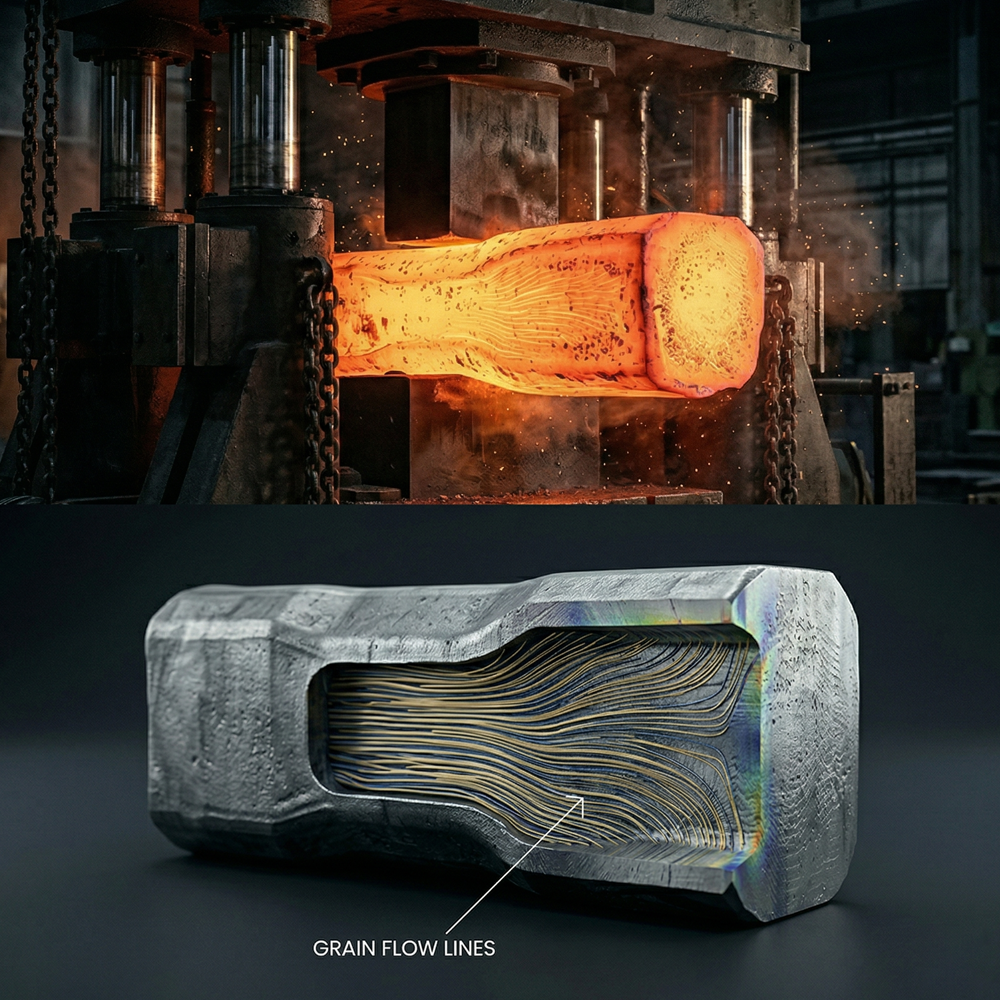
When metal is plastically deformed under compressive force, its internal grain structure elongates and aligns along the direction of deformation.
This grain alignment, often called “fiber flow,” differentiates forged components from cast or billet-machined parts.
Properly engineered grain flow:
- Follows load paths
- Improves fatigue resistance
- Delays crack initiation
- Enhances impact strength
For example:
- In a shaft, grain should align longitudinally.
- In a ring, grain should flow circumferentially.
- In pressure-retaining components, grain orientation must support stress distribution.
Grain flow engineering requires planning at die design and preform stages.
Internal Defect Closure and Structural Densification
One of the most critical functions of forging deformation is the closure of internal discontinuities.
Raw material may contain:
- Micro-voids
- Segregation zones
- Shrinkage cavities
- Inclusion clusters
Adequate reduction ratio compresses and welds these internal defects, improving structural density.
If deformation is insufficient, ultrasonic testing may reveal laminar defects or internal reflectors that lead to rejection.
This is particularly critical in nuclear and oil & gas pressure components.
The Relationship Between Reduction Ratio and Fatigue Performance
Fatigue failure is often the dominant failure mode in rotating and cyclically loaded components.
Reduction ratio influences fatigue performance by:
- Refining grain size
- Reducing inclusion size effect
- Aligning grain with stress direction
- Increasing crack propagation resistance
In aerospace and defence forgings, fatigue life is frequently a qualification criterion.
Reduction ratio validation becomes part of supplier evaluation discussions.
Reduction Ratio in Open Die vs Closed Die Forging
Different forging processes influence how reduction is achieved.
In open die forging, higher cumulative reduction can often be achieved for large sections, improving internal soundness.
In closed die forging, reduction is more geometry-controlled, and deformation must be carefully engineered to ensure uniform structural refinement.
Ring rolling introduces radial and circumferential deformation patterns that influence grain orientation differently.
Process selection must align with required structural outcome — not just part shape.
Why Reduction Ratio Is Audited in Critical Industries
In regulated sectors, reduction ratio is not assumed.
Auditors may request:
- Documented reduction calculations
- Process sheets showing deformation stages
- Validation of billet dimensions vs final geometry
- Inspection results confirming defect closure
Failure to demonstrate reduction planning can result in:
- Audit observations
- Non-conformance reports
- Qualification delays
Reduction ratio documentation forms part of compliance architecture in critical forging supply chains.
Heat Treatment and Reduction Ratio: Interconnected Variables
Reduction alone does not determine final properties.
Heat treatment stabilizes and enhances the microstructure created during deformation.
If reduction is inadequate, even correct heat treatment may not compensate for structural weaknesses.
Conversely, excessive or uncontrolled deformation combined with improper heat treatment may introduce residual stress or distortion.
Metallurgical engineering requires coordination between deformation planning and thermal processing.
Grain Flow Disruption During Machining
Improper machining strategy can unintentionally disrupt beneficial grain orientation.
In integrated forge-to-finish environments, machining allowances are planned to preserve:
- Load-bearing fiber alignment
- Structural continuity
- Surface integrity
This is particularly important in aerospace and pressure-retaining applications.
Fragmented supply chains often lack this coordination.
Evaluating Reduction Discipline When Selecting Forging Suppliers
OEMs evaluating forging manufacturers should consider:
- Whether reduction ratios are calculated or assumed
- Whether deformation planning is documented
- Whether grain flow orientation is engineered
- Whether UT acceptance rates reflect structural consistency
- Whether metallurgical discussion is supported by data
Reduction discipline often reveals the difference between process maturity and equipment capacity.
Forging Reduction Engineering at Vinir Engineering
Vinir Engineering operates with a structured focus on metallurgical control across high-mix, non-automotive forging programs.
Our approach includes:
- Documented reduction ratio validation
- Grain flow planning aligned with component geometry
- Coordinated forging and machining strategy
- Integrated heat treatment monitoring
- Inspection-backed structural verification
Serving oil & gas, aerospace, defence, nuclear, marine, and heavy industrial sectors requires deformation discipline beyond dimensional compliance.
If your component’s performance depends on fatigue resistance, pressure integrity, or long-term structural stability, Vinir’s engineering team can review deformation requirements and metallurgical expectations.
Connect with Vinir Engineering to discuss your forging reduction and grain flow requirements.