
API 20B Forging in India: What Oil & Gas Buyers Actually Audit
API 20B forging audit is the process by which oil and gas operators, EPC contractors, and procurement teams verify that a forging manufacturer genuinely meets the requirements of the API 20B specification — not just that they hold the license. The gap between holding an API 20B license and actually manufacturing forgings that satisfy a major oil and gas operator’s quality expectations is significant. Understanding what buyers actually check during audits, source inspection, and incoming quality review separates manufacturers who win repeat international oil and gas business from those who qualify once and struggle to sustain the relationship.
At a Glance: API 20B Product Specification Levels
| PSL | Additional Requirements vs PSL 1 | Typical Application |
| PSL 1 | Base requirements — standard heat treatment, dimensional inspection | General service, low-pressure, onshore |
| PSL 2 | Charpy impact testing mandatory, additional chemistry controls, tighter hardness | Offshore structural, general pressure service |
| PSL 3 | 100% UT for all forgings above 4.5 kg, wet fluorescent MT, hardness every component | Subsea, high-pressure, critical service |
| PSL 4 | All PSL 3 plus HIC testing, SSC testing, additional sour service requirements | HPHT, sour service, deepwater subsea |
What API 20B Actually Requires: Beyond the License
Holding an API 20B manufacturer license means the API conducted an audit of the facility and found the quality management system adequate to manufacture forgings to the specification. It does not mean every forging produced will meet every customer’s requirements — because customers layer additional requirements on top of API 20B through their own purchase order specifications, supplementary requirements, and approved vendor list standards.
A buyer who simply verifies that a supplier holds an API 20B license and proceeds to order has not done adequate qualification. The suppliers who consistently win and retain major oil and gas forging business understand that the license is the beginning of qualification, not the end.
What Major Oil & Gas Buyers Actually Check
Check 1: PSL Level Coverage on the License
The API 20B license specifies which PSL levels the manufacturer is qualified to produce. A license covering PSL 1 and PSL 2 does not authorise manufacture to PSL 3 or PSL 4. Buyers purchasing subsea or sour service forgings at PSL 3 or PSL 4 must verify that the supplier’s license explicitly covers those levels.
This is the most commonly overlooked verification step. A supplier who holds API 20B but only to PSL 2 cannot legitimately supply PSL 3 forgings — even if the physical manufacturing capability is identical. The API qualification process for PSL 3 and PSL 4 includes additional audit elements and witnessed test piece production that must be completed before those levels are covered.
Check 2: Material Traceability System — Live Test
The most revealing audit activity for experienced oil and gas buyers is a live traceability trace — asking the supplier to trace a forging currently in production back to its raw material mill certificate in real time, without advance preparation.
What a complete trace looks like:
- Physical heat number on the billet — marked before entering production
- Work order and traveller referencing the same heat number from billet cut
- Incoming inspection record showing the heat number was verified against the MTR
- MTR on file — immediately retrievable — showing the heat number, chemical analysis, mechanical properties, and compliance to the specified material standard (ASTM A105, ASTM A182, ASME SA-105, etc.)
- The MTR heat number matching the physical marking
A supplier who cannot complete this trace in 15 minutes has a traceability system that exists on paper but does not function under operational conditions. This is a disqualifying finding for most major oil and gas buyers.
Check 3: Heat Treatment Records and Furnace Calibration
Oil and gas buyers — particularly those familiar with NACE MR0175 sour service requirements — scrutinise heat treatment records more carefully than any other process documentation. The reason: hardness is the critical control parameter for sour service compliance. A forging heat-treated incorrectly — over-tempered or under-tempered — will either fail the minimum strength requirement or exceed the maximum hardness limit for NACE compliance.
What buyers review:
- Furnace calibration certificates — is the furnace calibrated to a recognised pyrometry standard? AMS 2750 or API 6A Annex equivalent. What is the temperature uniformity tolerance across the working zone?
- Furnace charts for recent production lots — do they show the complete cycle from charge through soak, quench initiation, and temper? Are the temperatures within the procedure limits throughout the entire cycle?
- Hardness test records — is every component (PSL 3) or a defined sample (PSL 1, 2) hardness-tested after heat treatment? Are results recorded by component identifier?
- Out-of-range hardness dispositions — when a component fails the hardness test, what happens? Is there a documented non-conformance and investigation, or does the component get re-tempered informally without a quality record?
Check 4: NDE Coverage and Acceptance Criteria
The NDE requirements in API 20B escalate with PSL level. A buyer ordering PSL 3 forgings who discovers the supplier is applying PSL 1 NDE has a serious conformance issue — not just a quality concern.
What buyers verify for UT:
- Is the UT being performed to the correct acceptance criteria for the specified PSL?
- Is the reference standard material the same specification as the production forging — or is a generic steel reference standard being used for a duplex or alloy steel production part?
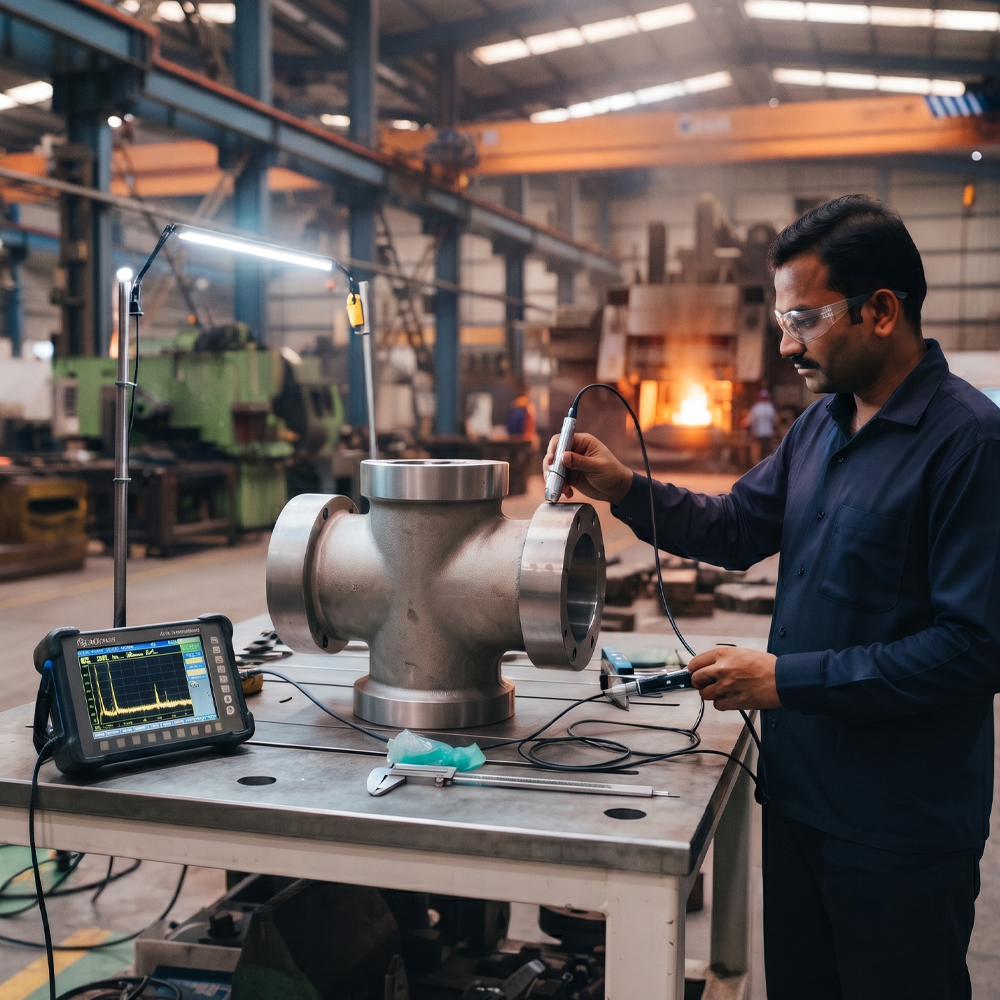
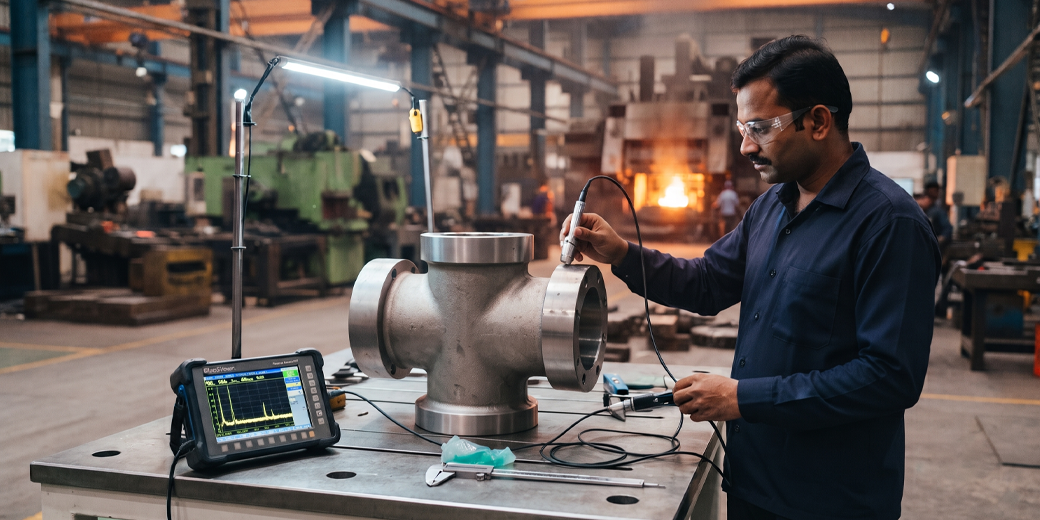
- Is the scanning coverage complete — or is the supplier spot-checking rather than performing 100% volumetric coverage?
- Are ASNT Level II operator certifications current for the specific UT technique being used?
What buyers verify for MT:
- Wet fluorescent MT or dry powder? For PSL 3 the distinction matters — wet fluorescent provides higher sensitivity and is required
- Is the UV lamp intensity being verified and recorded before each inspection session?
- Are two perpendicular magnetisation directions being applied to ensure all defect orientations are covered?
Check 5: Sour Service and NACE MR0175 Compliance
For sour service forgings — any application where H₂S partial pressure exceeds the threshold defined in NACE MR0175/ISO 15156 — buyers apply a specific set of additional checks.
Maximum hardness verification — every sour service forging must be hardness tested and the result must not exceed 22 HRC (250 HBW for Brinell) at any location. For complex geometry forgings where hardness varies across the cross-section, multiple hardness measurements at different locations are required.
Heat treatment procedure compliance — the heat treatment procedure for sour service forgings must be designed to achieve the target strength range while keeping maximum hardness within the NACE limit. Buyers review the procedure and confirm that the specified temper temperature and time are consistent with achieving sub-250 HBW hardness for the material grade and section size.
Carbon equivalent control — for carbon and low alloy steels, NACE MR0175 specifies maximum carbon equivalent limits. The supplier must demonstrate that the incoming material meets the CE limit and that this is verified at incoming inspection.
HIC and SSC testing for PSL 4 — Hydrogen Induced Cracking (HIC) testing and Sulphide Stress Cracking (SSC) testing of representative material from each heat, performed to NACE TM0284 and NACE TM0177 respectively. These are destructive tests on witness pieces — buyers review the test reports and verify that the test conditions (solution composition, test duration, stress level) match the specification requirements.
Check 6: Documentation Package Completeness
The documentation package that accompanies an oil and gas forging delivery is reviewed by the buyer’s quality team before components are accepted into their inventory. Major oil and gas buyers — Saudi Aramco, ADNOC, BP, Shell procurement teams — have defined documentation requirements that go beyond the API 20B baseline.
Standard API 20B documentation package:
- Mill test report to ASTM or ASME specification — chemical and mechanical properties
- Heat treatment record — procedure reference, furnace chart, hardness results
- NDE reports — UT and MT, referenced to applicable standards and acceptance criteria
- Dimensional inspection report
- Hydrostatic pressure test report — where specified for pressure-retaining components
- Certificate of Conformance — to API 20B and all applicable ASTM/ASME material standards
Additional requirements from major operators:
- Saudi Aramco SAMSS-012 supplementary requirements — additional chemistry controls, specific heat treatment requirements
- ADNOC supplementary specifications — similar to Aramco with ADNOC-specific additions
- Third-party inspection certificate — from an approved inspection company (Bureau Veritas, SGS, TÜV, Intertek) witnessing heat treatment and NDE
- Country of origin certificate — increasingly required for Middle East procurement
Check 7: Third-Party Inspection Integration
Major oil and gas operators routinely specify third-party inspection (TPI) by an approved inspection company for all forging lots — not just for qualification orders. The TPI inspector witnesses heat treatment, NDE, and dimensional inspection at the supplier’s facility and issues a release certificate before the components are shipped.
Suppliers who are unfamiliar with TPI integration — who treat the TPI inspector as an adversary rather than a part of the quality process, or who cannot produce complete heat treatment records when the inspector arrives for the heat treatment witness — create the kind of friction that causes repeat customers to qualify alternative sources.
Effective integration of TPI inspection requires:
- Advance notification to the TPI company of the production schedule with adequate lead time for inspector mobilisation
- All process documentation ready for inspector review before the inspected operation begins
- A dedicated quality contact who accompanies the inspector throughout the inspection visit
- Prompt response to any inspector queries or concerns during the visit
What Saudi Aramco and ADNOC Actually Require Beyond API 20B
Saudi Aramco SAMSS-012
Saudi Aramco’s Material System Specification 012 — Procurement of Forged Products — layers additional requirements on top of API 20B that represent the most demanding oil and gas forging specification applied by any single operator:
Chemistry controls — tighter limits on sulphur and phosphorus than standard ASTM specifications. Maximum sulphur 0.010% for sour service materials versus 0.040% in standard ASTM A105.
Heat treatment — Aramco requires that the heat treatment procedure be submitted and approved by Aramco engineering before production begins for new suppliers. The procedure approval is not a formality — Aramco engineers review the specified temperature range, soak time basis, quench medium, and temper temperature against the material specification and the application requirements.
Positive material identification (PMI) — 100% PMI verification of all forgings using XRF or OES spectrometry before shipment. This is in addition to the MTR — PMI catches material mix-ups that the MTR alone cannot detect.
Impact testing at low temperature — for offshore and sour service applications, Charpy impact testing at -46°C or lower, with minimum energy requirements that exceed API 20B PSL 2 baseline.
ADNOC Specifications
ADNOC (Abu Dhabi National Oil Company) applies similar supplementary requirements to API 20B.
ADNOC’s specifications cover :
- Vendor qualification audit by ADNOC’s technical team before the first order is placed
- Specific approval of heat treatment and NDE procedures before production
- TPI by an ADNOC-approved inspection company for every lot
- Material traceability documentation formatted to ADNOC’s standard documentation requirements
How Vinir Supports Oil & Gas Buyer Audits
Vinir Engineering’s API 20B quality system is designed for the operational reality of oil and gas buyer audits — not just the API audit that grants the initial license.
Live traceability trace — any forging in production can be traced to its MTR in real time. Electronic records link heat number from incoming inspection through every production operation. MTRs are filed by heat number and retrievable within minutes.
Complete heat treatment records — AMS 2750 equivalent furnace calibration across all four units. Electronic continuous temperature recording on all production cycles. Hardness test records by component identifier. Furnace charts retrievable for any production lot.
NDE to PSL 3 standard — 100% UT coverage for all oil and gas forgings above threshold weight. Wet fluorescent MT with UV lamp intensity verified and recorded. ASNT Level II operators with current certifications.
Third-party inspection support — dedicated quality contact for TPI witness coordination. All process documentation prepared in advance of TPI visits. TPI companies regularly working with Vinir include Bureau Veritas, DNV, SGS, and Intertek.
NACE MR0175 sour service capability — heat treatment procedures qualified to achieve target strength within the 22 HRC / 250 HBW maximum hardness limit. 100% hardness testing for sour service components. Carbon equivalent verification at incoming inspection.
Frequently Asked Questions – API 20B Forging Audit
What is the difference between API 20B PSL 1 and PSL 3 for a buyer?
PSL 1 is the base level — standard heat treatment, dimensional inspection, and basic NDE. PSL 3 adds mandatory 100% UT for all forgings above 4.5 kg, wet fluorescent MT (higher sensitivity than dry powder), hardness testing of every component, and tighter chemistry controls. For subsea and high-pressure critical service applications, PSL 3 is the minimum acceptable level from most major operators. The supplier’s API 20B license must explicitly cover the PSL level being ordered — a PSL 2 license does not authorise PSL 3 production.
What is PMI and why do Saudi Aramco and ADNOC require it for forgings?
Positive Material Identification (PMI) is the verification of material composition using a handheld XRF (X-ray fluorescence) or OES (optical emission spectrometry) instrument directly on the finished forging. PMI confirms that the material installed in the product matches the specified material and the MTR. Aramco and ADNOC require 100% PMI because material mix-ups — a carbon steel forging substituted for an alloy steel or stainless specification — have caused significant incidents in oil and gas facilities. MTR verification alone does not catch a physical mix-up if the wrong billet was allocated to the job.
What does a third-party inspection witness for oil and gas forgings?
TPI for oil and gas forgings typically covers: heat treatment — the inspector witnesses the load charging, reviews the furnace chart at cycle completion, and witnesses hardness testing. NDE — the inspector witnesses UT scanning and MT, reviews calibration records, and confirms acceptance criteria being applied. Dimensional inspection — the inspector witnesses or reviews dimensional measurements for critical dimensions. Documentation review — the inspector verifies the complete documentation package before issuing a release certificate. TPI does not replace the supplier’s own quality controls — it is an independent verification layer.
Can an Indian forging manufacturer get onto the Saudi Aramco approved vendor list?
Yes. Saudi Aramco’s vendor qualification process for forging manufacturers includes: submission of API 20B license and quality documentation, review by Aramco engineering, on-site qualification audit by an Aramco technical team, and production of qualification test forgings to Aramco specifications with Aramco witness inspection. The process typically takes 12–24 months from initial approach to full AVL approval. Once approved, Aramco procurement teams can place orders directly. Indian forging manufacturers with API 20B covering PSL 3 and PSL 4, NACE MR0175 sour service capability, and a quality system robust enough to pass Aramco’s detailed technical audit are genuine candidates for Aramco AVL approval.
What is the HIC test and when is it required for oil and gas forgings?
HIC (Hydrogen Induced Cracking) testing evaluates a material’s resistance to cracking caused by atomic hydrogen absorption in wet H₂S environments. Performed to NACE TM0284, the test exposes a material specimen to a sour test solution for 96 hours and then examines cross-sections for cracks. HIC is required for PSL 4 forgings under API 20B and is additionally specified by many operators for all sour service forgings regardless of PSL level. Passing HIC requires both the base material chemistry (low sulphur, low inclusion content — typically requiring clean steel practice) and the heat treatment to be correct. A material that passes all other requirements but fails HIC is not acceptable for sour service.