
Oil & Gas Forging in India: API 20B Certified Manufacturer Guide
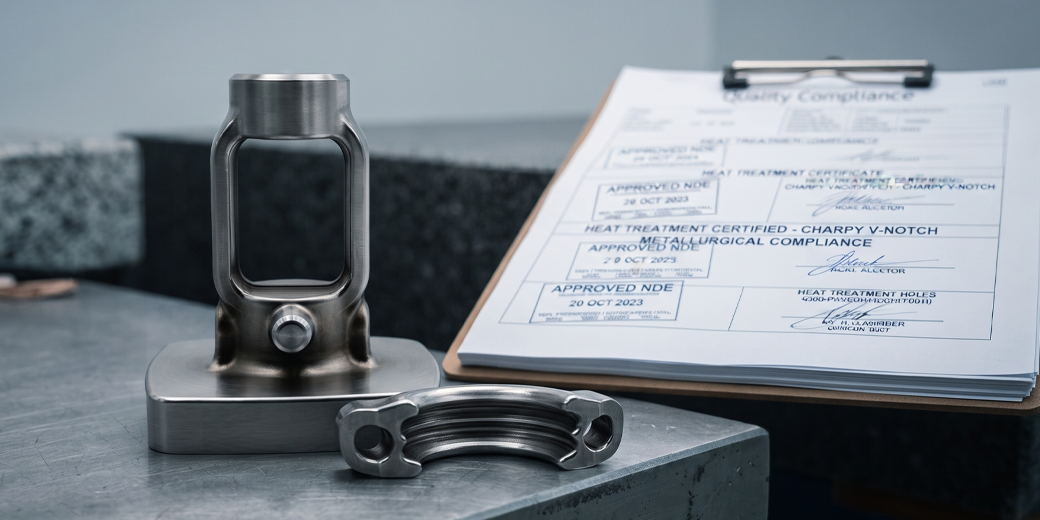
Oil and gas forging is the manufacture of structurally critical forged metallic components for upstream, midstream, and downstream petroleum applications — wellhead assemblies, choke bodies, valve bodies, subsea pressure housings, pipeline flanges, and pressure-retaining fittings. Unlike general industrial forging, oil and gas forging operates under API certification requirements, full material traceability from mill heat to finished component, mandatory pressure testing for certain component categories, and documentation that must satisfy operator quality audits in the most demanding procurement environments in the world. Vinir Engineering has manufactured API certified forgings in Bangalore and Hosur since 1984, holding API 20B, IBR, ABS, and AS9100D certifications across four manufacturing units.
At a Glance: Oil & Gas Forging Requirements
| Parameter | Requirement |
| Quality standard | API 20B (open die and closed die forgings) |
| Pressure test | Mandatory for pressure-retaining components |
| Material traceability | Heat number to finished component |
| NDT | UT + MT standard; PT for non-ferromagnetic |
| Documentation | MTR, heat treatment record, NDT report, pressure test cert, CoC |
| Key materials | Carbon steel, alloy steel, duplex, super duplex, Inconel |
| Weight range (Vinir) | 10 kg – 15,000 kg |
| Typical lead time | 6–12 weeks for standard programmes |
Why Oil & Gas Forging Is a Distinct Category
The oil and gas industry imposes quality and certification requirements on forged components that are fundamentally different from general engineering forging. The reason is simple — failure of a pressure-retaining component in an oil and gas system causes hydrocarbon release. At wellhead pressures of 10,000–20,000 psi, at subsea depths where recovery is impossible, or in hydrogen sulphide-bearing sour service environments, the consequences of a forging failure range from environmental catastrophe to loss of life.
This is why the American Petroleum Institute developed the API 20 series of standards — specifically to define the quality requirements for forged components entering oil and gas pressure-retaining applications. API 20B covers wrought seamless carbon and low alloy steel forgings. API 20C covers stainless steel and nickel alloy forgings. Together they define the floor of acceptability for oil and gas forging supply — not a preference, but a contractual requirement in virtually every significant oil and gas procurement worldwide.
For Indian forging manufacturers, API certification is the entry gate for international oil and gas supply. The Indian oil and gas market – ONGC, Oil India, BPCL, HPCL, Reliance, the Gujarat refinery complex — increasingly applies the same API quality expectations to domestic procurement that international operators impose globally. A forging manufacturer without API certification is effectively excluded from the oil and gas supply chain at the tier where it matters — direct supply to pressure-retaining component manufacturers and EPC contractors.
API 20B: What the Certification Covers and Requires
API 20B — Specification for Wrought Seamless Carbon and Low Alloy Steel Forgings for Use in the Petroleum and Natural Gas Industries — defines the requirements for:
- Material composition and mechanical property minimums
- Melting practice requirements — killed steel, fine grain practice
- Heat treatment requirements and verification
- Non-destructive examination methods, coverage, and acceptance criteria
- Dimensional inspection requirements
- Documentation and traceability requirements
- Manufacturer qualification requirements
What API 20B Requires of the Forging Manufacturer
Manufacturer qualification — API 20B requires that the forging manufacturer holds a current API 20B license from the American Petroleum Institute. The license is granted after an initial facility audit by an API auditor and is maintained through triennial re-audits. The license covers specific product specification levels (PSL) — PSL 1 through PSL 4 — with increasing requirements at each level.
Product Specification Levels:
- PSL 1 — basic requirements, standard for most general oil and gas forgings
- PSL 2 — additional chemistry controls, tighter mechanical property requirements, charpy impact testing mandatory
- PSL 3 — additional NDE requirements, tighter acceptance criteria, hardness testing of every component
- PSL 4 — most demanding, required for sour service and subsea critical applications — additional NACE MR0175 compliance, HIC testing, SSC testing
Most oil and gas operator specifications reference a PSL level as the minimum acceptable. Understanding which PSL applies to the specific application is the first qualification question.
Heat Treatment Under API 20B
API 20B requires that all forgings are heat treated to a defined procedure. Quench and temper is the standard treatment for carbon and low alloy steel oil and gas forgings — it achieves the combination of strength and toughness required for pressure service. Normalising alone is acceptable for some lower-pressure PSL 1 applications.
The heat treatment procedure is a controlled document. Furnace calibration is required. Hardness testing after heat treatment verifies that the specified hardness range was achieved — for sour service components (NACE MR0175), maximum hardness limits are as important as minimum strength requirements.
NDE Under API 20B
Ultrasonic testing of all forgings above a defined weight threshold — typically 115 kg for PSL 2 and above. Magnetic particle inspection of all surfaces after final heat treatment. For PSL 3 and PSL 4, additional NDE requirements including wet fluorescent MT and tighter UT acceptance criteria.
Oil & Gas Forging Applications: What Gets Forged and Why
Wellhead and Christmas Tree Forgings
Wellhead equipment — the assembly of valves, spools, and fittings that controls flow from the wellbore — uses forged bodies and bonnets almost exclusively. The reasons: wellhead components operate at the highest pressures in the system (10,000–20,000 psi working pressure for high-pressure wells), in environments that may include H₂S (requiring sour service material compliance), and they must be retrievable for maintenance throughout the well’s 20–40 year life.
Forged valve bodies and choke bodies for wellhead applications are typically produced in carbon steel (AISI 4130, 4140) for standard service or in 316 stainless, duplex, or Inconel alloys for corrosive or sour service. Closed die forging produces the near-net-shape body profiles, with subsequent machining of bore, port, and seal face features.
Pipeline Flange Forgings
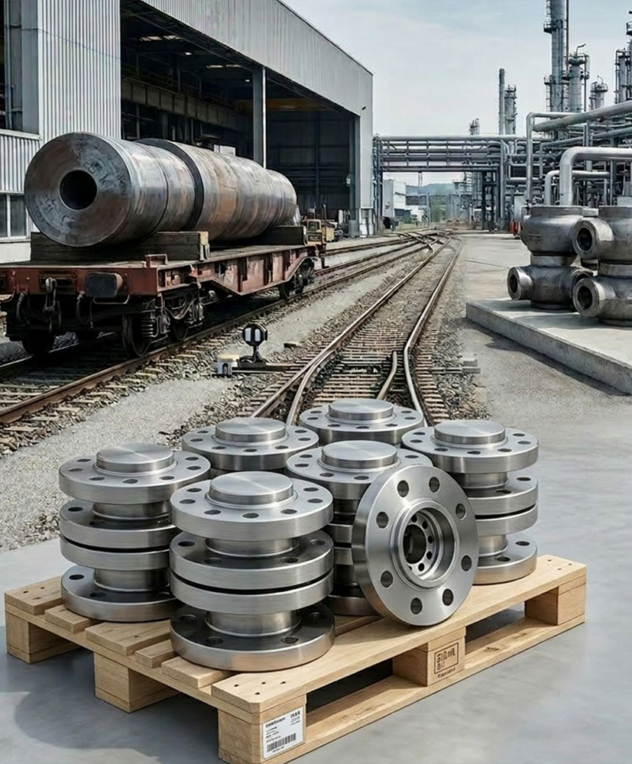
Flanges are the single highest-volume forging category in oil and gas. Every connection in an oil and gas pipeline, processing facility, or offshore platform that can be disassembled uses flanged connections. ASME B16.5 and B16.47 flanges — weld neck, slip-on, blind, socket weld, threaded — are produced by closed die forging or ring rolling depending on size and pressure class.
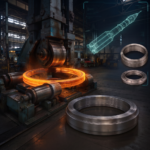
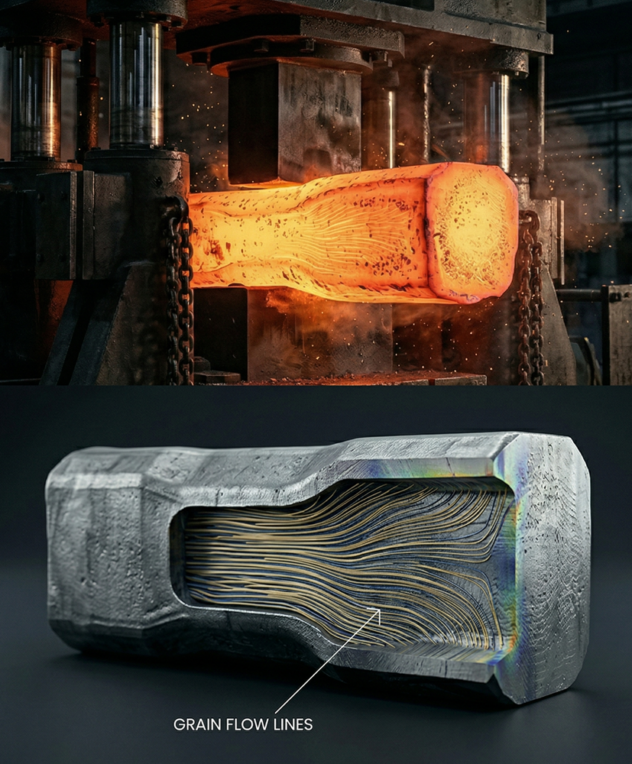
For large-diameter pipeline flanges — above DN 600 (24 inch) — ring rolling is the preferred process. Ring rolling produces seamless flanges with uniform grain flow circumferentially, which is the optimal grain orientation for the hoop stress in a pressurised flange. Welded flanges (fabricated from plate) are used in some commercial applications but are not accepted by most oil and gas operators for critical pressure-retaining service.
Valve Body Forgings
Gate valves, ball valves, check valves, and control valves throughout oil and gas systems use forged bodies. The forging provides the pressure-containing envelope — the body must retain the full working pressure of the system without leakage or structural failure for the valve’s service life.
Valve body forgings for oil and gas are produced to ASTM A105 (carbon steel), ASTM A350 LF2 (low-temperature carbon steel), ASTM A182 F316L (stainless steel), ASTM A182 F51 (duplex 2205), or ASTM A182 F53 (super duplex 2507) depending on the service conditions.
Subsea Forgings
Subsea production systems – wellheads, trees, manifolds, and associated piping at water depths up to 3,000 metres – impose the most demanding requirements in the oil and gas forging supply chain. Key characteristics:
- Operating pressures up to 15,000 psi working pressure
- Ambient temperatures at depth of 2–4°C — requiring good Charpy impact toughness at low temperature
- Corrosive seawater environment — requiring corrosion-resistant alloys or cathodic protection
- No access for maintenance or replacement — components must operate for 20–25 years without intervention
- NACE MR0175 compliance for sour service environments
Subsea forgings are typically in duplex stainless steel, super duplex, Inconel 625, or titanium for the most corrosion-critical applications. API 20B PSL 3 or PSL 4 is the standard certification level for most subsea forging applications.
Materials for Oil & Gas Forgings
Carbon Steel – AISI 4130, 4140, ASTM A105
The workhorses for general oil and gas service where H₂S concentrations and temperatures are within standard limits. 4130 and 4140 are alloy steels with chromium and molybdenum additions that provide good strength, toughness, and hardenability. ASTM A105 is carbon steel for ambient temperature service — the most common flange material specification.
For sour service (H₂S-containing environments), carbon and low alloy steel components must comply with NACE MR0175/ISO 15156 — limiting maximum hardness to 22 HRC (250 HBW) and defining material and heat treatment requirements that prevent sulphide stress cracking.
Duplex Stainless Steel — 2205 (UNS S31803/S32205)
Duplex 2205 has become the standard material for offshore and subsea oil and gas forgings where corrosion resistance is required alongside structural performance.
Compared to austenitic stainless (316L) :
- Approximately twice the yield strength — allows thinner walls and lighter components
- Significantly better resistance to chloride stress corrosion cracking — the dominant failure mode for 316L in seawater environments
- Better resistance to pitting and crevice corrosion in seawater
Solution annealing with rapid water quench is mandatory for 2205 — sigma phase precipitation during slow cooling destroys both corrosion resistance and toughness.
Super Duplex Stainless Steel — 2507 (UNS S32750)
For the most corrosive offshore environments — where standard duplex 2205 does not provide adequate pitting resistance — super duplex 2507 is specified. Higher chromium (25%), molybdenum (4%), and nitrogen content than 2205. Pitting Resistance Equivalent Number (PREN) above 40 — the standard threshold for seawater resistance without chloride-induced pitting.
Applications: subsea tree bodies, offshore valve bodies in high-chloride environments, seawater lift pump components, produced water handling system forgings.
Inconel 625 – For Extreme Corrosion Environments
For downhole applications in high-temperature, high-pressure (HPHT) wells where both corrosion resistance and strength at elevated temperature are required — Inconel 625 is specified. Corrosion-resistant alloy (CRA) liner forgings, downhole valve components, and HPHT tree components in particularly aggressive environments.
Indian Oil & Gas Market: The Domestic Opportunity
India’s domestic oil and gas sector — ONGC, Oil India, BPCL, HPCL, Reliance Industries, and the growing private sector E&P operators — represents a significant domestic market for oil and gas forgings that is increasingly applying international API quality standards.
ONGC — the largest domestic operator, with 150+ producing fields onshore and offshore. Forging procurement for valve bodies, wellhead components, and piping flanges follows API 20B requirements for most critical applications.
Reliance Industries — operates the KG-D6 deepwater gas fields with subsea production systems requiring API PSL 3/4 forgings and full NACE MR0175 compliance.
HPCL, BPCL, IOC refineries — process piping and pressure vessel flanges throughout the refinery complex. ASME B16.5 flanges and ASME B16.47 large diameter flanges in carbon steel and stainless steel.
LNG terminals — Petronet LNG (Dahej, Kochi), Shell Hazira, and the expanding LNG import terminal network require cryogenic grade forgings — ASTM A350 LF2 for carbon steel down to -46°C, 316L stainless for colder service.
International Oil & Gas Markets: Where Indian Forging Exporters Supply
Middle East – The Primary Export Market
Qatar, UAE, Saudi Arabia, and Oman collectively represent the largest international market for Indian oil and gas forgings. GSC data for vinirforge.org shows Qatar with 17.3% CTR and Oman with 24.5% CTR — the highest international click-through rates, indicating active buying intent from these markets already.
The Middle East oil and gas sector — Saudi Aramco, ADNOC, QatarEnergy, PDO Oman — applies the same API 20B quality expectations as international operators globally. Indian API 20B certified forging manufacturers with the ability to supply to ARAMCO approved vendor list standards or equivalent are accessing one of the highest-value export markets available to any Indian manufacturer.
UK and North Sea
The UK North Sea — operated by BP, Shell, Equinor, and others — is a mature but high-value market for subsea and topside forgings. North Sea operators apply API 20B as standard and often additionally require compliance with UK Energy Institute or DNV standards for specific applications. Indian API certified forging manufacturers can access this market through the established procurement channels of major EPC contractors (Wood Group, Subsea 7, TechnipFMC).
USA Gulf of Mexico
The US Gulf of Mexico deepwater development — operated by BP, Chevron, Shell, and independents — uses API 20B as the standard for forging procurement. US operators additionally require NACE MR0175/ISO 15156 compliance for all sour service applications. Indian forging exporters require API 20B certification and the ability to supply to ASTM specifications with full heat-to-component traceability.
How Vinir Engineering Serves Oil & Gas Forging Programmes
Vinir Engineering’s API 20B certification covers closed die and open die forgings in carbon steel, alloy steel, stainless steel, and nickel alloys — the complete material range for oil and gas forging applications. The certification covers all four manufacturing units in Bangalore and Hosur under a single API 20B license.
Closed die forging — valve bodies, choke bodies, wellhead components, flanges in the 10–1,400 kg range.
Open die forging — large flanges, heavy pressure housings, shaft and structural forgings up to 15,000 kg.
Ring rolling — seamless rings for large diameter flanges, pressure vessel shells, and compressor components to Ø4,500mm.
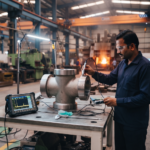
All oil and gas forgings are manufactured with in-house heat treatment (calibrated furnaces, continuous temperature recording), NABL-accredited in-house testing (tensile, impact, hardness, chemical analysis), and in-house NDT (UT, MT, PT) by ASNT Level II certified operators. The complete forge-to-finish workflow operates under one API 20B license and one AS9100D quality management system.
Frequently Asked Questions — Oil & Gas Forging India
What is API 20B and why is it required for oil and gas forgings?
API 20B is the American Petroleum Institute specification for wrought seamless carbon and low alloy steel forgings used in petroleum and natural gas industries. It defines material requirements, heat treatment, NDE methods and acceptance criteria, traceability requirements, and manufacturer qualification requirements. API 20B certification is required by virtually all major oil and gas operators and EPC contractors for pressure-retaining forged components. Without API 20B, a forging manufacturer cannot supply to the international oil and gas market regardless of other quality certifications held.
What is the difference between API 20B and API 20C?
API 20B covers carbon and low alloy steel forgings — the most common material family for oil and gas structural and pressure-retaining components. API 20C covers corrosion-resistant alloy forgings — stainless steels, duplex stainless steels, and nickel alloys (Inconel) used in corrosive service applications. A forging manufacturer supplying duplex valve bodies needs API 20C in addition to or instead of API 20B, depending on whether they also supply carbon steel components. Vinir Engineering holds API 20B covering the primary material range for oil and gas forging supply.
What is NACE MR0175 and when does it apply to oil and gas forgings?
NACE MR0175 (ISO 15156) is the standard governing material selection and qualification for equipment used in H₂S-containing (sour service) oil and gas environments. It applies when the partial pressure of H₂S in the system exceeds defined threshold levels. For forgings, NACE MR0175 limits maximum hardness — typically 22 HRC (250 HBW) for carbon and low alloy steels — to prevent sulphide stress cracking (SSC), a form of hydrogen embrittlement that occurs in sour service. Forgings intended for sour service must be heat treated to achieve the specified strength while remaining within the hardness limit.
What materials are most commonly used for offshore oil and gas forgings?
Carbon steel (AISI 4130, 4140, ASTM A105) for standard service. Duplex stainless steel 2205 for offshore environments where chloride corrosion is a concern. Super duplex 2507 for the most corrosive offshore and subsea environments. Inconel 625 for HPHT downhole applications and aggressive corrosive environments. Low-temperature carbon steel (ASTM A350 LF2) for LNG and cold climate applications. Material selection is driven by the service temperature, pressure, H₂S content, chloride level, and CO₂ partial pressure in the production fluid.
Can Indian oil and gas forging manufacturers supply to Saudi Aramco or ADNOC approved vendor lists?
Yes, provided they hold API 20B certification and meet the additional quality requirements specified in Saudi Aramco’s Materials System Specification (SAMSS) or ADNOC’s equivalent specification. Saudi Aramco and ADNOC maintain their own approved vendor lists for forging manufacturers that layer additional requirements on top of API 20B — including specific heat treatment and NDE requirements, additional chemistry controls for sour service materials, and vendor qualification audits by Aramco or ADNOC quality representatives. Indian API 20B certified manufacturers with the quality system maturity and production track record to pass these audits can access the highest-value oil and gas procurement programmes in the world.