
Missile Forging in India: Structural Components, Materials, and Qualification Requirements
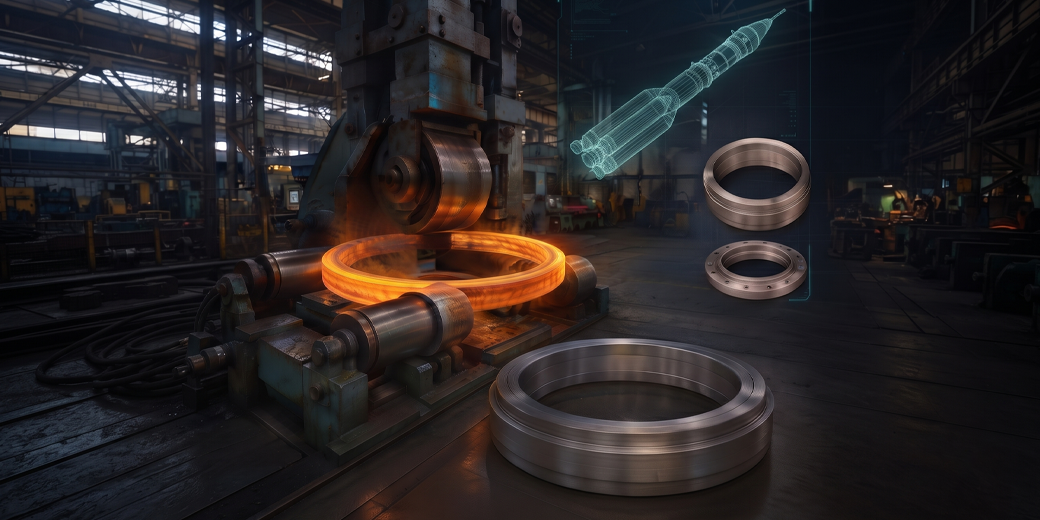
Missile forging refers to the manufacture of structurally critical forged components for guided missile and rocket systems — body section rings, fin roots, warhead housings, propulsion system components, nozzle assemblies, and launch mechanism structural parts. India’s indigenous missile programme — DRDO’s Agni, Prithvi, Astra, Akash, and the BrahMos joint venture — has created a growing domestic demand for precision missile forgings manufactured to standards that match or exceed international aerospace requirements.
Why Forgings Are Used in Missile Systems
Missile components face conditions that eliminate most alternative manufacturing processes. During launch, structural components experience acceleration loads of 20–50g. During flight, aerodynamic loads and thermal gradients from propulsion and atmospheric heating impose combined structural and thermal stresses. In intercept or penetrating warhead applications, terminal ballistic loads add further demand. Forged components are preferred over castings and fabrications because:
- Grain flow oriented to the primary stress direction maximises fatigue and impact strength per unit weight
- No porosity — the forging process eliminates the shrinkage voids that are inherent in castings
- Dimensional consistency — closed die and ring rolling produce repeatable geometry across small batches
- Weight efficiency — near-net-shape forging minimises machining stock, critical for weight-sensitive missile platforms
Key Missile Forging Categories
| Component | Material | Process | Critical Requirement |
| Body section rings | Alloy steel, aluminium 7075 | Ring rolling | Roundness, weight, UT cleanliness |
| Fin root forgings | Ti-6Al-4V, alloy steel | Closed die | Fatigue, dimensional accuracy |
| Warhead housing | Alloy steel, steel fragmentation grades | Closed die | Wall thickness, hardness uniformity |
| Motor case flanges | High-strength steel, titanium | Closed die, ring rolling | Pressure integrity, UT |
| Nozzle assembly forgings | Inconel 625, 718 | Closed die | High-temp strength, UT |
| Guidance section housing | Aluminium 7075, alloy steel | Closed die | Dimensional accuracy, weight |
| Launch tube fittings | Alloy steel | Closed die | Structural integrity, thread accuracy |
| Actuator housings | Alloy steel, aluminium | Closed die | Dimensional accuracy |
India’s Missile Programme and Forging Demand
Agni Missile Family
The Agni ballistic missile family — Agni I through Agni V — is managed by DRDO’s Advanced Systems Laboratory (ASL) in Hyderabad and produced by BDL. Structural forgings for the Agni programme are among the most tightly controlled in the Indian defence supply chain. Requirements include:
- High-strength steel body section ring forgings produced by ring rolling
- Titanium alloy structural forgings for upper stages where weight criticality is highest
- Inconel nozzle and propulsion system component forgings for high-temperature sections
- Component-level serialisation and full material traceability from mill certificate to finished forging
BDL and DRDO manage their forging supply through an approved vendor list where AS9100D certification is the minimum entry requirement. Development orders are issued to one or two suppliers for each new component family before production approval.
BrahMos Missile Programme
BrahMos Aerospace — the India-Russia joint venture managing the supersonic cruise missile — sources structural forgings from qualified Indian suppliers for its indigenisation content obligations. BrahMos operates at speeds above Mach 2.8, creating aerodynamic heating loads that drive material selection toward titanium and high-temperature alloys for external and propulsion-adjacent structures.
Akash Surface-to-Air Missile
The Akash missile, managed by DRDO and produced by BDL and Bharat Electronics, uses a solid rocket propulsion system. Structural forgings in alloy steel and aluminium alloy are used for body sections, fin roots, and guidance section housings. The Akash programme has significant batch requirements compared to ballistic missile programmes — volume is higher and component specifications, while demanding, are less extreme than Agni-class systems.
Astra Air-to-Air Missile
Astra — India’s beyond-visual-range air-to-air missile developed by DRDO — uses titanium alloy forgings for aerodynamic surface roots and structural members where strength-to-weight ratio is critical. The small cross-sections involved require closed die forging capability at the lower end of the weight range (1–50 kg per component).
Materials for Missile Forgings
High-Strength Alloy Steels (D6AC, 4340, 300M)
For structural components where maximum strength is required and weight is secondary — warhead casings, motor case attachment flanges, structural transition sections.
D6AC is widely used in US missile programmes and is increasingly specified in Indian programmes for its combination of tensile strength (1,520–1,720 MPa) and fracture toughness. It must be vacuum arc remelted (VAR) for missile applications — conventional air-melt D6AC has insufficient cleanliness for missile structural use.
300M (modified 4340) achieves tensile strengths above 1,900 MPa and is used for the most demanding structural applications. Extremely sensitive to hydrogen embrittlement — baking after any aqueous processing is mandatory.
4340 is the standard grade for lower-criticality structural fittings and launch system components. Well-characterised, readily available from VAR mills, straightforward to forge and heat treat.
Titanium Alloy Ti-6Al-4V (Grade 5)
The standard aerospace and missile titanium grade. Density 4.4 g/cm³ versus 7.8 g/cm³ for steel — a 44% weight saving per unit volume for equivalent strength. Used wherever the weight saving justifies the higher material and processing cost:
- Fin root and control surface forgings on supersonic missiles
- Upper stage structural members on ballistic missiles
- Body section rings on weight-critical short-range systems
- Guidance section housings where electronics mass budget is constrained
Titanium forging for missile applications requires controlled atmosphere or inert gas protection to prevent oxygen contamination of the surface layer (alpha case formation). Alpha case is a brittle oxygen-enriched layer that reduces fatigue life — the most critical property for cyclically loaded missile structural components.
Inconel 625 and 718
For propulsion system components exposed to combustion temperatures — nozzle assemblies, turbopump housings, aft body sections adjacent to the motor exhaust:
Inconel 718 — the workhorse high-temperature alloy. Solution annealed and double aged to achieve tensile strength above 1,240 MPa at room temperature, retaining useful strength to above 650°C. Difficult to forge — requires significantly higher forging loads than steel, narrow temperature window (1,010–1,065°C), and rapid die wear.
Inconel 625 — superior corrosion resistance but lower strength than 718. Used for components in corrosive combustion environments. Solution annealed condition, not age-hardened.
Aluminium Alloys (7075-T6, 2024-T4)
For body section rings and structural frames on shorter-range or surface-launched systems where aerodynamic heating is less severe and weight reduction is the primary driver:
7075-T6 — tensile strength 500–570 MPa, density 2.81 g/cm³. The strongest commercially available aluminium alloy. Standard for aerospace structural applications where temperature does not exceed 120°C.
2024-T4 — slightly lower strength than 7075, better damage tolerance. Used where fatigue and crack growth resistance are prioritised over maximum static strength.
Forging Processes for Missile Components
Ring Rolling for Body Sections
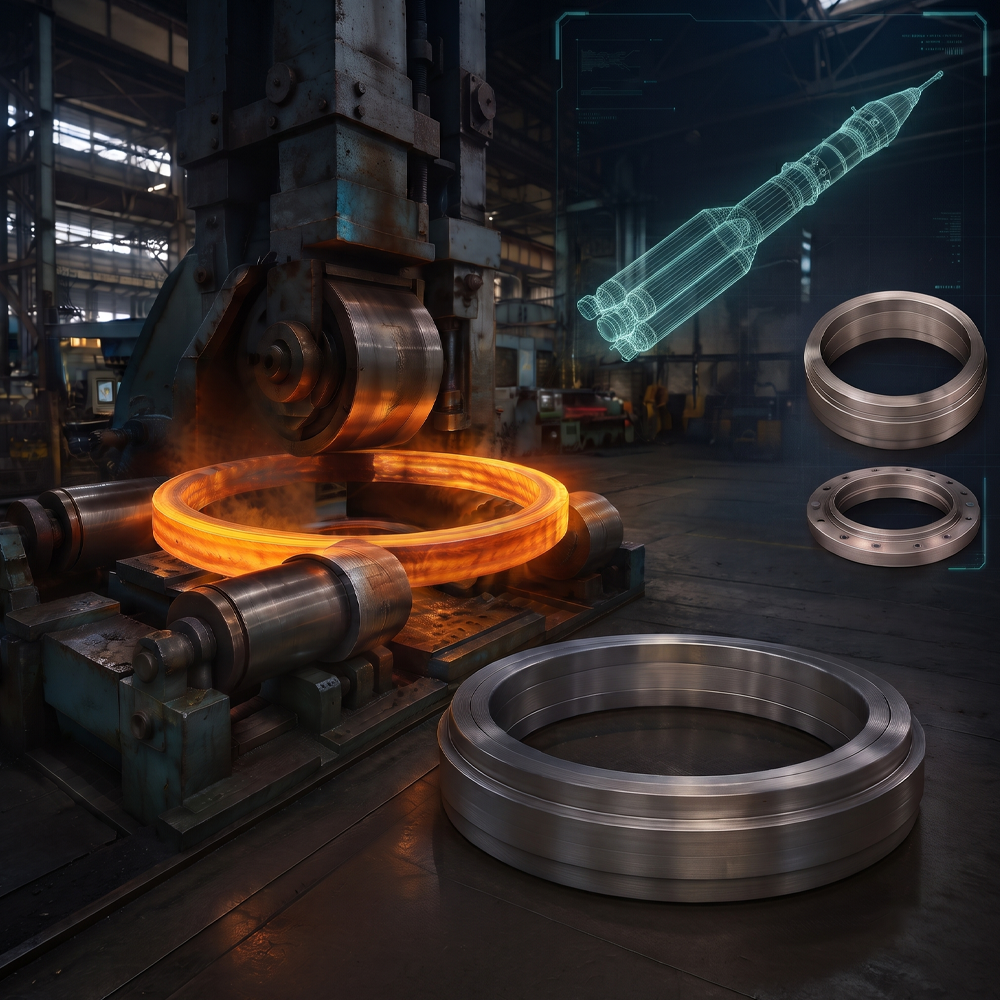
Missile body section rings — the cylindrical structural frames that form the outer skin attachment points — are produced by ring rolling. The advantages over alternative processes are significant:
- Seamless construction eliminates weld seam stress concentrations — critical for internal pressure applications
- Circumferential grain flow aligns with the hoop stress direction — the primary loading direction in a pressurised body section
- Consistent wall thickness and roundness from the rolling process — better than machining from bar
- Weight efficiency — near-net-shape production with minimal machining stock
Closed Die Forging for Fin Roots and Housings
Fin root forgings, guidance housings, actuator bodies, and launch system attachment fittings are produced by closed die forging. The closed die process provides:
- Near-net-shape geometry with controlled grain flow through the cross-section
- Consistent mechanical properties across a production batch — critical for missiles where every component must perform identically
- Tight dimensional repeatability — fin roots must align precisely to achieve the designed aerodynamic behaviour
Radial Forging for Cylindrical Sections
Thick-walled cylindrical motor case sections and guidance section tubes can be produced by radial forging — a multi-die process that simultaneously works the component from multiple directions to achieve uniform grain structure and wall thickness. Radial forging is preferred for long cylindrical sections where ring rolling cannot achieve the required length-to-diameter ratio.
Quality and Traceability Requirements for Missile Forgings
Missile forgings operate under the most stringent quality regime in the Indian defence forging supply chain.
100% Ultrasonic Testing
Every missile forging is 100% UT inspected to stringent acceptance criteria — typically AMS 2154 for aerospace quality bar, or tighter customer-specific standards. The acceptance threshold for internal defects is significantly more demanding than standard defence forging criteria. Immersion UT or phased array UT is often specified to achieve the required sensitivity and full volume coverage.
Component-Level Serialisation
Unlike many defence programmes where traceability is maintained at batch or heat level, missile forgings are often serialised — each component carries a unique serial number that links it to a specific heat of raw material, specific forging date, heat treatment lot, and NDT inspection record. This allows individual component tracking throughout the missile’s life.
Witness Inspection at Every Stage
For DRDO and BDL programmes, customer or DGQA representative witness inspection at forging, heat treatment, and NDT stages is standard — not just at final acceptance. Hold points are defined in the quality plan where production cannot proceed without inspector sign-off.
Material Certification to Aerospace Standards
Raw material for missile forgings must be certified to the applicable aerospace standard — AMS 6415 for 4340, AMS 6354 for D6AC, AMS 4928 for Ti-6Al-4V, AMS 5663 for Inconel 718. Each heat must be tested to the specific requirements of the applicable AMS, not just to a nominal chemistry specification.
Batch Sizes in Missile Forging Programmes
Missile forging programmes are characterised by the smallest batch sizes in the defence forging supply chain:
- Development and qualification: 3–10 components per part number
- Annual production: 10–100 components per year for active missile programmes
- Urgent spares: 1–5 components on priority call-off
This makes missile forging the most extreme example of high-mix low-volume manufacturing. A supplier serving multiple missile programmes simultaneously may be producing 20–30 distinct part numbers per year at quantities of 5–20 each. Every part number has its own drawing, material specification, heat treatment procedure, NDT procedure, and qualification record.
The documentation burden per component is high. The setup cost per batch is high. The quality control intensity is at the maximum end of the spectrum. This is why relatively few Indian forging manufacturers are qualified for missile programmes despite strong certification credentials in other defence categories.
How Vinir Approaches Missile Forging Programmes
Vinir Engineering’s capability profile — four manufacturing units, multi-material capability including titanium and Inconel, NABL-accredited in-house testing, AS9100D across all processes — positions Vinir for missile forging programmes that most general defence forging manufacturers cannot access.
The combination of closed die forging (10–1,400 kg), ring rolling (Ø200–4,500mm), and radial forging covers the three primary processes used in missile structural component manufacturing. In-house heat treatment including solution annealing, age hardening for Inconel 718, and controlled atmosphere capability for titanium-sensitive operations means the complete forging-to-certified-component workflow stays under one AS9100D quality system.
For DRDO laboratories, BDL programme offices, and BrahMos Aerospace procurement teams beginning qualification discussions, Vinir can provide a technical feasibility assessment within 24 hours of receiving a drawing and specification.
Frequently Asked Questions — Missile Forgings India
What materials are most commonly used in Indian missile forgings?
High-strength alloy steels (4340, D6AC, 300M) are used for structural components requiring maximum strength — warhead casings, motor case flanges, launch system fittings. Titanium alloy Ti-6Al-4V is used for weight-critical structures — fin roots, upper stage rings, guidance housings on high-performance systems. Inconel 625 and 718 are used for propulsion system components at elevated temperature. Aluminium alloys (7075-T6) are used for body section rings and structural frames on shorter-range systems where aerodynamic heating is limited.
Why is ring rolling preferred for missile body section rings?
Ring rolling produces seamless rings with grain flow oriented circumferentially — aligned with the hoop stress direction in a pressurised or loaded cylindrical body section. Rolled rings have no weld seam (eliminating weld failure risk), consistent wall thickness and roundness from the process itself, and superior mechanical properties compared to machined bar or cast sections. For pressurised motor cases and structural body sections on missiles, the seamless construction and circumferential grain flow are critical structural advantages.
What is alpha case in titanium missile forgings and why is it a rejection criterion?
Alpha case is a brittle, oxygen-enriched layer that forms on the surface of titanium when heated in an atmosphere containing oxygen or nitrogen — which occurs if atmospheric protection is inadequate during forging. Alpha case significantly reduces fatigue life — the most critical property for missile structural components subject to launch acceleration and vibration loads. Acceptance specifications for aerospace and missile titanium forgings define maximum allowable alpha case depth (typically 0.13–0.25mm). Detection is by chemical milling of a witness coupon or metallographic examination of a cross-section sample. Components with alpha case exceeding the specification limit are rejected.
What NDT standard is applied to missile forgings?
Ultrasonic testing of missile forgings is typically performed to AMS 2154 (for bar and billet) or AMS 2635 (for forgings) at the most stringent quality class specified. Customer-specific acceptance criteria often exceed AMS standard levels — defining smaller maximum allowable flaw sizes and tighter back-wall attenuation limits than the published standard minimums. Immersion UT or phased array UT is preferred for missile forgings to achieve complete volume coverage and the sensitivity required to meet tight acceptance criteria.
How does batch size affect the economics of missile forging?
Missile forging batches of 3–20 components require the full fixed cost of die preparation, furnace setup, NDT calibration, documentation, and witness inspection regardless of quantity. Per-unit costs are therefore very high compared to industrial forging. Missile forging pricing reflects this — die amortisation over small quantities, setup costs spread across few components, and the quality management overhead of first article inspection for every new part number. Suppliers who are not structured for high-mix low-volume economics will either underprice and lose money or overprice and lose the order.