
Rail Forgings in India: IRIS Certified Components for Indian Railways and Global Rolling Stock
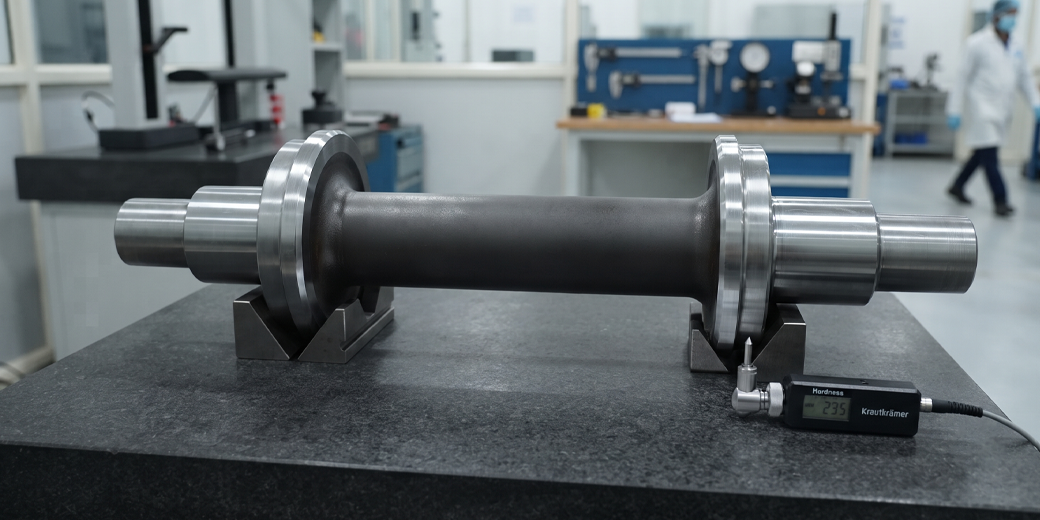
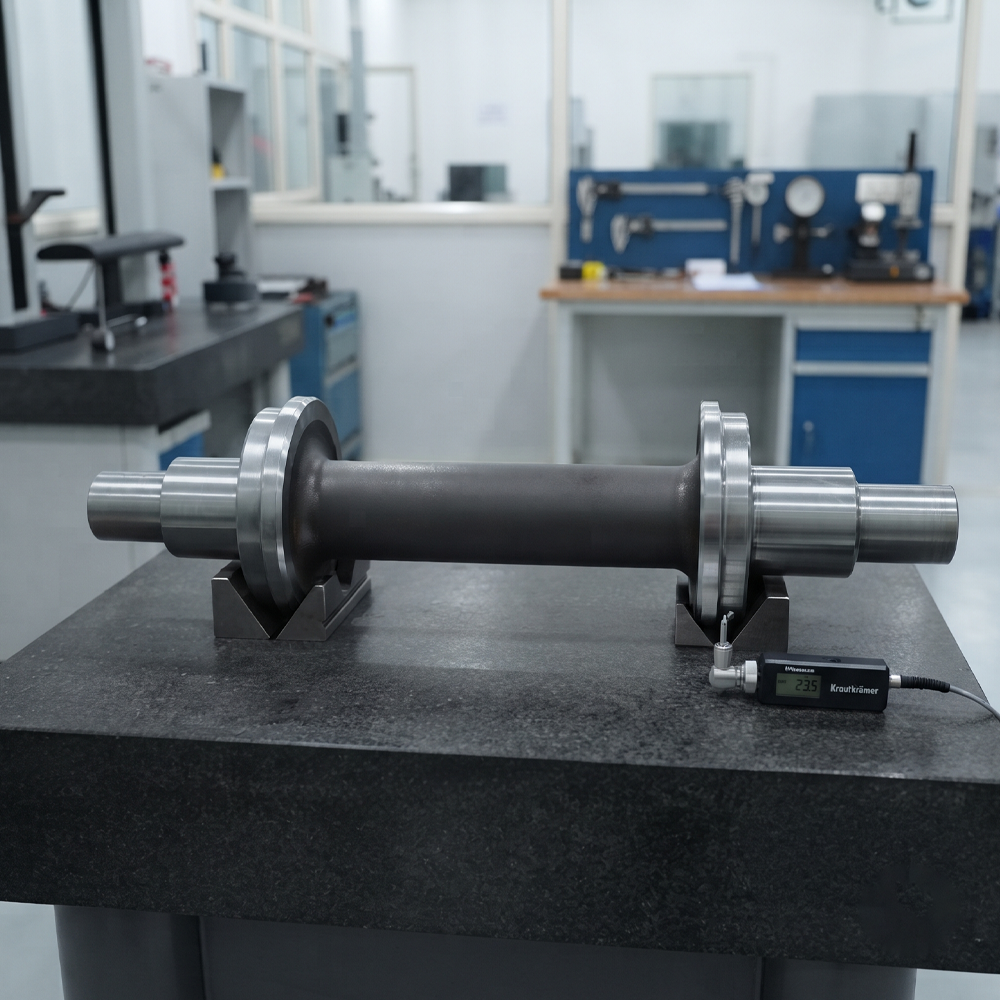
Rail forgings are structurally critical forged metallic components used in railway rolling stock, track infrastructure, locomotive systems, and metro rail platforms — axles, wheel blanks, bogie frames, draw gear components, brake system forgings, and traction motor housings. Railway forging is governed by the most stringent fatigue life and safety requirements in the land transport sector: a railway axle that fails at speed causes a derailment; a bogie frame forging that cracks propagates through the fleet. Vinir Engineering manufactures IRIS certified rail forgings in Bangalore and Hosur, holding IRIS (ISO 22163), AS9100D, IBR, and ABS certifications across four manufacturing units — serving Indian Railways, metro rail operators, and international rolling stock OEMs.
At a Glance: Rail Forging Requirements
| Parameter | Requirement |
| Quality standard | IRIS (ISO 22163) — railway sector QMS |
| Supporting standard | EN 13261 (axles), EN 13262 (wheels), EN 13103 (axle design) |
| Indian Railways standard | IRS specifications for indigenous procurement |
| Key materials | Carbon steel (EA1N, EA4T), alloy steel (30CrNiMo8, 34CrNiMo6) |
| Fatigue requirement | Highest priority — infinite life design for axles |
| NDE | 100% UT for axles and safety-critical components |
| Traceability | Heat number to finished component — mandatory |
| Surface finish | Ra ≤ 1.6 µm on axle journal surfaces — precision machining |
| Proof test | Mandatory for draw gear and coupling forgings |
Why Railway Forgings Demand the Highest Fatigue Standards
Railway rolling stock components operate under cyclic loading conditions that are more severe than most other transport or industrial applications. A railway axle on a passenger train operating at 160 km/h completes approximately 1.5 million rotations per day. Over a 30-year service life with periodic maintenance, the axle accumulates over 10 billion load cycles. At this scale, fatigue — not static strength — governs the design and the manufacturing quality requirements.
The consequences of fatigue failure in railway service are severe. The 1998 Eschede rail disaster — caused by a fatigue fracture in a rubber-spring wheel — resulted in 101 deaths and is the deadliest rail accident in post-war German history. The investigation established that undetected fatigue cracks had propagated over multiple inspection intervals before the catastrophic fracture. This accident fundamentally shaped the current railway forging inspection and certification regime across Europe and, through international standards adoption, globally.
For Indian Railways — operating the world’s fourth-largest rail network with over 22,000 trains per day — the structural integrity of forged components is a programme-level safety priority. RDSO (Research Designs and Standards Organisation) in Lucknow governs the technical specifications and approval process for all forged components used in Indian Railways rolling stock.
IRIS Certification: The Railway Sector Quality Standard
IRIS (International Railway Industry Standard) — now formalised as ISO 22163 — is the quality management system standard for the railway supply chain. It is to railway manufacturing what AS9100D is to aerospace — it builds on ISO 9001 and adds requirements specific to the railway sector.
What IRIS Adds Beyond ISO 9001
Product safety management — IRIS requires a formal product safety process covering safety-relevant characteristics, safety-critical component identification, and safety records retention.
Key characteristics — safety-critical dimensions and properties on railway components must be identified, controlled, and 100% inspected. This is directly analogous to the key characteristics concept in AS9100D.
Make-or-buy process — IRIS requires formal make-or-buy decisions with documented risk assessment for any externally sourced operations or components.
Project management — IRIS requires formal project management processes for new product introduction, covering feasibility assessment, design review, and production validation.
Maintenance, repair, and overhaul (MRO) — IRIS specifically covers the MRO supply chain, which is a significant market for rail forging in India — replacement axles, bogie components, and draw gear for overhaul programmes.
IRIS vs AS9100D: Both are sector-specific overlays on ISO 9001. IRIS is specific to railway, AS9100D to aerospace and defence. Both are required for supply to their respective industries. Vinir Engineering holds IRIS (ISO 22163) certification alongside AS9100D — enabling supply to both railway and aerospace/defence programmes without quality system gap.
Rail Forging Categories and Components
Axle Forgings — The Most Safety-Critical Railway Forging
Railway axles are the single most safety-critical forging in any rolling stock programme. They carry the full static and dynamic load of the vehicle through the wheel sets, transmit braking forces, and in powered axles also transmit traction torque. Axle failure causes immediate derailment.
Solid axles — for trailer bogies (non-powered axles), solid alloy steel axles are produced by open die forging from high-quality billet, followed by precision machining to very tight dimensional tolerances (journal diameter tolerance typically ±0.015mm) and surface finish requirements (Ra ≤ 1.6 µm on journal surfaces).
Hollow axles — for weight-critical applications (high-speed rail, tilting trains), hollow axles produced by radial forging reduce unsprung mass and enable through-axle instrumentation for condition monitoring. The hollow bore must be concentric with the journal surfaces — eccentricity causes vibration that degrades bearing life.
Powered axles — for locomotive and powered car axles that transmit traction torque from the gearbox to the wheels, the axle geometry includes gear wheel seats, brake disc seats, and journal seats — each machined to precise tolerances with specific surface finish requirements.
Material: EN 13261 defines the material specifications for European railway axles. EA1N (normalised carbon steel) for lower-load applications. EA4T (alloy steel, quenched and tempered) for higher-load and higher-speed applications. Indian Railways specifies equivalent grades through IRS M-46 and related specifications.
Wheel Blank Forgings
Railway wheels are produced by forging from steel billet — a process that orients grain flow circumferentially around the wheel tread, maximising resistance to the rolling contact fatigue that is the primary wear mechanism in railway wheel service. Wheel forgings start as round billets that are forged into a flat disc, then rolled and pressed into the wheel profile with hub, web, and rim.
The wheel tread — the rolling surface — must be forged and machined to the specified wheel profile with tight dimensional tolerances. The flange — the vertical protrusion that keeps the wheel on the rail — must have the correct geometry and must be produced with the correct microstructure to resist wear under the lateral forces at curves and switches.
Material: EN 13262 defines material requirements for European wheels. ER7 and ER8 grades cover standard applications. Higher-grade materials for high-speed rail. Indian Railways specifies equivalent grades for domestic procurement.
Bogie Frame Forgings
Bogie frames — the structural assembly that carries the wheelsets and supports the car body — use forged steel in their most highly stressed locations: side frame end sections, bolster connections, and traction/braking force transfer points. While much of the bogie frame is fabricated from rolled sections and plates, the forgings at stress concentration points are critical for fatigue life.
Bogie frame forgings are produced in alloy steel to tight dimensional tolerances with comprehensive UT and MT inspection. The forging geometry must allow complete NDT coverage — bogie frame forgings with complex internal geometry that cannot be fully UT scanned are a certification challenge.
Draw Gear and Coupling Forgings
Draw gear components — draw hooks, coupling links, buffer housings, and screw coupling components — must withstand the full train coupling and buffering loads. These components are proof load tested — subjected to a specified static load that they must sustain without permanent deformation — before acceptance.
Draw hook forgings for Indian Railways wagons are produced in high-strength alloy steel (typically 30Mn2 or 45Cr4 equivalent) and must pass a mandatory proof load test as a type approval and sampling requirement for ongoing production.
Brake System Forgings
Brake caliper bodies, brake disc hat sections, and brake pivot forgings are produced by closed die forging in alloy steel. Brake system forgings carry the forces of emergency braking — on a high-speed passenger train, emergency braking from 200 km/h requires sustained deceleration over 10–15 seconds with enormous heat generation in the brake disc. The brake caliper forging must maintain structural integrity under the combined thermal and mechanical loads of emergency braking.
Indian Railways: The Domestic Market for Rail Forgings
RDSO Approval for Indian Railways Supply
The Research Designs and Standards Organisation (RDSO) in Lucknow governs all technical specifications and vendor approvals for Indian Railways rolling stock components. The RDSO approval process for railway forging manufacturers involves:
Vendor registration — application to RDSO’s vendor management system with documentation of quality system certification (IRIS or equivalent), manufacturing capability, and relevant production history.
Developmental order — RDSO issues a developmental order for sample components. The manufacturer produces samples to RDSO specifications with full documentation.
RDSO inspection — RDSO’s inspection team visits the manufacturer’s facility for source inspection of the developmental components. Dimensional verification, material testing, and NDE are conducted or witnessed.
Vendor approval — successful developmental order leads to vendor listing in the relevant RDSO specification category. Production orders from Railway zones then follow.
Ongoing source inspection — RDSO or railway zonal inspection teams conduct source inspection at the manufacturer’s facility before each lot ships. For safety-critical items (axles, wheel sets), this is mandatory pre-dispatch inspection.
Indian Railways Production Volumes
Indian Railways operates approximately 85,000 wagons, 55,000 coaches, and 12,500 locomotives.
Annual additions and replacement requirements generate significant forging demand:
- Wagons: New wagon procurement of 25,000–30,000 wagons per year under the Gati Shakti programme. Each wagon requires approximately 8 axles and associated draw gear and brake forgings.
- Coaches: LHB coach production at Rail Coach Factory Kapurthala and Integral Coach Factory Chennai. Each LHB coach requires 4 axles plus bogie frame and brake system forgings.
- Vande Bharat trainsets: Semi-high-speed trainset production at ICF Chennai. Higher-specification alloy steel axles to EA4T or equivalent.
- Metro rail: Rapid expansion of metro networks across 25+ Indian cities — Delhi, Mumbai, Bangalore, Chennai, Hyderabad, Pune, and others — each requiring axle and bogie component forgings.
Vande Bharat and High-Speed Rail
The Vande Bharat Express trainsets — India’s semi-high-speed trains operating up to 180 km/h — use forged axles to a higher specification than conventional IR rolling stock. The higher operating speed increases the fatigue cycle accumulation rate and raises the dynamic loads on axle and bogie components. RDSO specifications for Vande Bharat axles reference EN 13261 EA4T material requirements — quenched and tempered alloy steel achieving minimum tensile strength of 800 MPa.
India’s planned high-speed rail network — beginning with the Mumbai-Ahmedabad Bullet Train project — will require Shinkansen-grade axle forgings to Japanese JIS or equivalent specifications, representing a step-change in specification above current Indian Railways requirements.
Materials for Rail Forgings
EA1N — Normalised Carbon Steel for Axles
EA1N is a normalised carbon-manganese steel used for railway axle applications where the combination of loads and speed does not require the higher strength of alloy steel. Widely used for freight wagon axles on Indian Railways where the operating speeds are lower and the primary loading is static.
Composition: Carbon 0.35–0.48%, manganese 0.50–0.80%, silicon 0.15–0.40%. Properties: Minimum tensile strength 540 MPa, minimum yield 320 MPa, Charpy impact at room temperature.
EA4T — Alloy Steel for Higher-Speed Applications
EA4T is a quenched and tempered alloy steel used for passenger coach and locomotive axles where higher speeds and fatigue requirements demand better mechanical properties than EA1N.
Composition: Carbon 0.34–0.41%, chromium 0.90–1.20%, molybdenum 0.15–0.25% — a chromium-molybdenum alloy steel. Properties: Minimum tensile strength 800 MPa, minimum yield 600 MPa, Charpy impact at room temperature and at low temperature where specified.
The quench and temper heat treatment for EA4T must achieve the target strength while maintaining adequate toughness — the tempering temperature must be above 550°C per EN 13261 to ensure adequate impact toughness. Under-tempering produces an axle that meets tensile and hardness specifications but has insufficient toughness against impact loading at low ambient temperatures in winter operations.
30CrNiMo8 — Draw Gear and High-Strength Components
High-strength nickel-chromium-molybdenum alloy steel for draw gear forgings, high-load bogie components, and traction motor mounting forgings. Minimum tensile strength 1,050 MPa. Quenched and tempered.
NDE Requirements for Rail Forgings
Axle Ultrasonic Testing — 100% Volume Inspection
100% ultrasonic testing of railway axles is mandatory — every axle, throughout its full volume. The inspection must be performed in the as-forged and heat-treated condition before machining, and in the finish-machined condition before delivery. The two-stage inspection catches defects introduced in the manufacturing process (pre-machining UT) and surface cracks or sub-surface defects revealed by machining (post-machining inspection).
The acceptance criteria for railway axle UT are among the strictest applied to any forging category. EN 13261 references European standards that define maximum allowable indication sizes at different axle zones — the mid-body, the wheel seat, and the journal are each evaluated against specific acceptance thresholds.
In-service periodic UT inspection of railway axles — typically at 300,000–400,000 km intervals — detects fatigue cracks propagating in service before they reach critical size. This maintenance inspection requirement is what drives the need for the machined axle surface finish (Ra ≤ 1.6 µm) — rough surfaces prevent effective UT coupling during in-service inspection.
Magnetic Particle Inspection
MT is applied to all steel axle and bogie forgings after heat treatment and after final machining. The ground journal surfaces, transition radii, and wheel seat surfaces are the critical inspection zones — these are the locations of highest stress concentration and therefore highest probability of fatigue crack initiation.
The transition radii on railway axles — the smooth curves that transition between the journal, wheel seat, and mid-body diameters — are produced with specific radius dimensions that minimise stress concentration. MT after machining confirms that these transitions are free from surface cracks or seams that would serve as fatigue initiation sites.
Vinir Engineering’s Rail Forging Capability
Vinir Engineering holds IRIS (ISO 22163) certification — the railway sector quality management standard — alongside AS9100D, covering the complete forge-to-finish workflow across four manufacturing units in Bangalore and Hosur.
Open die forging — solid railway axles in EA1N and EA4T alloy steel up to 15,000 kg. The 3000T hydraulic press with dango manipulators handles the length and weight requirements of locom
otive and heavy freight wagon axles.
Radial forging — hollow axles for weight-critical applications, with controlled bore concentricity and uniform wall thickness throughout the axle length.
Closed die forging — draw gear components, brake system forgings, bogie frame stress-concentration forgings, and smaller axle-adjacent components in the 10–1,400 kg range.
In-house heat treatment — quench and temper for EA4T and alloy steel draw gear forgings. Normalise for EA1N axles. Calibrated furnaces with AMS 2750 equivalent pyrometry. Continuous furnace charts on all production cycles.
NABL-accredited mechanical testing — tensile, Charpy impact, Brinell hardness, and chemical analysis. All testing to EN 13261 or equivalent IRS specification methods.
In-house UT and MT — 100% UT of all safety-critical rail forgings. MT of all surfaces after heat treatment and machining. ASNT Level II certified operators.
RDSO-aligned documentation — material traceability, heat treatment records, NDE reports, and dimensional inspection records formatted for RDSO source inspection review.
Frequently Asked Questions — Rail Forgings India
What is IRIS certification and why is it required for railway forging supply?
IRIS (International Railway Industry Standard), now formalised as ISO 22163, is the quality management system standard for the railway supply chain globally. It builds on ISO 9001 and adds requirements specific to railway manufacturing — product safety management, key characteristics control, make-or-buy risk assessment, and project management for new product introduction. IRIS is required by railway OEMs — Alstom, Bombardier (now Alstom), Siemens Mobility, CRRC, BEML, and others — for their tier-1 and tier-2 suppliers globally. For Indian Railways supply, RDSO vendor approval is the primary requirement, and IRIS certification demonstrates quality system maturity that supports and accelerates the RDSO approval process.
What is RDSO and how does it approve railway forging suppliers in India?
RDSO (Research Designs and Standards Organisation) is the technical arm of Indian Railways responsible for specifying and approving all rolling stock components used on the Indian Railways network. For railway forgings, RDSO approval involves vendor registration, a developmental order for sample components, source inspection of developmental components by RDSO engineers, and inclusion on the approved vendor list for the relevant specification. Ongoing supply requires RDSO source inspection before each lot ships. RDSO specifications for forgings reference IRS (Indian Railway Standards) material and dimensional requirements that must be demonstrated during the development order phase.
What is the difference between EA1N and EA4T railway axle steel?
EA1N is a normalised carbon-manganese steel for lower-speed and lower-load axle applications — primarily freight wagon axles. It achieves minimum tensile strength of 540 MPa by normalising heat treatment. EA4T is a quenched and tempered chromium-molybdenum alloy steel for higher-speed and higher-load applications — passenger coach axles, locomotive axles, and Vande Bharat trainset axles. EA4T achieves minimum tensile strength of 800 MPa. The higher strength of EA4T reduces the required axle diameter for equivalent load capacity, reducing unsprung mass and improving ride quality at higher speeds.
Why is 100% ultrasonic testing mandatory for railway axles?
Railway axles operate for 10 billion or more load cycles over their service life. Fatigue cracks can initiate at internal defects — inclusions, porosity, laminations — that are invisible externally and that produce no change in static mechanical properties. A fatigue crack growing from an internal defect will eventually reach critical size and cause fracture at normal operating loads. The 1998 Eschede disaster demonstrated that undetected axle defects can propagate to failure with catastrophic consequences. 100% UT inspection before delivery, combined with periodic in-service UT at defined maintenance intervals, is the safety-critical control that prevents in-service axle fracture.
Can Indian railway forging manufacturers supply to international rolling stock OEMs?
Yes. Indian IRIS-certified railway forging manufacturers can supply to international rolling stock OEMs — Alstom, Siemens Mobility, Stadler, and others — who procure components globally for their worldwide projects. Indian rolling stock exports are growing — railway coaches and components are exported under bilateral agreements and through international competitive procurement. Forging manufacturers with IRIS certification, demonstrated production history in EN 13261-grade axle steels, and the ability to provide EN-referenced material certificates and test reports are positioned to supply these programmes. The IRIS certification is specifically designed to be internationally portable — an IRIS-certified manufacturer in India is assessed against the same standard as one in Germany or France.