
How to Evaluate Defence Forging Companies in India: A Buyer’s Qualification Guide
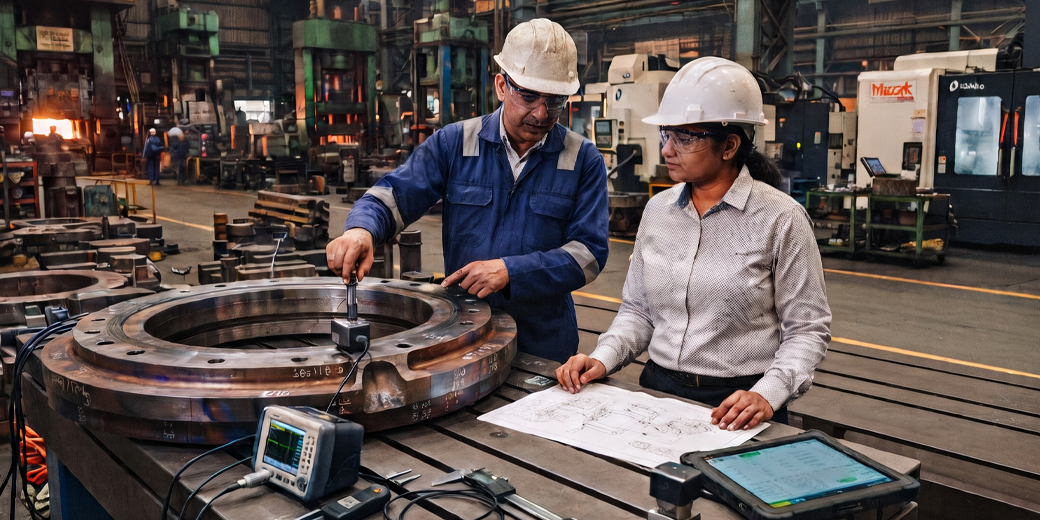
Evaluating defence forging companies in India involves far more than comparing quotations or checking that a supplier has a quality certificate on the wall. Defence forging is a regulated, long-term supply chain activity. The evaluation criteria that matter — certification scope, in-house process coverage, production history depth, quality system maturity — are largely invisible in a brochure and only become clear through structured assessment. Getting this evaluation wrong means a supplier who passes initial screening but fails first article, or passes first article but cannot sustain quality across a three-year programme.
The Five-Level Evaluation Hierarchy
Level 1: Certification Verification (Non-Negotiable Entry Gate)
Before any technical evaluation begins, certifications must be verified. Not assumed — verified.
AS9100D — Request the current certificate, not a copy of a previous certificate. Check the expiry date. Check the certification body is IAQG-recognised (Bureau Veritas, TÜV SÜD, DNV, Lloyd’s Register Quality Assurance). Read the scope statement — it defines exactly which processes and facilities are covered. A certificate scoped to forging alone does not extend to heat treatment or NDT performed at the same site. A certificate covering one facility does not extend to a second facility even under the same company name.
DGQA registration — where applicable for Indian PSU programmes. Ask for the registration number and the specific product categories covered. Verify directly with DGQA where programme criticality warrants it.
Application-specific approvals — IBR for pressure-retaining components, ABS or Lloyd’s for naval applications. Request originals or certified copies. Check whether the approval covers the specific material grades and processes required for your programme.
An AS9100D certificate with the wrong scope, from a non-IAQG-recognised body, or covering only one of several company facilities should not proceed to technical evaluation.
Level 2: Process Capability Assessment
Defence forging is process-specific. A supplier with excellent closed die capability up to 500 kg may have zero capability for open die forgings at 5,000 kg. Process capability assessment must cover:
Forging processes available in-house — closed die, open die, ring rolling, radial forging. Which processes are genuinely in-house versus sent to subcontractors.
Weight and dimensional range — not claimed, but evidenced. Ask for recent production records (material test reports, delivery notes) in the weight range and material required. A supplier claiming 15,000 kg open die capability should be able to show a recent production record of a forging in that range.
Materials forged with evidence — not material families, but specific grades. A supplier who has never forged Ti-6Al-4V presents a different risk profile from one who has produced 500 kg of Ti-6Al-4V last month.
Equipment list with capacities — press tonnage, hammer energy, furnace dimensions, ring mill specifications. Equipment that is listed but not maintained, or listed but shared with other facilities, is not reliable production capacity.
In-house versus outsourced operations — the single most important question. Heat treatment, NDT, and machining outsourced to third parties mean the supplier does not control the most critical operations. Source inspection becomes significantly more complex and the traceability chain passes through organisations you cannot audit in one visit.
Level 3: Quality System Maturity
Beyond the certificate, the operational maturity of the quality management system is what determines whether a supplier will sustain performance across a multi-year programme.
Non-conformance log — ask to review it. A healthy quality system has a well-populated NCR log with properly investigated and closed NCRs. An empty or nearly empty NCR log in a forging facility is not a sign of excellence — it is a sign that non-conformances are not being formally recorded. This is a major concern.
Internal audit programme — is it running on schedule? Are findings being actioned and closed? Ask for the last internal audit report and the status of corrective actions. A supplier who cannot produce these within 24 hours does not have a functioning internal audit programme.
Corrective action records — review three to five recent corrective actions from beginning to end. The quality of root cause analysis matters. “Operator error — retrained” is not root cause analysis. A properly investigated corrective action identifies the systemic cause and implements a permanent fix.
Management review records — AS9100D requires periodic management reviews of quality performance. Ask when the last review was held and what quality metrics were reviewed. A supplier whose senior management is not engaged in quality performance monitoring is a programme risk.
Level 4: Production History Depth
Production records in the relevant material and weight range are the strongest predictor of sustained capability. Ask for:
Recent material test reports — from production in the same material grade and similar weight range as your requirement. These confirm the supplier is actively forging in the material, not just claiming capability.
Customer acceptance records — delivery notes, customer quality acceptance, or shipping records showing successful deliveries to defence or regulated customers in the last 12 months.
First article records — from a programme in a similar material and complexity level. The completeness and quality of the FAIR package tells you what your first article package will look like.
Programme continuity examples — evidence of sustained supply to a programme over multiple years. A supplier who has delivered consistently for three years is a different risk profile from one with a single delivery followed by a two-year gap.
Level 5: Organisational and Financial Stability
A defence programme runs for years or decades. Supplier risk at this level includes:
Ownership and management continuity — family-owned or owner-managed companies with long establishment history present lower management continuity risk than recently acquired or frequently restructured organisations. Ask who owns the company and how long the current management team has been in place.
Key person dependency — is the quality director who will pass the AS9100D audit also the only person who understands the heat treatment procedures? Key person dependency is a programme risk that is rarely assessed but frequently causes problems.
Capacity headroom — a supplier operating at 95% capacity has no buffer for urgent orders, schedule changes, or reject-and-replace situations. Ask about current capacity utilisation and how your programme would be prioritised relative to existing customers.
Financial health indicators — not requiring full financial disclosure, but basic indicators — years in operation, customer payment history, willingness to discuss capacity investment — give a sense of financial stability.
Red Flags When Evaluating Indian Defence Forging Companies
Critical outsourcing of heat treatment or NDT — the two operations most critical to defence forging quality, both outsourced. This breaks traceability, prevents single-visit source inspection, and introduces coordination risk.
Automotive-focused production model — a plant designed around high-volume automotive production cannot serve low-volume defence programmes economically or operationally. Minimum order quantities, documentation burden, and setup economics are incompatible with defence batch sizes of 10–50 components.
Expired or narrow AS9100D scope — a certificate expired six months ago, or one that covers only one process at one facility, should not proceed to supplier evaluation for a multi-process defence programme.
No NABL-accredited testing — DGQA requires NABL-accredited test results for mechanical and chemical testing for most defence acceptance purposes. A supplier without NABL accreditation either outsources testing (with associated traceability and scheduling risks) or cannot support DGQA-overseen programmes.
Inability to produce a complete Stage 1 package quickly — a capable, well-organised defence forging supplier should be able to produce a complete initial submission package — quality manual overview, AS9100D certificate, capability statement, equipment list, representative production records — within five working days of a request. A supplier who takes four weeks to assemble basic documentation is telling you something about their operational readiness.
The Competitive Landscape: Indian Defence Forging Companies by Category
The Indian defence forging market is fragmented across capability levels. Understanding the competitive landscape helps buyers set appropriate expectations.
Tier 1 — Full-capability multi-certified suppliers: AS9100D, IBR, ABS, all processes in-house including heat treatment and NABL-accredited testing. Capable of titanium, Inconel, and special alloys. This is a small group — fewer than ten companies in India meet this standard across the full capability range.
Tier 2 — Certified single-process specialists: AS9100D certified but with narrower process or material scope. Strong in one process (ring rolling, or closed die) but not forge-to-finish. Require subcontractors for heat treatment or NDT. Suitable for well-defined single-process programmes.
Tier 3 — ISO 9001 general industrial forgers: Not AS9100D certified. Serving commercial markets with defence as an occasional customer. Not appropriate for primary defence supply chain unless exceptional other capabilities exist. Cannot satisfy DGQA acceptance requirements without upgrading certification.
Material specialists: Companies like Sagar Prakash Alloys, Robust Special Metals — specialised in superalloys and special material supply but not necessarily primary forging manufacturers. Different value proposition from a structural forging manufacturer.
A Practical Checklist for Evaluating Indian Defence Forging Suppliers
CERTIFICATIONS
- AS9100D current — expiry date checked
- Certification body is IAQG-recognised
- Scope covers all required processes and facilities
- DGQA registration — number and categories verified
- IBR / ABS as applicable — current approval confirmed
- NABL accreditation for test lab confirmed
PROCESS CAPABILITY
- All required forging processes confirmed in-house
- Weight and dimensional range evidenced by recent production records
- Required material grades confirmed by recent MTRs
- Heat treatment in-house — calibrated furnaces, AMS 2750 compliance
- NDT in-house — ASNT Level II operators, calibrated equipment
- Machining in-house where required
- No critical outsourcing of special processes
QUALITY SYSTEM
- NCR log reviewed — active and well-populated
- Internal audit programme running — last report available
- Corrective actions closed with proper root cause analysis
- Management review conducted — quality metrics reviewed
- Document control active — current revisions in production
PRODUCTION HISTORY
- Recent MTRs in required material and weight range
- Customer acceptance records — recent deliveries to defence customers
- FAIR package example reviewed
- Multi-year programme example — sustained supply evidenced
- Document control active — current revisions in production
ORGANISATIONAL
- Ownership and management continuity assessed
- Capacity headroom confirmed
- Key person dependency identified and risk assessed
- Stage 1 package produced within 5 working days of request
Vinir Engineering’s Profile Against the Evaluation Criteria
| Evaluation Criterion | Vinir Status |
| AS9100D | Current — all 4 units, complete forge-to-finish scope |
| Certification body | Bureau Veritas — IAQG recognised |
| IBR | Certified |
| ABS | Approved |
| NABL accreditation | In-house test lab — mechanical and chemical testing |
| Forging processes in-house | Closed die, open die, ring rolling, radial forging |
| Weight range | 10 kg – 15,000 kg |
| Heat treatment | In-house, calibrated, AMS 2750 equivalent |
| NDT | In-house, ASNT Level II operators |
| Materials | Alloy steels, titanium, Inconel, duplex, armour steels |
| Production history | 42 years continuous defence production |
| Stage 1 package turnaround | Within 5 working days |
Frequently Asked Questions — Evaluating Defence Forging Companies India
How many AS9100D certified forging manufacturers are there in India?
Estimates range from 15 to 40 companies depending on how scope and capability are counted. Not all AS9100D certified forging companies have equivalent capability — scope breadth, process range, material capability, and quality system maturity vary significantly. The number capable of handling titanium, Inconel, and armour steel within a forge-to-finish model with all processes in-house is considerably smaller — fewer than ten companies by most assessments.
What is the most important single question to ask a defence forging supplier?
Ask whether heat treatment and NDT are performed in-house or outsourced. This single question reveals more about the supplier’s actual capability and quality system integrity than any certification document. A supplier with all processes in-house under one AS9100D scope presents a fundamentally different — and lower — risk profile than one who outsources special processes, regardless of what their quality manual says.
Should a defence buyer prefer a larger or smaller forging company?
Size is not the primary evaluation criterion. The key factors are certification scope, in-house capability coverage, production history depth in the relevant material and weight range, and quality system maturity. Some of India’s most capable and reliable defence forging suppliers are mid-sized companies with deep specialisation and decades of programme continuity — not the largest by revenue or headcount.
What is a reasonable timeline to expect for a complete supplier evaluation?
A thorough supplier evaluation for a defence forging programme takes 3–6 months from initial submission to shop floor audit completion. Stage 1 (document review) takes 4–6 weeks with a responsive supplier. Stage 2 (shop floor audit) requires scheduling and travel and typically takes 1–2 months to arrange and execute. Evaluation shortcuts — skipping the shop floor audit, not requesting production evidence — consistently lead to first article failures and programme delays.
Can a supplier be evaluated against future capability rather than current capability?
No credible defence OEM evaluates against planned or promised capability. Evaluation is based on demonstrated, evidenced capability at the time of evaluation. A supplier who says “we are buying a new press next year” or “we plan to get AS9100D next quarter” is not qualified today. Return and re-evaluate when the capability is in place. Qualification against future capability that does not materialise on schedule is one of the most common causes of programme schedule overruns in defence forging supply chains.