
How Defence OEMs Qualify Indian Forging Suppliers: The Complete Process
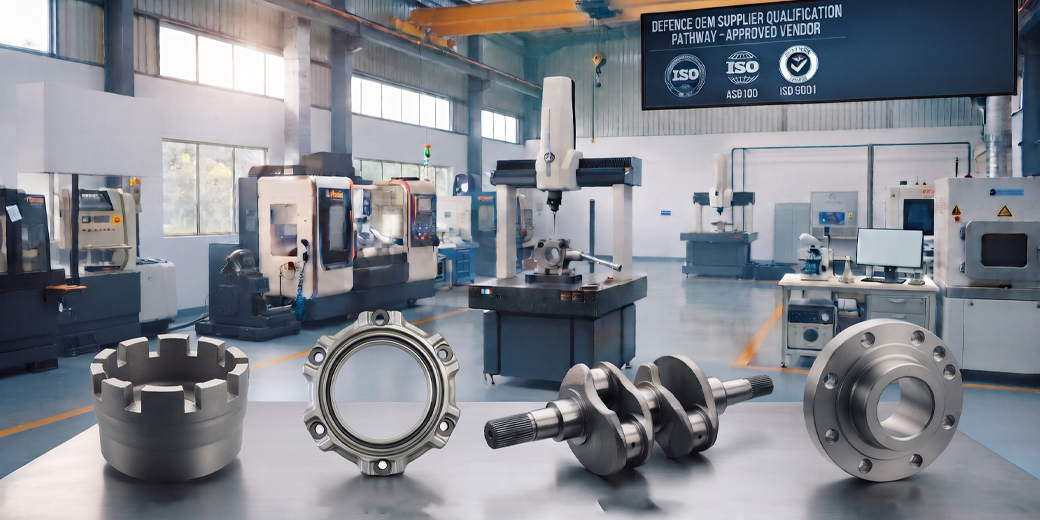
Defence forging supplier qualification is the structured process by which defence OEMs — domestic and international — evaluate, approve, and onboard Indian forging manufacturers into their supply chains. It is not a single audit or a certificate check. It is a multi-stage process covering quality systems, shop floor capability, material process controls, first article production, and long-term programme reliability. For Indian forging suppliers, understanding this process precisely determines how to prepare, what to invest in, and how long to realistically expect before receiving a first purchase order.
At a Glance: Defence Forging Supplier Qualification
| Stage | Activity | Typical Duration |
| 1 — Initial Assessment | Document review, certification check | 1–3 months |
| 2 — Shop Floor Audit | On-site quality system and capability audit | 1–3 months |
| 3 — First Article | Sample production, full dimensional and mechanical verification | 3–6 months |
| 4 — Process Validation | Repeat production runs, repeatability data | 6–12 months |
| 5 — AVL Approval | Approved Vendor Listing, first programme order | 1–6 months post-validation |
| Total | First contact to first order | 18–36 months |
Why Defence Qualification Takes So Long
The qualification timeline for defence forging suppliers surprises most people the first time they encounter it. Eighteen to thirty-six months from first contact to purchase order feels excessive when the same component might take eight weeks to manufacture. The reason is not bureaucracy — it is risk management.
A defence programme running over twenty years will consume forged components from the same supplier for that entire period. The OEM cannot afford to qualify a supplier, start a programme, and then discover eighteen months in that the supplier cannot maintain dimensional consistency across heats, or that heat treatment records are incomplete, or that the quality manager who passed the audit has left and the system only existed on paper.
The long qualification timeline exists to find these problems before they become programme problems. Every stage is designed to stress-test a different aspect of the supplier’s capability and management system.
For Indian forging manufacturers, this creates both a barrier and a moat. The barrier is the time and resource investment required before revenue starts. The moat is that once qualified, a defence forging supplier is very difficult to replace — the OEM has invested equally in the relationship and does not want to restart the process with someone else.
Stage 1: Initial Assessment — What OEMs Review First
Before any engineer visits a shop floor, the OEM’s procurement or supplier quality team reviews a standard set of documents. Getting this package right is the first test.
Certifications Required at Stage 1
AS9100D is non-negotiable. Without a current AS9100D certificate from an accredited certification body, most defence OEMs will not proceed further. This is not a preference — it is written into their approved supplier procedure. AS9100D demonstrates that the quality management system has been independently audited and found to meet aerospace and defence standards.
DGQA registration is additionally required for programmes involving Indian defence PSUs, ordnance factories, or government-to-government procurement. DGQA maintains its own approved vendor list separate from OEM qualification.
IBR, ABS, or other application-specific certifications are reviewed at this stage to assess whether the supplier already holds approvals relevant to the programme.
Capability Statement
The OEM expects a clear capability statement covering:
- Forging processes available (closed die, open die, ring rolling, radial)
- Weight and dimensional range per process
- Materials regularly forged — grades, not just families
- In-house versus outsourced operations (heat treatment, NDT, machining)
- Equipment list with capacities
- Production volume history in similar components
The critical signal here is in-house versus outsourced. Suppliers who outsource heat treatment, NDT, or machining are considered higher risk because the OEM cannot audit those processes in one visit and supply chain control is weaker. A forge-to-finish manufacturer — all processes under one roof — scores significantly better at this stage.
Financial Stability
Most defence OEMs include a basic financial health check at Stage 1. A supplier that cannot fund a twelve-month qualification process, invest in tooling, or carry inventory for a programme is a programme risk. This is not about being large — it is about demonstrating stability and continuity.
Stage 2: Shop Floor Audit — What Auditors Actually Check
The shop floor audit is where paper qualifications meet operational reality. Defence OEM quality auditors — and DGQA inspectors — are experienced at identifying gaps between what a quality manual says and what actually happens on the production floor.
Quality Management System in Operation
Auditors do not read the quality manual at this stage. They verify it is being followed. They pull random work orders and trace them through the system — does the traveller match the drawing revision? Is the material cert attached? Was the heat treatment furnace calibrated before this batch ran? Are non-conformances being raised and closed properly or being informally waived?
The most common finding at this stage is not a missing procedure — it is a procedure that exists but is not consistently followed. Defence OEMs have zero tolerance for this. An AS9100D certificate with inconsistent execution is worse than no certificate, because it means the supplier understands the requirement and is choosing not to meet it.
Special Process Qualification
Heat treatment and NDT are classified as special processes in AS9100D — processes whose output cannot be fully verified by subsequent inspection. This means the process itself must be qualified, not just the output.
Auditors review:
- Furnace calibration records (AMS 2750 or equivalent)
- Heat treatment procedure documentation and operator qualification
- NDT procedure qualification (written practice, technique sheets)
- NDT operator certification levels (ASNT Level II minimum)
- Equipment calibration certificates
A supplier without documented special process qualification fails Stage 2 regardless of how good everything else looks.
Material Traceability System
Auditors will ask to trace a component from the finished part back to the raw material certificate. This means:
- The material test report (MTR) from the steel mill is on file
- The heat number from the MTR is marked on the billet
- The heat number is carried through the traveller
- The finished component documentation references the same heat number
If this chain breaks at any point — even once — it is a major finding. Defence programmes require that in the event of a quality escape, every component from the same heat can be identified and recalled. If traceability is incomplete, this is impossible.
Equipment and Calibration
Every measuring instrument, furnace, press, and test machine used in the production of the component must be on a calibration schedule with current certificates. Auditors check calibration tags on equipment and cross-reference with the calibration register. Out-of-calibration equipment found during a defence audit is an automatic major non-conformance.
Stage 3: First Article Inspection — The Most Detailed Stage
First article inspection (FAI) is the most intensive stage of defence forging qualification. The supplier manufactures one or more components to the drawing and specification, and every measurable characteristic is independently verified.
What FAI Covers for Defence Forgings
Dimensional verification — every dimension on the drawing is measured and recorded. Not a sample. Every dimension. Results are recorded on a ballooned drawing or First Article Inspection Report (FAIR) that references each dimension by balloon number.
Material verification — chemical composition and mechanical properties (tensile strength, yield strength, elongation, reduction of area, Charpy impact) are tested from a witness coupon forged alongside the component in the same heat and same thermal cycle.
NDT results — UT, MT, and any specified additional methods are performed and results documented. Any rejectable indications must be dispositioned before the FAI is accepted.
Heat treatment records — furnace charts, temperature records, quench records, and hardness test results are included in the FAI package.
Process records — the forging traveller showing every operation, who performed it, what equipment was used, and what parameters were recorded.
The complete FAI package is submitted to the OEM for review. OEM engineers review every document. Any finding results in a corrective action request before FAI approval is granted.
DGQA Source Inspection
For programmes under DGQA oversight, a DGQA representative witnesses the first article production run at the supplier’s facility. This is not a document review — the inspector is present during forging, heat treatment, and testing. Pre-inspection meetings are held before production begins. Hold points are defined where production cannot proceed without inspector sign-off.
Suppliers unfamiliar with DGQA source inspection often underestimate the preparation required. Having a dedicated quality engineer as a single point of contact for the DGQA inspector, and maintaining real-time documentation that the inspector can review at each hold point, is standard practice for experienced defence forging suppliers.
Stage 4: Process Validation — Proving Repeatability
A successful first article proves the supplier can make the component once. Process validation proves they can make it consistently.
During process validation, the supplier manufactures multiple batches — typically three to five production runs across different raw material heats. The OEM analyses:
- Dimensional consistency across batches (are key dimensions within tolerance every time, or are they drifting?)
- Mechanical property consistency across heats (is the heat treatment process in control?)
- NDT results across batches (are there recurring indications suggesting a process problem?)
- Documentation completeness (is the paperwork consistently complete, or were there shortcuts in batches two and three?)
Process validation is where suppliers who performed well in Stage 3 sometimes fail. The first article was their best effort — full management attention, every procedure followed perfectly. Batches two and three under normal production conditions reveal whether the system is embedded or performed.
Defence OEMs specifically look for statistical evidence of process control. Capability indices (Cpk) on key dimensions are increasingly required. A Cpk of 1.33 or higher on safety-critical dimensions is the typical expectation.
Stage 5: AVL Approval and First Order
Upon satisfactory completion of process validation, the supplier is added to the OEM’s Approved Vendor List for the specific material, process, and component type that was qualified. AVL approval is component-family specific — being approved for closed die forgings in alloy steel does not automatically extend to titanium forgings or open die components.
First programme orders typically follow within six to twelve months of AVL approval, subject to programme schedules and the OEM’s procurement planning cycle.
Ongoing AVL status requires:
- Maintaining AS9100D certification (annual surveillance audits)
- Zero quality escapes reaching the OEM’s production floor
- Continued responsiveness to OEM requests for information and corrective actions
- Periodic re-qualification audits (typically every three years)
What Indian Defence Forging Suppliers Need to Enter Qualification
Based on the qualification process above, the minimum requirements for a credible qualification submission are:
Certifications in place before approaching: AS9100D from an accredited body. Without this, the process does not start.
All critical processes in-house: Heat treatment, NDT, and machining outsourced to third parties significantly reduce qualification probability. Defence OEMs prefer — and some require — that all special processes are under one roof and covered by the supplier’s AS9100D scope.
Documented production history: At least two years of production records in materials and weight ranges similar to the programme requirement. A supplier with no track record in titanium forgings above 500 kg should not approach a qualification for a 1,200 kg titanium airframe component.
Calibrated equipment and current records: Every instrument and furnace in calibration before the first auditor arrives. Expired calibration certificates found during an audit are a finding that delays qualification.
Dedicated quality resource: A full-time quality engineer who owns the qualification process, manages documentation, and is the single point of contact for the OEM’s supplier quality team. Qualification managed by a part-time resource or divided between multiple people rarely succeeds at Stage 2.
How Vinir Engineering Supports Defence OEM Qualification
Vinir Engineering enters qualification discussions with the most significant barriers already cleared:
- AS9100D certified across all four manufacturing units
- IBR and ABS certifications in addition to AS9100D
- All critical processes in-house — forging, heat treatment, CNC machining, NDT, assembly
- NABL-accredited in-house test lab for mechanical and chemical testing
- 42 years of documented production history across defence, aerospace, nuclear, and oil & gas
- Dedicated quality team experienced in DGQA source inspection and customer witness inspection
For defence OEMs beginning a supplier search, Vinir can provide a complete Stage 1 submission package within five working days — quality manual, certification copies, capability statement, equipment list, and representative production records.
Frequently Asked Questions — Defence Forging Supplier Qualification
What is the minimum requirement to begin defence forging supplier qualification in India?
AS9100D certification from an accredited body is the minimum entry requirement for most defence OEM qualification processes in India. DGQA registration is additionally required for programmes involving Indian defence PSUs. Beyond certifications, OEMs expect documented production history in the relevant material and process family, in-house special processes (heat treatment and NDT), and calibrated equipment with current certificates.
Can a forging supplier be qualified for multiple programmes simultaneously?
Yes, but each qualification is specific to the process, material, and component family. A supplier qualified for closed die forgings in EN24 alloy steel is not automatically approved for titanium forgings or large open die components. Each new programme family typically requires a separate first article and process validation. Suppliers with broader in-house capability can run multiple qualifications in parallel.
What is DGQA source inspection and how does it work?
DGQA source inspection is pre-delivery inspection conducted by a Directorate General of Quality Assurance representative at the supplier’s manufacturing facility. The inspector witnesses production, heat treatment, and testing against defined hold points. Production cannot proceed past a hold point without inspector sign-off. Source inspection is required for most components entering Indian defence PSU supply chains and ordnance factory programmes.
What happens if a non-conformance is found during first article inspection?
A non-conformance during FAI results in a corrective action request from the OEM. The supplier must perform root cause analysis, implement corrective action, and re-submit affected documentation or components. Depending on the severity of the finding, re-inspection of the first article or production of a new first article may be required. Timeline impact is typically three to six months per major finding.
How does a defence forging supplier maintain AVL status after initial qualification?
AVL maintenance requires continued AS9100D certification through annual surveillance audits, zero quality escapes reaching the OEM’s production, continued responsiveness to corrective action requests, and periodic re-qualification audits (typically every three years). A single quality escape — a non-conforming component reaching the OEM undetected — can result in suspension from the AVL pending corrective action review.
What is the difference between OEM qualification and DGQA approval?
OEM qualification is conducted by the defence company’s own supplier quality team and approves the supplier for that specific OEM’s programmes. DGQA approval is conducted by India’s government defence quality authority and is required for programmes where the Indian government is the end customer. Many programmes require both — OEM qualification first, then DGQA endorsement. Some programmes route entirely through DGQA without a separate OEM qualification stage.
Does Vinir Engineering hold DGQA approval?
Vinir Engineering holds AS9100D, IBR, and ABS certifications and has experience with DGQA source inspection across multiple defence programmes. For specific DGQA registration status relevant to your programme, contact our quality team directly at connect@vinirforge.org.