
Why “forge-to-finish” matters more than ever in critical component supply chains
The Problem with Fragmented Supply Chains
In many critical component programs, forging, machining, heat treatment, and inspection are handled by different vendors.
While this model may appear cost-efficient, it introduces hidden risks:
- Traceability breaks between operations
- Inconsistent interpretation of drawings and tolerances
- Delayed non-conformance detection
- Finger-pointing during audits or failures
For industries where failure has high consequence, fragmentation increases uncertainty.
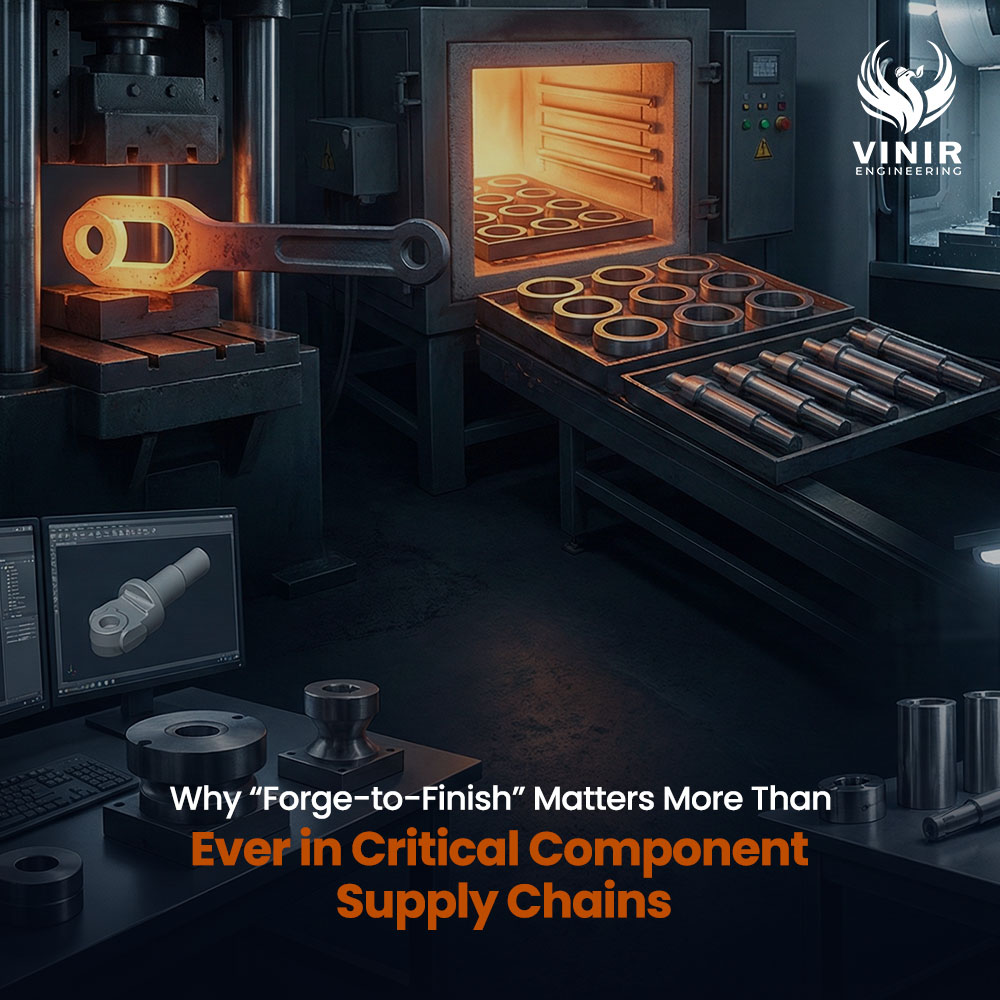
What “Forge-to-Finish” Actually Means
Forge-to-finish is not a marketing label.
It refers to a manufacturing model where a single supplier controls:
- Forging (open die, closed die, ring rolling, or radial forging)
- Heat treatment and process validation
- Machining to final dimensions
- Inspection and NDT
- Documentation and traceability
This creates one accountable system, not multiple handoffs.
Why Critical Industries Prefer Forge-to-Finish
1. Continuous Traceability Without Breaks
Critical buyers require:
- Heat-level material tracking
- Batch and lot segregation
- Clear linkage between forging, machining, and inspection
Forge-to-finish suppliers preserve traceability internally, reducing the risk of documentation gaps that can disqualify components during audits.
2. Better Dimensional and Metallurgical Control
When forging and machining are integrated:
- Grain flow intent is preserved during machining
- Heat treatment is aligned with final geometry
- Dimensional deviations are caught earlier
This is especially important for thick-section and fatigue-loaded components.
3. Faster Root Cause Analysis
In fragmented chains, failures trigger:
- Cross-vendor investigations
- Conflicting data
- Delayed corrective actions
Forge-to-finish suppliers can trace issues to:
- Forging parameters
- Heat treatment cycles
- Machining decisions
Corrective actions become faster, cleaner, and auditable.
4. Audit Readiness Improves by Design
Auditors evaluate systems — not just parts.
Forge-to-finish operations offer:
- Unified quality management systems
- Single NCR and CAPA framework
- Clear ownership of deviations
This simplifies supplier qualification and ongoing surveillance audits.
Where Forge-to-Finish Becomes a Deciding Factor
Buyers increasingly insist on forge-to-finish suppliers when:
- Components are safety- or mission-critical
- Volumes are low and variability is high
- Programs run for decades
- Certification and documentation are as important as strength
This is common across defence, aerospace, nuclear, oil & gas, rail, and energy programs.
The Cost Argument and Why It’s Misleading
Forge-to-finish suppliers may appear more expensive at the RFQ stage.
However, buyers often underestimate:
- Rework caused by interface misalignment
- Audit failures due to documentation gaps
- Program delays from supplier coordination
- Long-term risk exposure
In critical programs, risk-adjusted cost matters more than unit price.
Common Failure Points in Non-Integrated Supply Chains
Programs often fail when:
- Forging grain flow is compromised during machining
- Heat treatment assumptions differ between vendors
- Inspection standards are inconsistently applied
- Traceability breaks occur at handoff points
These issues surface late — when correction is expensive or impossible.
How Vinir Applies Forge-to-Finish in Practice
Vinir operates as a forge-to-finish manufacturer for critical components by integrating:
- High-mix forging operations
- Controlled heat treatment
- Precision machining
- Comprehensive inspection and NDT
- Certification-aligned documentation systems
This ensures components meet technical, regulatory, and audit expectations — not just dimensional requirements.
FAQ
Is forge-to-finish mandatory for all critical components?
Not always, but it significantly reduces risk for complex, low-volume, or long-lifecycle programs.
Do forge-to-finish suppliers cost more?
Unit costs may be higher, but total program risk and lifecycle costs are often lower.
Does forge-to-finish improve audit outcomes?
Yes. Auditors prefer clear accountability and integrated quality systems.Which industries benefit most from forge-to-finish?
Defence, aerospace, nuclear, oil & gas, energy, marine, and rail applications.