
Propulsion Shaft Forging for LNG Carriers: ABS DNV Approved from India

Propulsion Shaft Forging for LNG Carriers: ABS DNV Approved from India
Propulsion Shaft Forging for LNG Carriers: ABS DNV Approved from India

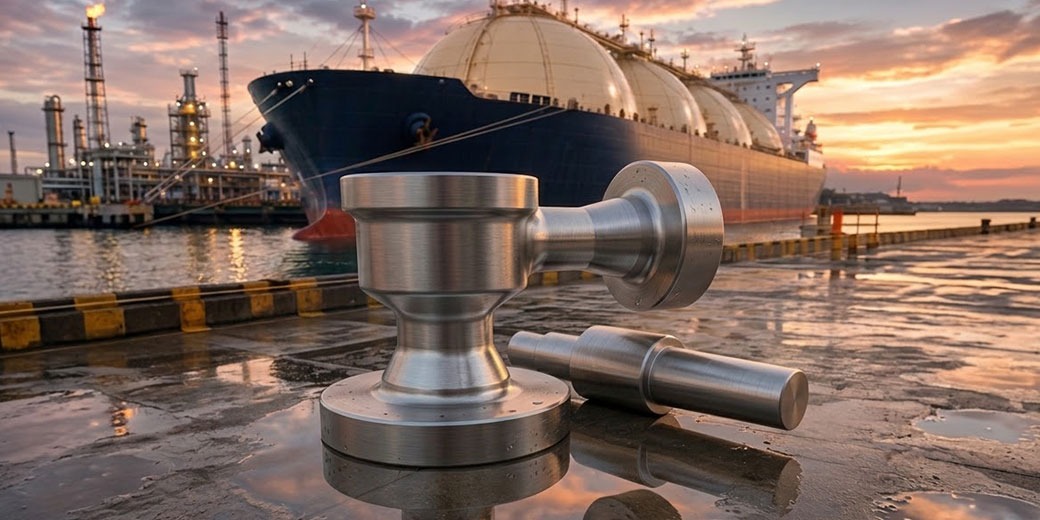
LNG carrier propulsion shafts — forged in carbon or alloy steel and classified by ABS, DNV, Lloyd’s Register, or Bureau Veritas — are the highest-value single forging in most commercial vessel propulsion systems. A Q-Flex LNG carrier (210,000 m³ capacity) uses twin propulsion shafts each weighing 12,000–18,000 kg in the finished-machined condition, forged in 30CrNiMo8 (equivalent to 4340) alloy steel. As LNG carrier orders surge — driven by Europe’s post-Russia gas diversification and Asia’s LNG import growth — Indian open die forging manufacturers with ABS and DNV marine approval are positioned to supply propulsion shaft forgings for newbuild LNG carriers at significant cost advantage over European and Korean shaft forge shops.


LNG Carrier TypeCapacityShaft TypeRough Forged Weight


Q-Flex (Qatargas)
210,000 m³
Twin shaft, 4-blade propeller
12,000–18,000 kg/shaft

Q-Max (Qatargas)

266,000 m³
Twin shaft, 4-blade propeller15,000–22,000 kg/shaft
Standard TFDE174,000 m³Single or twin shaft8,000–14,000 kg/shaft
LNG-FSRU (floating)
170,000+ m³Twin azimuth thruster shaft5,000–10,000 kg/shaft
LNG bunker vessel7,000–30,000 m³Single shaft2,000–6,000 kg/shaft

LNG carrier propulsion has evolved through three generations — steam turbine (early LNG carriers, now mostly retired), diesel-electric (DFDE — Dual Fuel Diesel Electric, dominant for a decade), and tri-fuel diesel-electric or multi-fuel electric (TFDE, ME-GI, XDF — current standard for newbuilds). The propulsion shaft for a DFDE or TFDE LNG carrier transmits the electrical motor or mechanical gearbox output torque to the propeller at the aft shaft end — exposing the shaft to combined torsion (from propeller torque), bending (from propeller weight and hydrodynamic forces), and axial thrust (from propeller thrust). The combination of these loads at the propeller keyway and intermediate bearing locations produces the highest fatigue stress in the propulsion shaft system.

The classification society rules for propulsion shaft forging — ABS Rules for Building and Classing Steel Vessels Section 2/7; DNV Rules for Classification of Ships Part 4 Chapter 1; Lloyd’s Register Rules and Regulations Part 5 Chapter 8 — specify minimum tensile strength, yield strength, elongation, and Charpy impact requirements for shaft material, plus mandatory witnessed heat treatment and mechanical testing. ABS Grade 3 shaft forging specification: minimum tensile 490 MPa, minimum yield 245 MPa, minimum elongation 21%, Charpy minimum 27 J at 0°C. ABS Grade 4 (used for shafts in higher-stress applications): minimum tensile 570 MPa, minimum yield 295 MPa. For LNG carrier propulsion shafts, Grade 4 or alloy steel forgings to higher specifications are typically used because the propulsion power (15,000–30,000 kW per shaft) demands higher shaft diameter-strength combinations than Grade 3 carbon steel can efficiently provide.

The LNG carrier shaft forging supply chain has historically been concentrated among a small number of European (Somers Germany, Saarstahl Germany) and Korean (DSME-related forging, Hyundai Steel) manufacturers. Indian open die forging manufacturers — specifically those with 3,000T+ hydraulic presses, dango manipulators for 15,000 kg shafts, and ABS/DNV classification society approval — can supply this market at 25–35% ex-works cost advantage over European suppliers. The logistics advantage of Indian supply (Chennai to Yokosuka, Geoje, or Nagasaki shipyards is 10–14 days ocean freight) also provides total lead time advantage over European supply.

The shaft material most commonly specified for LNG carrier main propulsion shafts is 30CrNiMo8 (EN 10083 standard, approximately 0.30% C, 2.0% Cr, 2.0% Ni, 0.4% Mo) or equivalent BS 970 817M40 (EN24) for lower-power vessels. 30CrNiMo8 Q&T achieves 900–1,050 MPa tensile at the section sizes relevant to LNG carrier shafts — providing the strength-to-diameter efficiency required to keep the shaft diameter practical. The full-cross-section hardness uniformity (≤±30 HBW between surface and core) is verified by hardness testing at multiple depths after machining the shaft test extension — confirming that the quench achieved adequate through-hardening at the shaft’s full diameter.

Vinir Capability

ABS approved manufacturer for propulsion shaft forgings — directly applicable to LNG carrier procurement. Open die alloy steel propulsion shaft forgings to 22,000 kg rough-forged weight on 3,000T hydraulic press with dango manipulator. Materials: 30CrNiMo8 (EN 10083), EN24 (817M40), 4340 (AMS 6415) for the most demanding applications. Q&T in AMS 2750-calibrated heat treatment furnaces — ABS Grade 3, Grade 4, and higher alloy steel grades. 100% UT per ASTM A388 before and after rough machining with large-section alloy steel calibration standard. ABS or DNV surveyor witness of heat treatment and mechanical testing. Hardness uniformity verification at multiple depths from NABL laboratory. Straightness ≤1mm/metre verified on precision surface table. CoC per ABS or DNV classification certificate format.

Frequently Asked Questions

1.What classification society survey is required for LNG carrier propulsion shaft forgings and what does it involve?+
LNG carrier propulsion shaft forgings must be surveyed by the vessel’s classification society — ABS, DNV, Lloyd’s Register, Bureau Veritas, or ClassNK for the most common LNG carrier flagging registries. The survey for each shaft forging production lot involves: furnace charge record review by the surveyor (confirming the shaft serial number is documented in the heat treatment furnace charge); witness of mechanical testing at the testing laboratory (the surveyor must be present during tensile and Charpy testing of the test extension piece cut from the shaft forging); review of the UT report (confirming that the UT scan covered the full shaft volume); and issuance of the classification society’s certificate for the shaft forging. The surveyor may alternatively review documentation at the forge shop after testing is completed, but witness of testing (being present in the laboratory during testing) is preferred by most classification societies for primary propulsion components.
2.What is 30CrNiMo8 and how does it compare to EN24 (817M40) for LNG carrier propulsion shafts?+
30CrNiMo8 (EN 10083-3 Grade 30CrNiMo8, also written 30CrNiMo8-5) is a European alloy steel containing 0.27–0.33% C, 1.8–2.2% Cr, 1.8–2.2% Ni, and 0.30–0.50% Mo. After Q&T, it achieves 900–1,050 MPa tensile strength in the typical shaft diameters (200–600mm). EN24 (BS 970 817M40) is a UK standard alloy steel with similar but slightly lower alloy content (1.5% Ni versus 2.0% Ni, 1.2% Cr versus 2.0% Cr, 0.25% Mo). The higher nickel and chromium in 30CrNiMo8 provide better hardenability — allowing adequate through-hardening at larger diameters than EN24 can achieve. For shafts up to approximately 350mm diameter, EN24 Q&T can achieve Grade 4 properties at the core. For shafts above 400mm diameter (typical for large LNG carrier propulsion shafts), 30CrNiMo8 is preferred for its better core hardening response.
3.What is the typical delivery programme for LNG carrier propulsion shaft forgings from order to delivery?+
Total lead time for LNG carrier propulsion shaft forgings from purchase order to delivery at the shipyard: alloy steel billet procurement (30CrNiMo8, EN24) from domestic Indian mills — 3–5 weeks; open die forging and rough turning (including one or two intermediate reheats for shafts above 10,000 kg) — 4–6 weeks; heat treatment (austenitise, quench, double temper for large sections) and cooling — 2–3 weeks; rough machining of journal surfaces and test extension — 2–3 weeks; hardness uniformity testing, 100% UT, dimensional inspection, and classification society survey — 2–3 weeks; finish machining and anti-corrosion coating — 1–2 weeks; ocean freight Chennai to Korean, Japanese, or Chinese shipyard — 10–16 days. Total: approximately 16–22 weeks from purchase order to delivery at shipyard. This is comparable to European supply lead times and significantly shorter than North American supply lead times for equivalent large marine shaft forgings.
4.What is an intermediate shaft and how does it differ from a propulsion shaft for forging specification purposes?+
A propulsion shaft system for a twin-screw LNG carrier consists of: the propeller shaft (aft section, supports the propeller — highest bending and torsional loading), the intermediate shaft (middle section, connects the propeller shaft to the gearbox or motor output shaft — primarily torsional loading), and the thrust shaft (forward section, transmits the propeller thrust to the thrust bearing — combined torsion and axial compressive loading). Each of these shaft sections may have different diameter requirements, different material grades, and different inspection requirements. The propeller shaft is typically the most demanding specification (requiring the highest-strength material for its diameter and the most rigorous UT). The intermediate shaft may be a lower-specification material or smaller diameter. The forging manufacturer receives separate purchase orders and specifications for each shaft section — they are not interchangeable even if they appear similar dimensionally.
5.What is the LNG carrier orderbook and what propulsion shaft forging volumes does it represent?+
The global LNG carrier orderbook (new vessels under construction) exceeded 250 ships in 2024 — the largest orderbook in LNG carrier history, reflecting the global gas diversification away from Russian pipeline supply. At an average of two propulsion shafts per vessel (twin-screw propulsion), 250 vessels represent 500 propulsion shaft forgings to be delivered over 2024–2028. At 10,000–20,000 kg per shaft (for Q-Flex and standard carriers), total shaft forging weight is approximately 5,000–10,000 tonnes. At $80–120 per kg for finished propulsion shaft forgings (machined to classification certificate), the LNG carrier propulsion shaft forging market value from this orderbook is approximately $400–1,200 million — a substantial commercial opportunity for Indian open die forging manufacturers with ABS or DNV classification approval.