
Landing Gear Forging for Commercial Aircraft: Titanium and Steel Requirements
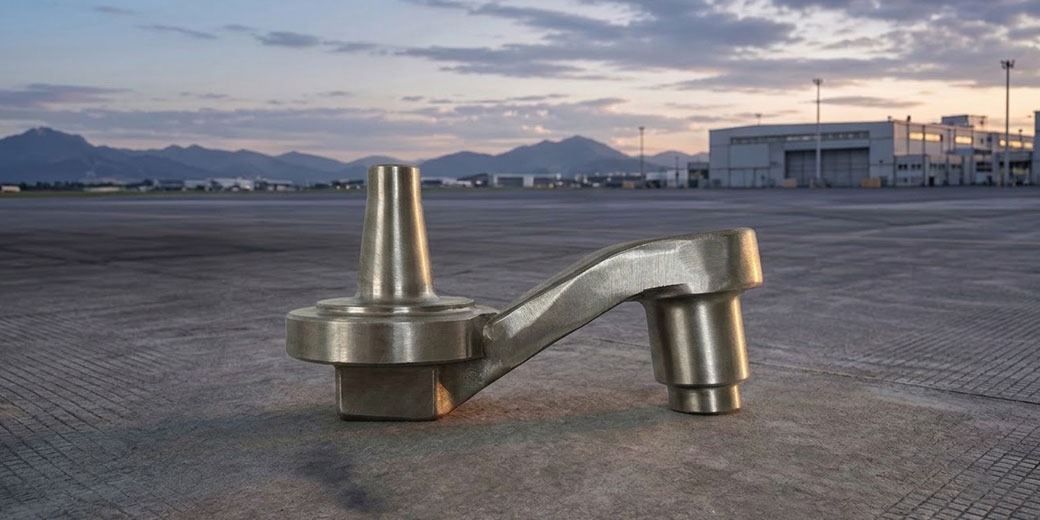
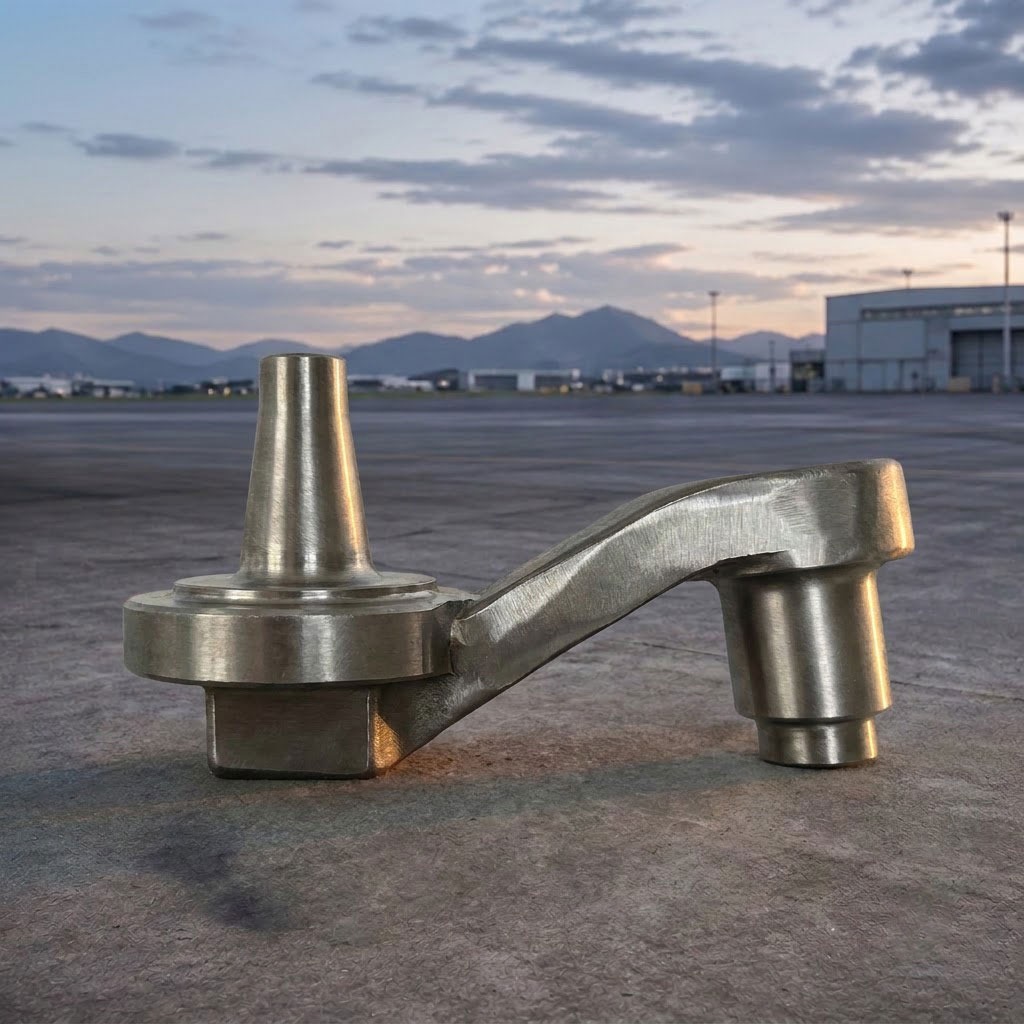
Landing gear is the most highly loaded structural assembly on a commercial aircraft – it must absorb the impact of thousands of hard landings over a 25-year service life while weighing as little as possible. The main gear beam, side struts, trunnion pin, and drag brace of a widebody aircraft landing gear are forged in Ti-6Al-4V (AMS 4935 beta-processed), 300M ultra-high-strength steel, and 4340M (AMS 6415) — materials chosen for their combination of high strength-to-weight ratio, fracture toughness, and fatigue resistance. This technical blog covers the forging specifications, heat treatment, and NDT requirements for commercial aircraft landing gear components.
| Component | Material | Specification | Key Property |
Main gear beam (widebody) | Ti-6Al-4V beta-processed | AMS 4935 STA | Fracture toughness, fatigue |
| Side strut (narrowbody) | 300M ultra-high-strength steel | AMS 6257 Q&T | 150 ksi UTS minimum |
| Trunnion pin | 4340M (modified) | AMS 6415 Q&T | High bending fatigue |
| Drag brace fitting | Ti-6Al-4V STA | AMS 4928 STA | Tensile + fatigue |
| Truck beam (widebody) | 300M or Ti-6Al-4V | AMS 6257 / AMS 4935 | Impact + fatigue |
Landing gear main gear beams for widebody aircraft (Boeing 777, 787, Airbus A330, A350) are among the largest and most demanding structural titanium forgings produced globally — each main gear beam forging weights 200–600 kg in the rough-forged condition before machining. These forgings are produced using beta-processed Ti-6Al-4V (AMS 4935) — where the solution treatment is performed above the beta transus (1,010–1,040°C) rather than the sub-beta-transus temperature used for standard AMS 4928 STA processing. Beta-processed microstructure provides the higher fracture toughness and damage tolerance required for landing gear primary structure, at a modest sacrifice in tensile strength compared to conventional STA.
The primary landing gear OEMs — Safran Landing Systems (formerly Messier-Bugatti-Dowty), Collins Aerospace (formerly UTC Aerospace/Goodrich), Liebherr-Aerospace, and Triumph Group — procure titanium landing gear forgings from a very small number of globally qualified manufacturers: Precision Castparts (PCC), Howmet Aerospace (Arconic), and Aubert & Duval (France). Entry into this supply chain is extremely challenging — the landing gear OEMs require extensive qualification programmes including full fatigue coupon testing, damage tolerance analysis, and multiple AS9102 FAIRs before production qualification. However, as a development or repair forging source for non-primary-structure landing gear components (trunnion pins, drag brace fittings), Indian AS9100D manufacturers with beta-processed Ti-6Al-4V capability can access the landing gear supply chain.
300M steel (UNS K44220) — a silicon-modified version of 4340 with superior fracture toughness at very high strength levels (minimum 280 ksi / 1,930 MPa tensile in the fully heat-treated condition) — is specified for narrowbody aircraft main gear side struts (Boeing 737, Airbus A320) where the weight penalty of titanium is less justified than for widebody applications. 300M forgings are produced per AMS 6257 (bar and billet specification) or AMS 6417 (forging specification), and heat treated per AMS 2759/2 (heat treatment of ultra-high-strength steel) to achieve the minimum 280 ksi tensile with adequate Charpy toughness. The combination of very high strength, high hardness (54–58 HRC), and adequate toughness in 300M requires extremely precise heat treatment — temperature control within ±3°C during austenite and within ±5°C during tempering.
Shot peening (AMS 2430) is mandatory for all landing gear structural forgings — the compressive residual stress induced by shot peening at the forging surface inhibits fatigue crack initiation at the stress concentrations of fillet radii, bore surfaces, and thread roots. The Almen intensity (the measure of shot peening energy, verified by the deflection of standard Almen strips) must be within the specified range — insufficient peening intensity fails to achieve the required compressive stress depth; excessive intensity can cause plastic flow and surface damage. For titanium landing gear forgings, the shot velocity and coverage requirements are specified in the applicable landing gear OEM’s engineering drawing, cross-referencing AMS 2430 with OEM-specific Almen intensity requirements.
Vinir Capability
AS9100D full scope. Ti-6Al-4V beta-processed (AMS 4935) closed die forgings to 600 kg — solution treat above beta transus at 1,010–1,040°C, controlled cooling, age at 538°C. Standard Ti-6Al-4V STA (AMS 4928) for drag brace and secondary structure forgings. 300M (AMS 6257/AMS 6417) open die and closed die forgings to 500 kg — Q&T per AMS 2759/2 to 280 ksi minimum tensile. 4340M (AMS 6415) closed die forgings. Alpha case control per AMS 2801 for all titanium landing gear forgings. AMS 2154 Class AA immersion UT for beta-processed titanium. FPI to AMS 2647 Level 3. Shot peening per AMS 2430 at NABL-accredited or OEM-approved peening facility. AS9102 FAIR for all new landing gear part numbers.