
Gun Barrel Blank Forging: Chrome-Molybdenum Steel and 100% UT Requirements

Gun Barrel Blank Forging: Chrome-Molybdenum Steel and 100% UT Requirements
Gun Barrel Blank Forging: Chrome-Molybdenum Steel and 100% UT Requirements

Artillery gun barrel forgings — the cylindrical steel blanks from which 105mm, 155mm, and 203mm artillery barrels, naval gun barrels, and tank main gun barrels are machined — are among the most technically demanding structural forgings in the defence sector. Produced in 55NiCrMoV6 (DIN 1.2745), CrMoV gun steels, or 4340 ultra-clean VAR-melted billet, gun barrel blanks must survive 1,000–5,000 high-pressure propellant gas impulses (each at 700+ MPa bore pressure) without fatigue crack initiation at the chamber throat — the highest-stress zone. India’s expanding domestic artillery production (Dhanush 155mm howitzer, DRDO Advanced Towed Artillery Gun System, K9 Vajra-T) creates direct domestic demand for Indian AS9100D certified gun barrel blank forging manufacturers.


PlatformCalibreMaterialBarrel Blank Weight


Dhanush howitzer (India)
155mm/45-cal
55NiCrMoV6 VAR
800–1,200 kg
K9 Vajra-T (Korea/India L&T)
155mm/52-cal
55NiCrMoV6 VAR1,000–1,400 kg
Arjun MBT (India, AVNL)120mm smoothboreCrMo gun steel VAR600–900 kg
ATAGS (DRDO towed)155mm/52-cal55NiCrMoV6 VAR1,000–1,400 kg
Naval gun (DRDO NGFS)76mm, 127mmCrMoV gun steel VAR200–600 kg

Gun barrel forging is a specialised subset of open die forging — the barrel blank is produced by forging a VAR (Vacuum Arc Remelted) or VIM+VAR (Vacuum Induction Melted + VAR) alloy steel billet into a cylindrical or stepped cylinder, then autofrettage (high-pressure hydraulic expansion beyond the elastic limit) is applied to the inner bore to create beneficial compressive residual stress at the barrel wall. The combination of high-purity steel (VAR melting eliminates the inclusions and segregation that cause premature fatigue cracking) and compressive bore residual stress (from autofrettage) extends barrel life by orders of magnitude compared to standard-cleanliness forgings without autofrettage.

55NiCrMoV6 (DIN 1.2745, approximately 0.55% C, 1.7% Ni, 1.0% Cr, 0.25% Mo, 0.1% V) is the standard European and Korean gun steel for medium and large calibre artillery barrels. The alloy is specified as vacuum arc remelted (VAR) — the VAR process removes hydrogen and metallic inclusions that would cause premature fatigue fracture under the repeated high-pressure propellant gas impulse loading of artillery firing. Mechanical properties after Q&T heat treatment: minimum yield strength 1,000–1,200 MPa, Charpy impact minimum 40–60 J at -20°C. The barrel blank is typically open die forged to a rough cylinder with an axial bore hole (produced by deep-hole boring after forging), then the bore is autofrettaged, and the final barrel profile is turned to drawing dimensions.

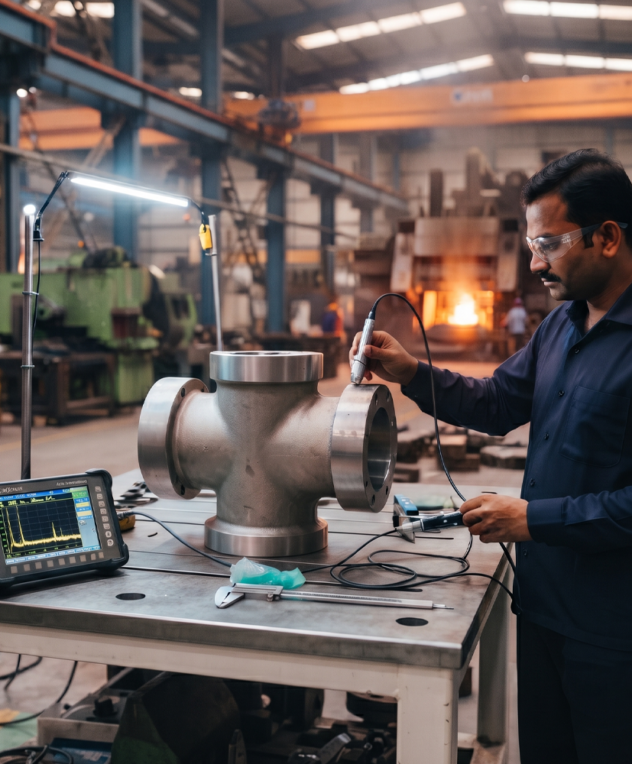
100% ultrasonic testing of the barrel blank — at both the rough-forged condition (before the bore is drilled) and after bore drilling — is mandatory for all military artillery barrel blanks. The UT before bore drilling verifies freedom from internal defects (segregation, inclusions, pipe remnants) that would be hidden by the bore drilling operation. The UT after bore drilling inspects the inner bore surface and the cylinder wall from the bore direction — using a rotating probe that scans the full bore surface. Acceptance criteria: no indication above 20% DAC in the cylinder wall; no indication above 50% DAC at the bore surface. Any indication at the chamber throat zone (the highest-stress area, typically at the origin of the rifling) is subject to additional scrutiny even if below the standard acceptance threshold.

India’s artillery barrel procurement has historically been concentrated at Ordnance Factory Kanpur (OFK) — which produces Bofors/Dhanush barrel blanks — and imported from South Korea (K9 barrels from S&T Dynamics) and Sweden/India (Bofors collaboration legacy). The Positive Indigenisation List (PIL) for artillery barrel blanks — which prohibits imports above a specified quantity — is creating demand for additional qualified domestic Indian forging sources. AS9100D-certified private sector Indian forge shops with VAR-melted billet sourcing capability and 100% UT programme are the primary candidates for this domestic procurement opportunity.

Vinir Capability

AS9100D full scope. Open die gun barrel blank forgings in 55NiCrMoV6 VAR-melted billet (sourced from SAARSTAHL Germany, ELECTROTHERM India, or equivalent VAR-certified mill). Barrel blank weight range 200–1,500 kg on 3,000T hydraulic press. Q&T heat treatment per material specification — quench and temper to 1,000–1,200 MPa yield, Charpy minimum 40 J at -20°C, NABL-verified. 100% UT before and after bore drilling per ASTM A388 with gun steel-specific calibration standard. Bore straightness verification (≤0.5mm/metre). PMI on every billet before forging — OES chemistry including vanadium verification. DGQA vendor assessment in progress for PIL-aligned domestic artillery barrel blank supply.
Frequently Asked Questions

1.What is autofrettage and why is it applied to gun barrel blanks after forging?+
Autofrettage is a manufacturing process applied to thick-walled cylindrical pressure vessels (including gun barrels) by pressurising the bore beyond the material’s yield strength with high-pressure hydraulic fluid (typically water or oil). The inner portion of the barrel wall yields plastically while the outer portion remains elastic. When the pressure is released, the elastic outer zone springs back but the inner plastic zone cannot — the inner zone is left in compression while the outer zone is in tension. This compressive residual stress at the bore surface (where the propellant gas pressure stress is highest during firing) directly opposes the firing tensile stress — increasing the effective fatigue life by 5–20× compared to an un-autofrettaged barrel at the same design firing pressure. All modern artillery barrels rated above 30,000 psi bore pressure are autofrettaged as a mandatory manufacturing step.
2.What is 55NiCrMoV6 and why is it the standard material for 155mm artillery barrel forgings?+
55NiCrMoV6 (DIN 1.2745) is a nickel-chromium-molybdenum-vanadium gun steel containing approximately 0.55% carbon, 1.7% nickel, 1.0% chromium, 0.25% molybdenum, and 0.1% vanadium. After Q&T heat treatment it achieves yield strength of 1,000–1,200 MPa with adequate ductility (elongation ≥10%) and Charpy toughness (40–60 J at -20°C). The nickel addition (1.7%) provides toughness at low temperatures — critical for artillery operated in cold climates. The vanadium addition (0.1%) refines the austenite grain during normalising, improving toughness without sacrificing strength. The alloy must be VAR-melted — standard air-melted or even EAF + ladle-refined 55NiCrMoV6 contains hydrogen and inclusion content that causes premature bore surface fatigue cracking under firing impulse loading. VAR melting reduces hydrogen below 1.5 ppm and eliminates large non-metallic inclusions.
3.What DGQA specifications apply to Indian domestic artillery barrel blank procurement?+
DGQA (Directorate General of Quality Assurance) governs quality specifications for Indian defence procurement through its Establishment at Pune (DGQA Chennai and Pune establishments for ordnance). For artillery barrel blank forgings, DGQA applies VTN (Vojenská Technická Norma — adopted Indian military technical norms derived from NATO standards) specifications that reference BS EN material standards for 55NiCrMoV6 and additional requirements for: VAR melting certification (mill test report confirming VAR process), ultrasonic testing per BSEN 10228-3 or equivalent, hardness uniformity (±20 HBW across the barrel blank cross-section), and chemical composition verification by PMI (OES). DGQA inspection requires witness of heat treatment by a DGQA inspector or DGQA-authorised surveyor before the barrel blank is released for machining.
4.What is the difference between 4340 and 55NiCrMoV6 for gun barrel applications?+
4340 (UNS G43400) is a US-standard nickel-chromium-molybdenum alloy steel (0.38–0.43% C, 1.65–2.00% Ni, 0.70–0.90% Cr, 0.20–0.30% Mo) that achieves similar strength levels to 55NiCrMoV6 after Q&T. The key differences: 55NiCrMoV6 has higher nickel (1.7% vs 1.8% max for 4340 — similar) and adds vanadium (0.10%) for grain refinement — which gives marginally better toughness at equivalent strength. For US-designed or US-licensed artillery barrels (M777 155mm howitzer, M256 120mm tank gun), 4340 to AMS 6415 (VAR quality) is the specified material. For European and Asian-designed systems (K9, Dhanush, AS90), 55NiCrMoV6 to DIN 1.2745 VAR is specified. Both materials require VAR melting for gun barrel applications — the VAR process requirement is more critical than the alloy selection difference.
5.What is the PIL (Positive Indigenisation List) status for artillery barrel blanks and what does it mean for private sector Indian forge shops?+
The Ministry of Defence’s Positive Indigenisation List (PIL) includes artillery barrel blanks among the categorised items — after the specified date (which has been progressively implemented), artillery barrel blanks for Indian armed forces procurement must be sourced from domestic Indian manufacturers rather than imported. Ordnance Factory Kanpur (OFK, now Munitions India Ltd/MIL) is the primary existing Indian supplier. However, MIL’s capacity is insufficient for the accelerated artillery procurement targets (Indian Army plans to order 150+ Dhanush howitzers, 100+ ATAGS, and additional K9 Vajra-T systems). Private sector Indian forge shops who achieve DGQA vendor approval for 55NiCrMoV6 VAR barrel blank supply can capture a share of this PIL-driven demand at competitive commercial terms — as private sector suppliers face less overhead burden than MIL’s legacy government production structure.