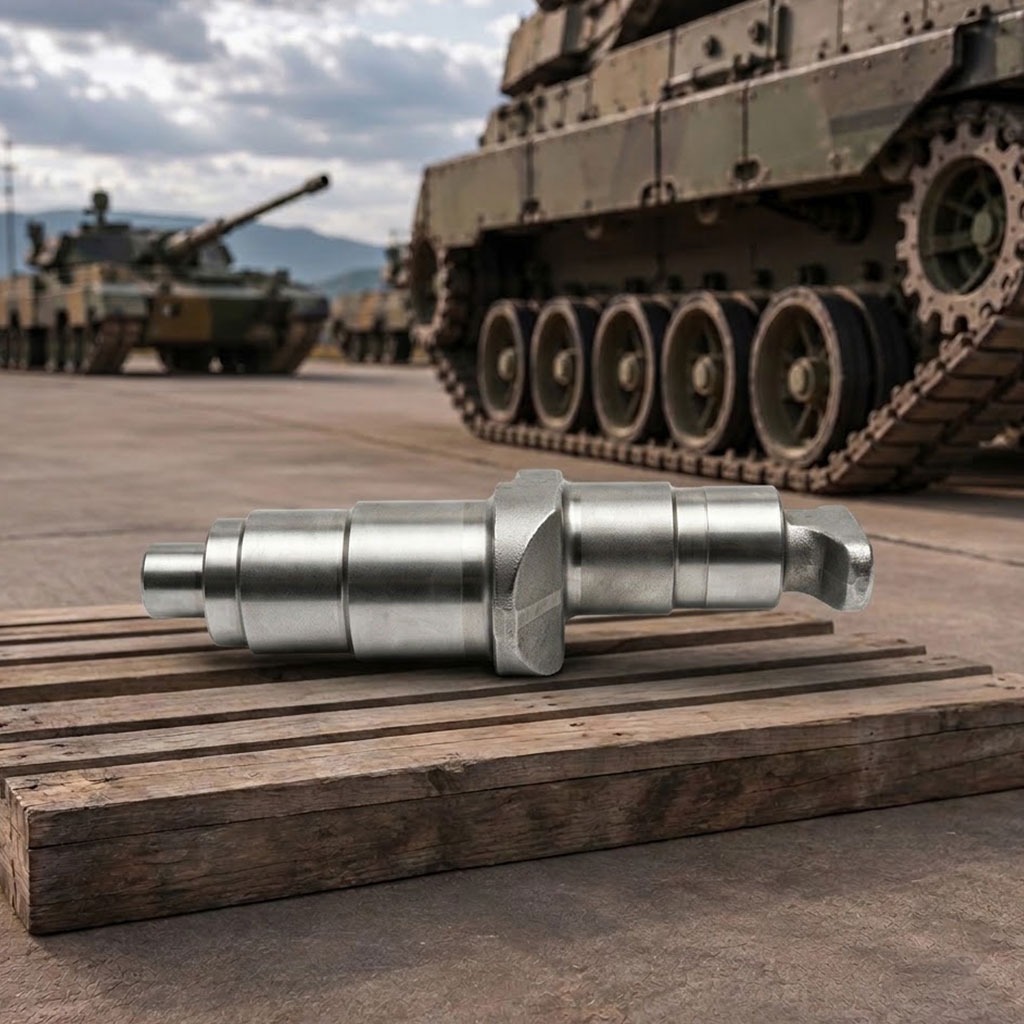
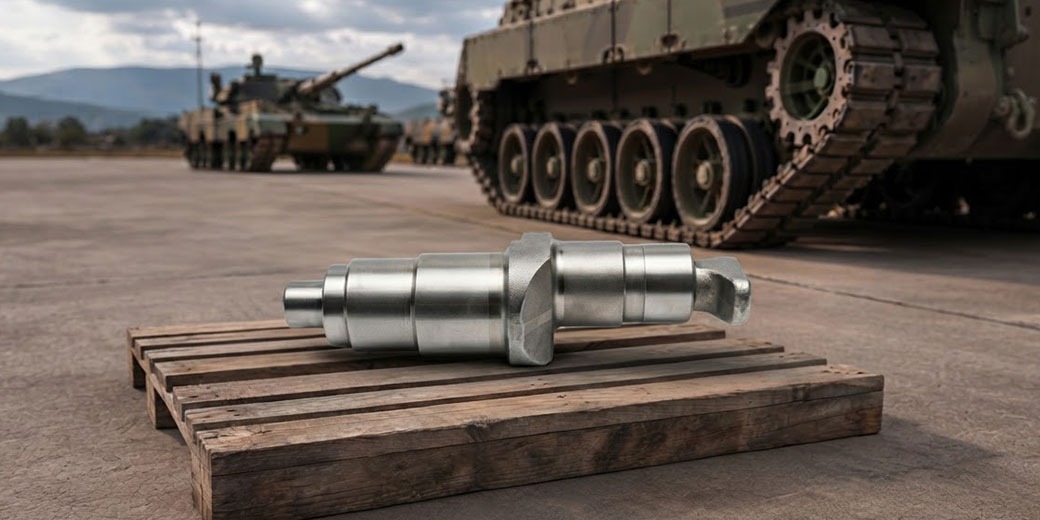
Torsion bars are the primary suspension spring elements in tracked armoured vehicles — each torsion bar connects a road wheel station to the vehicle hull and provides the spring force that supports the vehicle weight while absorbing terrain irregularities. A main battle tank uses 14–18 individual torsion bars per vehicle, each forged in 45CrNiMoVA spring steel (minimum yield strength 1,400 MPa) and shot-peened to the maximum allowable Almen intensity. India’s armoured vehicle fleet — Arjun MBT (118 Mk-1A on order), T-72 Ajeya (2,000+ in service), T-90 Bhishma (1,300+ in service), and BMP-2 Sarath (2,000+ in service) — creates sustained demand for torsion bar forgings from DGQA-approved domestic Indian suppliers.
Platform
Torsion Bars Required
Material
Yield Strength
Arjun MBT Mk-1A (India, AVNL)
16 bars per vehicle
45CrNiMoVA VAR
≥1,400 MPa
T-90 Bhishma (India, service)
12 bars per vehicle (replacement)
45CrNiMoVA or equiv
≥1,350 MPa
T-72 Ajeya (India, service)
12 bars per vehicle (replacement)
45CrNiMoVA or equiv
≥1,350 MPa
BMP-2 Sarath (India, service)
14 bars per vehicle (replacement)
45CrNiMoVA or equiv
≥1,300 MPa
Wheeled AFV (future India)
8–12 bars per vehicle
45CrNiMoVA
≥1,400 MPa
A torsion bar operates by twisting along its longitudinal axis when a road wheel deflects over terrain — the bar’s torsional elasticity stores the energy of the impact and returns the road wheel to its neutral position. The maximum shear stress at the torsion bar surface during maximum wheel deflection (the design limit load case) determines the required yield strength and the shot peening intensity needed to create sufficient compressive surface stress to prevent fatigue crack initiation. For a main battle tank torsion bar at maximum design deflection, the surface shear stress reaches 800–1,000 MPa — requiring a base material yield strength (in torsion) of at least 1,400 MPa and shot peening to create compressive residual stress of 800+ MPa at the surface.
45CrNiMoVA (approximate chemistry: 0.43–0.48% C, 1.3–1.6% Cr, 1.3–1.6% Ni, 0.2–0.3% Mo, 0.1–0.15% V, 0.1–0.15% Al) is the standard European and Asian spring steel for armoured vehicle torsion bars. The vanadium and aluminium additions refine the austenite grain size, allowing the steel to be quenched from higher austenitising temperatures without coarsening — producing finer martensite that gives better toughness at the very high strength levels required. After Q&T to 1,400+ MPa yield, the torsion bar is shot peened at Almen intensity 0.025–0.035A (high intensity) on the full surface — higher than landing gear shot peening because the torsion bar surface shear stress is proportionally higher relative to the material strength than the tensile stress on landing gear surfaces.
The torsion bar forging process — typically open die forging of a round bar with hexagonal ends (the hex ends engage with the hull mounting and the road wheel station arm) — is straightforward compared to aerospace forgings but requires precise dimensional control on the active bar length (the torsional spring length that determines the spring rate) and on the hex end geometry (which must engage with standard hull mounting fixtures). Straightness requirements are stringent (≤0.5mm over the active bar length) because a bent torsion bar induces bending stress in addition to torsional stress, dramatically reducing fatigue life.
India’s torsion bar supply has been dominated by imports from Germany (THYSSEN Schulte), the UK, and Russia (for T-72 and T-90 compatible bars). The Positive Indigenisation List (PIL) for torsion bars — and the specific indigenisation requirements of the Arjun Mk-1A programme — are creating direct procurement opportunities for DGQA-approved domestic Indian forge shops with 45CrNiMoVA capability and shot peening facilities.
AS9100D full scope. 45CrNiMoVA open die torsion bar forgings 5–50 kg, active bar diameters 40–120mm. VAR-quality billet sourcing from SAARSTAHL Germany or ELECTROTHERM India VAR furnace. Q&T heat treatment in AMS 2750-calibrated furnaces to minimum 1,400 MPa yield, 1,550–1,750 MPa tensile, minimum 35 J Charpy at -40°C — NABL-verified. Straightness verification ≤0.5mm/metre on precision surface plate. Hardness uniformity: ±15 HBW across full bar cross-section (verify no decarburisation at surface). Shot peening at NABL-accredited or OEM-approved facility per MIL-S-13165 or NATO STANAG 4101 equivalent. DGQA vendor registration process underway for domestic PIL supply.
Frequently Asked Questions
1.What is a torsion bar and how does it function as a suspension spring in an armoured vehicle?+–
A torsion bar is a cylindrical steel rod attached at one end to the vehicle hull (fixed end) and at the other end to a road wheel station arm (active end). When the road wheel rises over an obstacle, the road wheel arm rotates upward, twisting the torsion bar along its length. The bar’s torsional stiffness (resistance to twist) generates a restoring force that pushes the road wheel back down. The amount of twist at maximum wheel travel determines the maximum surface shear stress in the bar — which in turn determines the required material strength and shot peening intensity. Torsion bar suspension is preferred for tracked armoured vehicles over coil spring or hydropneumatic suspension because torsion bars are compact (they run transversely inside the hull), robust, and simple to replace in the field.
2.Why does 45CrNiMoVA require VAR melting for armoured vehicle torsion bar applications?+–
Torsion bars experience cyclic torsional loading at very high stress levels — the surface shear stress at maximum wheel deflection approaches the material’s fatigue limit. Non-metallic inclusions (aluminium oxide clusters, manganese sulphide stringers) in air-melted or standard EAF-melted steel act as fatigue crack initiation sites at these high stress levels. Even small inclusions (50–100 µm) at the torsion bar surface can nucleate fatigue cracks that propagate to failure within thousands of vehicle operating cycles — well before the design service life. VAR melting reduces non-metallic inclusion content by orders of magnitude compared to EAF melting, and virtually eliminates the large inclusion clusters that are the most damaging. NATO and European armoured vehicle specifications typically require VAR or ESR (Electro Slag Remelted) melt practice for torsion bar materials — plain EAF-melted 45CrNiMoVA is not acceptable for primary suspension torsion bars regardless of its mechanical property results.
3.What are the STANAG requirements for torsion bars in NATO armoured vehicles and how do they apply to Indian procurement?+–
NATO STANAG (Standardization Agreements) documents relevant to torsion bars include STANAG 4101 (Shot Peening of Metal Parts) which defines Almen intensity verification requirements equivalent to AMS 2430 but with NATO-specific documentation formats, and various STANAG documents governing vehicle components that reference DIN or EN material standards. India is not a NATO member but has adopted several NATO STANAG standards (directly or in adapted form) through Indian military cooperation and equipment procurement from NATO-member countries. The Arjun MBT and Indian-licensed armoured vehicles (BMP-2 Sarath) use specifications derived from Russian, German, or UK national standards rather than NATO STANAGs directly. For DGQA vendor approval, Indian forge shops must meet the specific VTN (Indian military technical norms) for torsion bar material — which typically reference EN material standards for 45CrNiMoVA or equivalent, with additional Indian-specific requirements for VAR melting and shot peening verification.
4.How does shot peening intensity for armoured vehicle torsion bars compare to aerospace landing gear requirements?+–
Armoured vehicle torsion bars require higher shot peening intensity than most aerospace landing gear components — because the torsional stress mode produces higher surface shear stress relative to material strength than the tensile/bending stress mode of landing gear. Torsion bars are typically peened at Almen intensity 0.025–0.035A (high intensity range) on the full bar surface. Landing gear forgings are typically peened at 0.010–0.020A on most surfaces, with higher intensity at specific high-stress locations (bore surfaces, fillet radii). The torsion bar’s higher peening intensity requirement means that the shot peening equipment must be qualified at the higher intensity range — which requires heavier shot media (S230 or S280 diameter) at higher velocity than the S170 or S110 media used for lower-intensity aerospace peening.
5.What Indian procurement volumes exist for armoured vehicle torsion bars and how does PIL affect private sector opportunities?+–
India’s armoured vehicle fleet requires torsion bar replacement at approximately every major overhaul cycle (8–12 years for T-72/T-90, 5–8 years for heavily-used training fleet). With 3,000+ T-72 and T-90 vehicles in service (12–16 bars each), the replacement torsion bar demand is approximately 36,000–48,000 bars over a 10-year cycle — approximately 3,600–4,800 bars per year for the Russian-lineage fleet alone. The Arjun Mk-1A programme (118 vehicles, 16 bars each) adds 1,888 new production bars. PIL requirements for torsion bars prohibit new vehicle production bars from being imported — they must come from domestic Indian manufacturers. The existing domestic supplier (Ordnance Factory Jabalpur, now MIL Jabalpur) has limited capacity. Private sector forge shops with DGQA approval can capture a share of this replacement and new production demand at competitive margins.