
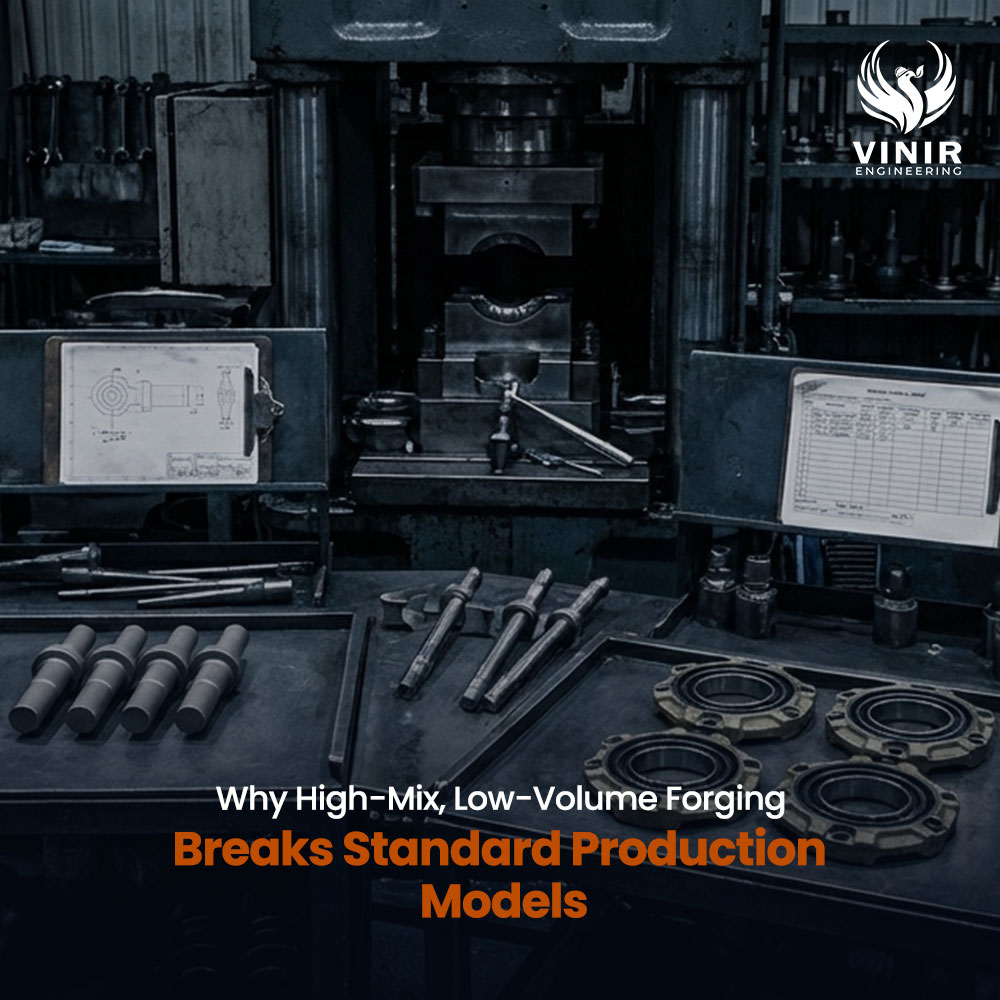
Why high-mix, low-volume forging breaks standard production models
Why Most Forging Shops Are Built for the Opposite
Traditional forging operations are optimized for:
- High-volume repetition
- Stable part geometry
- Predictable schedules
- Minimal engineering intervention
High-mix, low-volume (HMLV) programs break these assumptions entirely.
Instead of efficiency through repetition, they demand control through discipline.
What “High-Mix, Low-Volume” Really Means in Critical Forging
In critical industries, HMLV typically involves:
- Dozens of part variants
- Batch sizes as low as 1–20 pieces
- Irregular repeat orders
- Engineering changes across program life
Success here depends less on machines — and more on systems and people.
Where Standard Production Models Fail
1. Process Knowledge Is Not Embedded
In high-volume environments, knowledge lives in repetition.
In HMLV forging:
- Each job may be unique
- Tribal knowledge becomes a risk
- undocumented decisions resurface as failures
Buyers penalize suppliers who cannot demonstrate documented process logic.
2. Changeovers Become a Quality Risk
Frequent die, setup, and routing changes increase the chance of:
- Parameter drift
- Tooling errors
- Missed inspections
Without strong controls, variability compounds quickly.
3. Traceability Becomes Harder, Not Easier
Low volumes increase:
- Manual handling
- Lot fragmentation
- Documentation overhead
Buyers scrutinize HMLV suppliers for traceability robustness, not speed.
Why Critical Buyers Still Choose High-Mix Suppliers
Despite the difficulty, defence, aerospace, and nuclear programs require HMLV forging because:
- Parts are application-specific
- Volumes are tied to programs, not markets
- Redundancy is prioritized over scale
Suppliers are evaluated on consistency under variability.
What Buyers Look for in High-Mix Forging Suppliers
Buyers assess whether suppliers can:
- Restart production after long dormancy
- Maintain dimensional and metallurgical consistency
- Preserve process intent across variants
- Support audits years after delivery
Capacity matters less than process memory.
Common Failure Modes in High-Mix Forging
HMLV forging programs often fail due to:
- Poor job travelers and batch records
- Inconsistent inspection application
- Engineering decisions not carried forward
- Weak CAPA systems
These failures surface late — often during audits or service.
How Vinir Operates High-Mix, Low-Volume Forging Reliably
Vinir is structured specifically for HMLV critical forging through:
- Engineering-led process planning
- Controlled forge-to-finish execution
- Heat- and batch-level traceability
- Stable documentation frameworks
- Audit-ready quality systems
This allows Vinir to deliver reliability without scale dependency.
FAQ
Is high-mix forging always more expensive?
Per-unit cost is higher, but lifecycle risk is significantly lower for critical programs.
Why can’t automotive suppliers handle HMLV work easily?
Their systems are optimized for repetition, not variability.
How do buyers verify HMLV capability?
Through audits, historical NCR data, and restart performance.
Does HMLV limit certification scope?
No — but it increases scrutiny on systems and execution.