
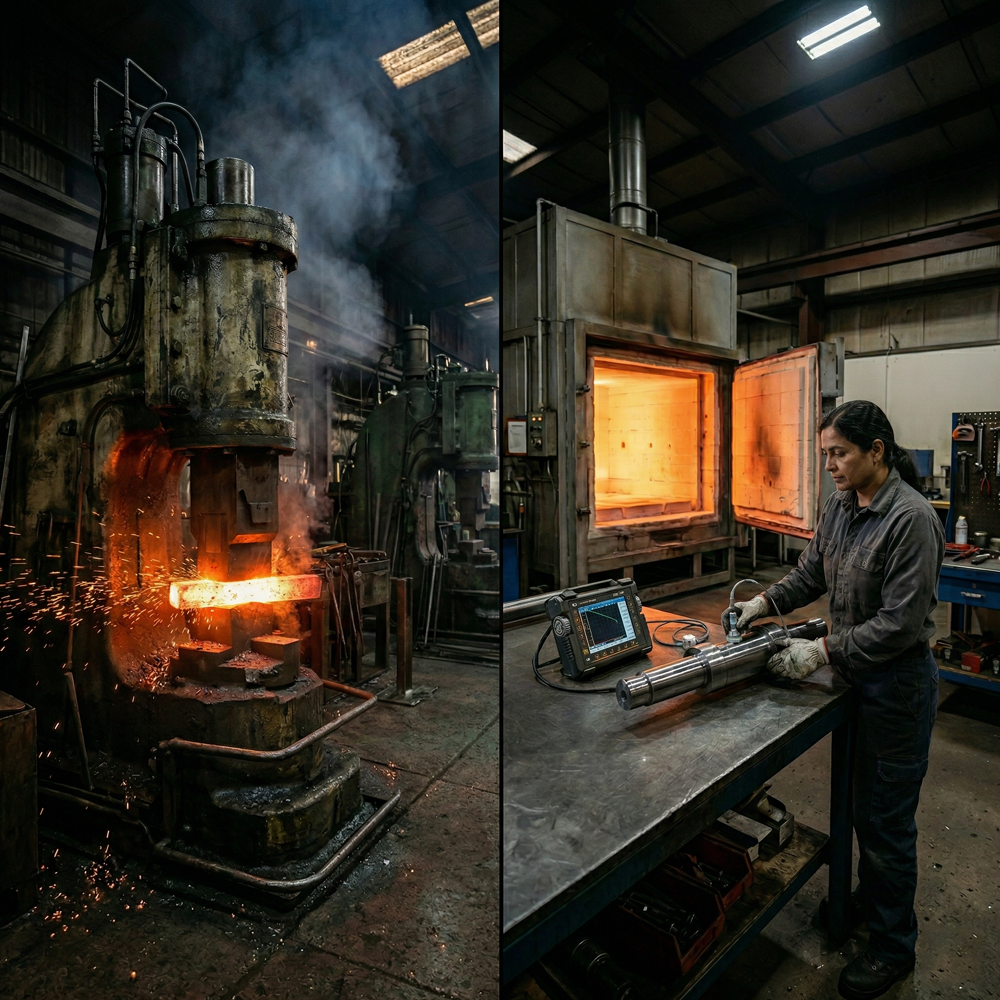
Special processes in forging: why heat treatment and ndt decide supplier approval
Why Special Processes Carry More Weight Than Forging
Forging shapes the part. Special processes determine whether it survives in service.
In defence, aerospace, oil & gas, nuclear, and rail programs, heat treatment and NDT are treated as irreversible quality gates. Once performed incorrectly, defects may remain hidden until failure. This is why buyer audits focus heavily on these operations.
What Qualifies as a “Special Process” in Forging
Special processes typically include:
- Heat treatment
- Non-destructive testing (UT, MPI, DPI)
- Shot peening
- Surface treatments and coatings
Their defining trait: output cannot be fully verified without destructive testing.
Heat Treatment: Where Most Approvals Are Won or Lost
Buyers evaluate heat treatment based on:
- Furnace calibration and uniformity
- Cycle validation for specific material grades
- Load configuration and segregation
- Quenching control and delay limits
Even well-forged components can fail approval if heat treatment discipline is weak.
NDT: Detection Is Only as Good as the System Behind It
Auditors look beyond inspection reports.
They assess:
- Procedure qualification
- Equipment calibration
- Operator certification
- Acceptance criteria alignment with codes
Missed or misinterpreted indications are treated as systemic failures, not operator errors.
Why Buyers Audit Special Processes More Aggressively
Special process failures are:
- Hard to detect
- Expensive to correct
- High-risk in service
As a result, buyers demand process validation, not just compliance.
Common Special Process Failures That Trigger NCRs
Approval issues often stem from:
- Mixed heat loads in furnaces
- Incomplete furnace survey records
- Uncontrolled subcontracting
- Weak linkage between NDT reports and part IDs
These failures signal lack of process ownership.
In-House vs Subcontracted Special Processes
Buyers increasingly prefer:
- In-house control for critical operations
- Or tightly governed, audited subcontracting
Uncontrolled outsourcing introduces traceability and accountability gaps — a red flag during audits.
How Vinir Controls Special Processes for Critical Forgings
Vinir treats special processes as qualification drivers by ensuring:
- Validated heat treatment workflows
- Calibrated and documented NDT processes
- Certified operators and inspectors
- Full traceability linking processes to individual components
This allows approvals to withstand deep technical audits.
FAQ
Why can’t final inspection replace heat treatment validation?
Because mechanical properties depend on internal structure, not just dimensions.
Is UT mandatory for all forgings?
No, but it is standard for load-bearing and pressure-containing components.
Can special processes be subcontracted?
Yes — but only under strict control and documentation.
What causes most special process NCRs?
Traceability gaps, poor validation, and inconsistent execution.