
Earthmoving & heavy equipment forgings: impact resistance, load integrity, and structural durability
Heavy Equipment Forgings Operate Under Extreme Mechanical Stress
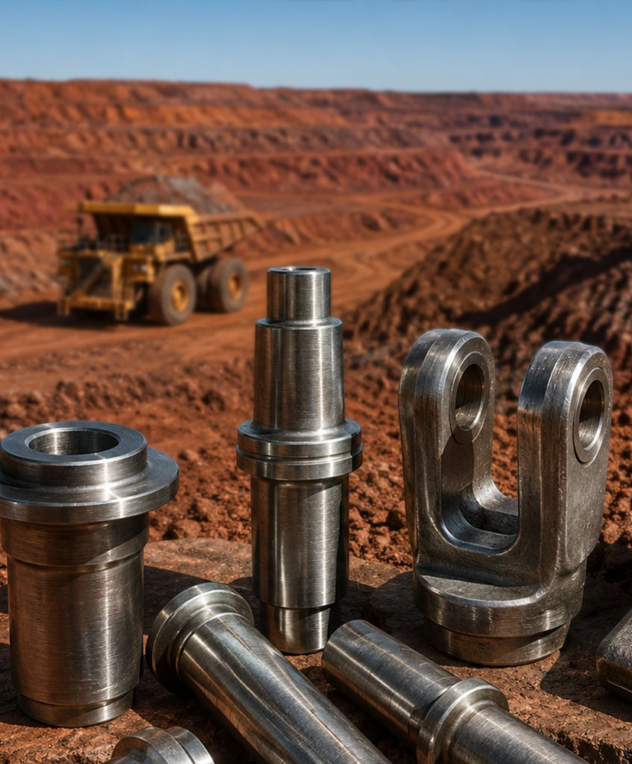
Earthmoving and heavy equipment systems — including excavators, loaders, mining trucks, hydraulic systems, and track assemblies — operate in environments defined by shock, abrasion, torsional loading, and unpredictable impact forces.
Unlike regulated sectors such as aerospace or nuclear, heavy equipment does not always operate under formal compliance codes. However, the structural demands can be equally unforgiving.
Forged components in these applications must withstand:
- Repeated impact loading
- High compressive forces
- Dynamic torsion
- Abrasive environmental exposure
- Sudden stress concentration
Failure in such systems may not carry regulatory implications, but it results in downtime, financial loss, safety risk, and operational inefficiency.
Structural reliability, therefore, becomes a performance-driven necessity.
The Nature of Stress in Mining and Earthmoving Equipment
Mining and heavy construction environments expose forged components to highly irregular loading conditions.
Components such as:
- Track links
- Gears and pinions
- Shafts and axles
- Hydraulic cylinder components
- Couplings and hubs
- Structural arms and connectors
experience repeated mechanical shock combined with environmental degradation.
Unlike steady-state power systems, heavy equipment parts endure variable forces that change with terrain, material load, and operational intensity.
This unpredictability makes impact resistance and fatigue tolerance critical design parameters.
Reduction Ratio and Structural Density in High-Impact Forgings
Impact-heavy applications demand internal structural soundness.
Adequate forging reduction ratio ensures:
- Elimination of internal voids
- Grain refinement
- Improved density
- Resistance to crack propagation
Under impact conditions, even minor internal discontinuities can grow into structural fractures.
Forging deformation must therefore be sufficient to create homogeneous internal structure.
In heavy sections, deformation planning becomes especially important because larger cross-sections can conceal internal segregation or porosity if reduction discipline is weak.
Grain Flow Alignment and Load Path Reinforcement
In heavy equipment components subjected to bending and torsion, grain flow orientation significantly influences durability.
When grain follows the principal load direction:
- Crack initiation is delayed
- Impact resistance improves
- Fatigue life increases
Improper grain orientation, by contrast, can create microstructural weak zones that respond poorly under dynamic loading.
Grain flow engineering must be considered during die design and preform shaping, not as an afterthought.
Wear Resistance and Surface Integrity
Heavy equipment components often operate in abrasive environments involving soil, rock, sand, and mineral materials.
Material selection and heat treatment strategy must therefore balance:
- Core toughness
- Surface hardness
- Resistance to abrasive wear
- Impact resilience
Over-hardening may increase brittleness, while insufficient hardness accelerates wear.
Heat treatment must create a controlled microstructure that maintains structural integrity under both abrasion and impact.
Dimensional Stability and Machining Coordination
Many heavy equipment forgings require subsequent machining for bearing fits, hydraulic seals, or gear profiles.
Dimensional stability becomes important because:
- Excess residual stress can cause distortion during machining
- Improper heat treatment may introduce dimensional variability
- Heavy sections can cool unevenly, affecting geometry
Integrated forge-to-finish manufacturing allows deformation planning and machining allowance coordination to minimize distortion risk.
Structural integrity must be preserved alongside dimensional precision.
Inspection Requirements in Heavy Equipment Forgings
While heavy equipment forgings may not always fall under strict regulatory frameworks, inspection discipline remains critical.
Typical inspection procedures include:
- Ultrasonic testing for internal discontinuities
- Surface inspection for cracks
- Hardness testing
- Dimensional verification
High-impact applications often require consistent UT acceptance, particularly for load-bearing shafts and structural connectors.
Inspection repeatability reflects manufacturing control maturity.
Lifecycle and Field Performance Considerations
Heavy equipment operates in environments where maintenance windows are limited and operational continuity is critical.
Forging suppliers must therefore consider:
- Long-term fatigue resistance
- Consistency across batches
- Replacement part reproducibility
- Documentation for maintenance traceability
Although compliance documentation may not be as extensive as in nuclear or aerospace sectors, structural repeatability remains essential for lifecycle reliability.
Why High-Mix Capability Supports Heavy Equipment Programs
Mining and construction projects frequently require:
- Custom geometries
- Multiple equipment configurations
- Variable material grades
- Moderate production volumes
Forging manufacturers optimized solely for repetitive automotive production may struggle with specification variability and engineering adaptation.
High-mix manufacturing capability allows:
- Faster response to design variation
- Flexible heat treatment planning
- Project-specific inspection alignment
- Engineering collaboration
Flexibility must be supported by process discipline to maintain structural reliability.
Earthmoving and Heavy Equipment Forging at Vinir Engineering
Vinir Engineering operates as a non-automotive, high-mix, forge-to-finish manufacturer serving heavy industrial sectors, including earthmoving and mining applications.
Our manufacturing systems emphasize:
- Controlled reduction ratio validation
- Grain flow alignment planning
- Heat treatment coordination for impact and wear balance
- Integrated machining for dimensional stability
- Continuous material traceability
- Structured inspection discipline
Heavy equipment forgings demand structural resilience rather than mass-production speed.
If your project involves shafts, hubs, gears, couplings, or structural load-bearing components for mining or earthmoving systems, Vinir’s engineering team can review performance requirements and metallurgical expectations.
Connect with Vinir Engineering to discuss your heavy equipment forging requirements.