
Custom forged components for critical applications
When Standard Forgings Are Not Enough
In many industrial sectors, catalog-based components are sufficient. Standard flanges, shafts, rings, or connectors can be sourced based on known dimensions and repetitive production models.
Critical industries operate differently.
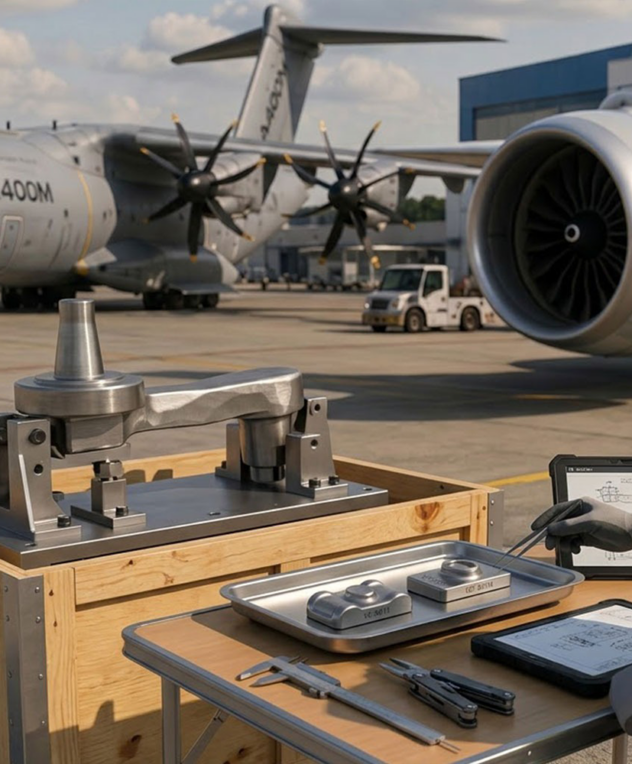
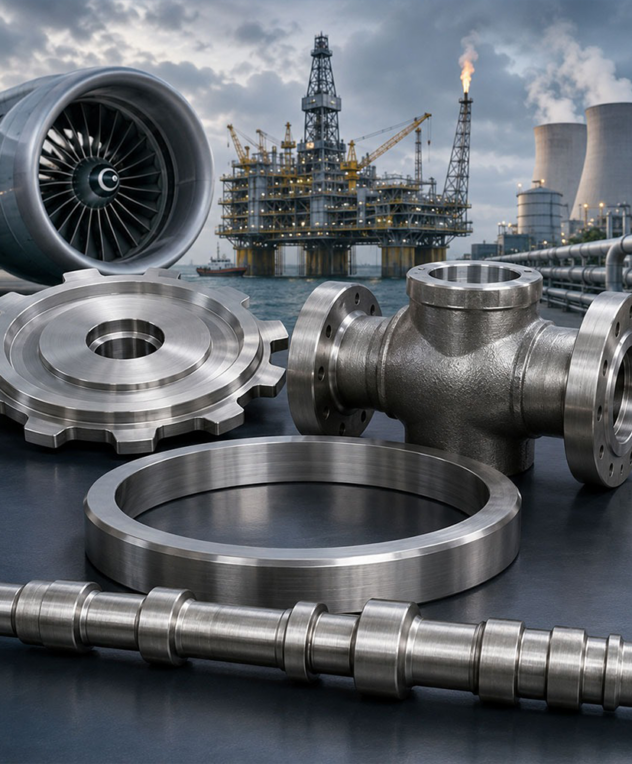
Oil & gas projects, aerospace platforms, defence systems, nuclear infrastructure, marine assemblies, rail networks, and heavy equipment programs frequently require components that do not fit standardized templates.
These applications demand custom forged components engineered around:
- Unique geometries
- Specific load paths
- Controlled material grades
- Regulatory compliance requirements
- Program-level documentation frameworks
Custom forging is not simply about shape variation. It is about engineering structural reliability into a component from the earliest design stage.
Engineering Begins Before the First Deformation
Custom forged components require early-stage technical alignment between design intent and manufacturing capability.
Before forging begins, engineering teams must evaluate:
- Service environment (pressure, temperature, corrosion, fatigue)
- Load distribution and stress concentration zones
- Required grain flow orientation
- Reduction ratio targets
- Machining allowances
- Heat treatment windows
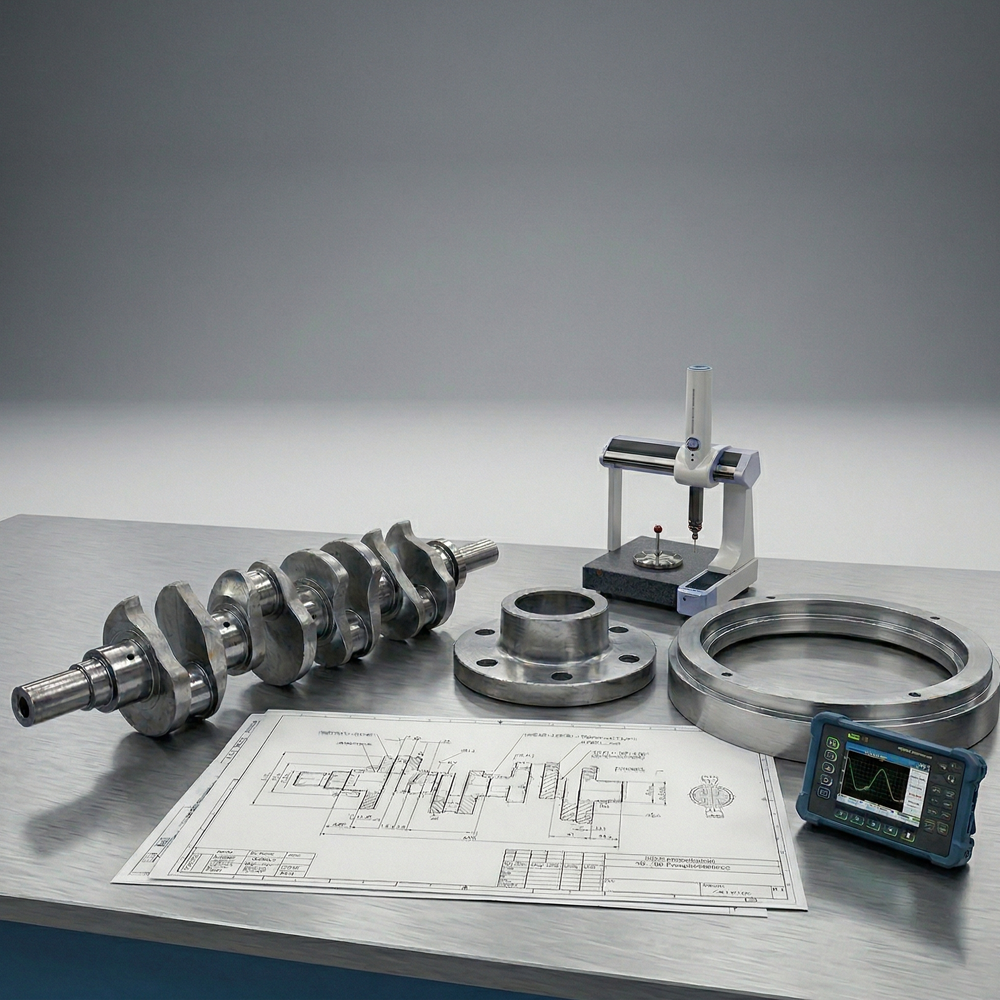
- Inspection and certification expectations
Unlike high-volume production, where tooling and parameters are fixed for long runs, custom forging demands process planning tailored to each component.
Manufacturing becomes a collaborative engineering exercise rather than a repetitive execution cycle.
Metallurgical Planning for Custom Forgings
Structural integrity in custom forged components is determined by how deformation is engineered.
Reduction ratio must be sufficient to:
- Close internal voids
- Refine grain structure
- Improve homogeneity
- Enhance fatigue resistance
Grain flow must be oriented to support actual stress paths.
For example:
- In a pressure-retaining component, grain alignment must reinforce hoop stress.
- In a rotating shaft, fiber orientation must support torsional load.
- In a structural bracket, deformation must prevent stress concentration zones.
Custom forging allows these metallurgical variables to be engineered intentionally.
Material Selection and Application-Specific Requirements
Custom components frequently require specialized material grades.
Depending on application, this may involve:
- Carbon and alloy steels for structural integrity
- Stainless or duplex grades for corrosion resistance
- Controlled hardness ranges for impact resistance
- Materials aligned with API, AS9100D, PED, or other regulatory frameworks
Material pedigree must remain traceable throughout forging, heat treatment, machining, and inspection stages.
For critical applications, compliance alignment is part of the component design itself.
Heat Treatment and Dimensional Stability
Custom forged components often involve unique geometries with variable section thickness.
This introduces heat treatment complexity.
Thermal cycles must account for:
- Differential cooling rates
- Residual stress risk
- Dimensional distortion
- Mechanical property balance
Integrated forge-to-finish systems allow deformation and machining allowances to be coordinated in advance, reducing post-processing instability.
Custom forging without thermal planning can introduce structural inconsistency.
Inspection Strategy in Custom Programs
Inspection requirements in custom forged components vary significantly depending on industry.
Programs may require:
- Ultrasonic testing
- Magnetic particle inspection
- Dye penetrant inspection
- Mechanical property validation
- Dimensional mapping
- Third-party inspection oversight
Inspection plans are often tailored to each project rather than standardized across production.
Manufacturers must demonstrate adaptability without compromising documentation discipline.
Documentation Architecture for Custom Projects
Custom forged components often serve regulated or safety-critical environments.
Documentation packages may include:
- Raw material certification
- Reduction ratio validation
- Heat treatment cycle records
- NDT reports
- Mechanical test certificates
- Dimensional inspection logs
- Compliance declarations
Because batch sizes are moderate or low, documentation rigor must remain consistent even without high production repetition.
Custom does not mean informal.
Risk Management in Custom Forging
Custom projects inherently introduce variability.
Effective risk mitigation requires:
- Structured engineering review
- Process simulation where necessary
- Clear documentation trails
- Cross-functional coordination
- Defined corrective action systems
Manufacturers experienced in high-mix environments are often better equipped to manage this variability than those optimized solely for repetitive automotive throughput.
Why Integrated Forge-to-Finish Matters in Custom Manufacturing
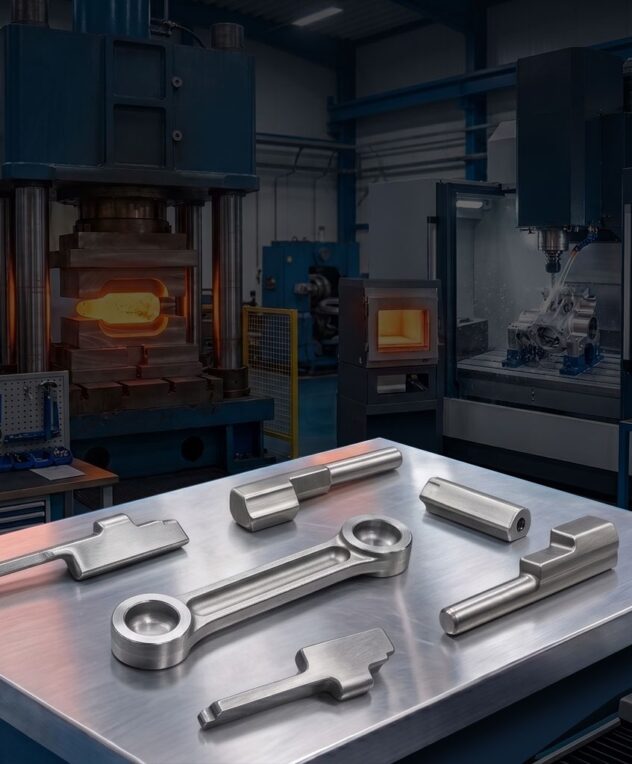
Custom components frequently require tight coordination between forging and machining.
Integrated systems allow:
- Grain flow preservation through machining
- Controlled dimensional correction
- Faster deviation response
- Reduced inter-vendor traceability gaps
- Centralized documentation management
This integration becomes especially important when compliance, inspection, and certification expectations are project-specific.
Custom Forging at Vinir Engineering
Vinir Engineering operates as a non-automotive, high-mix, forge-to-finish manufacturer structured specifically for custom forged components in critical industrial sectors.
Our approach emphasizes:
- Early-stage engineering alignment
- Documented reduction ratio validation
- Controlled grain flow planning
- Integrated heat treatment and machining coordination
- Continuous material traceability
- Audit-ready documentation systems
Serving oil & gas, aerospace, defence, nuclear, marine, railway, energy, and heavy equipment industries requires custom manufacturing discipline rather than mass-production adaptation.
If your project involves a non-standard forged component with defined structural, compliance, or lifecycle requirements, Vinir’s engineering team can review specifications and support technical evaluation.
Connect with Vinir Engineering to discuss your custom forged component requirements.