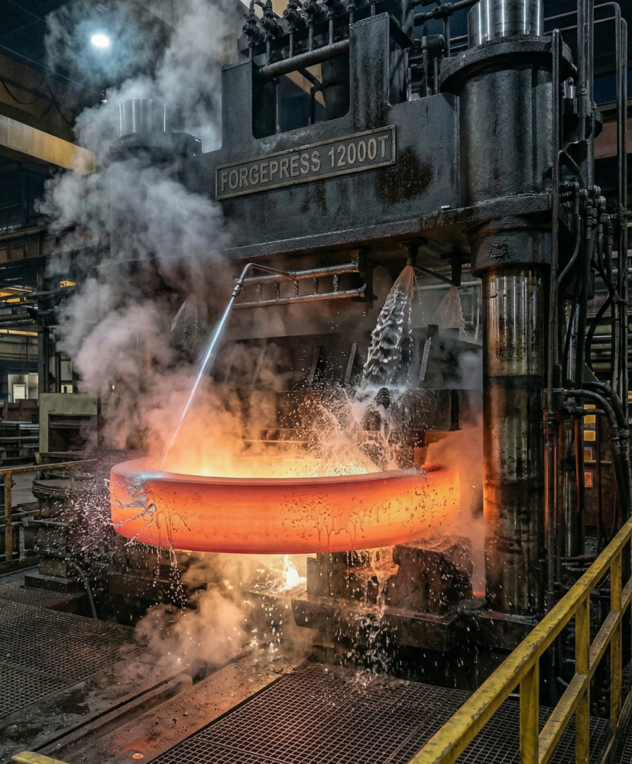


Quality control in forging manufacturing: inspection, ndt, and process validation in critical applications
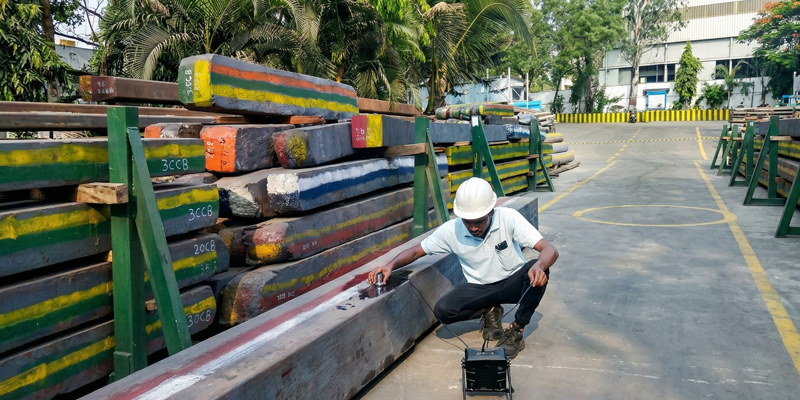
Why Quality Control in Forging Is Not an End-of-Line Activity
In critical industries, quality control is not a department.
It is an engineering system embedded into every stage of forging manufacturing — from raw material intake to final dimensional inspection.
For oil & gas, aerospace, defence, nuclear, marine, and heavy industrial applications, inspection is not simply about detecting defects. It is about validating process integrity.
When a forged component enters service in a pressure system, turbine assembly, armoured platform, or nuclear installation, failure is not tolerated. Therefore, quality systems must prove — not assume — structural reliability.
This pillar explains how quality control in forging manufacturing operates at three interconnected levels:
- Process control
- Inspection and NDT
- Documentation and audit validation
1. Process Control Begins Before Inspection
Many procurement teams assume inspection ensures quality.
In reality, inspection only verifies whether process control was successful.
Quality control in forging begins with:
- Raw material certification verification
- Heat number traceability
- Furnace calibration
- Controlled deformation planning
- Reduction ratio validation
- Die maintenance records
Without controlled process inputs, inspection becomes reactive rather than preventive.
In critical applications, auditors often focus more on process controls than final inspection reports.
2. Dimensional Inspection: Geometry Meets Engineering
Forged components must meet dimensional tolerances that align with:
- Assembly interfaces
- Pressure containment requirements
- Rotational balance constraints
- Structural load paths
Dimensional inspection typically includes:
- Vernier and micrometer verification
- Height gauges
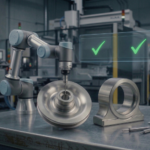
- CMM (Coordinate Measuring Machine) inspection
- Surface roughness measurement
- Concentricity and runout validation
In forge-to-finish environments, dimensional correction loops are faster because forging and machining teams collaborate internally.
This reduces rework cycles and improves lead-time predictability.
3. Non-Destructive Testing (NDT): Verifying Internal Integrity
Forged components in critical industries must undergo NDT to validate internal soundness.
Common methods include:
Ultrasonic Testing (UT)
- Detects internal voids and inclusions
- Validates defect closure from forging
- Mandatory in oil & gas and nuclear applications
Magnetic Particle Inspection (MPI)
- Identifies surface and near-surface discontinuities
- Frequently used in defence and heavy equipment forgings
Radiographic Testing (RT)
- Detects volumetric defects
- Used selectively depending on specification
Dye Penetrant Testing (DPT)
- Surface crack detection for precision components
Inspection acceptance criteria are defined by:
- API standards
- ASME codes
- Aerospace specifications
- Defence technical documentation
NDT is not merely about performing tests — it is about meeting specification thresholds.
4. Mechanical Testing: Confirming Metallurgical Performance
Beyond NDT, mechanical testing validates material properties.
Typical tests include:
- Tensile testing
- Yield strength measurement
- Elongation verification
- Charpy impact testing
- Hardness testing
In critical applications, testing must confirm:
- Compliance with specified grade
- Heat treatment effectiveness
- Consistency across batches
Mechanical test reports form part of qualification documentation submitted to OEMs.
5. Process Validation and Repeatability
Quality control systems must demonstrate repeatability.
This includes:
- Documented process parameters
- Standard operating procedures
- Control plans
- Calibration logs
- Operator qualification records
Auditors frequently assess:
- Whether forging reduction ratios are documented
- Whether furnace temperature mapping is recorded
- Whether NDT technicians are certified
- Whether inspection equipment is calibrated
Repeatability builds supplier credibility.
6. Traceability Architecture: Connecting All Data Points
In critical forging manufacturing, traceability must connect:
Raw material → Forging batch → Heat treatment cycle → Inspection stage → Machining → Final dispatch
This requires:
- Unique identification marking
- Batch documentation
- Inspection traceability logs
- Controlled document management
Without continuous traceability, audit approval becomes difficult.
Fragmented supply chains often struggle with this continuity.
Integrated forging systems simplify this architecture.
7. Audit Expectations in Critical Industries
Auditors from aerospace, oil & gas, nuclear, and defence sectors evaluate:
- Document control systems
- Corrective action procedures
- Non-conformance handling
- Root cause analysis capability
- Training documentation
- Process risk assessments
Quality control in forging manufacturing must demonstrate that:
- Defects are prevented
- Deviations are documented
- Corrective actions are systemic
- Improvements are continuous
Passing inspection is not enough. Passing audit scrutiny is equally critical.
8. Common Quality Failures in Forging
Quality breakdowns often occur due to:
- Insufficient reduction ratios
- Inadequate heat treatment control
- Poor raw material cleanliness
- Incomplete NDT coverage
- Inconsistent documentation
Failures may result in:
- Non-conformance reports (NCRs)
- Rejections during qualification
- Delays in program approval
- Supplier disqualification
Preventive systems reduce these risks.
9. Why Quality Control Is More Complex in High-Mix, Low-Volume Forging
High-volume automotive forging focuses on statistical process control.
In high-mix, low-volume critical forging:
- Each batch may differ
- Specifications may vary
- Documentation must adapt
- Inspection plans are often custom
This increases quality complexity.
Structured quality systems must handle variability without compromising compliance.
10. Integrated Forge-to-Finish Quality Advantage
When forging and machining operate under one quality management system:
- Inspection planning is coordinated
- Data continuity is preserved
- Corrective actions are internalized
- Audit responses are faster
This reduces:
- Inter-vendor blame cycles
- Traceability gaps
- Program risk
For critical industries, supplier reliability extends beyond production capability to quality architecture maturity.
Conclusion
Quality control in forging manufacturing is a multi-layered engineering system.
It integrates:
- Process control
- Dimensional verification
- Non-destructive testing
- Mechanical validation
- Documentation management
- Audit preparedness
In critical industrial applications, inspection is not an afterthought — it is the structured proof of structural integrity.
Manufacturers that treat quality control as an integrated, data-driven system are better positioned to support oil & gas, aerospace, defence, nuclear, marine, and heavy industrial programs.
Audit-Ready Quality Systems for Critical Forging Applications
In regulated industries, quality is demonstrated — not claimed.
Vinir Engineering’s quality architecture integrates:
- Controlled process validation
- Stage-wise inspection
- Certified NDT execution
- Mechanical property verification
- Centralized traceability documentation
Serving non-automotive critical industries requires quality systems capable of withstanding third-party audits and long-term compliance review.
If you are qualifying forging suppliers for oil & gas, aerospace, defence, nuclear, or marine applications, Vinir’s team can provide documentation insight and technical support aligned with your audit framework.
Contact Vinir to discuss your inspection and compliance expectations