
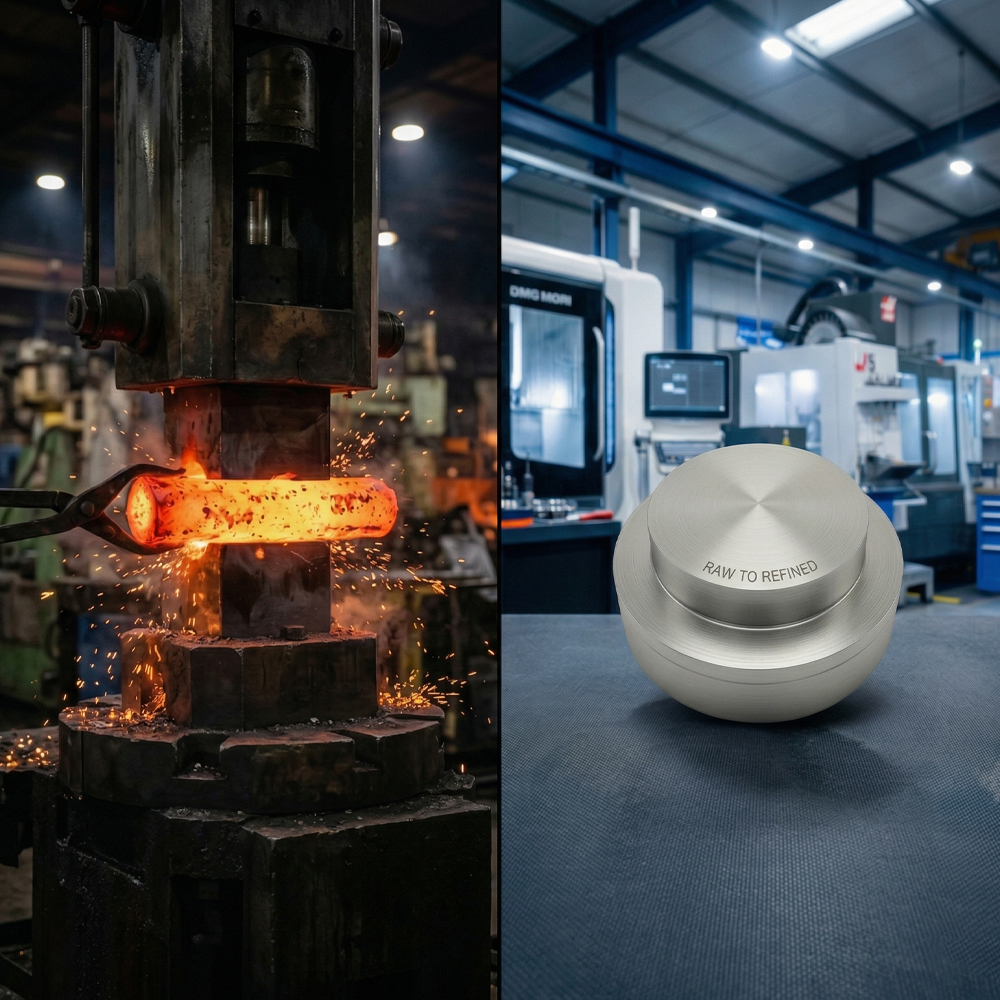
From raw material to machined component: the complete forge-to-finish workflow in critical manufacturing
Why Forge-to-Finish Is Not Just Vertical Integration
In critical industries, the journey of a forged component does not begin at the forging press — and it certainly does not end there.
Between raw material procurement and final machining lies a tightly controlled chain of metallurgical decisions, deformation engineering, heat treatment control, dimensional correction, inspection validation, and documentation traceability.
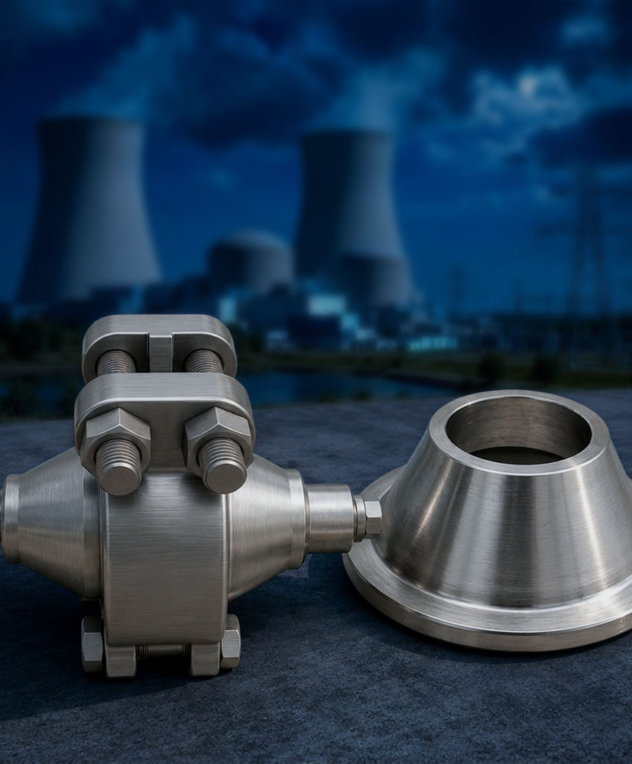
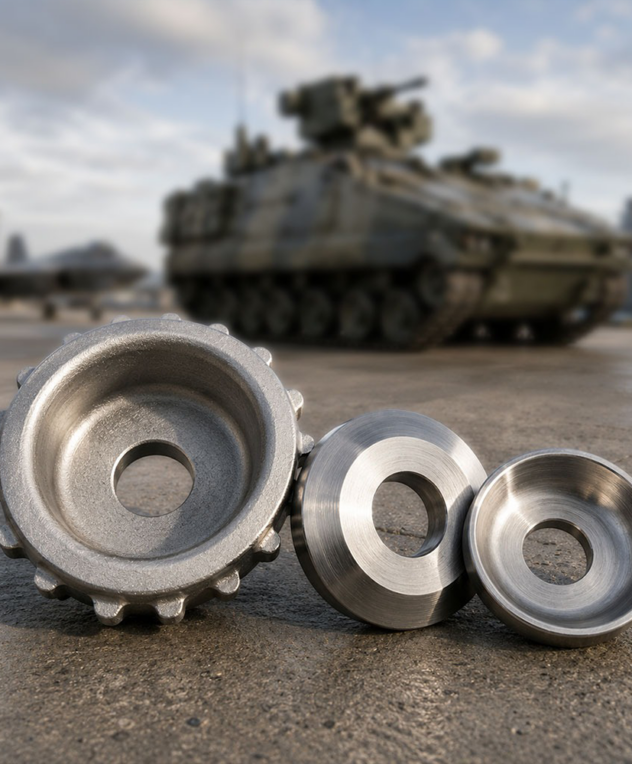
For oil & gas, aerospace, defence, nuclear, marine, and heavy industrial applications, forging is only one stage of a much larger reliability equation.
This is where forge-to-finish manufacturing becomes structurally important.
Forge-to-finish is not merely about owning multiple machines in one facility. It is about controlling grain flow, machining allowance, inspection planning, dimensional stability, and documentation continuity within one integrated system.
In high-mix, low-volume critical manufacturing, this integration directly influences:
- Fatigue life
- Pressure integrity
- Audit approval
- Lead time predictability
- Supply chain risk
This guide explains how the complete workflow functions —
Why OEMs increasingly prefer integrated forging partners.
1. Raw Material Selection: The Foundation of Structural Integrity
Every critical forging begins with material pedigree.
Before heating or deformation, manufacturers must verify:
- Heat number traceability
- Chemical composition compliance
- Inclusion rating
- Mill test certification
- Applicable industry standards (ASTM, ASME, EN, API, aerospace specs)
In sectors such as nuclear and aerospace, the raw material audit trail is often reviewed before production even begins.
If pedigree integrity fails at this stage, the entire forging program may be rejected later.
Forge-to-finish systems preserve this traceability throughout the manufacturing chain rather than handing it off between vendors.
2. Billet Preparation and Pre-Forging Controls
Once approved, material undergoes:
- Cutting to required weight
- Surface inspection
- Identification marking
- Pre-heating under controlled furnace cycles
Heating is not simply about softening metal.
Temperature must be controlled within defined windows to prevent:
- Overheating and grain growth
- Surface decarburization
- Oxidation damage
- Internal thermal gradients
Controlled furnace calibration and batch traceability become part of the documented process.
In integrated facilities, heating data directly links to forging batch records, preserving process continuity.
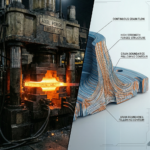
3. Forging Stage: Engineering the Grain Structure
During forging, material deformation is controlled to achieve:
- Required reduction ratio
- Target grain flow orientation
- Internal defect closure
- Structural densification
Unlike fragmented supply chains, integrated forge-to-finish manufacturers can plan forging geometry while anticipating final machining requirements.
This ensures:
- Correct fiber flow in load-bearing zones
- Optimized machining allowances
- Reduced material waste
- Controlled dimensional deviation
For example, pressure-retaining components may require specific grain orientation relative to stress direction. This can only be preserved if machining strategy aligns with forging strategy.
When forging and machining are separate vendors, this alignment is often lost.
4. Heat Treatment: Stabilizing Mechanical Properties
Forging establishes structure. Heat treatment refines and stabilizes it.
Depending on application, processes may include:
- Normalizing
- Quenching and tempering
- Annealing
- Stress relieving
Heat treatment determines:
- Tensile strength
- Yield strength
- Hardness
- Impact resistance
- Dimensional stability
In integrated workflows, heat treatment parameters are coordinated with:
- Target machining tolerances
- Distortion management
- Final inspection requirements
This reduces post-machining dimensional correction risk.
5. Rough Machining: Preparing for Precision
After forging and heat treatment, components undergo rough machining to:
- Remove scale and excess allowance
- Establish datum references
- Prepare inspection surfaces
- Correct forging distortion
In forge-to-finish environments, machining engineers collaborate with forging teams to:
- Predict deformation behavior
- Adjust allowances accordingly
- Preserve critical grain alignment
This level of coordination is rarely possible in multi-vendor chains.
6. Inspection and NDT: Verifying Structural Integrity
Inspection does not occur only at the end. It is staged throughout production.
Typical checkpoints include:
- Visual inspection
- Dimensional verification
- Ultrasonic testing (UT)
- Magnetic particle inspection (MPI)
- Radiographic testing (RT), where required
- Hardness and impact testing
Integrated systems ensure that inspection findings can immediately inform corrective machining or re-heat treatment decisions.
This reduces rejections and lead time uncertainty.
7. Finish Machining: Precision Meets Metallurgy
Final machining transforms forged geometry into finished industrial components ready for assembly.
Precision tolerances, surface finishes, and geometric accuracy are achieved while preserving:
- Designed load paths
- Structural integrity
- Surface quality for sealing or rotating applications
When machining is integrated with forging:
- Grain flow alignment is not unintentionally disrupted
- Critical surfaces are strategically positioned
- Documentation continuity is maintained
For aerospace and oil & gas programs, this continuity simplifies audit review.
8. Documentation Continuity and Audit Readiness
One of the most underestimated advantages of forge-to-finish manufacturing is documentation integrity.
Auditors may request:
- Raw material certificates
- Heat treatment charts
- Reduction ratio calculations
- NDT reports
- Dimensional inspection records
- Operator qualification evidence
When forging and machining occur under one system:
- Documentation architecture remains centralized
- Traceability is continuous
- Responsibility is clear
Fragmented supply chains often struggle to consolidate this data coherently.
9. Supply Chain Risk Reduction
Critical industry buyers evaluate not only component strength but supplier stability.
Integrated forge-to-finish systems reduce:
- Inter-vendor coordination delays
- Transport risks
- Traceability gaps
- Accountability disputes
- Rework loops
In long lifecycle programs — particularly defence and nuclear — supplier reliability over years matters more than marginal cost savings.
10. Why Forge-to-Finish Matters in High-Mix, Low-Volume Manufacturing
High-mix, low-volume programs require:
- Flexible tooling
- Process adaptability
- Rapid documentation preparation
- Engineering collaboration
When forging and machining are separate entities, coordination becomes time-intensive and risk-prone.
Integrated systems allow:
- Faster iteration
- Lower batch risk
- Controlled deviation management
- Better engineering feedback loops
This is particularly relevant in non-automotive forging sectors where repeat volumes are limited but technical requirements are stringent.
Conclusion
Forge-to-finish manufacturing is not a marketing phrase. It is a structural manufacturing philosophy.
By controlling the full chain — from raw material to final machined component — manufacturers ensure:
- Grain structure integrity
- Dimensional stability
- Audit-ready documentation
- Reduced supply chain risk
- Predictable quality outcomes
For critical industries where component failure is unacceptable, integration is not optional. It is strategic.
Integrated Forge-to-Finish Manufacturing for Reduced Supply Chain Risk
In high-mix, low-volume industrial programs, fragmentation increases risk.
Vinir Engineering operates as a fully integrated forge-to-finish manufacturer, ensuring:
- Continuous material traceability
- Coordinated forging and machining strategy
- Controlled dimensional stability
- Streamlined inspection architecture
- Centralized documentation management
By maintaining process continuity from raw material to finished machined component, Vinir reduces inter-vendor coordination risk and improves audit responsiveness.
For OEMs seeking reliable long-term forging partners with integrated capabilities, our engineering team can support early-stage technical alignment and qualification discussions.
Speak with Vinir about your forge-to-finish manufacturing requirements.