
Defence forging suppliers: qualification, compliance, and long-term program reliability
Defence Forgings Operate Under Strategic, Not Commercial, Expectations
Defence manufacturing is not driven purely by cost, speed, or volume. It is governed by reliability, national security considerations, long qualification cycles, and sustained lifecycle performance.
Forged components used in defence platforms — including armored vehicles, artillery systems, naval assemblies, aerospace structures, and mobility systems — must demonstrate structural integrity under extreme loading, impact, fatigue, and environmental stress.
For OEMs and government-linked procurement bodies, selecting defence forging suppliers is not a transactional decision. It is a long-term strategic alignment.
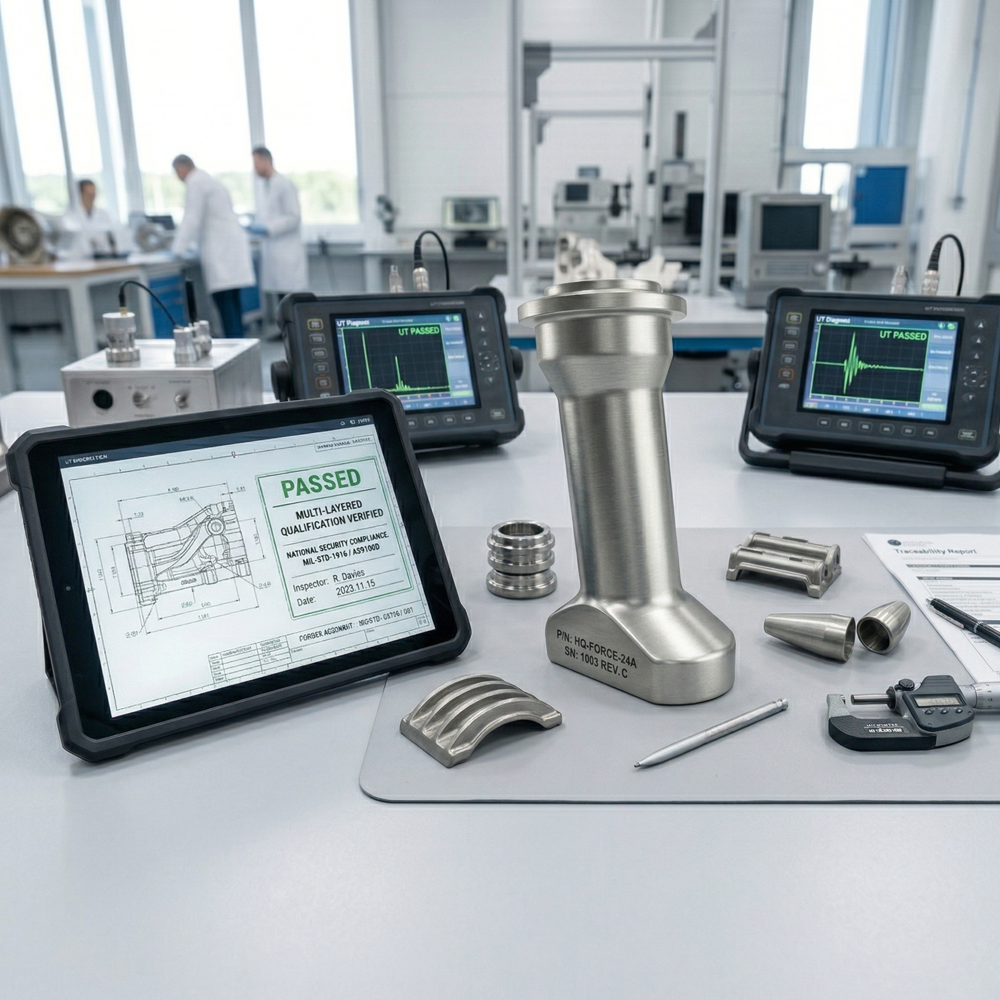
Defence Supplier Qualification Is Multi-Layered
Unlike general industrial onboarding, defence supplier approval often involves structured and prolonged evaluation.
Qualification may include:
- Technical capability review
- Facility audit and process validation
- Material traceability assessment
- Inspection system verification
- Pilot production approval
- Long-term performance monitoring
In many cases, approval is program-specific rather than universal.
Defence projects often require suppliers to demonstrate repeatability over extended evaluation cycles before full production release.
Material Control and Structural Integrity in Defence Forgings
Defence forgings frequently experience:
- High impact loading
- Cyclic stress
- Abrasion
- Dynamic mechanical forces
- Harsh environmental exposure
Material selection and deformation control must therefore ensure:
- Adequate reduction ratios
- Refined grain structure
- Controlled hardness
- Impact resistance
- Fatigue performance
Ultrasonic testing, mechanical validation, and dimensional verification are commonly embedded within program requirements.
Structural reliability is non-negotiable.
Documentation and Traceability Expectations
Defence programs demand disciplined documentation.
Suppliers must maintain traceability linking:
- Raw material heat numbers
- Forging batch records
- Heat treatment cycles
- Inspection reports
- Mechanical testing results
In many cases, documentation retention extends for years to support maintenance and lifecycle audits.
Breaks in traceability can delay program acceptance or trigger requalification.
Long Qualification Cycles and Program Stability
Defence platforms often remain operational for decades.
As a result, procurement teams evaluate suppliers based on:
- Operational stability
- Financial resilience
- Skilled workforce continuity
- Equipment maintenance systems
- Capacity planning discipline
Supplier continuity is essential for lifecycle support, spare part manufacturing, and platform upgrades.
Forging manufacturers serving defence sectors must demonstrate both technical depth and long-term institutional stability.
Risk Management in Defence Forging Programs
Defence buyers assess supplier risk across multiple dimensions:
- Process control reliability
- Inspection repeatability
- Compliance maturity
- Contingency planning
- Non-conformance management
Because program timelines are long and mission-critical, process inconsistency can have cascading effects across production schedules.
Suppliers must operate with structured discipline, not reactive correction.
Why High-Mix Capability Matters in Defence
Defence forging programs are rarely high-volume automotive-style runs.
They often involve:
- Custom geometries
- Moderate production volumes
- Platform-specific design updates
- Material grade variation
- Project-driven documentation
Forging manufacturers optimized for repetitive automotive output may struggle with this variability.
High-mix, low-volume capability aligns more naturally with defence program requirements.
Defence Forging at Vinir Engineering
Vinir Engineering operates as a non-automotive, high-mix, forge-to-finish manufacturer structured for critical industrial sectors, including defence applications.
Our systems emphasize:
- Controlled metallurgical processes
- Documented reduction ratio validation
- Structured inspection and NDT execution
- Continuous material traceability
- Integrated forge-to-finish workflow
- Audit-ready documentation architecture
For OEMs and defence program stakeholders evaluating forging suppliers, Vinir supports early-stage technical discussions, specification alignment, and structured qualification engagement.
If your project requires structurally reliable forged components for defence platforms, our engineering team can assist in reviewing technical and compliance requirements.
Connect with Vinir Engineering to discuss your defence forging needs.