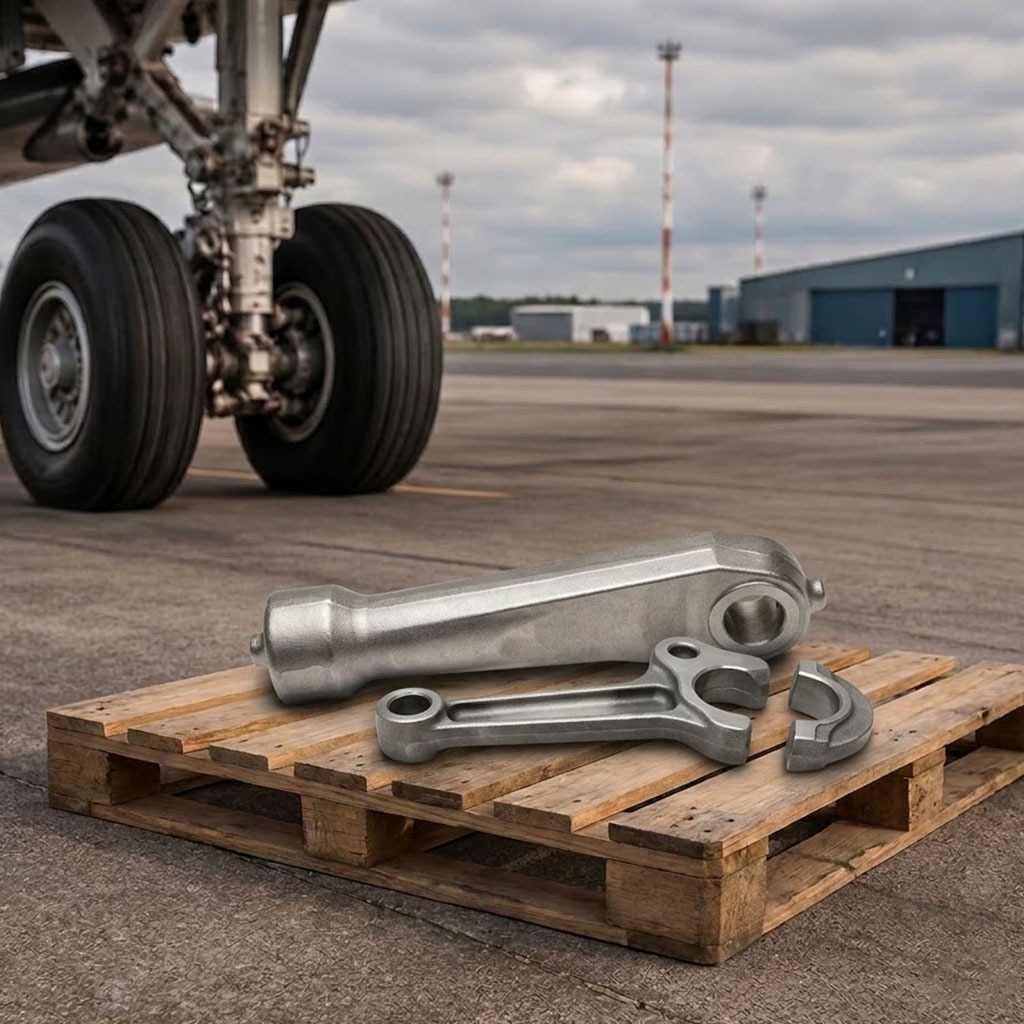
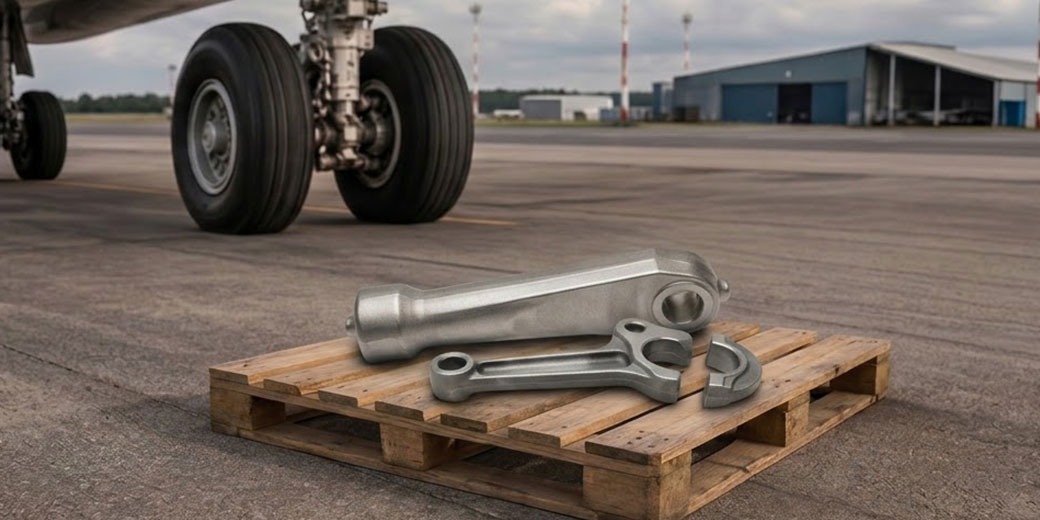
300M (UNS K44220, AMS 6257) is the ultra-high-strength low-alloy steel used for commercial aircraft landing gear side struts, Boeing 737 and Airbus A320 main gear actuator housings, and defence structural applications where the highest possible strength-to-weight ratio in steel is required. At 280–300 ksi (1,930–2,070 MPa) minimum tensile strength in the fully quenched and tempered condition, 300M is the strongest alloy steel produced in commercial quantities — achieving strength levels that exceed all other standard engineering steels except maraging steels and ultra-high-strength stainless steels that cost significantly more. This blog covers the 300M forging process, heat treatment, and the specialised NDT required for landing gear primary structure.
Property
300M (AMS 6257 Q&T)
4340 (AMS 6415 Q&T)
EN24 (817M40 Q&T)
Min Tensile Strength
280 ksi (1,930 MPa)
180 ksi (1,240 MPa)
125 ksi (860 MPa)
Min Yield Strength
240 ksi (1,655 MPa)
163 ksi (1,125 MPa)
105 ksi (725 MPa)
Min Elongation
8%
10%
13%
Charpy at 70°F (21°C)
≥20 ft-lb (27 J)
≥45 ft-lb (61 J)
≥50 ft-lb (68 J)
Hardness (HRC)
54–58 HRC
46–52 HRC
36–42 HRC
300M steel (composition: 0.40–0.46% C, 0.65–0.90% Mn, 1.45–1.80% Si, 0.70–0.95% Cr, 1.65–2.00% Ni, 0.30–0.45% Mo, 0.05–0.10% V, 0.003% max S) differs from 4340 primarily in its high silicon content (1.45–1.80% versus 0.20–0.35% in 4340) and the addition of vanadium. The silicon content is the critical differentiator — at the very high tempering temperatures required to develop the ductility needed for landing gear service (approximately 290–315°C for 300M versus 200–220°C for 4340 at 280 ksi), epsilon carbide normally transforms to cementite (a coarser carbide with lower toughness contribution). Silicon in 300M delays this cementite formation, allowing the higher tempering temperature while retaining the fine carbide dispersion that provides the combination of high strength and adequate (for landing gear applications) toughness.
300M billet must be vacuum arc remelted (VAR) — AMS 6257 mandates VAR practice to achieve the inclusion cleanliness required for landing gear fracture-critical applications. Non-metallic inclusions (aluminium oxide, manganese sulphide) at the 280 ksi strength level act as immediate crack initiation sites under the cyclic loading of landing impacts. VAR melting reduces hydrogen below 1.5 ppm and eliminates large inclusion clusters that would be catastrophic crack initiators. 300M billet for aerospace applications is produced by a small number of VAR-capable mills globally: Carpenter Technology (Reading, PA, USA), Timken Steel (Canton, OH, USA), and Aubert & Duval (France). Indian manufacture of 300M VAR billet is not currently established — MIDHANI Hyderabad produces some ultra-high-strength steels but 300M-equivalent VAR billet for aerospace is currently imported.
The heat treatment of 300M — austenitise at 871°C (1,600°F), oil quench, double temper at 290–315°C for minimum 2 hours each — is precise and critical. The double tempering (two separate temper cycles at the same temperature) is required to temper the martensite formed during the first temper’s cooling from the tempering temperature. If only a single temper is applied, some untempered martensite remains from the cooling phase of the first temper — producing a microstructure with lower ductility and toughness than the specification requires. Temperature uniformity during tempering must be within ±6°C (equivalent to AMS 2750 Class 2 furnace requirements) — deviating above 315°C risks over-tempering and strength loss; below 290°C risks under-tempering and toughness loss.
Hydrogen embrittlement is the primary delayed failure risk for 300M forgings after electroplating (cadmium plating of finished landing gear components). AMS 2759/9 (stress relief heat treatment of steel parts after plating) requires baking at 191°C for minimum 4 hours within 4 hours of plating — to drive hydrogen absorbed during the plating process out of the 300M steel lattice before it can concentrate at the highest-stress zones and cause delayed fracture. Landing gear OEMs specifically require certification of bake-out treatment on all plated 300M components.
AS9100D full scope. 300M (AMS 6257) closed die and open die forgings 1–500 kg. VAR-quality 300M billet sourced from Carpenter Technology or Timken Steel (USA) — billet MTR with VAR certification and hydrogen content report. Double temper heat treatment at 290–315°C in AMS 2750 Class 2 furnaces — both temper cycles documented on separate furnace charts. 100% immersion UT per AMS 2154 Class AA — 300M acoustic velocity calibration standard used (acoustic velocity for 300M at 58 HRC is measurably different from 4340 at 52 HRC). 100% fluorescent penetrant inspection (FPI) per AMS 2647 Level 3 after final machining. 100% magnetic particle inspection (MPI) per AMS 2641 on machined surfaces. Bake-out certification capability for post-plating hydrogen embrittlement relief per AMS 2759/9.
Frequently Asked Questions
1.What is the role of silicon in 300M steel and why is it not used in other ultra-high-strength steels?+–
Silicon in 300M (1.45–1.80%) delays the transformation of epsilon carbide to cementite during tempering. In standard high-strength steels (4340, D6AC, H11), tempering above approximately 250°C causes the fine epsilon carbides (which strengthen without embrittling) to coarsen and transform to cementite (which is coarser and contributes less to strengthening). This transformation limits the tempering temperature and hence the toughness achievable at very high strength levels. Silicon’s thermodynamic interaction with carbon delays cementite formation, allowing tempering at 290–315°C — which provides better ductility and toughness than the 200–220°C tempering required without silicon. The silicon is not used in other steels because at levels above 1.5% it can cause temper embrittlement at grain boundaries in improperly processed steel — 300M’s chemistry is carefully balanced to avoid this, requiring tight control of phosphorus, tin, antimony, and arsenic (the grain boundary embrittling elements).
2.What is hydrogen embrittlement in 300M and why is the bake-out procedure mandatory for landing gear components?+–
Hydrogen embrittlement is a delayed fracture mode — atomic hydrogen diffuses into the 300M steel lattice during electroplating (cadmium or zinc-nickel plating of landing gear), concentrates at the highest-stress microstructural locations (grain boundaries, martensite lath boundaries, dislocation tangles near inclusions), and reduces the fracture toughness of the steel to near zero at those locations. At 280 ksi strength level, the normal fracture toughness of 300M is approximately 60–80 MPa√m — adequate for landing gear design. With hydrogen saturation from plating, the local fracture toughness can drop to 5–10 MPa√m — causing fracture at stresses well below the design limit, typically hours to days after plating. The bake-out procedure (191°C for minimum 4 hours within 4 hours of plating completion) accelerates hydrogen diffusion out of the steel — hydrogen mobility at 191°C is high enough to purge the absorbed hydrogen before it reaches dangerous concentrations at stress risers.
3.How does the double tempering requirement for 300M differ from single tempering, and why does it matter for landing gear applications?+–
Single tempering of 300M at 290–315°C heats the as-quenched martensite structure, tempers the martensite, and then cools from the tempering temperature. During this cooling from 290–315°C, some new martensite forms from any retained austenite that transforms during cooling — this newly formed martensite is untempered (it formed at too low a temperature to receive the tempering effect). Double tempering repeats the 290–315°C heat treatment for a second cycle — the second cycle tempers the martensite that formed during the cooling from the first cycle. Without double tempering, the untempered martensite fraction (typically 2–5% of the microstructure) produces localised brittle zones that significantly reduce fracture toughness and can cause brittle fracture under the cyclic landing impact loading. AMS 2759/2 mandates double tempering for 300M — this is not optional or advisable, it is a mandatory heat treatment requirement.
4.What NDT is required for 300M landing gear forgings and why is the calibration standard material important?+–
300M landing gear forgings require: 100% immersion UT to AMS 2154 Class AA (3.18mm FBH rejection threshold) using a 300M-specific calibration standard (because acoustic velocity in 300M at 58 HRC differs measurably from 4340 at 52 HRC — using the wrong calibration standard gives incorrect depth readings and incorrect sensitivity); 100% FPI to AMS 2647 Level 3 (fluorescent penetrant, high sensitivity, on all machined surfaces); and 100% MPI to AMS 2641 on all machined surfaces (magnetic particle — detects tight fatigue cracks and subsurface defects not detectable by FPI). For each new part number, a qualification UT scan map is prepared showing the probe coverage path and confirming 100% volumetric coverage. Landing gear OEMs (Safran Landing Systems, Collins Aerospace) review and approve the UT procedure before production inspection begins.
5.Can 300M be replaced by titanium (Ti-6Al-4V) for landing gear weight reduction and what are the trade-offs?+–
Replacing 300M steel with beta-processed Ti-6Al-4V (AMS 4935) for landing gear main structural members reduces component weight by approximately 40% (titanium density 4.51 g/cm³ versus 7.84 g/cm³ for 300M) while maintaining comparable strength-to-weight ratio. Widebody aircraft (Boeing 787, Airbus A350) use titanium alloy for main gear beams because the weight saving over the aircraft’s life is commercially significant. Narrowbody aircraft (Boeing 737, Airbus A320) continue using 300M for main gear side struts because: the weight saving is proportionally smaller for a smaller landing gear; 300M’s manufacturing simplicity (standard machining, plating, inspection) is more cost-effective at high volumes; and the landing gear replacement cycle for narrowbody aircraft (much shorter design life cycles per unit than widebody) makes the per-landing cost of titanium’s higher initial cost less economically attractive.