
Duplex Stainless Steel Forging in India: API Certified Manufacturer Guide
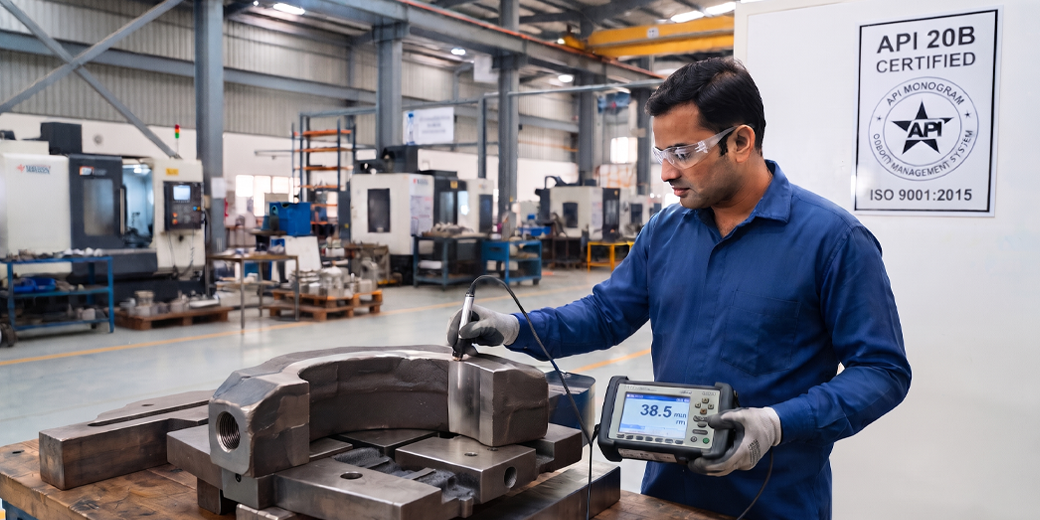
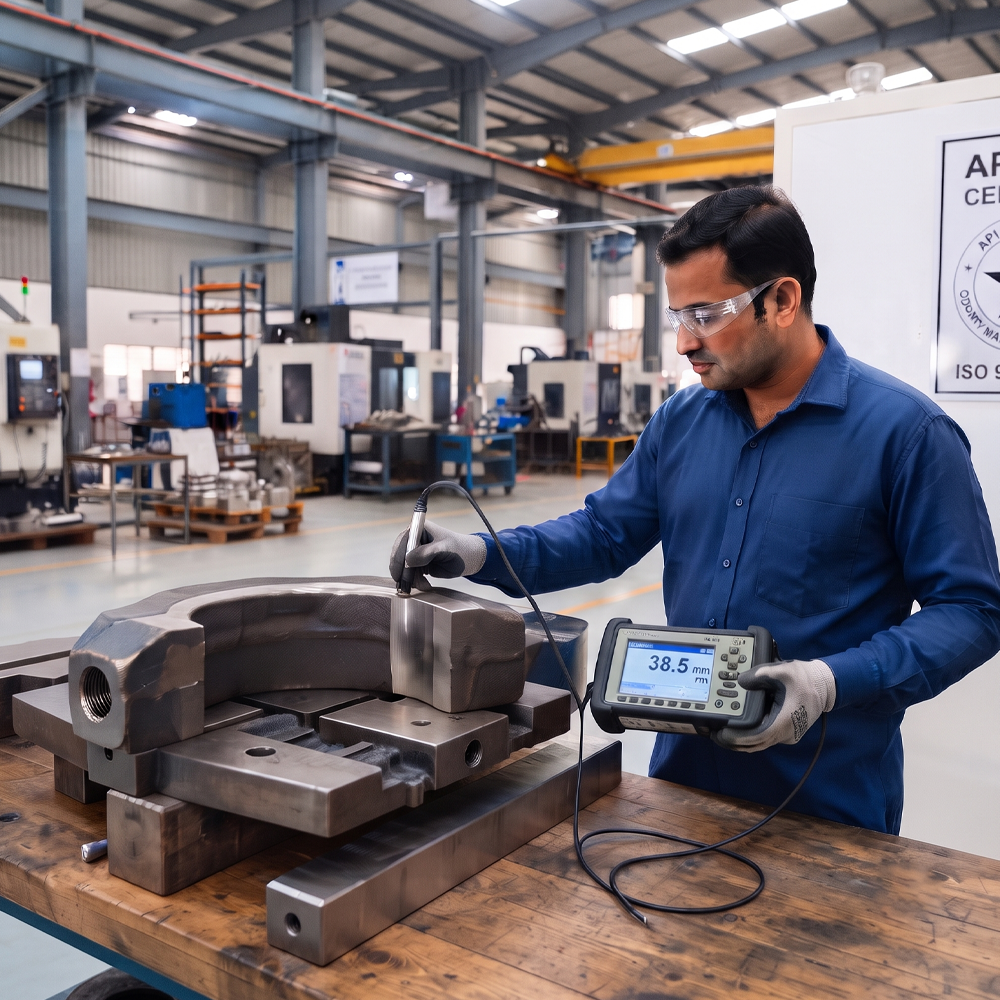
Duplex stainless steel forging is the manufacture of forged components from two-phase stainless steels — containing approximately equal proportions of austenite and ferrite — for applications where standard austenitic stainless steels fail due to chloride stress corrosion cracking, pitting corrosion, or insufficient strength. Duplex stainless steel forgings are specified across oil and gas, offshore, chemical processing, desalination, and marine industries wherever seawater, chloride-bearing process fluids, or corrosive production environments are present. Vinir Engineering manufactures API 20B certified duplex stainless steel forgings in Bangalore and Hosur, holding API 20B, AS9100D, ABS, and IBR certifications across four manufacturing units.
At a Glance: Duplex Stainless Steel Forging Requirements
| Parameter | Duplex 2205 | Super Duplex 2507 |
| UNS designation | S31803 / S32205 | S32750 |
| ASTM forging grade | A182 F51 | A182 F53 |
| Chromium | 22% | 25% |
| Molybdenum | 3% | 4% |
| PREN (pitting resistance) | 34–36 | 40–43 |
| Min yield strength | 450 MPa | 550 MPa |
| Annealing temperature | 1,020–1,080°C + rapid quench | 1,060–1,120°C + rapid quench |
| Ferrite content target | 40–60% | 40–60% |
| NACE MR0175 | Qualified — max 310 HV10 | Qualified — max 310 HV10 |
| Certification | API 20B, ABS, AS9100D | API 20B, ABS, AS9100D |
| Weight range (Vinir) | 10 kg – 15,000 kg | 10 kg – 15,000 kg |
Why Duplex Is Specified Over Standard Stainless Steel
The most important commercial decision a process or offshore engineer makes when selecting stainless steel for a chloride-containing application is whether standard austenitic (316L) or duplex (2205) or super duplex (2507) is appropriate. Getting this wrong in either direction is costly — specifying 316L when duplex is needed leads to premature corrosion failure, while specifying super duplex when 316L would serve adds unnecessary cost.
The decision is driven by three failure mechanisms specific to austenitic stainless steels in chloride environments:
Chloride Stress Corrosion Cracking (SCC) — the dominant failure mode. Type 316L stainless steel undergoes transgranular cracking under the combination of tensile stress, chloride ions, and temperature above approximately 50°C. The cracks are often invisible until failure occurs. Duplex steels are highly resistant to SCC because the mixed austenite-ferrite microstructure arrests crack propagation at phase boundaries.
Pitting Corrosion — localised attack initiated at surface discontinuities where the passive film breaks down in high-chloride environments. 316L has a PREN of approximately 24 — adequate for atmospheric and mild aqueous service but insufficient for seawater above 20°C. Duplex 2205 at PREN 34–36 and super duplex 2507 at PREN 40–43 provide progressively better pitting resistance.
Crevice Corrosion — concentrated attack at tight gaps in the stainless steel surface — under gaskets, in threaded connections, between mating flange faces. Duplex and super duplex grades are significantly more resistant to crevice corrosion than 316L in seawater and chloride-bearing process fluids.
Industries and Applications for Duplex Stainless Steel Forgings in India
Oil and Gas — The Primary Market
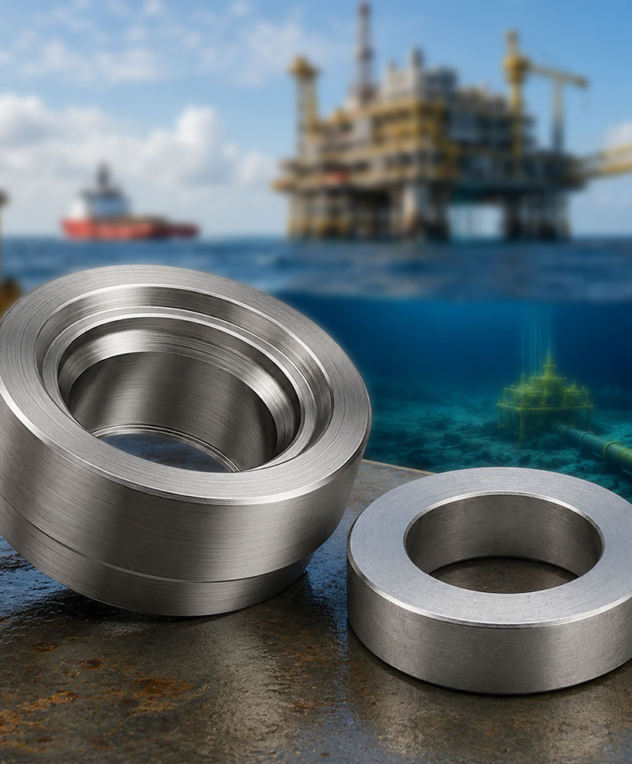
Offshore and subsea: Seawater lift pump components, firewater system valve bodies and flanges, produced water handling valve bodies, subsea tree components in shallow and deepwater, injection manifold fittings, umbilical end termination forgings.
Onshore oil and gas: High-chloride produced water handling, water injection system valve bodies and flanges at coastal and offshore oil fields, sour gas processing where combined H₂S and chloride service makes duplex the preferred material.
Indian operators using duplex: ONGC Mumbai High offshore platform seawater systems, Reliance KG-D6 subsea production, Cairn’s Rajasthan production where produced water salinity is high.
Chemical and Petrochemical Processing
Chemical plants handling chloride-bearing process streams — chloralkali plants, PVC production, pulp and paper, phosphoric acid production — specify duplex for pump casings, valve bodies, heat exchanger tube plates, and reactor vessel nozzle forgings. The combination of corrosion resistance and higher strength compared to 316L allows thinner sections and lighter components at equivalent pressure ratings.
Specific applications:
- Chlorine and hypochlorite handling valve bodies — F51 duplex or F53 super duplex
- Seawater-cooled heat exchanger tubesheet forgings — super duplex 2507
- Phosphoric acid process valve bodies — super duplex for highest concentration acid service
- Urea plant high-pressure components — duplex grades specified in many urea process licences
Desalination
India’s expanding desalination sector — driven by water scarcity in coastal states including Tamil Nadu, Gujarat, and Andhra Pradesh — uses duplex and super duplex forgings extensively. Reverse osmosis and multi-stage flash desalination processes handle large volumes of seawater at elevated pressures and temperatures. All seawater-wetted components require chloride-resistant materials.
Key desalination forging applications:
- High-pressure seawater pump casing forgings — super duplex 2507
- Pressure exchanger component forgings — super duplex for maximum corrosion resistance at high pressure
- RO membrane housing end cap forgings — duplex 2205
- Brine discharge valve bodies — duplex or super duplex depending on brine concentration and temperature
Marine and Offshore Structural
Marine structural applications — offshore platform structural connections, riser clamps, seawater piping structural fittings, vessel sea chest components — increasingly specify duplex over carbon steel to reduce maintenance coating requirements and eliminate the corrosion-driven replacement cycles that carbon steel components require in seawater service.
Power Generation
Coastal power stations using seawater cooling — thermal and nuclear power plants on the Indian coastline — use duplex stainless in their seawater cooling circuit valve bodies, heat exchanger channel covers, and seawater intake structural fittings. The IBR (Indian Boiler Regulations) certification that Vinir holds is relevant where duplex components are part of pressure systems under IBR jurisdiction.
The Manufacturing Process for Duplex Stainless Steel Forgings
Raw Material Selection and Verification
Duplex and super duplex forging begins with billet selection from approved international mills — Sandvik, Outokumpu, and Acerinox are the primary sources of AMS-equivalent certified duplex bar and billet used for critical oil and gas and offshore forgings.
The incoming billet must carry a mill test report certifying chemistry to ASTM A182 F51 (2205) or F53 (2507) requirements. Critical chemistry elements beyond the standard ASTM limits include:
For 2205 (F51): Chromium 21–23%, molybdenum 2.5–3.5%, nitrogen 0.08–0.20% (nitrogen is a key austenite stabiliser and contributes significantly to PREN), sulphur maximum 0.02%.
For 2507 (F53): Chromium 24–26%, molybdenum 3.0–5.0%, nitrogen 0.24–0.32%, nickel 6–8%, sulphur maximum 0.02%.
The heat-specific PREN is calculated from the actual chemistry of each incoming billet — not the nominal specification limits. The PREN must meet or exceed the minimum specified in the purchase order for each heat.
Forging of Duplex Stainless Steel
Duplex stainless steels are forged in the temperature range 950–1,200°C for 2205 and 1,000–1,200°C for 2507. Within this range the material is sufficiently ductile for forging without cracking. Below 950°C the increasing ferrite fraction becomes progressively harder and more prone to surface cracking. Above 1,200°C excessive grain growth occurs.
Specific challenges compared to carbon steel forging:
Higher forging loads — duplex stainless requires approximately 50–70% higher forging load than equivalent carbon steel at the same temperature and reduction. Equipment that is adequate for carbon steel forgings of a given size may be at or near capacity for equivalent duplex forgings.
Faster temperature loss — duplex stainless loses heat faster than carbon steel during the forging operation. The number of forging passes before reheating must be limited, and billet temperature must be monitored by pyrometer at the press to ensure the forging temperature does not drop below the minimum before the pass is complete.
Oxide scale management — duplex stainless forms a tenacious oxide scale that must be removed between passes to prevent scale entrapment in the forging surface. Descaling by high-pressure water jet between passes is standard practice.
Solution Annealing — The Critical Heat Treatment
After forging, solution annealing is not optional — it is mandatory for all duplex and super duplex forgings. The objectives of solution annealing are:
- Dissolve all intermetallic phases (sigma phase, chi phase, Laves phase) that formed during forging
- Dissolve carbides and nitrides that precipitated at grain boundaries
- Re-establish the correct austenite-ferrite phase balance (40–60% ferrite)
- Produce a homogeneous, stress-free microstructure ready for service
2205 duplex: Anneal at 1,020–1,080°C. Hold for minimum time proportional to section thickness — typically 1 hour per 25mm of ruling section, minimum 30 minutes. Immediate rapid water quench.
2507 super duplex: Anneal at 1,060–1,120°C. Same time basis. Immediate rapid water quench. The higher annealing temperature compared to 2205 is required to dissolve the more stable intermetallic phases that form in the higher-alloy super duplex.
The water quench must be rapid — the forging must pass through the 600–900°C sigma phase formation range quickly enough to prevent sigma phase nucleation. For large section forgings (above 200mm equivalent diameter), the quench tank capacity, water temperature, and agitation must be verified to ensure adequate cooling rate at the centre of the section.
Ferrite Content Measurement
After solution annealing and quench, ferrite content is measured on every forging at multiple locations. The measurement is performed using a calibrated ferritescope — a hand-held magnetic permeability instrument whose reading is proportional to ferrite content. Results are compared to the acceptance range of 40–60% ferrite.
Ferrite content that falls outside this range indicates that either:
- The annealing temperature was incorrect (too low — insufficient sigma dissolution; too high — excess ferrite)
- The cooling rate was insufficient — sigma phase formed during slow cooling through the 600–900°C range, consuming ferrite phase and distorting the balance
- The incoming material chemistry was out of specification — affecting the equilibrium phase balance
A forging with out-of-range ferrite content is rejected — re-annealing may be attempted if the out-of-range condition is due to a correctable heat treatment issue, but re-annealing must be followed by repeat ferrite measurement and ASTM A923 corrosion testing if sigma phase was present.
NDE Requirements for Duplex Stainless Steel Forgings
Why MT Cannot Be Used for Duplex Forgings
Magnetic particle inspection requires the material to be ferromagnetic. Duplex stainless steels are partially ferromagnetic — the ferrite phase responds to magnetic fields but the austenite phase does not. This mixed and variable magnetic response produces unreliable MT results — some surface defects are detected, others are missed depending on their orientation relative to the ferrite grain boundaries. MT is not an acceptable surface inspection method for duplex or super duplex stainless steel forgings.
Fluorescent Penetrant Inspection (FPI)
FPI is the mandatory surface inspection method for all duplex and super duplex forgings. The penetrant enters surface-breaking defects by capillary action, and the developer draws it back to the surface as a visible fluorescent indication under UV light. FPI detects all surface-breaking defects regardless of their orientation relative to the microstructure — providing reliable 100% surface inspection.
Standard for oil and gas duplex forgings: AMS 2647 equivalent sensitivity level — Type 1 fluorescent penetrant, Method D (post-emulsifiable), sensitivity level 3 or 4 as specified by the buyer. Higher sensitivity levels detect finer defects at the cost of more rigorous penetrant system qualification and control.
Ultrasonic Testing
UT of duplex stainless steel forgings requires specific parameter selection because the duplex microstructure produces higher acoustic attenuation and grain scattering noise than fine-grain carbon steel. Key differences from carbon steel UT:
Reference standard material — the calibration reference standard must be made from the same duplex alloy as the production forging. A carbon steel reference standard has significantly different acoustic properties — calibration against it produces incorrect sensitivity settings for duplex UT.
Probe frequency selection — lower frequencies (2–4 MHz) provide better penetration in duplex but lower sensitivity to small defects. Higher frequencies (5–10 MHz) provide better sensitivity but increased grain noise. The optimum frequency depends on the specific duplex grade, the section size, and the acceptance criteria.
Grain noise assessment — before production UT inspection, the background grain noise level in the duplex forging is assessed. If grain noise exceeds a defined threshold — indicating coarse grain from inadequate forging or heat treatment — the UT inspection may not be able to achieve the required sensitivity. This provides an indirect quality check on the forging and heat treatment process.
API 20B Certification for Duplex Stainless Steel Forgings
API 20B covers wrought seamless carbon and low alloy steel forgings — its scope extends to some stainless steel grades. For duplex stainless steel forgings in oil and gas service, API 20C (Specification for Corrosion-Resistant Alloy Seamless Forgings) is the more specific standard covering F51 and F53 duplex grades.
In practice, many oil and gas buyers specify API 20B from the manufacturer’s license as evidence of quality system maturity, while referencing ASTM A182 F51 or F53 as the material specification and NACE MR0175 as the sour service compliance standard. The API 20B quality system — with its PSL levels, mandatory Charpy impact testing, and NDE requirements — provides the quality framework for duplex forging production even where API 20C is not explicitly on the license.
Vinir Engineering’s API 20B certification covers the quality management system applicable to duplex and super duplex forging production. ASTM A182 F51 and F53 material compliance is verified through NABL-accredited in-house chemical analysis and mechanical testing.
Documentation for Duplex Stainless Steel Forging Deliveries
A complete duplex stainless steel forging documentation package includes:
Mill test report — original certification from Sandvik, Outokumpu, or equivalent approved mill to ASTM A182 F51 or F53. Chemistry for all specified elements. Heat number.
PREN calculation — calculated from actual heat chemistry, showing that the minimum PREN requirement is met. This should appear on the supplier’s certificate alongside the chemistry results.
Independent chemical analysis — NABL-accredited in-house OES spectrometry results compared to ASTM F51 or F53 specification limits, referenced to the same heat number as the MTR.
Mechanical test report — tensile (UTS, yield, elongation, reduction of area) and Charpy impact from NABL-accredited in-house testing. Test method referenced (ASTM E8, ASTM E23).
Heat treatment record — annealing temperature, soak time, quench method, and furnace chart showing the complete thermal cycle including rapid quench. AMS 2750 equivalent furnace calibration reference.
Ferrite content results — ferritescope readings at multiple locations on the forging surface. Minimum and maximum readings reported. Results compared to the 40–60% acceptance range.
FPI report — penetrant type and sensitivity level, dwell time, developer type, UV lamp intensity, inspector name and ASNT certification level, result (pass/fail), referenced to component serial or batch number.
UT report — where UT is specified, calibration standard material and serial number, probe frequency, scanning coverage description, acceptance criteria, result.
Certificate of Conformance — quality manager signed declaration that the forgings conform to ASTM A182 F51 or F53 as applicable, to the applicable API and NACE requirements, and to the buyer’s purchase order specification.
Vinir Engineering’s Duplex Stainless Steel Forging Capability
Vinir Engineering produces duplex 2205 (ASTM A182 F51) and super duplex 2507 (ASTM A182 F53) forgings across the full weight range required by Indian and international oil and gas, offshore, and chemical processing buyers.
Closed die forging — valve bodies, flanges, structural fittings, pump casings in the 10–1,400 kg range. The 3000T press provides the higher forging loads required for duplex grades relative to equivalent carbon steel sections.
Open die forging — larger pressure vessel nozzle forgings, heavy structural fittings, shaft forgings in duplex up to 15,000 kg.
Ring rolling — seamless rings in duplex 2205 and super duplex 2507 to Ø200mm–4,500mm for offshore structural applications, large-diameter flange rings, and desalination pump components.
Solution annealing — calibrated in-house furnaces with rapid water quench capability. Adequate quench tank capacity and agitation for section sizes up to 400mm equivalent diameter. Continuous electronic temperature recording on all annealing cycles.
Ferrite measurement — calibrated ferritescope with certified reference standards. Results recorded by location and reported on the inspection certificate.
NABL-accredited testing — chemical analysis by OES spectrometry, tensile testing, Charpy impact, and hardness in the in-house NABL-accredited laboratory.
FPI in-house — fluorescent penetrant inspection by ASNT Level II certified operators. AMS 2647 equivalent system qualification.
API 20B certification, ABS approval, and AS9100D covering the complete forge-to-finish scope.
Frequently Asked Questions — Duplex Stainless Steel Forging India
What is the difference between duplex 2205 and super duplex 2507 forging?
Duplex 2205 (UNS S31803/S32205, ASTM A182 F51) has PREN of 34–36 — adequate for most offshore topside and structural seawater service at temperatures up to approximately 35°C. Super duplex 2507 (UNS S32750, ASTM A182 F53) has PREN of 40–43 — required for continuous seawater immersion, deepwater subsea, high-temperature seawater service, and the most aggressive produced water environments. Super duplex also has higher minimum yield strength (550 MPa versus 450 MPa) enabling thinner walls at equivalent pressure ratings. The cost premium of super duplex raw material over duplex is typically 30–50%.
Why is rapid water quench mandatory after solution annealing of duplex forgings?
Sigma phase — a brittle chromium-iron intermetallic — forms in duplex steels when cooled slowly through the 600–900°C temperature range. Sigma phase formation simultaneously reduces Charpy impact toughness to near zero and destroys corrosion resistance by depleting chromium from the surrounding matrix. Rapid water quenching through this range prevents sigma phase formation. A duplex forging cooled inadequately — even in water, if the quench system has insufficient capacity or agitation — can appear to pass room temperature tensile and hardness testing but will fail Charpy impact testing and corrosion testing in chloride service.
Why can’t magnetic particle inspection be used for duplex stainless forgings?
Duplex stainless steels are partially ferromagnetic — the ferrite phase responds to magnetic fields but the austenite phase does not. This mixed magnetic response produces variable and unreliable MT results. Some surface defects are detected, others are not, depending on their orientation relative to the ferrite grain structure. MT is therefore not an acceptable surface inspection method for duplex forgings. Fluorescent penetrant inspection (FPI) provides reliable 100% surface defect detection regardless of material ferromagnetic behaviour and is the specified method for all duplex and super duplex forgings.
What is PREN and how is it used to specify duplex stainless steel for oil and gas service?
PREN (Pitting Resistance Equivalent Number) is calculated as: PREN = %Cr + 3.3 × %Mo + 16 × %N. It predicts chloride pitting resistance — higher values mean better resistance. For offshore seawater service, PREN above 32 is required (met by duplex 2205 at 34–36). For subsea continuous seawater immersion and high-temperature seawater service, PREN above 40 is required (met by super duplex 2507 at 40–43). PREN is calculated from the actual chemistry of each heat — not the nominal specification — and must be reported on the material certificate for every duplex and super duplex forging delivery to oil and gas customers.
What documentation must accompany duplex stainless steel forging deliveries to international oil and gas buyers?
A complete documentation package for international oil and gas duplex forging deliveries includes: original mill test report (ASTM A182 F51 or F53 certification from an approved mill such as Sandvik or Outokumpu), heat-specific PREN calculation from actual chemistry, independent chemical analysis from a NABL-accredited laboratory, tensile and Charpy impact test report from NABL-accredited testing, heat treatment record with furnace chart showing the complete annealing and quench cycle, ferrite content measurement results at multiple forging locations, FPI report (AMS 2647 equivalent), UT report where specified, and certificate of conformance signed by the quality manager referencing all applicable specifications. For Saudi Aramco and ADNOC deliveries, 100% PMI results by XRF or OES on every component are additionally required.