
How Radial Forging Works: Incremental Deformation, Grain Flow and Dimensional Control

Radial forging appears deceptively simple: several dies strike a heated billet until its diameter becomes smaller.
In reality, the process involves simultaneous control of deformation, rotation, axial feed, temperature, reduction and geometry.
These variables determine not only what the component looks like but how the material has been worked internally.
Incremental Deformation
Radial forging does not normally transform a billet into its final geometry through one enormous press stroke.
Instead, deformation is incremental.
Multiple dies repeatedly apply compressive force while the workpiece moves through the forging zone.
Each deformation event changes only part of the geometry.
The cumulative effect of many controlled events produces the final forged profile.
This is particularly valuable for long components because the deformation zone can travel along the workpiece rather than requiring the complete shaft to fit within a single die impression.
Rotation
Rotation helps distribute deformation around the circumference.
Without controlled circumferential working, dimensional variation and uneven deformation could occur.
Rotation, die synchronisation and axial movement therefore work together.
Modern radial forging should be understood as a coordinated forming system rather than simply a hammering operation.
Axial Feed
Axial feed determines how quickly the workpiece travels through the deformation zone.
The relationship between feed and die action affects the amount and distribution of working.
If the process is incorrectly designed, some sections can receive insufficient deformation while others receive unnecessary working.
The manufacturing programme therefore needs to reflect starting diameter, target diameter, material and temperature.
Temperature
Metals become easier to plastically deform as temperature rises, but forging temperature cannot simply be maximised.
Excessive temperature can promote grain growth or undesirable microstructural changes.
Too low a temperature increases flow stress and can increase cracking risk.
The allowable window becomes especially important for titanium and nickel alloys.
Research on high-strength aerospace titanium alloys repeatedly emphasises the dependence of their final properties on precise thermomechanical processing and subsequent heat treatment.
Grain Flow
Metal contains a microstructural history inherited from casting, primary breakdown and subsequent working.
Forging changes that history.
During radial forging, plastic flow occurs predominantly in response to radial compression and axial elongation.
This can establish a longitudinally worked structure appropriate to shafts and similar components.
The exact grain size and phase structure after forging still depend on temperature, strain and heat treatment.
Diameter Reduction and Elongation
Metal volume is approximately conserved during plastic deformation.
When the cross-sectional area of a solid billet decreases substantially, material must flow elsewhere, producing an increase in length.
This simple principle explains why radial forging is so naturally suited to long products.
Process engineers need to account for this elongation when selecting starting billet dimensions.
Stepped Geometry
Radial forging machines can vary the degree of reduction along the workpiece.
This allows different shaft diameters to be produced from one billet.
The forged component is generally not taken directly to finished precision dimensions. Instead, sufficient machining allowance is retained.
The goal is to move expensive material only where the final component actually needs it.
Hollow Radial Forging
When a hollow component is required, a mandrel can be introduced into the workpiece.
External deformation causes the material to flow around the mandrel.
Process engineers must then control both outside and inside geometry.
Wall thickness, concentricity and material flow become central considerations.
Straightness
Long components introduce straightness challenges.
Uneven heating, asymmetric deformation or non-uniform cooling can contribute to bending.
Process control therefore continues after the last forging stroke.
Handling and heat-treatment practices can influence the dimensional condition presented to the machine shop.
From Forging to Finished Component
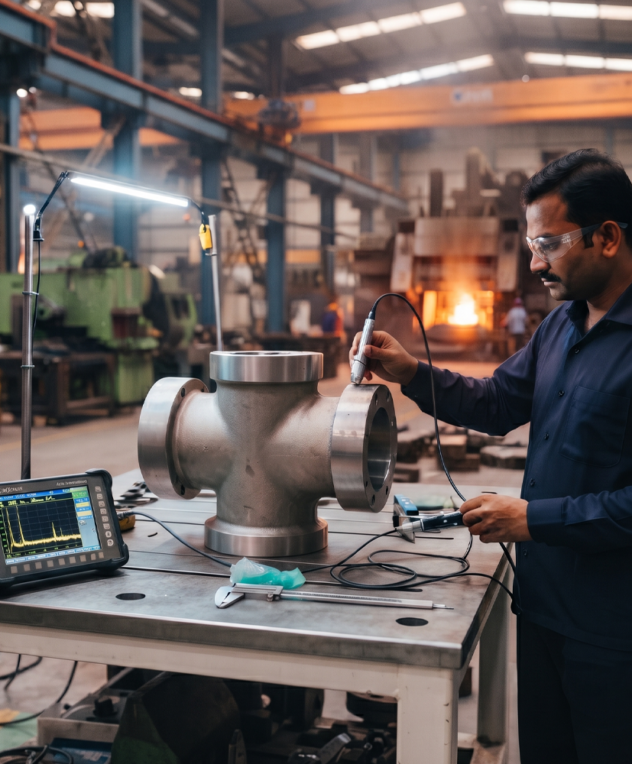
The radial forged blank typically proceeds to heat treatment, NDT and machining.
The order depends on the component and specification.
A critical shaft may undergo preliminary machining before ultrasonic inspection to provide suitable inspection surfaces, followed by final machining after acceptance.
Manufacturing planning should therefore consider the entire process chain before the first billet is heated.