
Radial Forged Shaft Supplier for USA from India: Aerospace, Defence & Energy Applications
A shaft appears geometrically simple, but mechanically it can be one of the most demanding components in a machine.
Shafts transmit torque, support rotating equipment, carry bending loads and can experience millions of fatigue cycles.
In aerospace, defence and energy systems, shaft failure can have consequences far beyond the value of the component itself.
This makes radial forging an important manufacturing route for selected high-strength shafts.
Why Forge a Shaft?
Machining a shaft from bar is straightforward, but it does not necessarily provide the most efficient material route.
Large diameter transitions require oversized starting stock. Every smaller section then generates machining waste.
Forging allows material to be redistributed before machining.
It also creates a thermomechanically worked structure rather than simply exposing the original structure of a large bar.
Torsional Loading
Many shafts transmit torque.
Torsion creates shear stresses that vary across the cross-section.
The shaft may simultaneously experience bending from bearings, gears or attached equipment.
This combination creates a fatigue-sensitive loading environment.
Material cleanliness, surface finish, geometry transitions and heat treatment can therefore become as important as nominal tensile strength.
Aerospace Shafts
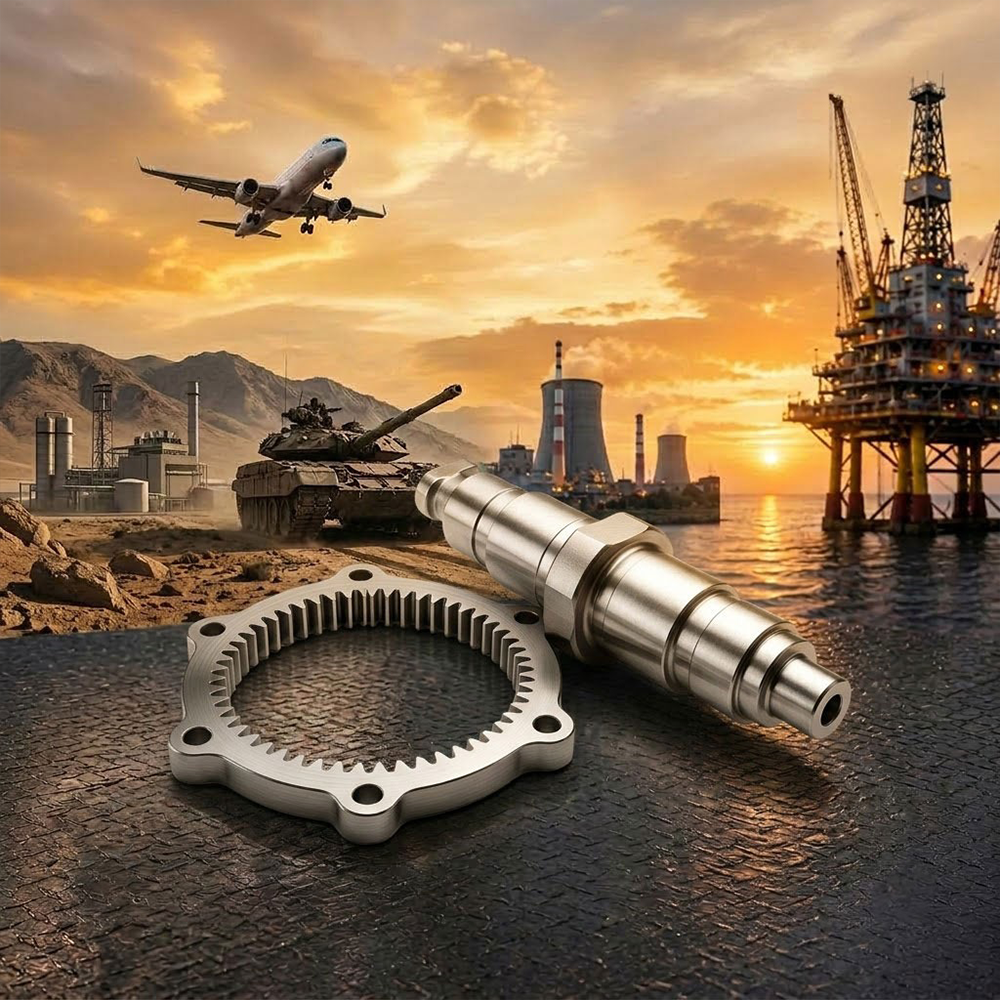
Aircraft systems use shafts in engines, transmissions, actuators, rotor systems and other mechanical assemblies.
Aerospace steels are tightly specified because high strength must coexist with toughness and fatigue resistance.
SAE maintains numerous AMS material specifications covering bars and forgings for aircraft applications, illustrating the degree of material-specific control in this sector.
Aerospace supplier qualification can additionally require AS9100 quality controls, special-process approvals, NDT and first-article documentation.
Defence Shafts
Defence applications can combine shock loading, high torque, low production volume and demanding traceability.
The relevant material can range from conventional alloy steel to specialised high-strength grades.
SAE’s AMSF7190B, for example, covers steel forgings for aircraft/aerospace equipment and special ordnance applications, although it is a stabilized specification and programme drawings must always identify the applicable current requirement.
Energy Applications
Power-generation systems contain long rotating components where dimensional stability and mechanical properties matter.
Turbine, generator and auxiliary equipment can require forged shafts or shaft-like components.
Depending on service temperature, materials can range from alloy steels to stainless and high-temperature alloys.
Large energy shafts may favour open die forging, while suitable smaller and intermediate axial components can be radial-forging candidates.
Stress Concentrations
Most shaft failures do not begin in the middle of a perfectly smooth cylindrical section.
Geometry changes matter.
Shoulders, grooves, threads, splines and diameter transitions can create local stress concentrations.
The forged preform should therefore be developed with the finished geometry in mind.
Enough machining allowance is necessary, but excessive stock around every feature defeats much of the economic advantage of near-net forging.
Heat Treatment
For alloy-steel shafts, quench and temper treatment is commonly used where high strength and toughness are required.
The challenge increases with section size because the centre cools more slowly than the surface.
The heat-treatment plan therefore needs to consider hardenability, ruling section and required through-section properties.
Ultrasonic Testing
Critical shafts can require ultrasonic inspection because surface inspection alone cannot establish internal integrity.
UT is particularly useful for evaluating the volume of long forged products.
The customer should specify the required procedure and acceptance criteria.
“UT tested” without a standard, coverage requirement or acceptance level is not a complete technical requirement.
Machining
Final shaft machining can include precision journals, bearing seats, splines, threads and coupling interfaces.
Grinding may be required for high-precision bearing surfaces.
Surface integrity is particularly important in fatigue-sensitive regions.
The finished manufacturing route therefore extends well beyond the forge.
Vinir Engineering for US Shaft Programmes
Vinir’s integrated forging and machining capabilities are relevant to high-mix, low-volume shaft programmes where US OEMs want to consolidate the supply chain.
A drawing review can compare radial forging with open die forging or other routes and determine which approach provides the best combination of metallurgy, material utilisation and machining economics.