
Radial Forging vs Open Die Forging: Which Process Is Better for Long Shafts and Hollow Components?
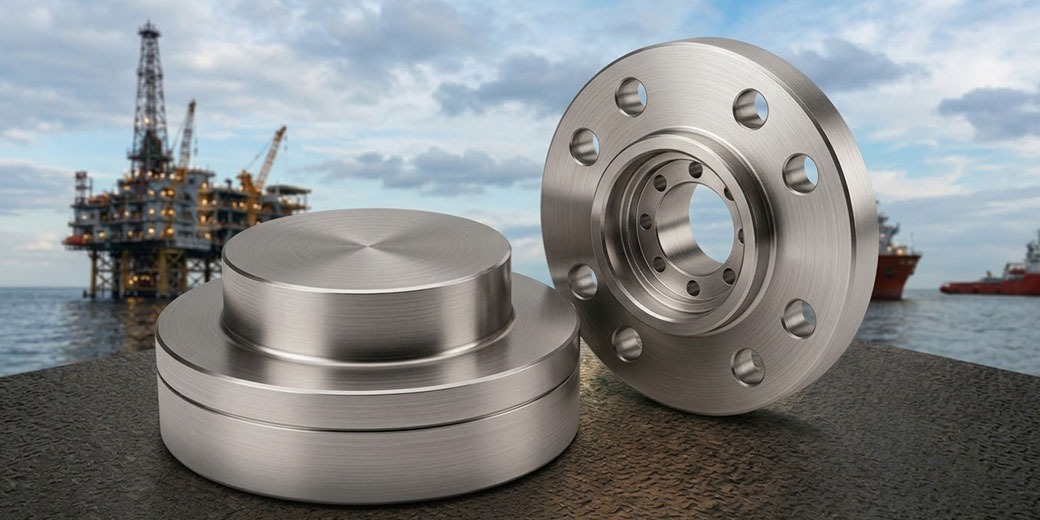
Radial forging and open die forging can both manufacture high-integrity shafts and cylindrical components.
They are not, however, identical processes.
Understanding the difference is particularly important for US procurement and engineering teams sourcing long shafts, stepped components and hollow forgings from India.
The correct process can reduce material consumption and machining. The wrong process can introduce unnecessary cost even if the final component ultimately meets the drawing.
How Open Die Forging Works
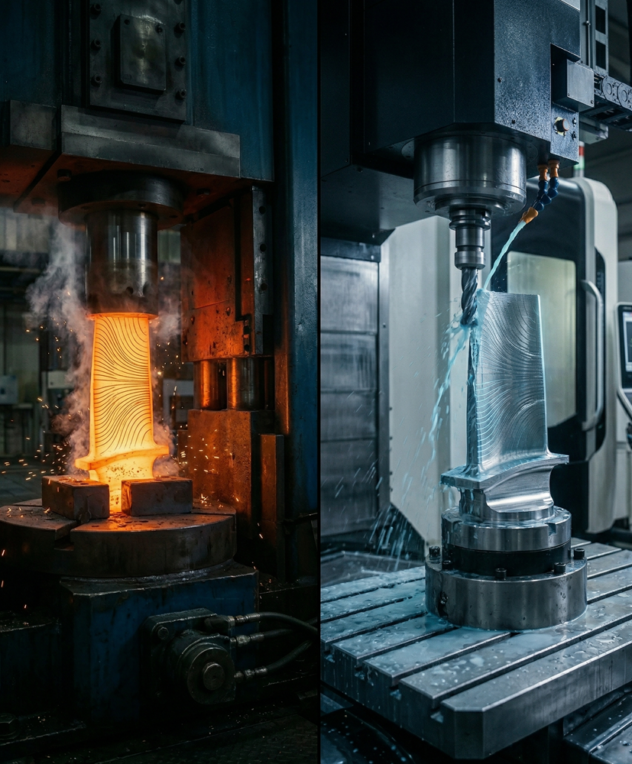
In open die forging, a heated billet is progressively compressed between relatively simple dies.
The workpiece is manipulated between strokes to produce the required shape.
Open die forging is exceptionally versatile.
It can produce shafts, discs, blocks, cylinders, bars, rings and large custom preforms without requiring a fully enclosed impression die.
For very large heavy forgings, this flexibility makes open die forging indispensable.
How Radial Forging Differs
Radial forging applies deformation from multiple directions around the circumference of a workpiece.
The billet is moved axially and rotated while the dies work it.
This makes the process particularly effective for long, rotationally symmetric components.
Rather than repeatedly repositioning a large billet between conventional dies, the radial forging system controls feed, rotation and reduction to create the required longitudinal profile.
Long Shafts
For long shafts with relatively simple axial geometry, radial forging can provide excellent process efficiency.
Diameter transitions can be developed progressively and repeatably.
Open die forging can also produce long shafts and remains particularly useful when the component is extremely large or when geometry and production volume favour conventional manipulation.
The choice therefore depends on dimensions, alloy, starting stock, equipment envelope and finished geometry.
Hollow Components
Both processes can be used to manufacture hollow products.
Open die forging can involve punching and mandrel operations to create hollows.
Radial forging can use a mandrel while external dies work the material around it.
For long tubular geometries, the latter can provide a highly controlled route for establishing the outside and inside dimensions.
Tooling
Neither process necessarily requires the expensive fully enclosed tooling associated with conventional closed die forging.
That makes both attractive for lower-volume heavy-engineering work.
Radial forging does, however, rely on machine-specific dies and manipulation programming.
The commercial comparison should therefore consider the entire manufacturing route rather than assuming either process is “tooling free.”
Material Utilisation
For stepped shafts, radial forging can be especially efficient because different diameters can be established along the length.
Open die forging can also create stepped shafts, but the optimal route depends on the specific geometry.
The more expensive the alloy, the more important this optimisation becomes.
Removing 100 kg of ordinary carbon steel is economically very different from removing 100 kg of aerospace titanium or nickel superalloy.
Dimensional Repeatability
Radial forging’s controlled machine manipulation can provide strong repeatability for appropriate geometries.
Open die forging depends heavily on process design, manipulation and operator/machine control.
Neither process normally delivers final aerospace or precision bearing tolerances directly from forging.
Finish machining remains essential for critical interfaces.
Grain Flow
Both processes plastically work the metal and can establish beneficial grain flow.
The direction and intensity of deformation differ.
For long axial components, radial forging naturally creates a deformation pattern associated with progressive axial working.
Open die forging can be designed to achieve strong longitudinal working as well.
The engineering objective should be the required final properties not selecting a process based solely on marketing claims about grain flow.
When Should a Buyer Choose Radial Forging?
Radial forging is particularly worth evaluating when the component is :
long relative to diameter
axisymmetric
stepped or tapered
solid or hollow
made from expensive material
and produced in quantities where dedicated closed dies may not be economical.
Open die forging may be preferable for exceptionally large components, broader geometric families or components requiring manipulation that does not align naturally with radial forging.