

Hollow Shaft Radial Forging Supplier for USA from India: High-Strength Tubular Components

Removing the centre of a large shaft can save weight.
Machining that centre from a solid billet, however, can waste a considerable amount of material and machining time.
Hollow radial forging addresses this problem by using deformation to create or maintain the internal bore while the outside of the component is forged.
For US OEMs sourcing expensive alloy-steel, titanium or nickel-alloy tubular components, the economics can be compelling.
Why Hollow Shafts Are Used
A shaft’s outer regions contribute strongly to its bending and torsional behaviour.
This means some applications can remove material near the centre while retaining much of the structural efficiency of a larger external diameter.
The exact benefit depends on the load case and engineering design.
A hollow shaft can therefore provide lower mass without reducing outside diameter.
For rotating equipment, lower mass can also reduce inertia.
The Mandrel
A mandrel is central to many hollow radial-forging routes.
The workpiece surrounds the mandrel while external dies apply compressive deformation.
The mandrel provides internal support and helps control bore geometry.
Material flows both longitudinally and around the mandrel as the outside diameter is reduced.
Wall Thickness Control
Hollow forging introduces variables that do not exist in solid shafts.
The manufacturer must control outside diameter, inside diameter, wall thickness and concentricity simultaneously.
A small positional error in the bore can create a large wall-thickness difference after final machining.
This makes process setup and dimensional control especially important.
Material Savings
Consider a large tubular titanium component.
Starting from solid bar requires the complete bore volume to be drilled, bored or trepanned away.
That discarded material was not cheap scrap it was aerospace-quality titanium purchased at full input cost and processed through primary manufacture.
Creating a hollow preform can reduce this buy-to-fly or buy-to-finish burden.
The precise savings need to be calculated from actual geometry.
Mechanical Properties
Hollow forging should not be evaluated purely as a cost-saving exercise.
The material surrounding the bore must still achieve the required deformation and microstructure.
The forging sequence therefore needs to ensure adequate working across the wall.
Subsequent heat treatment must also account for the hollow geometry, which changes heating and cooling behaviour compared with a solid shaft.
Applications
Hollow radial-forged components can be relevant to aerospace shafts, defence tubes, power-generation components, marine systems and specialised industrial equipment.
They are particularly interesting where the component is simultaneously long, mechanically loaded and made from expensive material.
Machining the Bore
Even when the hollow is created during forging, final bore machining may still be required.
The forged bore establishes the material-efficient preform.
Machining then provides the final dimensional tolerance, surface finish and geometric relationship between the bore and outside features.
Inspection
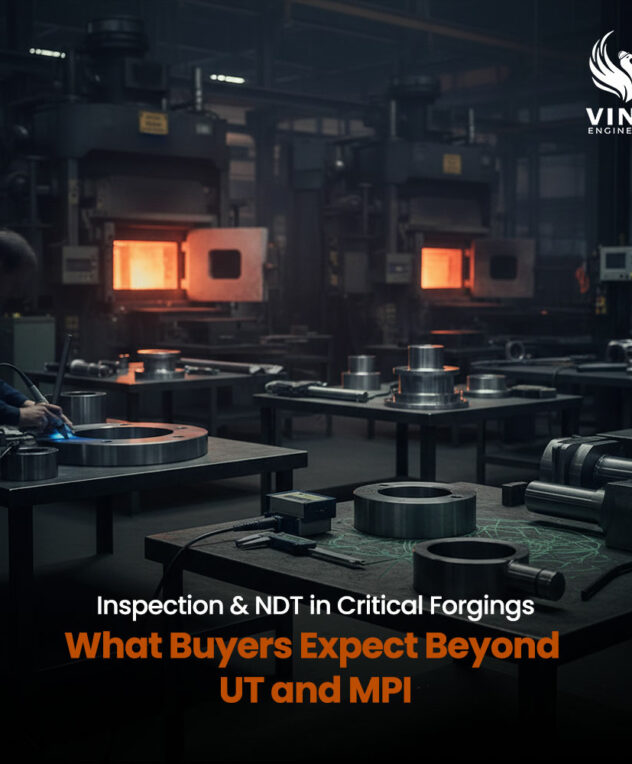
Inspection of a hollow shaft can include ultrasonic examination, surface NDT and dimensional verification.
Depending on geometry, the hollow condition can provide additional access for inspection.
The exact method must nevertheless follow the governing customer or industry specification.