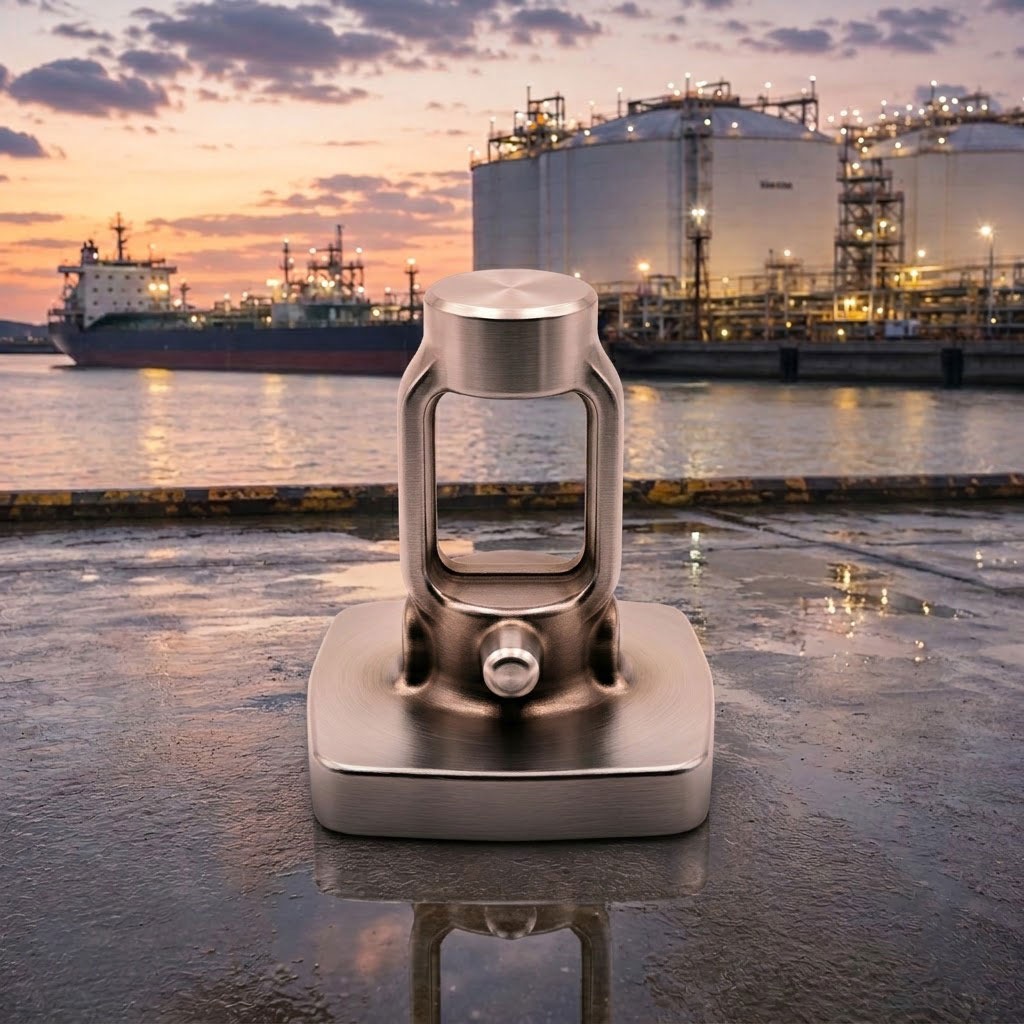
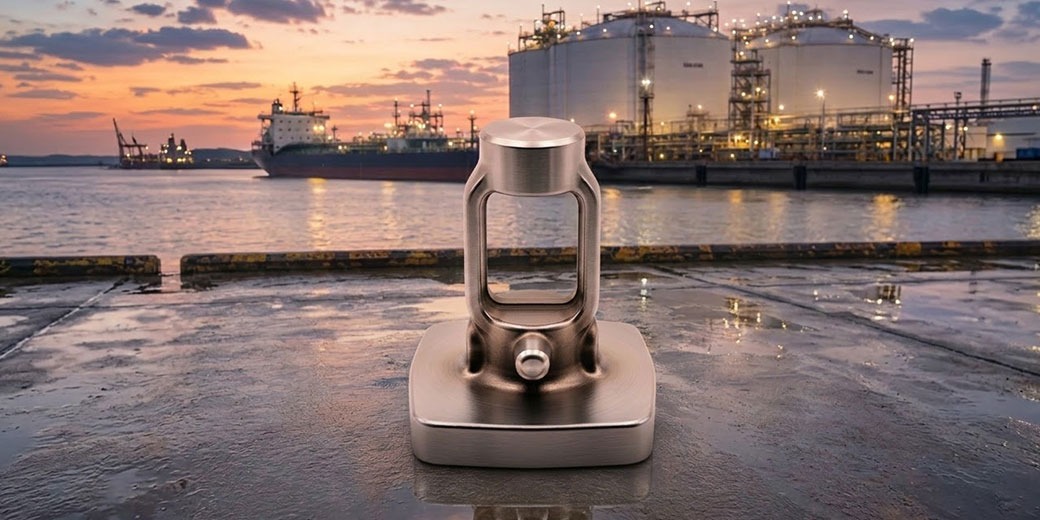
9% nickel steel (UNS K81340, ASTM A353, ASTM A553) is the primary structural material for cryogenic LNG storage tank shells, LNG carrier primary barriers, and liquid nitrogen storage vessels — it maintains adequate toughness at -196°C (liquid nitrogen temperature) and -162°C (LNG temperature) where carbon steel and most low-alloy steels become catastrophically brittle. As India’s LNG import infrastructure expands (Petronet Dahej, H-Energy, Adani Dhamra, DPCL Chhara) and as Indian shipyards target LNG carrier construction, 9% nickel steel forging capability — for nozzle forgings, manway forgings, and structural fittings — is an emerging domestic requirement.
Application
Component
Specification
Test Temperature
LNG storage tank (onshore)
Tank shell nozzles, manway rings
ASTM A353 / A553 Type I
-196°C Charpy ≥34 J
LNG carrier (IMO Type C)
Pressure vessel nozzles, fittings
ASTM A553 Type I
-196°C Charpy ≥34 J
LNG regasification piping
Flanges, valve body fittings
ASTM A182 F9Ni (equiv)
-196°C Charpy ≥34 J
Liquid nitrogen storage
Pressure vessel nozzles
ASTM A353 / A553
-196°C Charpy ≥34 J
Space launch vehicle propulsion
LOX/LH₂ structural fittings
9% Ni or equivalent
≤-196°C Charpy qualified
9% nickel steel achieves its exceptional cryogenic toughness through a unique microstructural mechanism — the 9% nickel stabilises a fine-grained martensite (body-centred tetragonal crystal structure) with inter-lath austenite films at martensite lath boundaries. These austenite films (approximately 10–20% by volume, retained after the double normalise-and-temper or quench-and-temper heat treatment) are metastable at cryogenic temperatures — they remain austenitic even at -196°C because their nickel content is higher than the bulk average (austenite stabilisation is nickel-concentration-dependent). The retained austenite films at martensite lath boundaries absorb fracture energy by transforming to martensite under the stress ahead of a propagating crack tip — this stress-induced transformation plasticity at the crack tip dramatically increases fracture toughness at temperatures where the bulk steel would otherwise be brittle.
ASTM A353 and ASTM A553 are the two primary specifications for 9% nickel steel pressure vessel plate — A353 for the older double-normalised-and-tempered condition (DN+T), and A553 Type I for the quenched-and-tempered (Q&T) condition. Q&T processing (A553 Type I) produces slightly higher strength (minimum 690 MPa yield versus 585 MPa for A353) and marginally better Charpy toughness at -196°C. For forged nozzle and fitting components, the equivalent material is not directly standardised in ASTM A182 — buyers specify 9% Ni steel forgings by referencing ASTM A353 or A553 chemistry and mechanical requirements in the forging specification, with the heat treatment adapted from A353/A553 to the forging cross-section geometry.
The critical quality verification for 9% nickel steel forgings is the Charpy impact test at -196°C (liquid nitrogen immersion cooling of test specimens) — minimum 34 J average (3-specimen set) with no individual value below 27 J. This is more demanding than the -196°C requirements for austenitic stainless (304L, 316L) because 9% nickel steel’s cryogenic toughness mechanism is more sensitive to heat treatment deviations than austenite’s face-centred cubic crystal structure-based toughness. The -196°C Charpy test requires NABL-accredited capability — the test specimens must be cooled in liquid nitrogen and rapidly transferred to the Charpy test machine, with the transfer time controlled to within 5 seconds to prevent specimen warming above -187°C during transfer.
The global LNG infrastructure boom — over 150 MTPA of new LNG liquefaction capacity under construction or in advanced development — and India’s domestic LNG terminal expansion create a growing market for 9% nickel steel forged nozzle and fitting components. Indian forging manufacturers who develop 9% nickel steel forging capability (with NABL Charpy at -196°C as the essential laboratory credential) can supply both the domestic Indian LNG terminal market (Petronet, H-Energy, Adani) and the export LNG plant construction market.
AS9100D. 9% nickel steel (ASTM A353 / A553 Type I chemistry) closed die and open die nozzle and fitting forgings 1–2,000 kg. Double-normalise-and-temper (DN+T) heat treatment per ASTM A353 or quench-and-temper (Q&T) per ASTM A553 Type I in AMS 2750-calibrated furnaces. NABL Charpy at -196°C — liquid nitrogen immersion cooling, transfer time controlled to within 5 seconds. Minimum 34 J average, no individual below 27 J. NABL OES chemistry including nickel verification (8.5–9.5%). PMI on 100% of 9% nickel steel deliveries. ASME Section VIII material certification format (A/SA-353, A/SA-553). TPI by Bureau Veritas and Intertek. LNG service documentation package (MTR, heat treatment record, -196°C Charpy report, CoC).
Frequently Asked Questions
1.What makes 9% nickel steel uniquely suited for LNG cryogenic service compared to austenitic stainless steel?+–
9% nickel steel and austenitic stainless steel (304L, 316L) both maintain adequate toughness at -196°C LNG temperature — but they achieve this toughness through different mechanisms and have different cost and weldability profiles. 9% nickel steel achieves cryogenic toughness through retained inter-lath austenite films that provide transformation plasticity at crack tips. Austenitic stainless achieves it through the FCC crystal structure’s intrinsic ductility at all temperatures. The commercial difference: 9% nickel steel costs approximately 60–70% less than 316L stainless by weight for equivalent structural sections, making it the economic choice for large LNG storage tanks (which use very large quantities of plate material). Austenitic stainless is preferred for smaller components (nozzles, fittings, piping) where fabrication labour dominates over material cost and where the corrosion resistance of stainless is additionally beneficial.
2.What is the ASME code designation for 9% nickel steel pressure vessel forgings?+–
ASTM A353 (Standard Specification for Pressure Vessel Plates, Alloy Steel, 9 Percent Nickel, Double-Normalized and Tempered) and ASTM A553 Type I (Standard Specification for Pressure Vessel Plates, Alloy Steel, Quenched-and-Tempered 8 and 9 Percent Nickel) are the plate material standards. ASME II Part A adopts these as SA-353 and SA-553. For forged components, buyers specify the chemistry and mechanical requirements of SA-353 or SA-553 in the forging specification, with ASME II Part A SA-182 format certificates. ASME BPVC Code Case 2736 (Nickel Steel Forgings for Cryogenic Service) provides a specific code recognition pathway for 9% nickel steel forgings in ASME Section VIII pressure vessels — forging manufacturers qualifying under Code Case 2736 can provide ASME Code-compliant certifications for 9% nickel steel cryogenic nozzle and fitting forgings.
3.What are the weldability requirements for 9% nickel steel forgings and what filler materials are specified?+–
9% nickel steel is weldable using either nickel-alloy filler wire (ERNiCrMo-6 or ENiCrMo-6) or matching 9% nickel filler (ER80S-Ni9 or similar). Nickel-alloy filler (ERNiCrMo-6, Inconel 625 filler wire) is the preferred choice for most LNG tank and pressure vessel welding because: it provides fully austenitic weld metal that is inherently tough at -196°C (the matching 9% nickel filler wire produces martensitic weld metal that requires post-weld heat treatment to develop adequate cryogenic toughness, whereas the ERNiCrMo-6 austenitic weld metal does not require PWHT). PWHT after welding 9% nickel steel with nickel-alloy filler is typically not required — which simplifies fabrication significantly compared to other ferritic or martensitic alloy steels. The forging manufacturer should ensure that the forging surface condition (free of scale, oxide, and carbon contamination) is adequate for the weld procedure qualification.
4.What is India’s LNG infrastructure expansion and what 9% nickel steel forging demand does it create?+–
India’s LNG import capacity is expanding from approximately 45 MTPA (2024) to a planned 100+ MTPA by 2030 — through new terminals at Dhamra (Adani, 5 MTPA), Chhara (Swan Energy/DPCL, 5 MTPA), Jaigarh (H-Energy, 5 MTPA), and expansions at Dahej (Petronet, additional trains). Each new LNG terminal includes 9% nickel steel cryogenic storage tanks (typically 160,000–180,000 m³ per tank) whose construction requires large quantities of 9% nickel steel plate — procured from international mills (POSCO Korea, Nippon Steel Japan, ArcelorMittal). The forged components in each LNG terminal cryogenic system — nozzle forgings for storage tank manway and pipe connections, fitting forgings for cryogenic piping — represent a smaller but accessible fraction of the total 9% nickel steel procurement. Indian forging manufacturers with -196°C Charpy test capability can supply these nozzle and fitting forgings for domestic LNG terminal construction.
5.How does the transfer time requirement for -196°C Charpy testing affect the NABL laboratory accreditation for this test?+–
ASTM E23 (Standard Test Methods for Notched Bar Impact Testing of Metallic Materials) and the supplementary requirements of ASTM A353/A553 specify that specimens cooled in liquid nitrogen must be transferred to the Charpy test machine and tested within 5 seconds of removal from the cooling medium — to prevent specimen warming above -187°C (≥9°C temperature rise). This 5-second transfer time requirement means: the Charpy test machine must be positioned immediately adjacent to the liquid nitrogen cooling bath (maximum 1–2 metres separation); the operator must have practiced the transfer procedure until it is consistently completed within the time limit; and a thermocouple or temperature indicator must verify specimen temperature at the test point. For NABL accreditation of -196°C Charpy testing, the laboratory must demonstrate equipment layout compliance with the 5-second transfer requirement and demonstrate measurement uncertainty analysis for temperature at the test point.