

ABS Certified Marine Forging Supplier for US Shipbuilding
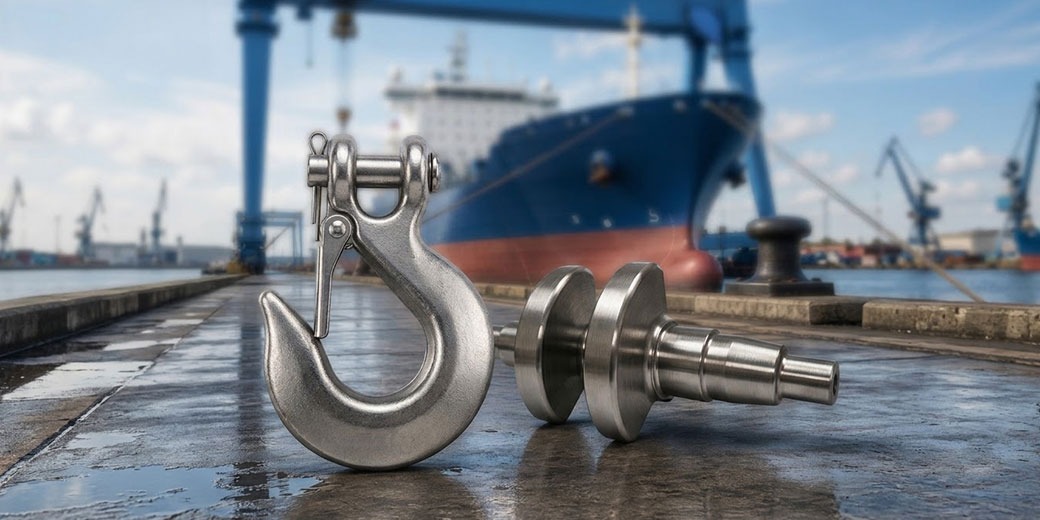
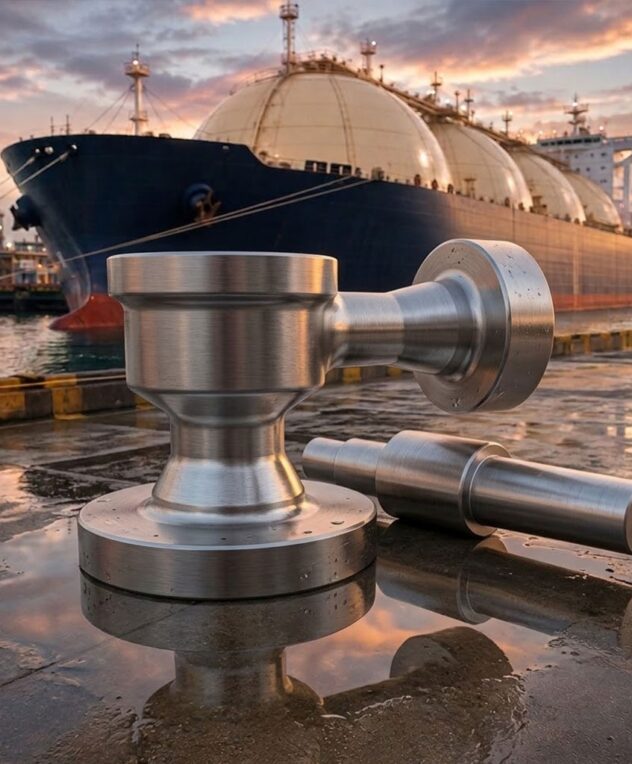
US commercial and naval shipbuilding – at HII, Bath Iron Works, Philly Shipyard, and NASSCO – requires ABS-certified propulsion shaft forgings, rudder stock forgings, and structural hull fitting forgings. Indian ABS-approved forging manufacturers supply this market at 15–25% cost advantage over domestic US marine forging supply.
| Component | Material | ABS Grade | Weight |
| Propulsion shaft | Alloy steel | Grade 3 / Grade 4 | 2,000–8,000 kg |
| Intermediate shaft | Alloy steel | Grade 3 | 1,000–4,000 kg |
| Rudder stock | High-strength alloy steel | Grade 4 | 500–3,000 kg |
| Structural hull fitting | Alloy steel | Grade 2 | 50–500 kg |
ABS (American Bureau of Shipping) material certification is mandatory for structural and propulsion forgings incorporated in ABS-classed US vessels. The ABS surveyor witnesses heat treatment and mechanical testing at the forge shop without ABS Form C1 material certificate, forgings cannot be installed in an ABS-classed vessel.
ABS Grade 3 (minimum tensile 590 MPa) is the standard for destroyer and commercial vessel propulsion shafts. Grade 4 (minimum tensile 690 MPa) is specified for higher-load applications including destroyer-class rudder stocks. The ABS surveyor witnesses quench and temper heat treatment, tensile testing, Charpy impact, and hardness all from witness pieces from the same heat as the production shaft.
Entry point: US auxiliary vessels (T-AO fleet oilers, MSC support ships) are the most accessible starting point commercial-standard propulsion shaft forgings, ABS class, no ITAR, no SUBSAFE. Qualification for US Navy surface combatants (DDG-51) follows once the ABS survey relationship and US naval documentation familiarity are established.
Vinir Engineering’s Capability
- ABS approved manufacturer.
- Open die propulsion shaft forgings up to 15,000 kg on 3,000T hydraulic press.
- ABS Grade 3 and Grade 4 alloy steel.
- ABS surveyor coordination for heat treatment witness.
- 100% UT before and after heat treatment.
- Wet fluorescent MT two-direction.
- AS9100D full scope.