
Heavy Equipment Forging from India for US Construction and Mining OEMs
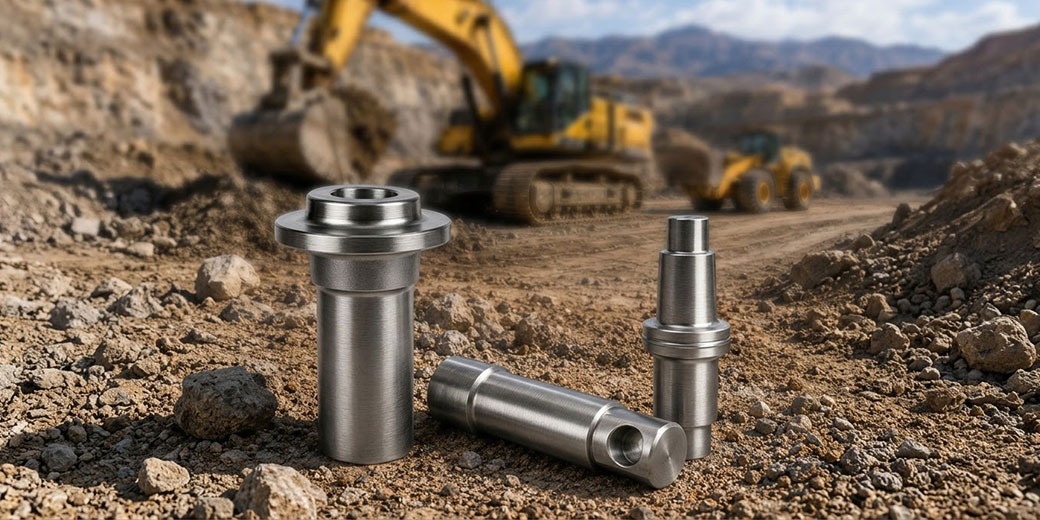
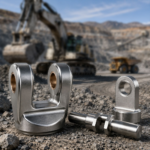
US construction equipment OEMs — Caterpillar, John Deere, Komatsu, CNH Industrial (Case and New Holland), Volvo CE, and Liebherr and their mining equipment counterparts consume substantial forged components across crawler excavators, wheel loaders, motor graders, articulated haul trucks, and large construction cranes. Structural pin forgings, drive shaft forgings, hydraulic cylinder rod forgings, final drive components, and undercarriage system forgings are the highest-volume forging categories in construction equipment manufacturing. Indian forging manufacturers with ISO 9001 or AS9100D certification, 4340 and 4140 alloy steel production history, open die capability for heavy components, and established OEM supply relationships are positioned to supply US construction equipment OEMs at 20–35% cost advantage over domestic US supply.
At a Glance: US Construction Equipment Forging Requirements
| Equipment | Key Forging | Material | Weight | OEM |
| Crawler excavators (20–90 tonne) | Boom pin, arm pin, bucket pin | 4340, EN36 | 5–200 kg | Cat, Komatsu, Deere, Volvo |
| Wheel loaders (medium-large) | Bucket pin, lift arm pin, Z-bar | 4340 | 10–150 kg | Cat, Komatsu, CNH |
| Motor graders | Drawbar ball stud, circle drive | 4340, 4140 | 20–200 kg | Cat, Deere, CASE |
| Articulated haul trucks | Front hitch pin, oscillation pin | 4340 | 30–300 kg | Cat, Volvo, Liebherr |
| Crawler dozers | Final drive gear blank, sprocket | EN36, 4340 | 20–150 kg | Cat, Komatsu |
| Tower cranes | Slew bearing ring, mast pin | 42CrMo4, S355 | 100–2,000 kg | Liebherr, Manitowoc |
| Piling rigs | Leader pin, crowd cylinder rod | 4340, EN24 | 50–400 kg | Liebherr, Bauer |
| Concrete pumps | Boom pin, outrigger cylinder rod | 4140 | 20–150 kg | Putzmeister, Schwing |
The US Construction Equipment Market
Market Scale and OEM Structure
The US construction equipment market the second largest in the world after China generates approximately $45 billion in annual equipment sales across earthmoving, lifting, road building, and concrete equipment. Caterpillar alone manufactures over $25 billion in construction and mining equipment annually, with manufacturing at Decatur (Illinois), Aurora (Illinois), and multiple additional US plants.
Construction equipment replacement parts market: Beyond new equipment, the US construction equipment aftermarket replacement structural pins, drive components, and undercarriage parts generates substantial forging demand. Caterpillar’s parts business (Caterpillar Parts, managed through Cat dealers) and independent aftermarket suppliers (H&L Tooth Company, Hensley Industries, ESCO Corporation) source replacement structural pin forgings globally, including from India.
The aftermarket opportunity for Indian forging manufacturers: The replacement parts market is more accessible than OEM new equipment supply for first-time Indian forging suppliers to the US construction market. Aftermarket parts distributors have simpler supplier qualification processes than OEM procurement teams, and the volumes though smaller per order are consistent and repeat.
US Construction Market Growth Drivers
Infrastructure Investment and Jobs Act (IIJA): The $1.2 trillion IIJA signed in 2021 is funding US highway reconstruction, bridge replacement, water infrastructure, and broadband expansion through 2026 and beyond. Highway and bridge construction is one of the most equipment-intensive activities in the construction sector motor graders, crawler excavators, wheel loaders, and compactors are all active on IIJA-funded projects. This has driven above-trend US construction equipment utilisation rates and equipment replacement demand.
Data centre construction: The US data centre construction boom driven by AI computing demand is one of the fastest-growing segments of the US commercial construction market. Large crawler excavators and haul trucks are active on data centre campus site preparation projects across Texas, Virginia, Georgia, and the Mountain West.
Residential construction recovery: US residential construction starts have recovered from the 2022–2023 interest rate shock. New residential development particularly in Sun Belt states (Texas, Florida, Arizona, the Carolinas) uses compact and mid-range excavators, wheel loaders, and graders in large quantities.
Structural Pin Forgings — The Highest-Volume Construction Equipment Forging
Why Structural Pins Are Forged
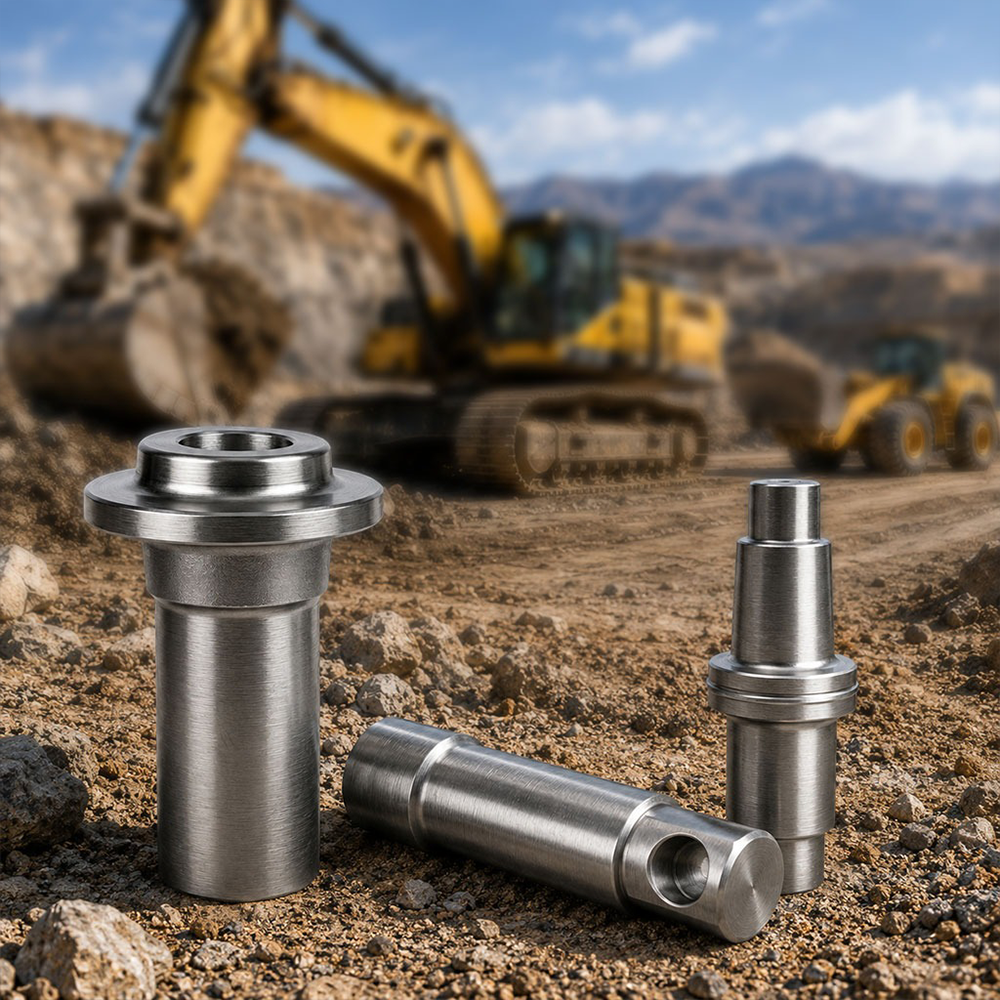
Every articulation point in a crawler excavator, wheel loader, or motor grader is a pin joint a forged steel pin that carries the structural load while allowing rotation between adjacent members. A typical 30-tonne crawler excavator has approximately 15–20 structural pin joints: boom-to-machine body, boom-to-arm, arm-to-bucket, bucket link pins, and multiple attachment pins. Each pin is replaced on a maintenance cycle of 2,000–8,000 hours depending on operating conditions.
Why forged, not cast: Structural pins in construction equipment experience concentrated bending and shear loading at the pin bushing interfaces locations where stress concentrations would initiate fatigue cracks in cast components. Forged pins with longitudinal grain flow along the pin axis resist these stresses through the strongest grain orientation. Casting defects porosity and shrinkage create fatigue crack initiation sites in locations that cannot be detected by standard surface inspection. For structural safety-critical pins in large construction equipment, forgings are the required manufacturing process.
Pin Geometry and Heat Treatment Classes
US construction equipment OEMs classify structural pins by load category, which drives the heat treatment requirement:
Class 1 (standard duty): Tensile 860–1,000 MPa (125,000–145,000 psi). Tempered at 550–600°C. Used for lower-load pin positions – bucket linkage, attachment pins.
Class 2 (heavy duty): Tensile 1,000–1,200 MPa (145,000–174,000 psi). Tempered at 480–550°C. Used for primary structural pins boom-to-machine, boom-to-arm.
Class 3 (severe duty): Tensile 1,200–1,400 MPa (174,000–203,000 psi). Tempered at 400–480°C. Used for highest-load applications large hydraulic mining shovel pins.
The heat treatment class is defined on the OEM’s pin drawing or purchase order specification. Indian forging manufacturers must have validated heat treatment procedures for each class demonstrating that the specified tensile range is achieved with adequate Charpy impact toughness at the specified test temperature.
Undercarriage System Forgings
Why Undercarriage Components Are Critical
The undercarriage of a tracked construction or mining machine crawler shoes (track pads), track pins, track bushings, carrier rollers, bottom rollers, and final drive sprockets operates in the most abrasive and impact-intensive environment in any construction or mining machine. An excavator working in hard rock or abrasive soil replaces its undercarriage every 3,000–5,000 hours generating continuous replacement demand.
Track Pin and Bushing Forgings
Track pins: The pins that connect adjacent track links in a crawler undercarriage. Produced in case-hardening steel (EN36, 18CrNiMo7-6) with a through-hardened core and a carburised surface to 58–62 HRC. The surface hardness resists the abrasive wear from soil and rock particles that pass between the pin and bushing during track rotation. The tough core absorbs the impact from track engagement with the drive sprocket and idler.
Track bushings: The mating component to the track pin a hollow cylindrical forging that rotates relative to the pin as the track articulates. Same material and heat treatment as track pins. The bushing bore surface (in contact with the pin) and OD surface (in contact with the sprocket tooth) are both carburised and hardened.
Indian forging supply for track pins and bushings: Track pin and bushing forgings for US construction equipment are produced in quantities of hundreds to thousands per OEM model year. This is a high-volume, repeat-order forging category that suits Indian forge shop production economics well. The heat treatment (carburise plus case harden) requires a carburising furnace capability not all Indian forge shops have this, but those with carburising infrastructure are competitive for this category.
Final Drive Gear Blank Forgings
Final drives transmit power from the hydraulic motors to the track drive sprockets. The gear blanks are case-hardening steel (EN36 or 18CrNiMo7-6) forgings that are subsequently gear-tooth-machined and case-hardened by the gear manufacturer. Weights range from 20–150 kg depending on the machine size.
The same gear blank forging category discussed in the armoured vehicle blog (EN36 for M1 Abrams final drives) applies directly to construction equipment the material, heat treatment, and geometry requirements are similar. Indian forge shops with EN36 gear blank production experience for defence programmes are directly qualified for construction equipment final drive gear blank supply.
Hydraulic Cylinder Rod Forgings
Construction Equipment Hydraulic System Scale
A large crawler excavator uses 5–7 hydraulic cylinders boom cylinder, arm cylinder, bucket cylinder, and blade/attachment cylinders. Each cylinder rod is a precision alloy steel forging that must:
- Achieve high tensile strength (typically 900–1,100 MPa) for the column load of the hydraulic pressure force
- Maintain a precision-machined OD (the surface that the cylinder seal contacts) within tight concentricity tolerances
- Be straight within 0.1mm per metre a bent cylinder rod causes premature seal wear and cylinder leakage
- Have a chrome-plated or alternatively coated working surface the forging must provide adequate base material properties for hard chrome or HVOF coating adhesion
Material: AISI 4140 (chromium-molybdenum steel) for standard duty cylinder rods. EN24 (nickel-chromium-molybdenum) for higher-duty applications. Some OEMs specify 17-4PH stainless steel for corrosion-resistant cylinder rods in marine or agricultural applications.
Indian supply opportunity: Hydraulic cylinder rod forgings are a high-volume, repeat-order category for construction equipment suppliers. US hydraulic cylinder manufacturers (Parker Hannifin, Bosch Rexroth, Eaton Hydraulics, Caterpillar hydraulics division) purchase cylinder rod forgings in substantial quantities. Indian forge shops with 4140 and EN24 production capability, straightness verification equipment, and surface finish capability for chrome plating substrate are competitive for this category.
Tower Crane and Lifting Equipment Forgings
US Tower Crane Market and Forging Requirements
The US tower crane market dominated by Liebherr, Manitowoc (Potain), Wolffkran, and Comansa is experiencing strong growth from the data centre, high-rise residential, and commercial construction boom. Tower cranes use large-diameter slew bearing ring forgings (42CrMo4), mast connection pin forgings (4340), jib connection pins, and hook block structural forgings.
Slew bearing ring forgings for tower cranes: The slew ring bearing that allows the tower crane superstructure to rotate on the tower mast is a large-diameter 42CrMo4 ring-rolled forging typically Ø1,500–3,000mm OD for commercial tower cranes, Ø3,000–5,000mm for large luffing jib cranes. Heat treatment to 28–34 HRC through-hardened, with subsequent induction hardening of the gear tooth profile and raceway the same process as wind turbine bearing rings.
FEM (finite element method) load analysis for crane structural forgings: Unlike construction equipment structural pins which are produced to standard specifications crane structural forgings are often project-specific or model-specific designs where the OEM has conducted FEM load analysis to optimise the geometry. Indian forging manufacturers supplying crane structural forgings must be able to interpret FEM analysis results and confirm that the proposed forging geometry provides the required properties at the critical load-bearing cross-sections.
Crawler Crane and Piling Rig Forgings
Liebherr LTM and Manitowoc crawler cranes: Large crawler cranes (100–3,000 tonne lifting capacity) use boom section connection pin forgings in the 50–500 kg range and slew ring bearing forgings at Ø1,500–4,000mm. German OEMs (Liebherr, Tadano Faun) source from European and Asian forge shops Indian suppliers with appropriate quality systems and dimensional capability can compete for this supply.
Bauer and Liebherr piling rigs: Foundation engineering equipment piling rigs, soil mixing units, and diaphragm wall cutters uses leader pin forgings and crowd cylinder rod forgings in 4340 and EN24. These are produced in the 50–400 kg range with tight straightness and cylindricity tolerances.
Concrete Equipment Forgings
US Concrete Equipment Market
The US concrete equipment sector concrete pump trucks, concrete mixing trucks, and stationary concrete batching plants generates forging demand for boom pin forgings and outrigger cylinder rod forgings.
Putzmeister and Schwing concrete pump booms: Concrete pump truck booms articulated steel booms that extend up to 65 metres to place concrete on construction sites use high-strength alloy steel boom section pin forgings (4140 or 4340, 900–1,100 MPa tensile) at each articulation point. A 5-section concrete pump boom has 8–10 pin joints per boom, each requiring a precision forged pin.
US concrete equipment distributors (Putzmeister America, Schwing Stetter America) source replacement boom pins through US distribution channels some of which source from Indian forge shops for cost-competitive replacement parts supply.
Qualification Process for US Construction Equipment Forging Supply
The Path to OEM Approval
Construction equipment OEM forging qualification is more accessible than aerospace or nuclear qualification but more structured than general industrial supply:
ISO 9001 (minimum): All major US construction equipment OEMs require ISO 9001 minimum from forging suppliers. AS9100D is not required but is a strong differentiator it signals quality system maturity that construction equipment OEM quality engineers appreciate.
Material approval: OEMs require review of the supplier’s heat treatment procedures for the specific material grades and tensile classes specified on their drawings. The procedure qualification must demonstrate that the specified tensile strength class is achieved with adequate toughness at the minimum specified test temperature.
First Article Inspection (FAI): Most US construction equipment OEMs require an FAI for new part numbers all drawing dimensions measured and reported, heat treatment records reviewed, and material test results verified. Less formal than the AS9102 FAIR used in aerospace but covering the same dimensional verification intent.
TPI for initial lots: Bureau Veritas or Intertek witness inspection for the first 2–3 production lots is typically required by major OEMs for new suppliers. Once the supplier’s quality track record is established, TPI may be relaxed to annual surveillance or self-certification for repeat orders.
Typical timeline: 6–10 months from initial capability submission to first production order for a well-prepared Indian AS9100D supplier.
Vinir Engineering’s Construction Equipment Forging Capability
Structural pin forgings: 4340, EN24, and EN36 closed die forgings 5–1,400 kg. Heat treatment to Class 1, 2, and 3 tensile specifications. 100% hardness testing per pin. MT of all surfaces. NABL Charpy at -20°C standard.
Undercarriage components: EN36 and 18CrNiMo7-6 case-hardening steel forgings track pin, bushing, and final drive gear blanks. Soft anneal or pre-harden condition as specified. Carburising capability available through qualified subcontractor with AS9100D certification.
Hydraulic cylinder rod forgings: 4140 and EN24 alloy steel, 50–500 kg. Straightness verification to 0.1mm/metre post-heat treatment. Precision-machined stock for chrome or HVOF coating substrate.
Ring-rolled components: 42CrMo4 slew bearing rings to Ø4,500mm for tower crane and crawler crane applications.
Open die forgings: Crusher shaft equivalents, large hydraulic cylinder bodies, and structural components up to 15,000 kg.
AS9100D: Full scope. ISO 9001 compliant as superset. TPI through Bureau Veritas and Intertek.
Lead times: Structural pins 50–200 kg 10–14 weeks to US port. Large open die shaft forgings 14–18 weeks. All including ocean freight Chennai to US Gulf Coast.