
Naval Forgings in India: ABS Certified Components for Naval Defence Programmes
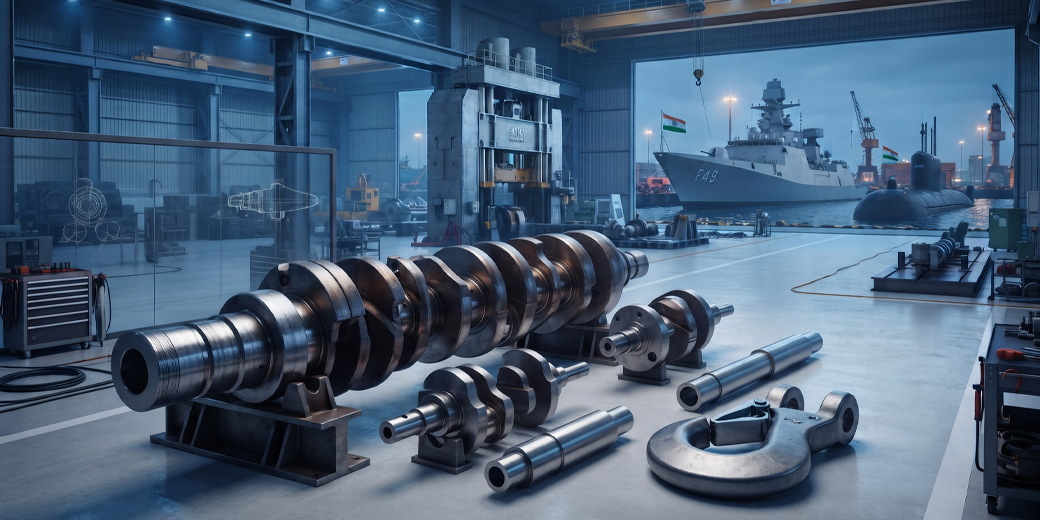
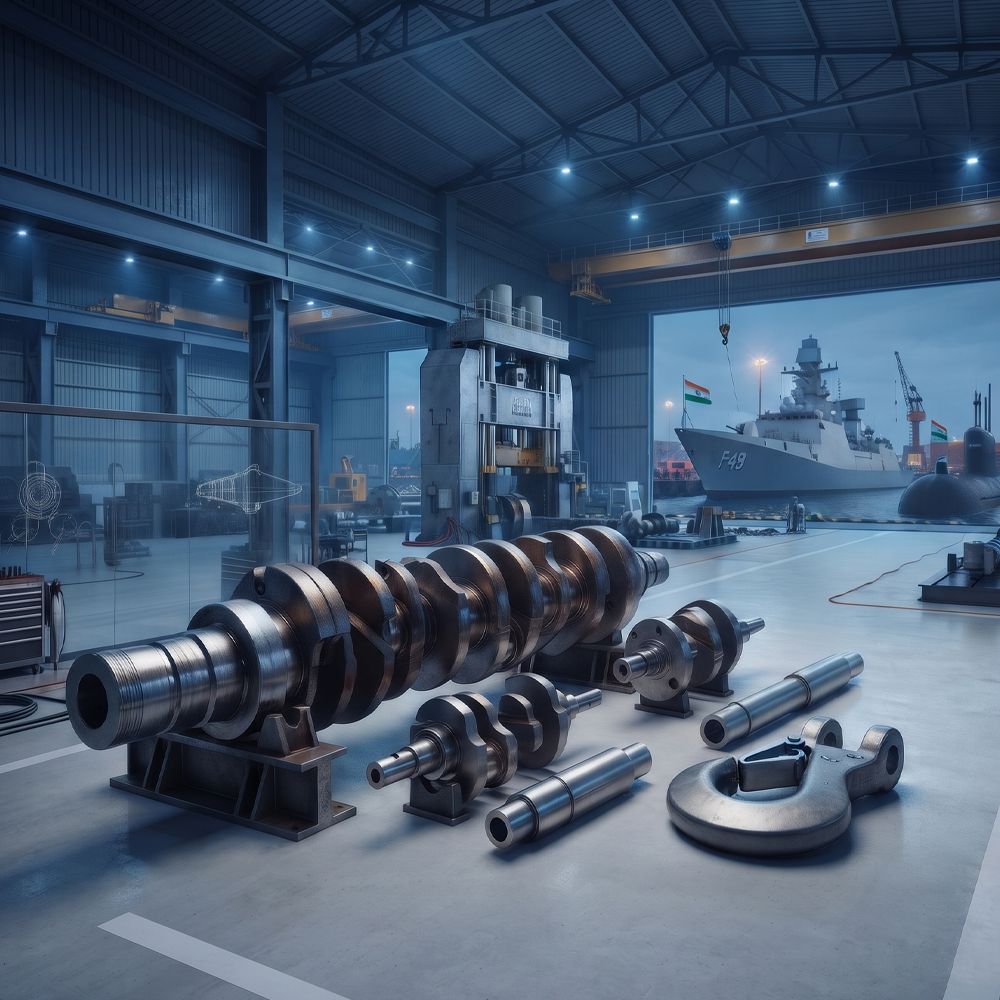
Naval defence forgings are forged metallic components used in warships, submarines, offshore patrol vessels, and coastal defence platforms. Unlike commercial marine forgings, naval components carry additional requirements — classification society approval (ABS, Lloyd’s Register, or Bureau Veritas), material specifications that exceed commercial grades, DGQA oversight for Indian Navy procurement, and in many cases specific naval authority design standards (NES, DEF STAN) where international OEM involvement exists.
Naval Forging Categories and Requirements
| Component | Material | Certification | Forging Process |
| Propulsion shafts | Alloy steel, duplex | ABS, DNV | Open die |
| Stern tube forgings | Alloy steel | ABS | Open die |
| Rudder stock | Alloy steel | ABS | Open die |
| Structural hull forgings | High-strength steel | ABS / BV | Open die, closed die |
| Flange and coupling forgings | Carbon steel, alloy steel | ABS | Closed die |
| Valve body forgings | Duplex, super duplex | ABS, IBR | Closed die, ring rolling |
| Pressure vessel forgings | Alloy steel, duplex | IBR, ABS | Open die, closed die |
| Anchor and mooring forgings | Carbon steel | ABS | Open die, closed die |
| Gun mount structural forgings | High-strength alloy steel | AS9100D, ABS | Closed die, open die |
| Submarine pressure hull fittings | High-strength steel | ABS, DGQA | Closed die, open die |
India’s Naval Shipbuilding DPSUs and Their Forging Requirements
India’s three principal naval shipbuilding DPSUs each operate distinct build programmes with specific forging supply requirements.
MDL — Mazagon Dock Shipbuilders, Mumbai
MDL is building the most technically demanding naval platforms in India — P75 Kalvari-class submarines, Project 15B Visakhapatnam-class destroyers, and Project 17A Nilgiri-class frigates. Forging requirements at MDL include:
- Propulsion shaft forgings — 8,000 to 12,000 kg open die forgings in alloy steel, requiring comprehensive UT to verify internal cleanliness across the full shaft volume
- Structural ring forgings — ring rolled to Ø2,500mm+ for hull frame rings and structural transition sections
- Submarine pressure hull penetration forgings — high-strength steel closed die forgings for torpedo tube end caps, mast glands, and hull valves, manufactured to the most stringent dimensional and NDT requirements in Indian naval forging
- Duplex and super duplex valve bodies — for seawater piping systems where corrosion resistance alongside structural integrity is mandatory
All structural and propulsion forgings for MDL programmes require ABS or Bureau Veritas certification from the forging manufacturer.
GSL — Goa Shipyard Limited
GSL builds offshore patrol vessels, survey ships, and fast interceptor craft. Forging requirements are skewed toward medium-sized structural and propulsion components — shaft forgings in the 2,000–6,000 kg range, propeller shaft couplings, structural hull fittings, and machinery foundation forgings. ABS or BV certification required.
GRSE — Garden Reach Shipbuilders, Kolkata
GRSE builds frigates, landing craft, fast patrol vessels, and survey vessels. Broad forging requirements across hull structure, propulsion, and deck equipment categories. Forging sizes range from small valve bodies and fittings through to intermediate propulsion shaft forgings. ABS certification required for structural and propulsion forgings.
ABS Certification for Naval Forging Manufacturers
The American Bureau of Shipping (ABS) is the primary classification society for Indian naval shipbuilding programmes. ABS-certified forgings are manufactured under a quality plan approved by ABS, with ABS surveyors witnessing heat treatment and mechanical testing for each certified lot.
The ABS Approval Process
Initial ABS approval for a forging manufacturer involves:
Facility assessment — ABS reviews the manufacturer’s quality management system, heat treatment equipment and calibration records, NDT capability and operator qualifications, and testing laboratory NABL accreditation.
Approval test pieces — The manufacturer produces test forgings in representative material grades to the ABS-specified test piece dimensions. These are tested for mechanical properties (tensile, Charpy impact, hardness) with ABS surveyor witness. Chemical analysis is performed and compared to the specified grade.
Approval certificate — Upon satisfactory completion, ABS issues a manufacturer’s approval covering the specific material grades and forging processes demonstrated. This approval must be maintained through ongoing surveyor oversight.
Ongoing ABS Survey for Each Lot
Once approved, production of ABS-certified forgings requires:
- ABS surveyor notification before each production lot
- Surveyor attendance at heat treatment for critical components
- Surveyor witness of mechanical testing (tensile, impact, hardness) for each cast/heat
- Surveyor review and stamping of the ABS material certificate (Form C1 or equivalent)
The ABS certificate accompanies the forging and is a mandatory document for acceptance by the naval shipyard’s quality team and DGQA.
Duplex and Super Duplex Forgings for Naval Applications
Naval environments — surface ship seawater piping, submarine external structures, offshore naval platforms — demand corrosion resistance alongside structural strength. Duplex stainless steel (UNS S31803, grade 2205) and super duplex stainless steel (UNS S32750, grade 2507) are increasingly specified for naval valve bodies, flange rings, and structural fittings in seawater service.
Why Duplex Over Austenitic Stainless
Standard austenitic stainless steels (316L, 304) are susceptible to stress corrosion cracking in chloride-rich naval environments under stress. Duplex steels have approximately twice the yield strength of 316L, superior resistance to chloride stress corrosion cracking, and better resistance to pitting corrosion in seawater. For pressure-bearing naval components in seawater service, duplex and super duplex are now the standard specification in most new-build programmes.
Critical Process Requirements for Duplex Naval Forgings
Solution annealing after forging is mandatory for duplex and super duplex grades. The heat treatment window is narrow — typically 1,020–1,100°C for 2205, slightly higher for 2507 — and the cooling rate must be rapid enough to prevent sigma phase precipitation, which destroys both corrosion resistance and toughness. Deviation from the solution annealing specification can produce a forging that passes mechanical testing but fails corrosion testing.
Ferrite content verification (typically by magnetic measurement or metallographic examination) is standard for duplex naval forgings to confirm the target austenite-ferrite balance of approximately 50:50.
Propulsion Shaft Forgings: The Most Technically Demanding Naval Forging
Propulsion shaft forgings for frigates and destroyers are among the most technically demanding forgings in the Indian naval supply chain. A single propulsion shaft for a Project 15B destroyer may be:
- 10–14 metres in length
- 8,000–12,000 kg in weight
- Forged in nickel-chromium-molybdenum alloy steel to Naval authority specifications
The manufacturing challenges are significant. Ingot quality must be exceptional — hydrogen content controlled to avoid flaking, inclusion content minimised through vacuum degassing. The forging sequence must achieve the required reduction ratio throughout the shaft cross-section. Straightness after forging must be within controlled limits to avoid excessive machining removal. Cooling after forging must be controlled to avoid differential cooling stresses.
Ultrasonic testing of completed shaft forgings — 100% volume scan — is performed before machining to verify internal cleanliness throughout the shaft volume. Any rejectable indication requires disposition before machining proceeds.
Naval Forging Materials: What Is Specified and Why
Alloy steels (En24, 605M36, 817M40) — standard for propulsion shafts, rudder stocks, and structural fittings where strength and toughness are the primary requirements. EN24 (817M40) is the most widely used grade for Indian naval propulsion applications.
High-strength steels (HY80, HY100, Q1N) — used for submarine pressure hull components where yield strength must exceed 550MPa (HY80) or 690MPa (HY100) to withstand operating depths. These require carefully controlled heat treatment and welding procedures — the forging supplier must understand the downstream welding implications of the material selection.
Duplex 2205 and super duplex 2507 — for seawater piping valve bodies, heat exchanger tube plate forgings, and structural fittings in contact with seawater. Mandatory solution annealing, ferrite content verification.
IBR-compliant carbon and alloy steels — for steam system components in naval propulsion — main steam flanges, valve bodies, pressure housing forgings on steam-propelled vessels and submarines.
IBR and Naval Forgings
Indian Boiler Regulations (IBR) apply to pressure-retaining components on Indian-flagged vessels and naval platforms using steam systems. For naval forging suppliers, IBR certification is required alongside ABS for steam system components — main steam flanges, stop valve bodies, and pressure vessel forgings on steam-propelled platforms.
IBR inspection involves the Chief Inspector of Boilers’ authorised inspectors witnessing heat treatment and testing for each lot, similar to the ABS survey process. The IBR material certificate (Form III B) accompanies the forging along with the ABS certificate for dual-certified components.
Vinir Engineering holds both IBR certification and ABS approval — one of the few forging manufacturers in India with both approvals, enabling supply of dual-certified components for naval steam and pressure applications without involving a second supplier.
Vinir Engineering’s Naval Forging Capability
Vinir holds ABS approval and IBR certification across four manufacturing units in Bangalore and Hosur.
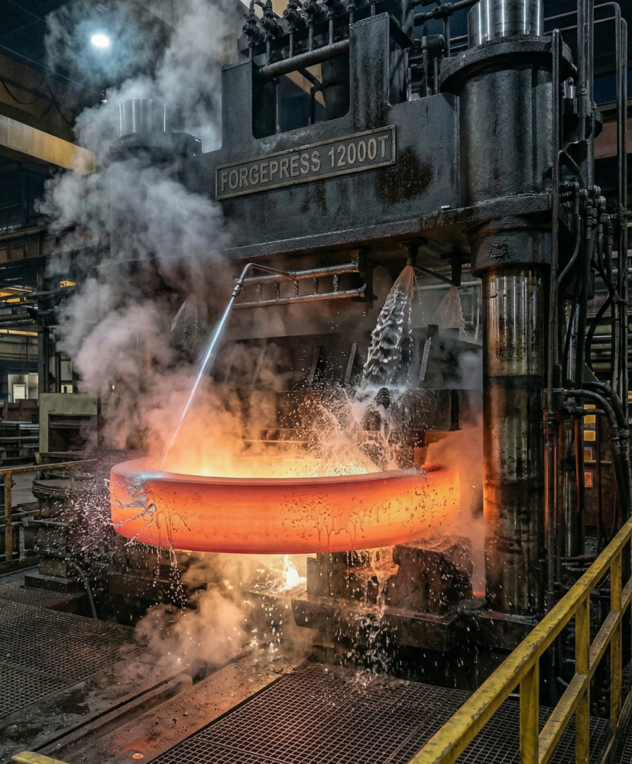
Open die forging to 15,000 kg — covers propulsion shaft forgings for frigates, destroyers, and patrol vessels. The 3000T hydraulic press with dango manipulators handles the weight and length requirements of naval shaft forgings.
Ring rolling to Ø4,500mm — covers structural ring forgings for hull frames, transition sections, and large flange rings. Wagner and Banning radial-axial mill.
Closed die forging 10–1,400 kg — covers valve bodies, flange fittings, coupling forgings, and structural components throughout the naval forging weight range.
Duplex and super duplex forging — solution annealing in-house with controlled rapid cooling. Ferrite content verification in NABL-accredited lab.
All naval forgings are manufactured with NABL-accredited in-house mechanical testing and comprehensive ABS documentation — material test certificates, heat treatment records, mechanical test results, NDT reports, and ABS form C1 where applicable.
Frequently Asked Questions — Naval Forgings India
What is the difference between commercial marine and naval defence forgings?
Naval defence forgings carry additional requirements beyond commercial marine standards — classification society approval (ABS, DNV) is mandatory for all structural and propulsion forgings, material specifications are typically higher grade or to specific naval authority standards (NES, DEF STAN), DGQA inspection applies to Indian Navy procurement, and traceability requirements include component-level documentation. Commercial marine forgings may satisfy class society requirements without the military quality overlay that DGQA adds.
Which classification society is most relevant for Indian naval shipbuilding?
ABS (American Bureau of Shipping) is the most commonly specified classification for Indian Navy shipbuilding at MDL, GSL, and GRSE. Lloyd’s Register and Bureau Veritas are also accepted. Indian Register of Shipping (IRS) is accepted for some auxiliary and patrol vessel programmes. Buyers should confirm the specific classification society specified in the quality plan for each programme before approaching forging suppliers.
What is the typical weight range for naval propulsion shaft forgings?
Naval propulsion shaft forgings in the Indian context range from approximately 1,500 kg for fast patrol vessel shafts to over 12,000 kg for destroyer-class main propulsion shafts. Intermediate frigates and offshore patrol vessels typically require shaft forgings in the 3,000–7,000 kg range. All require open die forging capability and comprehensive UT inspection before machining.
Why is duplex steel specified instead of stainless steel for naval seawater applications?
Standard austenitic stainless steels (316L) are susceptible to stress corrosion cracking in warm seawater chloride environments under tensile stress — a condition present in most naval piping systems. Duplex stainless steel has approximately twice the yield strength of 316L, significantly better resistance to chloride stress corrosion cracking, and better pitting resistance. For valve bodies, flange rings, and structural fittings in seawater service, duplex and super duplex have become the standard specification in Indian and international naval new-build programmes.
Can the same forging manufacturer supply both ABS-certified and IBR-certified naval forgings?
Yes, if the manufacturer holds both approvals. ABS covers classification-required structural and propulsion forgings. IBR covers pressure-retaining components in steam systems. For naval vessels with steam propulsion — some submarine classes and older surface ship designs — components at the intersection of these two requirements need dual certification. Vinir Engineering holds both ABS approval and IBR certification, enabling supply of dual-certified naval forgings from a single source.