
Mining Equipment Forging Supplier for US Mining Industry
The United States mining industry — copper mining in Arizona and Nevada, coal mining in Wyoming’s Powder River Basin, gold and silver mining across Nevada and the Mountain West, iron ore in Minnesota’s Iron Range, and the emerging critical minerals sector across the western states consumes substantial forged components for excavation equipment, crushing machinery, conveyor systems, and drilling equipment. Indian forging manufacturers with AS9100D certification, demonstrated capability in high-impact alloy steels, open die capability for heavy components, and established relationships with Caterpillar, Komatsu, Epiroc, and Sandvik supply chains are positioned to supply the US mining equipment forging market at 20–35% cost advantage over domestic US supply.
At a Glance: US Mining Equipment Forging Requirements
| Equipment | Key Forging | Material | Weight | Critical Property |
| Mining excavators (Cat 6090, Komatsu PC8000) | Boom pin, stick pin, bucket pin | 4340, EN36 | 50–500 kg | Impact toughness, wear resistance |
| Draglines (Marion, Bucyrus) | Drag chain pin, bucket rigging | 4340, Hadfield Mn steel | 100–800 kg | Extreme impact resistance |
| Rotary drilling rigs | Kelly bar connection, drill collar | 4140, 4340 | 200–2,000 kg | Fatigue, torsional strength |
| Jaw and cone crushers | Eccentric shaft, main shaft | 4340, EN24 | 200–3,000 kg | Bending fatigue, shock loading |
| Conveyor systems | Drive shaft, gearbox output shaft | EN24, 4340 | 50–500 kg | Torsional fatigue |
| Roof bolting machines | Feed beam, rotation head | 4140 | 20–200 kg | Impact resistance |
| Continuous miners | Cutting head hub, gearbox housing | 4340, cast/forged hybrid | 100–600 kg | Abrasion + impact |
| Longwall mining | Shearer drum hub, AFC drive | 4340 | 100–500 kg | Cyclic impact |
The US Mining Equipment Market: Scale and Structure
Surface Mining – The Highest-Volume US Forging Consumer
US surface mining – primarily copper, coal, gold, and iron ore uses the world’s largest mining excavators, draglines, and haul trucks. Equipment at this scale consumes forged components of correspondingly large size:
Copper mining – Arizona and Nevada: Freeport-McMoRan’s Morenci mine (Arizona), the largest copper mine in North America, and the Bingham Canyon mine (Rio Tinto/Kennecott, Utah) operate fleets of Caterpillar 6090 and Komatsu PC8000 mining shovels 800–1,000 tonne machines with boom and arm pin forgings of 200–500 kg each. Each shovel requires 8–12 major structural pin forgings that are replaced on 6–18 month maintenance cycles.
Coal mining – Powder River Basin: Peabody Energy, Arch Resources, and Foresight Energy operate large draglines in Wyoming’s Powder River Basin -Marion and Bucyrus draglines with booms up to 100 metres and bucket capacities of 100+ cubic metres. Dragline drag chain pins and bucket rigging forgings are in the 200–800 kg range, produced in 4340 or Hadfield manganese steel for maximum impact resistance.
Iron ore – Minnesota Iron Range: US Steel and Cleveland-Cliffs operate large-scale taconite mining operations in Minnesota’s Mesabi Range. Rotary drilling equipment for blast hole drilling uses drill collar forgings and rotary connection forgings in 4140 and 4340 alloy steel.
Underground Mining – Lower Volume but Higher Complexity
US underground mining gold and silver in Nevada, copper in Arizona, potash in New Mexico uses continuous miners, longwall mining systems, and roof bolting machines. Forging requirements are for smaller, more complex geometries at lower individual weights but with extremely demanding impact and fatigue properties.
Nevada gold mining: Barrick Gold and Nevada Gold Mines operate the largest gold mining complex in the world the Carlin Trend and Cortez mine complex in Nevada. Underground operations use Atlas Copco and Sandvik drill jumbos for development drilling with drill rod connection forgings and feed beam structural forgings requiring high fatigue resistance.
Critical minerals — the emerging opportunity: The US Government’s critical minerals strategy targeting domestic production of lithium, cobalt, nickel, and rare earth elements is driving new mining development across Nevada, Idaho, and the Mountain West. New mine development requires substantial mining equipment investment which drives new equipment forging demand from OEMs serving these projects.
Material Requirements for US Mining Equipment Forgings
4340 Alloy Steel — The Standard for High-Impact Mining Components
AISI 4340 is the most widely used alloy steel for US mining equipment structural pin and shaft forgings. Its nickel-chromium-molybdenum composition achieves:
- Tensile strength 1,000–1,400 MPa after quench and temper (depending on section size and tempering temperature)
- Excellent impact toughness at both ambient and sub-zero temperatures critical for open-pit mining equipment in Wyoming and Montana where winter ambient temperatures reach -30°C
- High hardenability – deep-hardening even in large cross-sections, ensuring consistent properties through the full pin or shaft diameter
- Good weldability compared to higher-carbon alternatives important for mining equipment where on-site weld repair of structural components is common
Heat treatment for mining equipment 4340: Quench and temper to the required tensile strength class. For structural pin forgings at 1,000–1,200 MPa tensile, tempering at 500–600°C achieves the required strength with adequate Charpy impact (typically minimum 35 J at -20°C for surface mining equipment in cold climates). For higher-strength applications (1,200–1,400 MPa), tempering at 400–500°C but impact toughness must be verified to ensure it does not fall below the minimum for the application.
Hadfield Manganese Steel for Extreme Impact Applications
Hadfield austenitic manganese steel (approximately 1.1–1.4% C, 11–14% Mn) is the material of choice for dragline bucket teeth, lip shrouds, and wear components. It is not a conventional forging material it is primarily cast. However, some large dragline structural components particularly drag chain pins and bail pins subject to extreme impact are forged in 4340 or high-manganese alloy steel rather than cast Hadfield.
The distinction is important for Indian forging manufacturers: the standard mining equipment structural pin forgings (boom pins, stick pins, bucket pins) are 4340 forged components well within Indian forge shop capability. The Hadfield wear components (teeth, shrouds) are typically cast not a forging product.
4140 Alloy Steel for Drilling Equipment
Rotary drill collars, sub adaptors, and kelly bar connection forgings for rotary drilling equipment use 4140 alloy steel. The drill collar experiences torsional loading from the rotary table torque combined with compressive loading from the drill string weight above it fatigue under combined torsion and compression is the governing failure mode.
4140 for drill collar forgings: Quench and temper to minimum 965 MPa (140,000 psi) tensile strength. 100% UT inspection before any machining internal defects in a drill collar create fatigue crack initiation sites that cause downhole failure and expensive fish-out operations. Thread profile machining (API IF or NC thread connections) to very tight tolerances API 7 governs rotary drill string connections and thread geometry is critical for make-up and torque resistance.
Key Mining OEM Supply Chains for Indian Forging Supply
Caterpillar – The Largest US Mining Equipment OEM
Caterpillar (headquartered in Irving, Texas, manufacturing in Decatur Illinois and Aurora Illinois) is the largest mining equipment manufacturer in the world. Key Caterpillar mining product lines consuming forged components:
Cat 6090 and 6060 mining shovels: The largest hydraulic mining shovels in the Caterpillar line. Boom and arm structural pin forgings, bucket pin assemblies, and swing drive output shaft forgings. Caterpillar’s supply chain for large structural forgings historically has included a mix of US domestic forge shops and international sources including India.
Cat 794 and 798 haul trucks: The world’s largest mining haul trucks (340–363 metric tonne payload). Front spindle forgings, rear axle housing forgings, and suspension cylinder pin forgings. Front spindle forgings for 300-tonne haul trucks are in the 500–1,500 kg range — open die forging territory.
Caterpillar supplier qualification: Caterpillar uses a supplier quality management system (SQMS) that requires ISO 9001 minimum, preferably AS9100D for precision forgings. Indian forging manufacturers approaching the Caterpillar supply chain typically do so through Cat’s established tier-1 suppliers (component manufacturers who purchase forgings as sub-components) rather than direct OEM engagement for initial supply.
Komatsu – Expanding US Mining Presence
Komatsu (Japanese OEM, US operations based in Milwaukee, Wisconsin) produces the PC8000 hydraulic mining shovel one of the largest in the world and the 980E haul truck. The Komatsu PC8000 uses boom and arm pins in the 300–600 kg range, produced in high-strength alloy steel.
Komatsu’s Indian supply chain: Komatsu has established manufacturing and supply chain relationships in India for its broader construction equipment business. Komatsu Mining (formerly Joy Global) which produces underground mining equipment has evaluated Indian forging sources for longwall mining equipment components.
Epiroc (Atlas Copco Mining) – Underground Drilling Equipment
Epiroc (spun off from Atlas Copco in 2018, headquartered in Stockholm but with major US operations in Garland, Texas) produces underground drill jumbos, longhole drills, and surface drill rigs used in US underground mining. Key forging categories:
Drill jumbo feed beam and rotation head forgings: The feed beam is the linear guide for the drill rod it experiences high bending loads during drilling. Structural alloy steel forgings in 4140 or equivalent, 50–200 kg per piece.
Drill rod connection forgings (shank adaptors): The connection between the drill rod and the rotation unit. Fatigue under combined torsion and bending produced in alloy steel with tight dimensional tolerances on the spline connection.
Epiroc supplier qualification: Epiroc uses ISO 9001 as the minimum quality standard for forging suppliers. AS9100D is not required but is viewed positively. Epiroc’s US procurement team (Garland, Texas) manages US market forging procurement the most direct engagement point for Indian forging manufacturers.
Sandvik Mining and Rock Solutions
Sandvik (Swedish OEM, US operations in Smyrna, Georgia) produces underground drill rigs, raise borers, and mine automation systems for US underground mining. The raise borer used for vertical shaft sinking in underground mines uses large-diameter reamer head structural forgings in alloy steel.
Sandvik forging requirements: Sandvik’s quality system requires ISO 9001 minimum. For structural and safety-critical forgings (raise borer structural components, rock bolt installation equipment structural members), Sandvik applies additional material and NDE requirements that overlap with AS9100D.
Open Die Forgings for Large Mining Equipment Components
Crusher Main Shaft Forgings
Cone and jaw crushers the primary size reduction equipment in US copper, gold, and iron ore processing plants use large main shaft forgings that carry the full crushing load. A Metso Outotec MP1250 cone crusher main shaft weighs approximately 2,500–3,000 kg in the rough-forged condition. These are open die forgings produced in 4340 or equivalent nickel-chromium-molybdenum alloy steel, quenched and tempered to 1,100–1,200 MPa tensile.
Why crusher shafts fail and what forgings must prevent: The crusher main shaft experiences bending fatigue from the eccentric crushing load the shaft deflects with every crusher revolution as the mantle approaches and recedes from the concave. The fatigue crack initiation sites are subsurface inclusions which is why 100% UT before machining is mandatory. A shaft that fails in service causes immediate crusher shutdown and expensive repair at the mine site.
Indian forging opportunity: Large crusher shaft forgings (1,000–3,000 kg) in 4340 at 1,100–1,200 MPa tensile with 100% UT are within Indian open die forging capability. The US domestic supply of large crusher shaft forgings is served by a limited number of forge shops US Forge, Precision Castparts, and a few specialty industrial forges. Indian competition for this category at 20–30% cost advantage is viable for non-emergency procurement.
Dragline Structural Forgings
Large draglines still operating at several Powder River Basin coal mines and at some US copper operations use structural pin forgings of exceptional size. The Marion 8750 dragline (the largest operating dragline in the world, at the Buckskin Mine in Wyoming) has a walking mechanism that uses structural pin forgings up to 800 kg in size.
Material for dragline structural pins: 4340 or equivalent high-strength alloy steel, quenched and tempered to 1,000–1,200 MPa tensile. The extreme impact loading of dragline operation the bucket swings at high speed and impacts the ground hard requires not just tensile strength but high impact energy absorption. Charpy impact at -30°C minimum 28 J is typical for Powder River Basin dragline components where winter operating temperatures are severe.
Quality Requirements for US Mining Equipment Forging Supply
ISO 9001 and the Path to AS9100D
US mining equipment OEMs Caterpillar, Komatsu, Epiroc, Sandvik require ISO 9001 as the minimum quality standard for forging suppliers. AS9100D is not universally required but is viewed favourably and indicates quality system maturity that mining OEM quality engineers recognise.
For Indian forging manufacturers with AS9100D, the mining equipment qualification process is typically faster than aerospace or nuclear qualification the documentary requirements are less demanding and the inspection oversight is less intensive. AS9100D-certified Indian suppliers who have demonstrated aerospace or oil and gas forging supply typically qualify for mining equipment supply within 6–10 months.
Hardness and Impact Testing
Mining equipment structural forgings require hardness verification to confirm heat treatment compliance the tempered condition that achieves the specified tensile strength must be verified on every production lot by Brinell hardness testing on the forging surface. For components used in cold climates (Powder River Basin, Alaska, Minnesota Iron Range), Charpy impact testing at the lowest expected operating temperature (-20°C to -40°C depending on location) is specified.
Indian forging manufacturers must have NABL-accredited Charpy impact capability at the relevant low temperatures. This is the same -20°C or -46°C capability discussed in the wind energy and oil and gas blogs multiple sectors benefit from this single laboratory investment.
100% UT for Large Mining Forgings
All large mining equipment shaft and pin forgings above approximately 50 kg require 100% volumetric UT before machining. The UT reference standard must be in the same alloy steel as the production forging not a generic carbon steel reference.
For mining equipment forgings, the standard UT acceptance criteria are per ASTM A388 (standard practice for UT of heavy steel forgings) less stringent than aerospace AMS 2154 but more rigorous than general industrial forgings. US mining OEMs specify A388 acceptance criteria on their forging drawings.
Vinir Engineering’s Mining Equipment Forging Capability
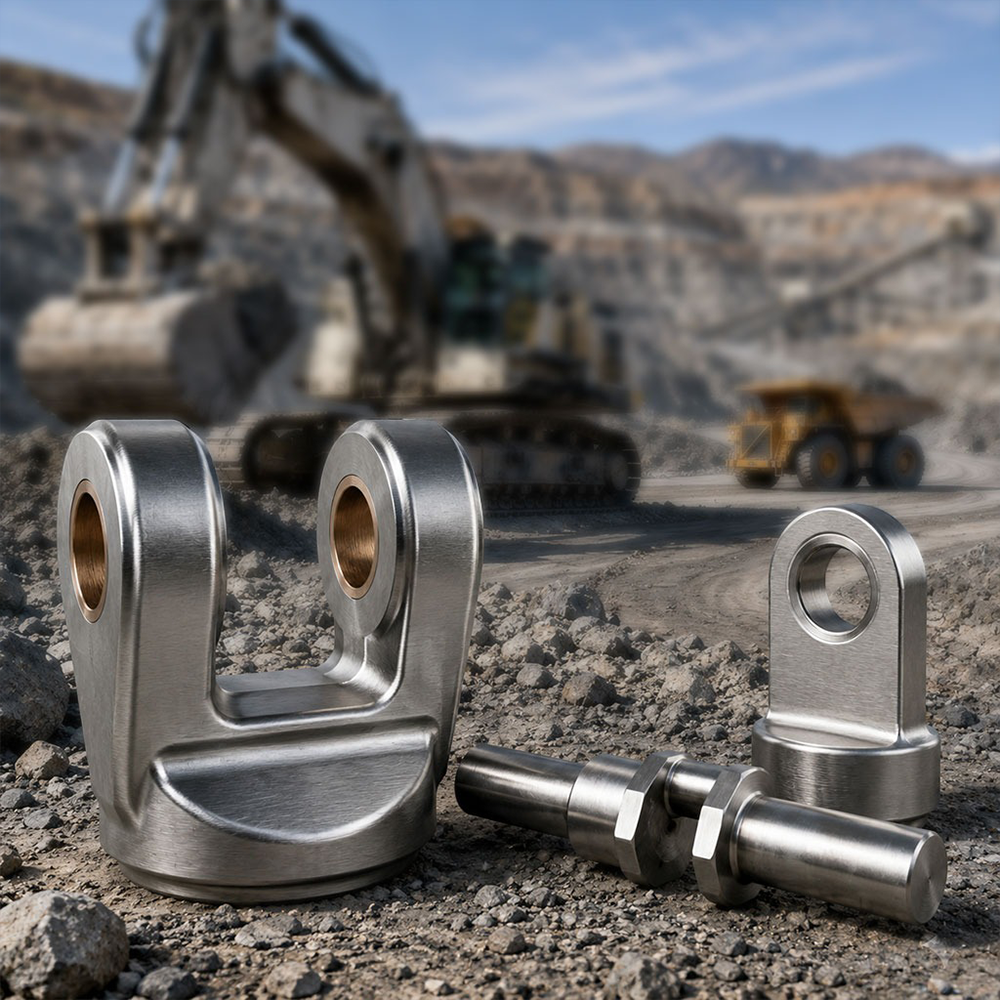
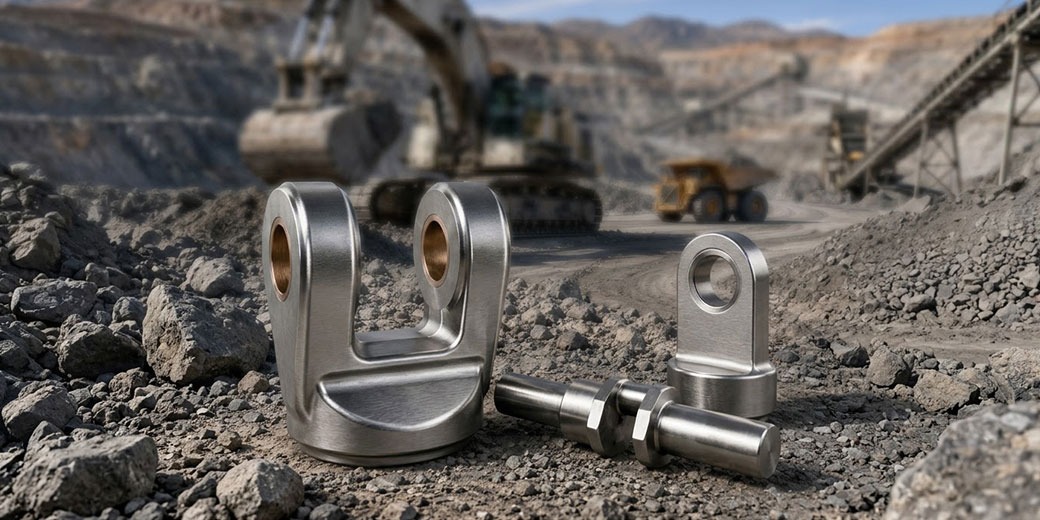
Structural pin forgings (boom pins, stick pins, bucket pins): 4340 and EN36 closed die forgings 10–1,400 kg. Quench and temper to OEM-specified tensile strength. 100% hardness testing after heat treatment. NABL-accredited Charpy impact at -20°C and -30°C. MT of all surfaces.
Large shaft forgings (crusher shafts, dragline pins): 4340, EN24, and CrMoV open die forgings up to 15,000 kg. 100% UT per ASTM A388. Straightness verification for shaft forgings. AMS 2750-calibrated furnaces for Q&T.
Drilling equipment forgings: 4140 and 4340 alloy steel, 50–2,000 kg. API 7 thread-compatible dimensional stock for drill collar forgings. 100% UT before machining.
Ring-rolled components: Crusher eccentric rings, conveyor drive sprocket rings, and seal rings in alloy steel to Ø4,500mm.
AS9100D: Full scope across four manufacturing units. ISO 9001 compliant (AS9100D is a superset of ISO 9001).
TPI: Bureau Veritas and Intertek available for Caterpillar, Komatsu, and Epiroc-specified witness inspection.
Lead times: Structural alloy steel forgings (50–500 kg) 10–14 weeks to US port. Large open die shaft forgings (500–5,000 kg) 14–18 weeks. Both include ocean freight from Chennai to US Gulf Coast (Houston, New Orleans).