
Missile and Ordnance Forging Supplier for US Defence Programmes
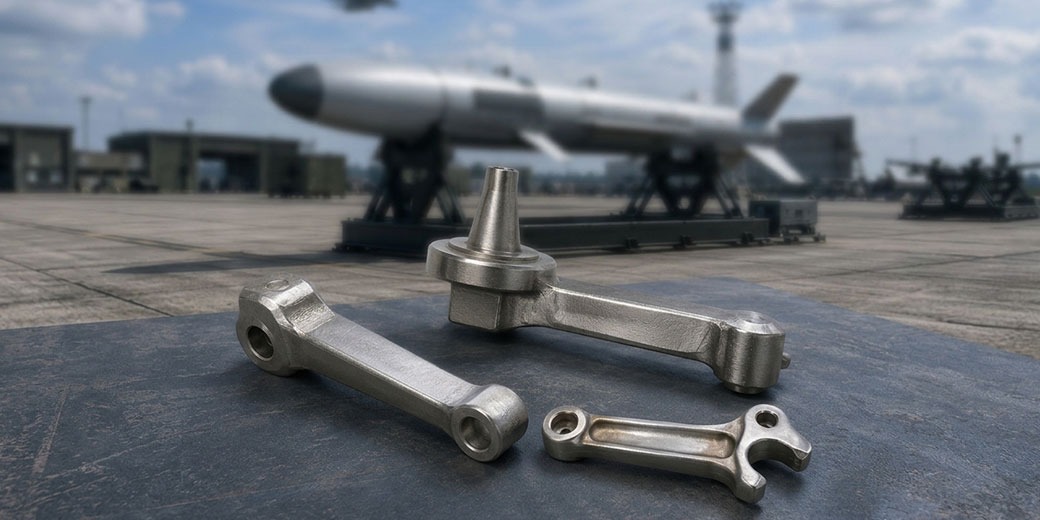
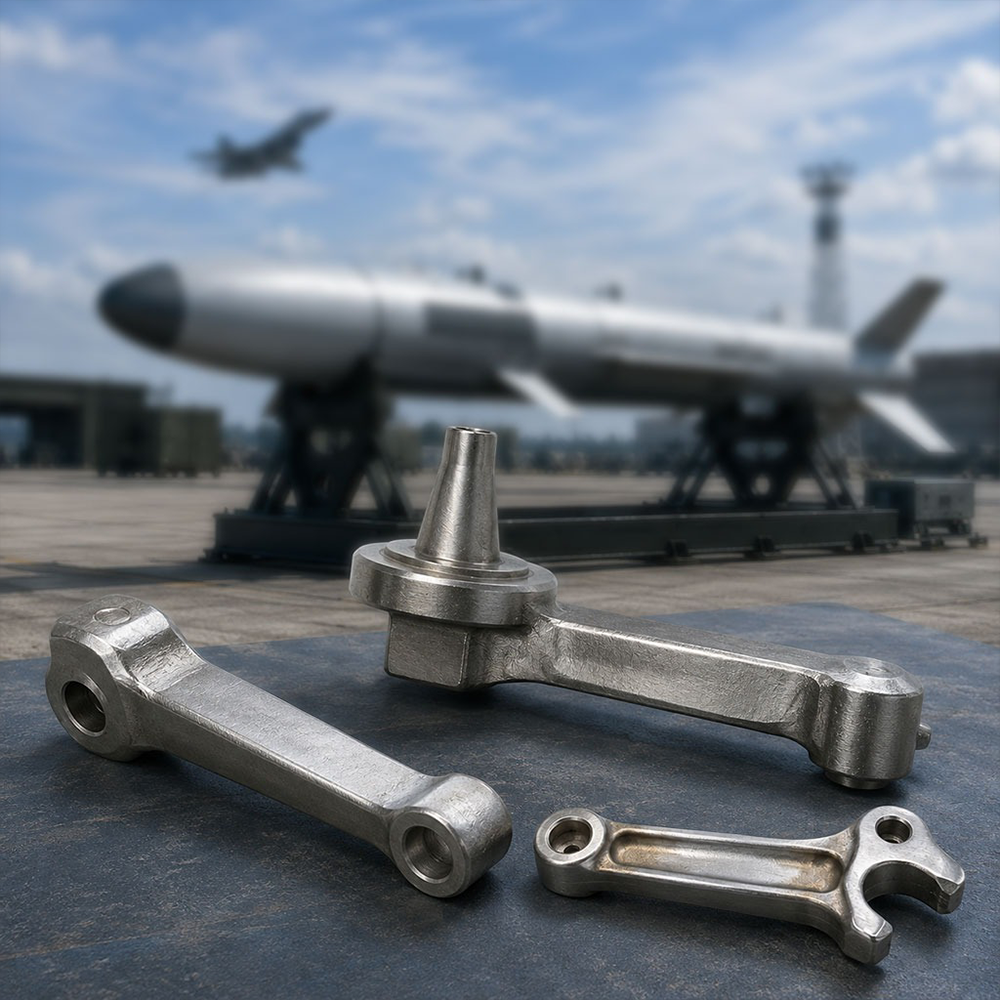
US missile and ordnance programmes – Raytheon’s Tomahawk cruise missile, Lockheed Martin’s JASSM-ER, Boeing’s JDAM, L3Harris’s AARGM-ER, and the expanding hypersonic weapons portfolio use forged titanium, alloy steel, and Inconel components for structural body sections, fin root fittings, motor case flanges, and warhead housing structures. Indian forging manufacturers with AS9100D certification, Ti-6Al-4V and 300M production history, and ITAR compliance infrastructure are positioned to supply missile and ordnance forging programmes one of the highest-value and most technically demanding segments of the US defence forging market.
At a Glance: US Missile Programme Forging Requirements
| Programme | Prime | Key Forging | Material | ITAR Sensitivity |
| Tomahawk Block V | Raytheon | Body section rings, fin root fittings | Ti-6Al-4V, Inconel 625 | High — TAA required |
| JASSM-ER | Lockheed Martin | Structural airframe rings, motor case flanges | Ti-6Al-4V, 300M | High — TAA required |
| JDAM | Boeing | Guidance section structural rings, tail assembly | Alloy steel, aluminium | Medium — case by case |
| AIM-120 AMRAAM | Raytheon | Body section rings, guidance housing | Ti-6Al-4V | High |
| Javelin | Raytheon/Lockheed | Motor case structural fittings, warhead housing | Alloy steel | Medium |
| AARGM-ER | Northrop Grumman | Structural rings, seeker section housing | Ti-6Al-4V, Inconel | High |
| Hypersonic (development) | Multiple | Thermal protection structural fittings | Inconel 718, Ti alloys | Highest |
Why Missile Forgings Are a Distinct Supply Chain Category
Missile and ordnance forgings differ from aerospace structural forgings in three fundamental ways that shape the entire supply chain structure:
ITAR sensitivity is uniformly high.
Unlike commercial aviation where most drawings are unclassified, missile programme drawings contain information about flight performance, guidance systems, and warhead geometry that is inherently ITAR-controlled under the United States Munitions List Category IV (missiles and rockets). Every missile programme drawing transmitted to India requires TAA or DSP-5 export authorisation no exceptions.
Quantities are large and continuous.
A single Tomahawk cruise missile contains 15–25 distinct forged components. At production rates of 200–500 missiles per year across active programmes and with the US Navy’s stated goal of increasing Tomahawk inventory the cumulative forging demand is substantial and long-duration.
Performance requirements are extreme.
Missile structural forgings must survive the entire flight envelope launch acceleration (up to 20g), supersonic aerodynamic loading, and in some cases hypersonic heating. Weight is a primary design driver every gram of structure mass reduces range or payload. This combination of extreme mechanical loading and minimum weight drives the use of Ti-6Al-4V, 300M, and Inconel in geometries that challenge forging process capability.
ITAR Framework for Missile Forging Supply from India
Why Missile Programme ITAR Is More Complex Than Aerospace ITAR
F-35 airframe structural drawings are ITAR-controlled but many contain primarily geometric information about structural performance.
Missile programme drawings contain information about :
- Aerodynamic body geometry that directly reveals flight performance characteristics
- Guidance section geometry that may reveal seeker type and capabilities
- Warhead housing geometry that reveals warhead design
- Motor case geometry that reveals propulsion performance
This information density means that even geometric drawings for relatively simple missile structural rings may require the highest level of ITAR review and the most restrictive export authorisation.
The TAA requirement for missile programmes: For most US missile programme forging supply to India, a Technical Assistance Agreement (TAA) between the US prime contractor and the Indian forging manufacturer is the appropriate authorisation mechanism. TAA processing time through DDTC: 3–6 months for standard cases, longer where interagency review is required (State, DoD, Commerce, and sometimes NSC for hypersonic and advanced missile programmes).
Indian supplier obligations under TAA:
- Implement a TCP with the most stringent physical security controls typically a dedicated vault-like secure room for missile programme technical data
- Maintain a detailed access log for all personnel accessing missile programme drawings
- Undergo periodic US prime contractor or DDTC compliance audits
- Immediately report any suspected ITAR violation or unauthorised access
Structural Body Section Ring Forgings
The Highest-Volume Missile Forging Category
Missile body section rings the circumferential structural members that form the tubular missile body are produced by ring rolling from titanium, alloy steel, or aluminium billets. Each missile section uses one or more structural rings. For a typical 6-metre cruise missile body, 4–8 structural rings are required per missile.
Ti-6Al-4V ring-rolled forgings for cruise missile bodies:
Ring rolling of Ti-6Al-4V for missile structural applications requires:
- Radial-axial ring rolling mill capable of the required diameter range Tomahawk body diameter is approximately 520mm; JASSM body diameter approximately 450mm
- Forging temperature control within the Ti-6Al-4V forging window monitored by pyrometer at the mill
- Alpha case control the oxide layer that forms during heating must be completely removed in subsequent machining. Adequate machining allowance must be provided on all ring surfaces
- Post-rolling annealing or STA heat treatment per the drawing specification
- 100% FPI after heat treatment all ring surfaces including bore, OD, and both faces
- Dimensional verification by CMM ring roundness, diameter uniformity, and face squareness are critical for missile body assembly
Alloy steel ring-rolled forgings for missile aft body and motor case interfaces: The aft body section of most cruise and air-launched missiles interfaces with the solid rocket motor or turbofan engine. This interface requires alloy steel structural rings typically 4340 or 4130 that provide the mechanical connection between the motor case and the missile body. Higher density than titanium but typically in short sections where the weight penalty is acceptable in exchange for the higher structural stiffness of steel.
Fin Root and Control Surface Structural Forgings
The Most Geometrically Complex Missile Forgings
Missile fin root fittings the structural interfaces between the missile body and the aerodynamic control surfaces (fins or canards) are among the most geometrically complex forgings in any missile programme.
They must :
- Transmit the full aerodynamic load on the fin into the missile body structure without yielding
- Accommodate the actuator mechanism that deflects the fin for flight control
- Maintain dimensional stability across the temperature range from cold storage (-54°C) through aerodynamic heating at supersonic speed (surface temperatures up to 300°C for Mach 2+ missiles)
- Weigh as little as possible fin root fittings are at the extremities of the missile where mass directly affects moment of inertia and control authority
Material for supersonic missile fin root fittings: Ti-6Al-4V is the standard for subsonic and transonic missile fin root fittings. For supersonic missiles (Mach 2+), the aerodynamic heating at the leading edge of the fin creates surface temperatures above Ti-6Al-4V’s oxidation limit (~315°C sustained) Inconel 625 or 718 is specified for the most thermally exposed fin root areas.
Die design for fin root forgings: The complex geometry of fin root fittings with attachment lugs, actuator pivot bosses, and tapered aerodynamic profile requires sophisticated die design. FEM (finite element method) simulation of metal flow during forging is essentially mandatory for this complexity level without simulation, the first die may produce underfill at critical features or excessive forging flash that wastes expensive titanium or Inconel billet material.
Motor Case Flange Forgings
The Pressure-Critical Component
Solid rocket motor cases the pressure vessels that contain the burning propellant are among the most critically loaded components in any missile. Motor case forgings include the forward closure (connecting the motor case to the missile body) and the aft closure (containing the nozzle assembly).
These flanges must :
- Contain the full motor operating pressure typically 70–100 bar (1,000–1,500 psi) for military solid rocket motors
- Withstand the thermal shock of propellant ignition
- Maintain structural integrity across the full temperature range from cold storage to motor burnout
- Connect to the motor case cylinder (typically filament-wound composite) through a precision-machined interface
Motor case flange material selection:
- D6AC steel (AMS 6431) — ultra-high-strength alloy steel achieving 1,723 MPa (250,000 psi) tensile strength. The most common material for solid rocket motor case forgings where maximum strength-to-weight at moderate temperature is required
- Ti-6Al-4V — for weight-critical applications where the titanium weight saving justifies the higher material and processing cost
- Maraging 300 steel — for the highest-performance motor cases where D6AC strength is insufficient
Processing requirements for D6AC motor case flanges: D6AC must be vacuum arc remelted air melt D6AC contains inclusions that initiate fatigue cracks under the cyclic pressure loading of multiple ground firings. Heat treatment to 1,723 MPa (250,000 psi) minimum tensile strength requires precise quench and temper the tempering temperature window that achieves target strength with adequate fracture toughness is narrow. Immersion UT before machining is mandatory.
Warhead Housing and Guidance Section Forgings
Where Precision Meets Extreme Loading
The warhead housing and guidance section structural forgings serve dual purposes they are structural members in the missile body and they are the precision enclosures for the most sensitive electronic and explosive components.
Warhead housing forgings: Typically alloy steel (4340 or equivalent) for blast fragmentation warheads the controlled fragmentation of the warhead case requires a specific steel chemistry and heat treatment that produces the target fragment size distribution. For shaped charge warheads, the liner is a precision copper or tantalum forging, not steel one of the few non-steel aerospace forging categories.
Guidance section housings: The guidance section contains the GPS receiver, inertial navigation system, data link, and flight computer. The structural housing is typically aluminium (7075-T6 or 7075-T73) for weight minimisation. Precision machined to very tight tolerances the guidance electronics must be mounted in a stable, vibration-controlled environment with specific thermal management requirements.
ITAR note: Guidance section drawings are among the most ITAR-sensitive in any missile programme they reveal the type and configuration of the missile’s navigation and targeting system.
US Missile Programme Prime Contractors and Qualification
Raytheon Technologies (RTX) Tomahawk and AMRAAM
Tomahawk Block V: Raytheon’s primary long-range precision strike missile. The US Navy has approximately 4,000 Tomahawks in inventory and is seeking to expand the stockpile. Block V upgrades (JMEWS warhead, Maritime Strike Tomahawk) are in production.
Raytheon’s supplier qualification process for Tomahawk forging suppliers requires:
- AS9100D with scope covering the specific forging categories and materials
- TAA in place before any Tomahawk drawings are transmitted to India
- Raytheon-specific supplier quality requirements flowing down from Raytheon’s Prime Integration Level (PIL) quality documents
AIM-120 AMRAAM: The US Air Force and Navy’s standard active radar air-to-air missile. Production at approximately 500+ missiles per year. Ti-6Al-4V body section rings and guidance section structural forgings.
Lockheed Martin – JASSM-ER and PAC-3
JASSM-ER (Joint Air-to-Surface Standoff Missile – Extended Range): Lockheed Martin’s primary long-range air-launched cruise missile. Production at approximately 400–500 missiles per year at the Troy, Alabama facility. JASSM-ER uses Ti-6Al-4V structural forgings for the missile body and 300M alloy steel for the highest-load structural connections.
PAC-3 Patriot missile: Lockheed Martin’s advanced Patriot interceptor. The PAC-3 MSE (Missile Segment Enhancement) is in active production. Small-diameter, high-performance interceptor with titanium and alloy steel structural forgings.
Boeing – JDAM and SDB
JDAM (Joint Direct Attack Munition): Boeing’s GPS-guided tail kit that converts unguided bombs into precision weapons. Production at thousands of units per year the highest production volume of any US precision guided munition programme. JDAM guidance section structural rings and tail assembly forgings in aluminium and alloy steel. ITAR sensitivity is medium – JDAM drawings are controlled but not at the same level as cruise missile guidance drawings.
SDB (Small Diameter Bomb): Boeing’s GBU-39 Small Diameter Bomb. Small-diameter glide weapon with aluminium and alloy steel structural forgings.
Quality Requirements for US Missile Forging Programmes
AS9102 FAIR for Missile Forgings
Every new missile forging part number requires an AS9102 FAIR before production approval same as commercial aerospace. For missile forgings, the FAIR has additional considerations:
ITAR-controlled FAIR documentation: The AS9102 FAIR package for a missile forging includes the actual drawing dimensions which may be ITAR-controlled. The FAIR must be transmitted to the US prime contractor through an ITAR-authorised channel. Printed copies of the FAIR cannot be taken outside the secure TCP area.
Key characteristics for missile structural forgings: Missile structural ring forgings typically have fewer dimensions than complex structural fittings, but the key characteristics wall thickness uniformity, diameter concentricity, face squareness are critical for missile body assembly alignment and flight stability. US missile prime quality engineers review Form 4 (Key Characteristics) of the FAIR with particular attention to whether the Indian supplier has correctly identified all key characteristics on the missile drawing.
Traceability for Missile Forgings
US missile programme traceability requirements are as stringent as aerospace rotating component requirements every forging must be traceable from raw material mill to installed location in the missile. This enables lot recall if a material or process deviation is identified after deliveries have been made.
For Ti-6Al-4V missile body rings, the traceability chain covers:
- VAR (vacuum arc remelted) billet MTR from the approved titanium mill
- Billet UT inspection records
- Ring rolling records rolling temperature, reduction, dimensions achieved
- Heat treatment record with furnace chart
- FPI report
- Dimensional inspection CMM data for all key characteristics
- CoC referencing all applicable specifications
- Delivery record lot number, quantity, and date shipped
Vinir Engineering’s Missile and Ordnance Forging Capability
Vinir Engineering’s manufacturing capability for US missile and ordnance forging programmes:
Ti-6Al-4V ring rolling: Wagner and Banning radial-axial ring rolling mill to Ø4,500mm. Covers the diameter range for all major US cruise missile and air-launched weapon body section rings. Alpha case control procedure documented and implemented.
300M and D6AC alloy steel: Closed die and open die production with VAR-melted input material. Heat treatment to 1,900+ MPa tensile strength with AMS 2750 calibrated furnaces.
Inconel 625 for thermally exposed applications: Solution annealing at 1,093–1,204°C. Immersion UT with Inconel calibration standards.
AS9100D: Full forge-to-finish scope, OASIS-verifiable. AS9102 FAIR assembly experienced.
ITAR infrastructure: ITAR awareness procedure. TCP preparation and implementation capability for missile programme engagement. Experienced in ITAR-controlled technical data management.
FEM die design: For complex fin root and structural fitting geometries FEM simulation before die cutting to predict fill and optimise forging parameters.