
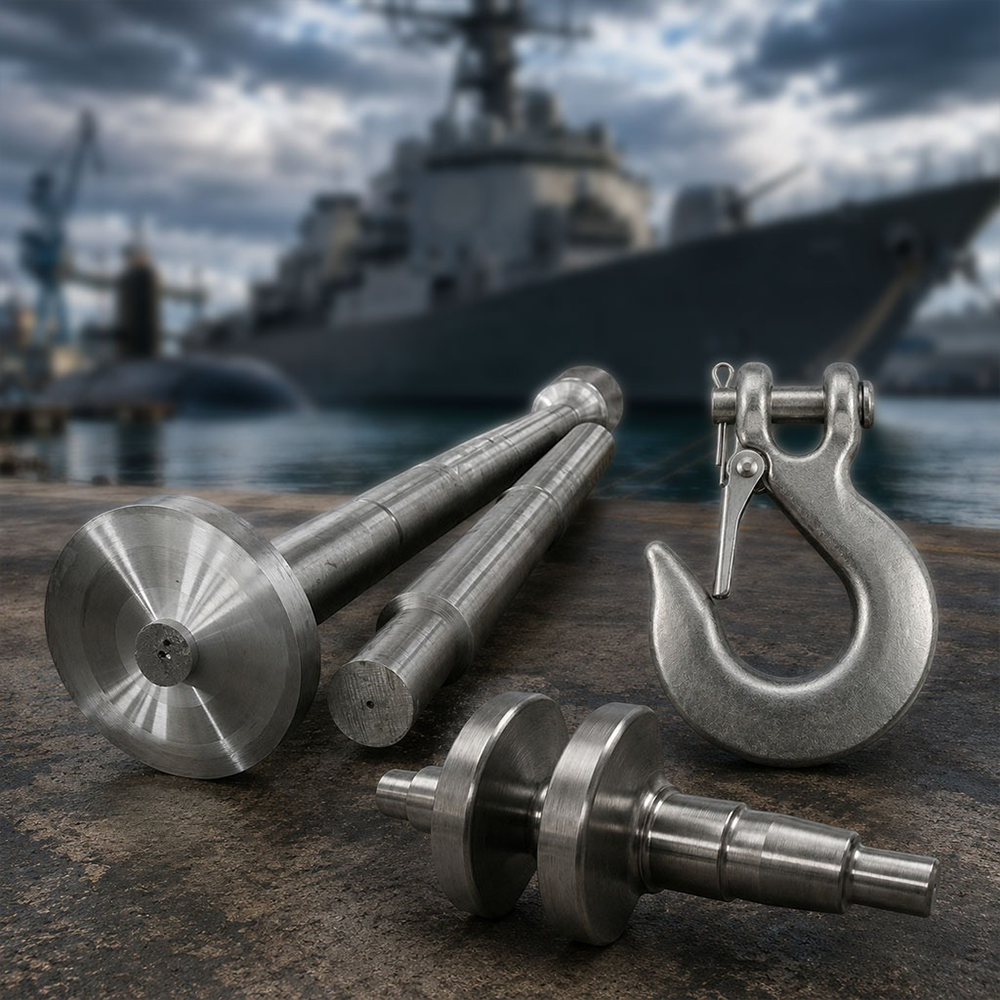
Naval Forging Supplier for US Navy Shipbuilding Programmes
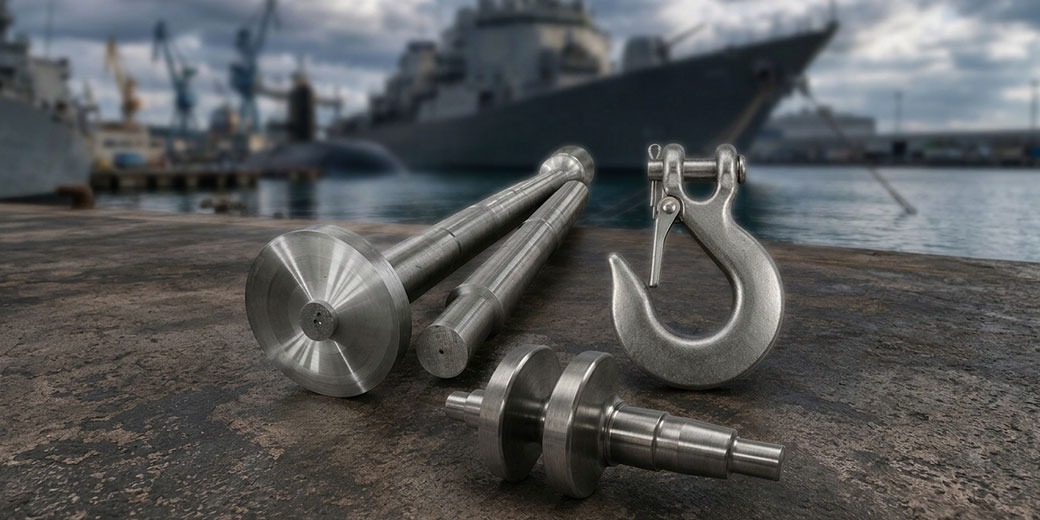
US Navy shipbuilding programmes — Arleigh Burke destroyers, Virginia class submarines, Gerald R. Ford carriers, and the evolving surface combatant portfolio generate substantial annual demand for propulsion shaft forgings, structural hull fittings, rudder stock forgings, and pressure-retaining valve body forgings. Indian forging manufacturers with ABS approval, AS9100D certification, open die capability for heavy propulsion shafts, and experience with DCMA source inspection are positioned to supply US naval shipbuilding at cost advantage over domestic US marine forging supply.
At a Glance: US Navy Shipbuilding Forging Requirements
| Vessel | Shipyard | Key Forging Categories | Weight Range | Annual Production |
| DDG-51 Arleigh Burke | HII Pascagoula, Bath IW | Propulsion shafts, rudder stocks | 4,000–8,000 kg/shaft | 2–3 ships/yr |
| Virginia class SSN | Electric Boat, HII Newport News | Pressure hull fittings, propulsion shaft | 2,000–6,000 kg | 2 boats/yr |
| Gerald R. Ford CVN | HII Newport News | Shaft forgings, structural hull fittings | Up to 15,000 kg | 1 carrier/yr |
| LCS | Lockheed/Austal | Propulsion components, structural | 500–3,000 kg | 1–2/yr |
| T-AO (Fleet oiler) | Philly Shipyard | Propulsion shafts, structural | 3,000–6,000 kg | 1–2/yr |
The US Naval Shipbuilding Supply Chain
How Naval Forging Procurement Works
US Navy shipbuilding forgings flow through a supply chain that differs from commercial marine in one critical respect government oversight. The DCMA (Defense Contract Management Agency) maintains quality assurance presence at major US naval shipyards and at their critical suppliers. For Indian forging manufacturers entering the US naval supply chain, DCMA source inspection is a routine part of the delivery process not an exception.
HII (Huntington Ingalls Industries) — the largest US naval shipbuilder, operating Ingalls Shipbuilding in Pascagoula (DDG-51, LPD, LHA) and Newport News Shipbuilding (CVN, Virginia class). HII is the only builder of US nuclear-powered aircraft carriers and one of two Virginia class submarine builders.
General Dynamics Electric Boat — Groton, Connecticut and Quonset Point, Rhode Island. Co-producer of Virginia class submarines with HII Newport News. Electric Boat manages approximately half of each Virginia class submarine’s manufacturing.
Bath Iron Works (General Dynamics) — Bath, Maine. DDG-51 Arleigh Burke class destroyer production alongside HII Ingalls.
Indian forging manufacturers approach these shipyards through their tier-1 material and equipment suppliers propulsion system manufacturers (GE Marine, Rolls-Royce Naval), hull structural steel suppliers, and marine equipment manufacturers who procure forgings as components for larger assemblies.
ABS Certification: The Gateway to US Naval Forging Supply
Why ABS Certification Is Non-Negotiable
US Navy surface combatants destroyers, cruisers, amphibious ships are built to ABS (American Bureau of Shipping) class rules. The ABS material certification requirement for structural and propulsion forgings is a hard requirement forgings without ABS material certificates cannot be incorporated in ABS-classed vessels regardless of any other quality credentials.
ABS manufacturer approval for an Indian forging manufacturer involves:
Facility assessment — an ABS marine surveyor visits the Indian facility and reviews the quality management system, heat treatment calibration records, NDT capability, and NABL laboratory accreditation. The surveyor confirms the facility is adequate to produce ABS-grade forgings under ongoing ABS surveillance.
Approval test pieces — production of test forgings in representative ABS grades. The surveyor witnesses heat treatment and mechanical testing. Chemistry, tensile, Charpy impact, and hardness results are compared to ABS grade requirements.
ABS approval certificate — covering specific material grades (ABS Grade 1 through Grade 4), product types (shafts, structural forgings, fittings), and size ranges demonstrated.
Ongoing survey per lot — every subsequent production lot for ABS-classed vessels requires ABS surveyor attendance at heat treatment and mechanical testing. The surveyor stamps and signs the ABS Form C1 material certificate. Without this certificate, the forgings cannot be incorporated in an ABS-classed naval vessel.
DDG-51 Arleigh Burke Propulsion Shaft Forgings
Why Propulsion Shafts Are the Highest-Value Naval Forging
The Arleigh Burke destroyer uses a combined gas and gas (COGAG) propulsion system with four GE LM2500 gas turbines driving two propulsion shafts. Each shaft transmits up to 26,000 shaft horsepower to the propellers. A single DDG-51 propulsion shaft from the gearbox output flange to the propeller shaft is 15–20 metres in length and weighs 5,000–8,000 kg in the rough-forged condition.
Material: ABS Grade 3 alloy steel typically a nickel-chromium-molybdenum alloy equivalent to 4340 quenched and tempered to minimum tensile strength 590 MPa. Higher strength grades (Grade 4, minimum 690 MPa) are used for destroyer-class shafts where the combined torque and bending loads require additional material strength.
Manufacturing sequence:
- Open die forging on a 3,000+ tonne hydraulic press with dango manipulators the shaft is forged in multiple passes, rotating between passes to achieve uniform reduction around the circumference
- 100% UT inspection of the rough forging before any machining the investment in machining a forging with an internal defect is wasted. UT catches defects before machining begins
- Heat treatment quench and temper with ABS surveyor witness
- ABS mechanical testing tensile, Charpy impact, hardness from witness pieces
- Final 100% UT after heat treatment, before machining
- CNC turning and grinding to finished dimensions journal diameters, flange faces, coupling geometry
- Final MT inspection of all machined surfaces
- Straightness verification shaft straightness within 0.1mm per metre total bow
ABS survey scope for propulsion shafts: The ABS surveyor witnesses the complete heat treatment cycle for every shaft production lot. The surveyor reviews the furnace calibration records, observes the cycle completion, and witnesses tensile, Charpy, and hardness testing on witness pieces from the same heat. The ABS Form C1 is issued only after satisfactory results without it, the shaft cannot be installed in a DDG-51.
Virginia Class Submarine Forging Requirements
The Submarine Environment – Most Demanding Naval Application
Virginia class nuclear attack submarines operate at depths where external hydrostatic pressure reaches 30–50 bar (435–725 psi). Every structural connection penetrating the pressure hull every hull fitting, every valve connection, every shaft seal housing must maintain structural integrity and leak-tight sealing at depth while resisting the cyclic pressure loading of repeated diving and surfacing cycles across the submarine’s 33-year service life.
Pressure Hull Penetration Forgings
Material: HY-80 (minimum yield 80,000 psi / 550 MPa) or HY-100 (minimum yield 100,000 psi / 690 MPa) — the high-yield, high-toughness steels specifically developed for submarine pressure hull construction.
Key characteristics of HY-80 and HY-100 that make them unique:
- High toughness at low temperature — submarines operate in cold deep water. Charpy impact at -84°C (-120°F) is specified for HY-80 to ensure the steel is well above its ductile-brittle transition temperature at operating depth
- Weldability — pressure hull fittings are welded into the hull plating. The heat-affected zone of the weld must maintain HY-80/HY-100 toughness — which requires strict control of preheat, interpass temperature, and post-weld heat treatment
- Cleanliness — high sulphur or phosphorus would reduce toughness at the HAZ. HY-80/100 has maximum 0.008% sulphur and 0.010% phosphorus — tighter than most structural steels
ITAR considerations: Virginia class submarine pressure hull geometry and structural design contain tactically sensitive information. Drawings for pressure hull fitting forgings may be ITAR-controlled. TCP and TAA/DSP-5 authorisation are required before drawings are transmitted to India.
Submarine Propulsion Shaft Forgings
The Virginia class uses an electric drive propulsion system with a single shaft. The propulsion shaft from the motor output through the stern tube to the propeller hub is a single-piece forging approximately 8–12 metres long, weighing 3,000–5,000 kg.
The submarine propulsion shaft operates under conditions that differ from surface ship shafts:
- Full submergence — the shaft seal system must prevent seawater ingress at depth operating pressure
- Acoustic signature — shaft geometry tolerances affect propeller performance and the acoustic signature of the submarine. Tighter straightness and concentricity tolerances than surface ship equivalents
- SUBSAFE requirements — the US Navy’s SUBSAFE programme is the most comprehensive quality programme in any US Navy surface or subsea system. All submarine primary systems including propulsion operate under SUBSAFE requirements that impose additional documentation, traceability, and inspection requirements beyond standard ABS and AS9100D requirements
SUBSAFE – The US Navy’s Submarine Safety Programme
SUBSAFE was established after the loss of USS Thresher in 1963 the worst peacetime submarine accident in US history. SUBSAFE imposes requirements on all systems that, if they failed, could cause flooding and loss of the submarine:
Traceability: Every SUBSAFE-critical material must be traceable from the raw material mill to the installed location in the submarine. The traceability chain must be maintained and documented for the life of the submarine.
Certification: SUBSAFE-critical components require formal certification a documented review and sign-off by authorised personnel that the component meets all SUBSAFE requirements. For forgings, this means the MTR, heat treatment record, NDE reports, and dimensional data are all reviewed and certified before the component can be installed.
Re-entry control: Any rework of a SUBSAFE-critical component requires a formal re-entry procedure the component returns to a controlled status and goes through a documented inspection and certification cycle before being released back to service.
For Indian forging manufacturers the SUBSAFE documentation and certification requirements are the most demanding documentation requirements in any US naval programme. An Indian supplier who cannot produce complete, properly cross-referenced documentation packages will struggle with SUBSAFE compliance regardless of how good their physical manufacturing capability is.
Gerald R. Ford Class Carrier Forging Requirements
The Largest US Navy Forging Programme
The Gerald R. Ford class (CVN-78, CVN-79 John F. Kennedy, CVN-80 Enterprise) nuclear aircraft carrier programme uses the largest individual forgings in US naval shipbuilding. HII Newport News Shipbuilding is the only builder.
Propulsion shaft forgings for CVN-78 Ford class: The Ford class uses a nuclear propulsion plant with four propulsion shafts. Each shaft from the steam turbine reduction gear to the propeller is 25–30 metres long and weighs 10,000–15,000 kg in the rough-forged condition. These are among the largest open die forgings produced anywhere in the world.
For Indian forging manufacturers, carrier-scale propulsion shaft forgings at 10,000–15,000 kg per piece represent the upper limit of what even large Indian forge shops can produce requiring the largest hydraulic press capacity (5,000+ tonnes) and the longest available furnaces for heat treatment of 30-metre shafts. This category is accessible to only a very small number of Indian manufacturers.
Structural forgings for carrier hull construction: Below the scale of propulsion shaft forgings, the Ford class uses thousands of structural forgings for hull penetrations, equipment mounting, and structural connections. These are more accessible to Indian forging manufacturers 200–2,000 kg structural fitting forgings in HY-80 or alloy steel, produced in the quantities consistent with one carrier per year production rate.
T-AO and Auxiliary Vessel Forging Programmes
Fleet Oilers and Support Vessels
Beyond combat vessels, the US Navy’s logistics and support fleet T-AO(X) fleet replenishment oilers, T-AKE combat logistics force ships, and T-ATS salvage and towing vessels generate ongoing forging demand that is less ITAR-sensitive and more accessible to new Indian forging suppliers.
T-AO(X) fleet oilers: Built at Philly Shipyard (Philadelphia) and NASSCO (San Diego). Single-screw commercial-grade propulsion with one shaft per vessel. Shaft forgings in ABS Grade 3 alloy steel, 3,000–5,000 kg. ABS class certification required. No SUBSAFE. No ITAR restriction on propulsion shaft drawings.
Why auxiliary vessels are the best entry point for Indian naval forging supply:
- Drawings for commercial-standard auxiliary vessel forgings are typically unclassified and not ITAR-controlled
- ABS class certification (which India’s established forging manufacturers can hold) is the primary quality requirement
- No SUBSAFE
- No DCMA for commercial shipyard-built vessels operating under MSC (Military Sealift Command)
Indian forging manufacturers who qualify for auxiliary vessel forging supply build the ABS survey relationship, the US shipyard quality interface experience, and the naval documentation familiarity that facilitates progression to combat vessel supply.
Quality Requirements Specific to US Naval Forging Supply
DCMA Source Inspection Integration
DCMA maintains a quality assurance presence at HII, Electric Boat, and Bath Iron Works. For procurement contracts with DCMA oversight, DCMA source inspection at the Indian forging manufacturer is required before propulsion and structural forgings ship.
DCMA source inspection at Indian facilities: DCMA QARs do not permanently reside in India. Source inspection at Indian facilities is typically conducted by a DCMA-recognised third-party quality company Bureau Veritas and Intertek have established DCMA-recognition for specific inspection activities. The DCMA QAR at the US shipyard coordinates with the third-party company, reviews their inspection reports, and accepts the lot.
For Indian forging manufacturers, the practical requirement is: maintain complete and compliant quality records that a third-party DCMA-designated inspector can review and accept without findings. The physical inspection is typically limited to dimensional verification of a sample and review of the documentation package the manufacturing process controls that produced the forging are what the DCMA ultimately relies on.
Magnetic Particle Inspection for Propulsion Shaft Forgings
Wet fluorescent MT is the standard surface inspection method for alloy steel naval propulsion shaft forgings. Dry powder MT is not acceptable for US Navy shaft forgings wet fluorescent provides significantly higher sensitivity for the detection of surface and near-surface longitudinal seams and transverse cracks that are the primary failure modes for rotating shafts.
Two-direction magnetisation: The shaft must be magnetised in both the circular (current flow) direction and the longitudinal (coil) direction to detect defects in all orientations. A single-direction MT inspection misses defects perpendicular to the magnetisation direction.
After final machining: MT is performed after all machining operations are complete. Post-machining MT detects any cracks introduced during machining (grinding cracks, tool marks that propagate into cracks) and any near-surface defects revealed by material removal.
Vinir Engineering’s Naval Forging Capability for US Navy Programmes
Vinir Engineering holds ABS approval and produces naval propulsion and structural forgings for Indian Navy programmes. The capability for US Navy programme supply:
Open die forging to 15,000 kg: Propulsion shaft forgings for destroyer and frigate-class vessels on the 3,000T hydraulic press with dango manipulators. Maximum shaft length capability 12 metres.
ABS Grade 3 and Grade 4 shaft forgings: Quench and temper with ABS surveyor witness. Charpy impact at ambient temperature standard; low-temperature Charpy available from NABL-accredited laboratory. ABS Form C1 issued per lot.
100% UT before and after machining: Contact UT to ABS acceptance criteria. Immersion UT available for rotating component inspection where specified.
Wet fluorescent MT: Two-direction magnetisation. UV lamp intensity verified before each inspection session. ASNT Level II certified operators.
Structural hull fitting forgings: HY-80/100 alloy steel forgings for submarine hull connections subject to ITAR review and TCP implementation for Virginia class applications.
DCMA readiness: Documentation formatted for DCMA source inspection review. Third-party DCMA-recognised inspection company coordination available through Bureau Veritas and Intertek relationships.
AS9100D: Full forge-to-finish scope, Bureau Veritas, OASIS-verifiable.