
AS9100D Certified Defence Forging Supplier for US Military Programmes
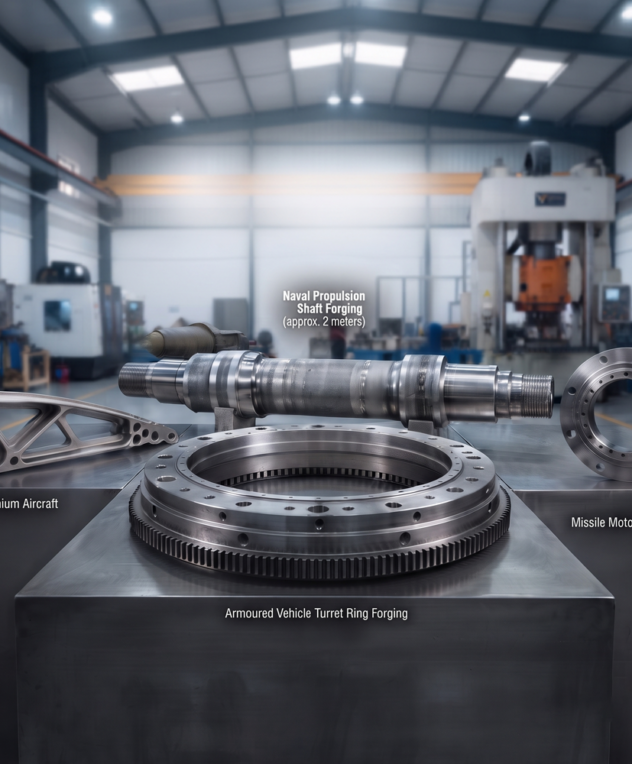
US military procurement teams sourcing forged components from India for Army, Navy, and Air Force programmes apply qualification requirements that combine the quality rigour of aerospace (AS9100D, FAIR, AMS specifications) with defence-specific regulatory requirements (ITAR, DFARS, DCMA oversight, MIL-SPEC). Indian forging manufacturers who have built the infrastructure to operate within this framework are positioned to supply US military forging programmes across the complete range of platform categories ground vehicles, naval vessels, military aircraft, missiles, and ordnance.
At a Glance: US Military Forging Requirements by Service Branch
| Service | Key Programmes | Primary Forging Categories | Certification |
| US Army | M1A2 Abrams, Bradley, Stryker, M109 Paladin | Drivetrain, suspension, artillery barrel blanks | AS9100D, DFARS, DCMA |
| US Navy | DDG-51, Virginia class, LCS, CVN-78 | Propulsion shafts, structural hull fittings, valve bodies | AS9100D, ABS, DCMA |
| US Air Force | F-35, F-22, C-17, B-21 | Airframe structural, landing gear, engine components | AS9100D, NADCAP, ITAR |
| US Marine Corps | M1A1, LAV-25, V-22 Osprey | Vehicle drivetrain, tilt-rotor structural | AS9100D, DFARS |
| SOCOM | Special operations vehicles, aircraft modifications | Various — high-mix low-volume | AS9100D, ITAR |
What Makes US Military Qualification Different from Commercial
US military programme qualification for Indian forging suppliers builds on commercial aerospace AS9100D foundations and adds three defence-specific layers:
First layer — ITAR compliance.
Military programme drawings for primary structural and weapons system components are typically ITAR-controlled. Indian facilities receiving these drawings must operate under an approved Technology Control Plan (TCP). The US prime contractor manages the export authorisation (TAA or DSP-5 licence) the Indian supplier implements the physical and administrative controls described in the TCP.
Second layer — DCMA oversight.
Defence Contract Management Agency quality assurance representatives conduct source inspection at supplier facilities for major US defence contracts. Indian forging manufacturers must be prepared to host DCMA QAR source inspection witnessing heat treatment, reviewing quality records, and releasing lots before shipment.
Third layer — MIL-SPEC alignment.
Military specifications for heat treatment (MIL-H-6875), NDE (MIL-STD-2154, MIL-STD-6866), and materials (MIL-DTL-7068 for aluminium) add requirements that parallel but are not identical to commercial AMS specifications. Indian suppliers qualifying for US military programmes must demonstrate that their procedures address MIL-SPEC requirements, not just their AMS commercial equivalents.
US Army Ground Vehicle Forging Programmes
M1A2 SEPv3 Abrams Main Battle Tank
General Dynamics Land Systems (GDLS) in Lima, Ohio manufactures the M1A2 SEPv3 the current production version of the Abrams. Annual production: approximately 100–150 tanks per year for US Army and Foreign Military Sales.
Key forging categories for Abrams supply:
Final drive gear blanks — EN36 or 18CrNiMo7-6 case-hardening alloy steel. The final drive transfers power from the transmission to the track drive sprocket. Gear blank forgings are carburised and case-hardened after machining the forging must provide the correct microstructure for case hardening response. 20–80 kg per piece. Quantities: 4 final drives per tank.
Torsion bar forgings — 45CrNiMoVA spring steel, minimum tensile strength 1,400 MPa. Torsion bars provide the suspension spring function each bar stores and releases energy with every road irregularity the tank traverses. A single Abrams has 14 torsion bars per side (28 total). The torsion bar is one of the most fatigue-critical forgings in any ground vehicle it must survive hundreds of millions of reversed torsional load cycles across the tank’s service life.
Drive shaft forgings — 4340 alloy steel, quenched and tempered. Multiple shafts per vehicle connecting the engine to the transmission and the transmission to the final drives.
Roadwheel hub forgings — alloy steel. Seven roadwheels per side (14 total) per Abrams. Hub forgings carry the combined vehicle weight and dynamic shock loads transmitted through the rubber-bonded roadwheel.
DFARS and DCMA: Abrams programme forgings are procured under DFARS-compliant contracts. India’s qualifying country status applies. DCMA source inspection is typically required at the forging manufacturer’s facility for new suppliers.
Bradley IFV and Stryker Armoured Vehicle
BAE Systems produces the M2A4 Bradley infantry fighting vehicle. General Dynamics produces the M1126 Stryker family. Both programmes share similar drivetrain forging requirements to the Abrams final drive gear blanks, drive shafts, and suspension components but in different sizes reflecting the lighter vehicle weight classes.
Bradley-specific: The Bradley’s Bushmaster 25mm cannon system uses high-strength alloy steel forgings for the cannon mount structural members components that must withstand the firing impulse loads at the cannon’s rated firing rate.
Stryker-specific: The wheeled Stryker uses different suspension forgings from the tracked Abrams steering knuckle forgings, hub forgings, and axle shaft forgings in alloy steel for the 8×8 wheeled configuration.
US Navy Shipbuilding Forging Programmes
DDG-51 Arleigh Burke Class Destroyers
The DDG-51 is the US Navy’s most actively produced surface combatant approximately 2–3 destroyers per year at HII Ingalls Shipbuilding (Pascagoula) and Bath Iron Works (Maine). Each destroyer requires:
Propulsion shaft forgings — 4 propulsion shafts per destroyer, each 4,000–6,000 kg in alloy steel. The largest single forging category by weight in any surface combatant. ABS survey certification required the ABS surveyor witnesses heat treatment and mechanical testing at the forging manufacturer’s facility.
Rudder stock forgings — high-strength alloy steel. Must transmit full steering torque at maximum vessel speed. Structural loads are higher than commercial marine equivalent due to naval manoeuvring requirements.
Gas turbine exhaust casing structural forgings — the DDG-51 uses General Electric LM2500 gas turbines. Exhaust casing structural connections use alloy steel and stainless forgings.
ABS class requirement: HII and Bath Iron Works require ABS material certification for structural and propulsion forgings incorporated in DDG-51 construction. ABS survey at the forging manufacturer’s facility witnessed heat treatment and mechanical testing is mandatory.
Virginia Class Submarines
General Dynamics Electric Boat and HII Newport News Shipbuilding jointly produce the Virginia class nuclear attack submarine the US Navy’s primary SSN programme at 2 boats per year.
Submarine-specific forging requirements:
- Pressure hull connection forgings — high-strength HY-80 or HY-100 steel forgings for through-hull connections. These forgings must maintain structural integrity at submarine diving depth the hydrostatic pressure at maximum diving depth (>300 metres) imposes significant compressive loads on the hull.
- Propulsion shaft and seal housing forgings — the submarine’s single propulsion shaft and its associated sealing system use precision alloy steel forgings that must maintain dimensional stability under the combined mechanical and thermal loads of nuclear propulsion.
- Valve body forgings for primary and secondary systems — multiple valve bodies for seawater, steam, and hydraulic systems throughout the submarine. IBR-equivalent certification required for pressure-retaining components.
ITAR sensitivity: Virginia class programme forgings particularly pressure hull structural forgings may have ITAR-controlled drawing implications due to submarine tactical performance data. TCP and TAA are typically required before drawings are transmitted to India.
US Air Force Forging Programmes
F-35 Lightning II
The F-35 produced by Lockheed Martin at Fort Worth is the largest military aircraft programme in history by programme value. Over 3,000 aircraft are planned across US Air Force, Navy, Marine Corps, and allied nation deliveries.
Forging content per F-35: Approximately 900 aluminium structural forgings plus titanium primary structural members and high-strength steel landing gear components per aircraft. At 150+ aircraft per year production rate, annual F-35 forging demand is substantial.
F-35 programme-specific requirements:
- Lockheed Martin SQAR (Supplier Quality Assurance Requirements) programme-specific quality requirements beyond AS9100D
- NADCAP required for heat treatment and NDT on primary structure forgings
- ITAR applies F-35 is one of the most ITAR-sensitive US defence programmes. TAA required before any F-35 drawings are transmitted to India
Access pathway for Indian suppliers: Direct F-35 supply from India requires TAA approval (3–6 months DDTC processing) and Lockheed Martin SQAR qualification. The more accessible pathway for Indian forging manufacturers is through Lockheed Martin’s established US-based tier-1 suppliers who subcontract specific forging categories to pre-qualified Indian sources.
C-17 Globemaster III and C-130J Super Hercules
While C-17 production has ended (final delivery 2015), the fleet of 279 US Air Force C-17s generates extensive MRO (maintenance, repair, and overhaul) forging demand replacement structural fittings, landing gear components, and engine mount forgings for aircraft that will remain in service to 2040+.
The C-130J still in active production at Lockheed Martin Marietta uses aluminium airframe forgings and alloy steel landing gear forgings. The C-130J fleet serves USAF, USMC, and 20+ allied air forces with ongoing spares demand.
US Military Qualification Process: The Defence-Specific Elements
What Changes from Commercial Aerospace Qualification
The commercial aerospace AS9100D qualification process OASIS verification, self-assessment questionnaire, site visit, qualification parts, FAIR is the foundation.
US military qualification adds :
Pre-qualification ITAR review : Before the technical qualification begins, the US prime contractor’s export compliance team reviews the ITAR status of the technical data that will be shared during qualification. If the qualification forging drawings are ITAR-controlled, the TAA or DSP-5 export licence must be in place before any technical data is transmitted. This pre-qualification ITAR step adds 3–6 months to the timeline if an export licence must be obtained.
TCP implementation verification : The US prime’s export compliance team verifies that the Indian facility has implemented the TCP before ITAR data is transmitted not just that the TCP document exists.
DCMA pre-qualification engagement : For major defence programmes with DCMA oversight, the DCMA QAR assigned to the US prime is notified of the new Indian supplier before production begins. DCMA may conduct an initial facility review at the Indian forging manufacturer either by travel to India or by delegating to a DCMA-recognised third-party.
MIL-SPEC procedure review : The US prime’s quality engineer reviews the Indian supplier’s heat treatment and NDE procedures for alignment with applicable MIL-SPECs (MIL-H-6875, MIL-STD-2154, MIL-STD-6866). Gaps must be closed before qualification parts are produced.
Security review for classified-adjacent programmes: For programmes where the forging is not classified but is associated with a classified platform (Virginia class submarine, B-21 Raider), the US prime’s security team reviews the information flow to confirm that no classified technical data will reach the Indian facility.
Timeline for US Military Qualification
For a well-prepared Indian forging manufacturer with AS9100D, ITAR awareness, and relevant production history:
| Activity | Duration |
| ITAR status determination and export licence (if required) | 3–6 months |
| TCP implementation and verification | 1–2 months (concurrent with ITAR) |
| AS9100D/OASIS verification and initial screening | 2–3 weeks |
| Self-assessment questionnaire | 2–3 weeks |
| MIL-SPEC procedure review and gap closure | 4–8 weeks |
| Site visit (DCMA or prime QE) | 4–8 weeks to arrange, 3 days to execute |
| Qualification parts and FAIR | 12–16 weeks |
| DCMA source inspection of qualification lot | 2–3 weeks |
| Production approval | 4–6 weeks |
| Total (with ITAR licence) | 12–20 months |
Materials for US Military Forgings
High-Strength Steels – The Ground Vehicle Standard
4340 alloy steel — the most widely used alloy steel for US ground vehicle drivetrain and structural forgings. Chromium-nickel-molybdenum alloy achieving 1,000–1,400 MPa tensile strength after quench and temper depending on section size. Used for drive shafts, axle shafts, structural members, and weapon mount components across Abrams, Bradley, Stryker, and wheeled vehicle programmes.
EN36 / 18CrNiMo7-6 case-hardening steel — for gear blank forgings requiring deep case hardening. The through-hardened core provides toughness while the carburised case provides wear resistance at gear contact surfaces.
45CrNiMoVA spring steel — for torsion bar forgings. Yield strength above 1,400 MPa is required in the finished torsion bar. The forging must be produced with the correct microstructure to achieve this strength after the final heat treatment a combination of the forging reduction ratio, the steel cleanliness, and the quench and temper procedure all contribute.
300M Ultra-High-Strength Steel for Military Aircraft
300M (AMS 6257) — silicon-modified 4340 steel achieving tensile strength above 1,900 MPa (276,000 psi) after double vacuum arc remelting and precision heat treatment. Used for F-35 and F-22 landing gear structural members, military helicopter rotor head structural pins, and highest-load structural fittings where titanium’s lower strength is insufficient.
Processing 300M requires:
- Vacuum arc remelt (VAR) — mandatory, not optional. Avoids hydrogen inclusions that cause delayed fracture
- Precise quench and temper — the tempering temperature window that achieves >1,900 MPa tensile with adequate toughness is narrow
- Comprehensive immersion UT before machining — internal defects that escape detection in 300M at these strength levels cause in-service fracture under high-cycle fatigue loading
HY-80 and HY-100 for Naval Structural Forgings
HY-80 (minimum yield strength 80,000 psi / 550 MPa) and HY-100 (minimum yield 100,000 psi / 690 MPa) are the high-yield steels used for US submarine pressure hull construction and structural forgings. These steels are weldable to the hull plating a critical requirement since naval structural forgings are typically welded in place during ship construction.
The Navy’s Mil-S-16216 specification governs HY-80 and HY-100 for submarine construction. Indian forging manufacturers supplying Virginia class submarine structural forgings must demonstrate compliance with this specification which adds to the standard AS9100D and ABS requirements.
Vinir Engineering’s US Military Forging Capability
Vinir Engineering’s production capability for US military forging programmes across all three service branches:
AS9100D: Current across four manufacturing units, Bureau Veritas, OASIS-verifiable. Full forge-to-finish scope.
Ground vehicle materials: 4340, EN36, EN24, 45CrNiMoVA all with documented production history in drivetrain and suspension forging categories. Torsion bar forging experience including post-forge straightness control.
Naval materials: Alloy steel shaft forgings to ABS Grade 3 and Grade 4. ABS survey coordination at Bangalore and Hosur facilities. IBR certification for pressure-retaining naval forgings.
Military aircraft materials: Ti-6Al-4V, 300M, 4340 – AS9100D certified. Alpha case control for titanium. AMS 2750 calibrated heat treatment at solution treatment and ageing temperatures.
ITAR readiness: ITAR awareness procedure. TCP preparation capability for specific US defence programme engagement.
DCMA readiness: Defence quality assurance source inspection experience. Documentation and facility prepared for DCMA QAR source inspection.
MIL-SPEC alignment: Heat treatment procedures aligned to MIL-H-6875. NDE procedures aligned to MIL-STD-2154 and MIL-STD-6866.