
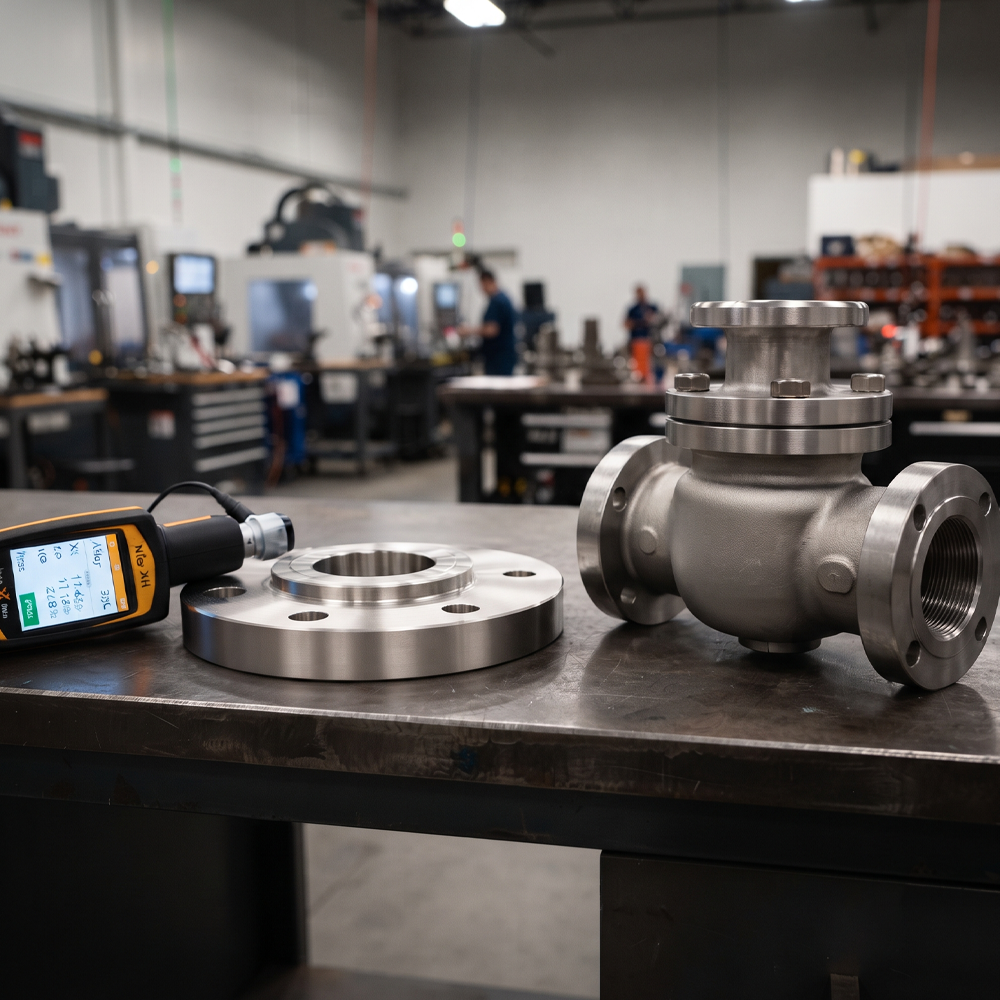
Indian Forging Exporters for Oil & Gas: What International Buyers Evaluate
Indian forging exporters for oil and gas are manufacturers who supply forged components — valve bodies, flanges, pressure housings, structural fittings — directly to international oil and gas operators, EPC contractors, and equipment manufacturers outside India. The market for Indian oil and gas forging exports is substantial and growing: Middle East operators sourcing from India at 17–24% click-through rates (per GSC data for vinirforge.org), North Sea EPC contractors qualifying Indian API 20B certified suppliers, and US Gulf of Mexico operators diversifying their supply chains away from single-country dependence. Understanding what international buyers actually evaluate — and what distinguishes Indian exporters who win repeat international business from those who qualify once and fail to sustain the relationship — is the subject of this guide.
At a Glance: What International Oil & Gas Buyers Evaluate in Indian Forging Exporters
| Evaluation Area | Minimum Requirement | What Distinguishes Top Exporters |
| Certification | API 20B current license | PSL 3/4 coverage, API 20C for CRA grades |
| Quality system | ISO 9001 | AS9100D covering full forge-to-finish scope |
| TPI integration | Willing to host TPI | Established relationships with BV, DNV, SGS, Intertek |
| Documentation | Complete to API 20B standard | Formatted to operator-specific requirements (SAMSS, ADNOC) |
| PMI capability | On request | In-house XRF — 100% PMI standard on every delivery |
| Material traceability | Heat number on MTR | Real-time digital retrieval within 15 minutes |
| Export experience | Can handle export logistics | SBLC, LC, DAP/CIF terms, export documentation fluency |
| Lead time | Quoted lead time | Track record of meeting quoted lead times consistently |
The Indian Oil and Gas Forging Export Opportunity
India’s oil and gas forging export market is larger than most Indian manufacturers realise.
Three data points frame the scale :
Middle East: Saudi Arabia, UAE, Qatar, and Oman collectively spend over USD 150 billion per year on oil and gas capital and maintenance expenditure. The forging content of this spend is a significant fraction — billions of dollars of valve bodies, flanges, pressure housings, and structural fittings procured annually. Indian API 20B certified manufacturers who can pass Aramco or ADNOC vendor qualification access this market directly.
GSC evidence of demand: Vinirforge.org’s Google Search Console data shows Qatar achieving 17.3% click-through rate from international visits and Oman achieving 24.5% CTR — the two highest international CTRs on the site. These numbers indicate active buying intent from Middle East markets already finding and engaging with Vinir’s content. The buyers are searching — the question is whether the supplier can pass qualification.
North Sea and US: The UK North Sea and US Gulf of Mexico have historically sourced oil and gas forgings from European and American suppliers. Following supply chain disruption from 2020 onwards, major operators and EPC contractors have been actively qualifying alternative sources including Indian manufacturers. Indian API 20B certified forging manufacturers entering these markets now are getting into qualification queues that were previously closed.
What International Buyers Evaluate — In Order of Priority
Priority 1: API Certification — License, PSL Level, and Scope
The first thing every international oil and gas buyer verifies is the API 20B license — and they verify it in more detail than Indian buyers typically do.
License currency — the API maintains a public list of licensed manufacturers at api.org. International buyers check this directly. A supplier who presents an API 20B certificate from three years ago that has since lapsed will be immediately disqualified — the buyer has checked.
PSL level coverage — international buyers for subsea, offshore, and sour service applications require PSL 3 or PSL 4. A license covering only PSL 1 and PSL 2 cannot supply these applications. Indian exporters seeking to access the highest-value international oil and gas markets — deepwater Gulf of Mexico, North Sea subsea, Middle East sour service — need PSL 3 and PSL 4 coverage.
API 20C for CRA grades — major operators specify duplex, super duplex, or Inconel forgings for offshore and corrosive service. API 20B covers carbon and low alloy steel only. A supplier claiming CRA forging capability without API 20C is not licensed to supply these materials to API-compliant programmes. International buyers check both licenses.
Scope specificity — the API 20B license document specifies what product types, sizes, and materials are covered. A license covering flanges up to 4-inch does not extend to 24-inch flanges. International buyers read the scope statement and verify that it covers their specific requirements.
Priority 2: Third-Party Inspection Integration
For most international oil and gas operators, TPI by an approved inspection company is mandatory for every forging delivery — not just for qualification lots. This is a structural difference from domestic Indian procurement where TPI is less consistently applied.
What international buyers assess:
- Which TPI companies has the supplier worked with internationally? Bureau Veritas, DNV GL, SGS, Intertek, Lloyd’s Register, and TÜV are the names international buyers recognise.
- Does the supplier have a documented TPI coordination procedure — advance notification lead times, dedicated quality contact for TPI visits, document preparation protocol?
- What is the typical time from order placement to TPI clearance? Buyers who have experienced suppliers who notify TPI one day before planned shipment — too late for the inspector to mobilise — know this is a programme risk.
- Can the supplier accommodate TPI at heat treatment, NDE, and final inspection as separate inspection stages if required by the operator’s inspection and test plan?
The practical test: Ask the supplier to describe the last TPI witness they hosted for an international customer. Which company did the inspector come from? What was the inspection scope? Was the lot released on the first inspection visit or were there return visits required? The answers reveal the supplier’s real TPI experience and the maturity of their inspection coordination.
Priority 3: Documentation Package Quality and Format
International oil and gas buyers — particularly those in the Middle East — have specific documentation requirements that go beyond the API 20B baseline. The gap between what Indian suppliers typically provide and what major operators expect is one of the most consistent failure points in Indian oil and gas forging export qualification.
What Saudi Aramco SAMSS-012 requires beyond API 20B:
- Material test report certified to ASTM specification with tighter chemistry limits than ASTM baseline (sulphur maximum 0.010% versus ASTM’s 0.040%)
- Heat treatment record formatted to show the complete thermal cycle including ramp rates, not just the soak temperature and time
- Hardness test results recorded by component serial number — not batch average
- Positive material identification results by XRF or OES — 100% of components
- Certificate of Conformance referencing the SAMSS document number and revision specifically
What ADNOC and QatarEnergy require: Similar to Aramco but with operator-specific certificate formats and, in some cases, operator-supplied forms that must be completed and signed by the supplier quality manager and the TPI inspector.
Common documentation failures from Indian exporters:
- MTR from a non-internationally recognised mill — buyers from the Middle East are familiar with the major international steel mills and will question an MTR from a mill they have not previously approved
- Heat treatment record showing only the target temperature and time — no furnace chart, no continuous temperature record
- NDE report not referencing the specific calibration standard used by serial number
- CoC signed by a quality manager without stating their authority reference
Priority 4: Positive Material Identification Capability
PMI is mandatory on every forging delivery for Saudi Aramco, ADNOC, and most major international oil and gas operators. It is not optional and it cannot be waived. The requirement exists because material mix-ups — a carbon steel component in a stainless or alloy steel specification — have caused serious incidents.
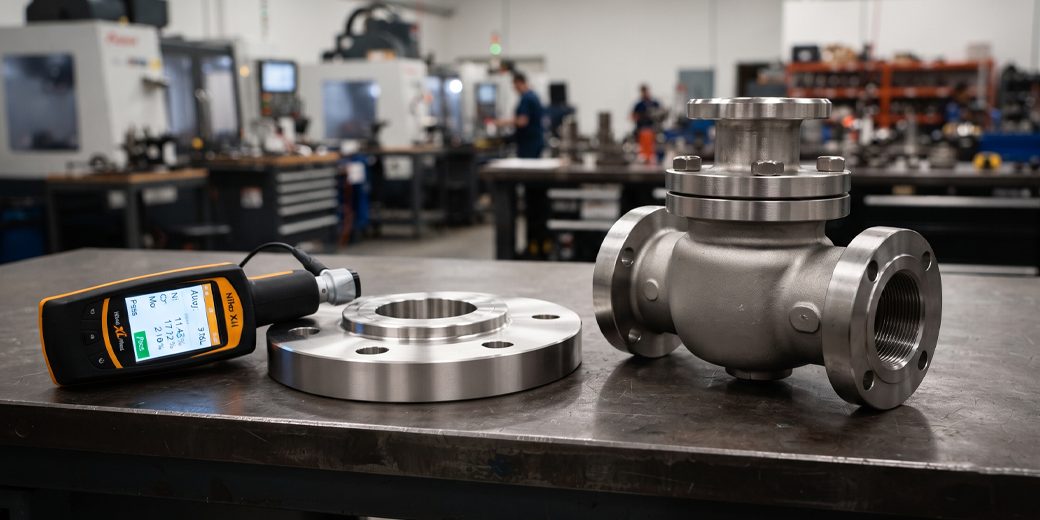
In-house XRF capability is the differentiator. A supplier who owns a calibrated XRF instrument can perform 100% PMI internally before TPI arrival, building it into the standard quality workflow. A supplier who relies on sending components to a third-party PMI service creates scheduling dependency and potential for mix-up during transport to and from the PMI lab.
For international export, PMI results must be reported in the documentation package with the XRF instrument serial number, calibration certificate reference, and the actual readings for the specified elements — not just a statement that PMI was performed.
Priority 5: Export Logistics and Commercial Capability
International oil and gas buyers have been burned by Indian suppliers who win a qualification but cannot execute the commercial aspects of export supply. The technical qualification and the commercial execution are evaluated separately.
What buyers assess on commercial capability:
Payment terms experience — can the supplier work with Letters of Credit (LC), Standby Letters of Credit (SBLC), and Documentary Collection? Many Middle East operators pay against confirmed LC. Suppliers who have never operated LC terms face a learning curve that adds risk.
Export documentation fluency — Certificate of Origin, commercial invoice in the buyer’s specified format, packing list, insurance certificate, inspection release certificate, bill of lading — every document must be correct for customs clearance in the destination country. Errors in export documentation cause port delays that can cost more than the value of the forging order.
Delivery terms understanding — CFR, CIF, DAP, DDP — the Incoterms applicable to oil and gas forging exports to different markets. A supplier quoting EXW to a buyer expecting CIF has not understood the commercial requirement.
Export packing — oil and gas forgings are heavy and geometrically complex. Inadequate packing causes transit damage that arrives at the destination facility. International buyers specify packing standards (typically to ISPM-15 for wooden packaging, with specific rust-preventive coating requirements for machined surfaces) and verify compliance through TPI.
Lead time reliability — this is the most important commercial capability for repeat business. A supplier who quotes 16 weeks and delivers in 16 weeks gets repeat orders. A supplier who quotes 16 weeks and delivers in 24 weeks — even once, even with a good explanation — is immediately evaluated against alternative sources. International procurement teams have no tolerance for lead time surprises on critical path items.
Priority 6: Material Sourcing and Mill Approvals
International oil and gas operators — particularly Saudi Aramco — maintain lists of approved raw material mills for specific product categories. Forgings supplied from non-approved mills may not be accepted regardless of the forging manufacturer’s qualifications.
ASTM material with traceable mill: International buyers require that the MTR comes from a recognised international steel mill — Ovako, Ascometal, Böhler, Sandvik, TimkenSteel, Carpenter Technology, and others — whose laboratory results and quality systems are known to the oil and gas industry. Domestic Indian steel mills are increasingly capable but may not be on the approved lists of major Middle East operators.
CRA material from approved sources: Duplex and super duplex from Sandvik, Outokumpu, or Acerinox. Inconel from Special Metals, Haynes International, or ATI. These mills’ certificates are recognised by international buyers without further investigation. Certificates from alternative sources require operator engineering review and approval before acceptance.
The Middle East Market: Qatar, Oman, UAE, Saudi Arabia
The Middle East represents the highest-value and highest-volume international oil and gas forging export market for Indian manufacturers. Understanding each market’s specific characteristics helps target qualification effort effectively.
Qatar — QatarEnergy
QatarEnergy operates the world’s largest LNG production facility (North Field) and is the world’s largest LNG exporter. North Field expansion projects are among the largest oil and gas capital projects currently under execution globally — multi-billion dollar investments in LNG trains, offshore platforms, and onshore processing facilities.
QatarEnergy applies API 20B as baseline with operator-specific supplementary requirements. TPI by approved inspection companies is mandatory. Indian API 20B certified manufacturers who can demonstrate North Sea or Aramco supply track record are well-positioned for QatarEnergy qualification.
Oman — PDO and OQ
Petroleum Development Oman (PDO) operates the majority of Oman’s oil production. OQ (Oman Oil and OmanOil) manages petrochemical and refining assets. Both apply API 20B with Omani supplementary standards that are less demanding than Aramco SAMSS but more detailed than API 20B baseline.
Oman’s relatively pragmatic vendor qualification process — less prescriptive than Aramco — makes it an accessible entry point into Middle East oil and gas forging supply for Indian manufacturers. GSC data showing 24.5% CTR from Oman suggests active engagement from Omani buyers already.
UAE — ADNOC
The Abu Dhabi National Oil Company manages the UAE’s oil and gas assets. ADNOC’s vendor qualification process for forging manufacturers parallels Aramco’s in rigour — on-site technical audit by ADNOC engineers, SAMSS-equivalent supplementary chemistry requirements, mandatory TPI by ADNOC-approved inspection companies.
Dubai’s position as a regional procurement hub means that much Middle East oil and gas forging procurement — even for Saudi and Qatari projects — passes through Dubai-based trading companies and procurement offices. Indian exporters with relationships with Dubai-based oil and gas trading companies access a broader range of Middle East projects than direct operator qualification alone provides.
Saudi Arabia — Saudi Aramco
Saudi Aramco is the world’s largest oil company and the largest single customer for oil and gas forgings globally. Aramco vendor qualification is the most demanding in the industry — the SAMSS-012 supplementary requirements, the Aramco technical audit, and the 100% PMI requirement set a standard that exceeds most other operators.
However, Aramco qualification provides a commercial credential that opens doors across the Middle East and beyond. Operators who know Aramco qualification standards accept an Aramco-qualified Indian supplier with significantly reduced additional qualification effort.
North Sea Market: UK, Norway, Netherlands
The North Sea oil and gas market — operated by BP, Shell, Equinor, TotalEnergies, Repsol, and others — is a mature but high-value market for subsea and topside forgings. North Sea characteristics:
NORSOK standards — Norway’s NORSOK standards (particularly M-630 for subsea materials) add requirements beyond API 20B baseline. NORSOK M-630 qualification requires corrosion testing of CRA grades, additional impact testing, and specific weld procedure qualification for subsea service.
Small lot sizes — North Sea maintenance and modification projects often require small quantities of specialised forgings — one or two valve bodies in a specific CRA grade. Indian exporters who can handle these small-lot requirements efficiently compete effectively with European suppliers on price while matching quality.
Subsea focus — the North Sea subsea sector — subsea trees, manifolds, umbilical termination assemblies — uses extensive duplex and super duplex forgings to NORSOK M-630. Indian manufacturers with API 20C and demonstrated super duplex 2507 capability are well positioned for North Sea subsea qualification.
How Vinir Engineering Serves International Oil and Gas Export
Vinir Engineering’s export profile for international oil and gas buyers covers the complete requirement set that major operators evaluate:
API 20B certification — current license across all four manufacturing units covering PSL 1 through PSL 3 in carbon steel, alloy steel, and CRA grades.
AS9100D — full forge-to-finish scope covering forging, heat treatment, CNC machining, NDT, and assembly.
TPI relationships — established working relationships with Bureau Veritas, DNV, SGS, and Intertek. Dedicated TPI coordination with defined notification lead times and a dedicated quality contact for every TPI visit.
In-house PMI — XRF spectrometry for 100% positive material identification. PMI results reported by component serial number in the documentation package.
International material sourcing — carbon and alloy steel from internationally recognised mills with AMS or ASTM-referenced MTRs. Duplex and super duplex from Sandvik and Outokumpu. Inconel from Special Metals.
Export experience — LC, SBLC, and DAP/CIF commercial terms. Full export documentation capability including SABER certification for Saudi Arabia, COO for all destinations. ISPM-15 compliant wooden packaging. Rust-preventive coating on machined surfaces to ASTM D1 or equivalent.
Lead time track record — 8–14 weeks for standard carbon steel valve body and flange forgings. 12–18 weeks for CRA grades including duplex and super duplex. These timelines are quoted conservatively and consistently met.
Frequently Asked Questions — Indian Forging Exporters Oil and Gas
What is the most important certification for an Indian forging manufacturer seeking oil and gas export business?
API 20B is the non-negotiable entry requirement for international oil and gas forging export. Without a current API 20B license covering the relevant PSL level and material grades, no major international operator or EPC contractor will qualify an Indian forging manufacturer. Beyond API 20B, AS9100D provides the quality management system credential that distinguishes serious exporters from opportunistic suppliers. For CRA grades — duplex, super duplex, Inconel — API 20C is additionally required.
How long does it take for an Indian forging manufacturer to qualify for Saudi Aramco supply?
Saudi Aramco vendor qualification for Indian forging manufacturers typically takes 12–18 months from initial approach to AVL approval. The process includes Stage 1 document submission and review (4–8 weeks), Stage 2 Aramco technical audit at the Indian facility (scheduling and travel adds 8–16 weeks), Stage 3 qualification test forgings to SAMSS-012 (8–14 weeks), and Stage 4 AVL processing (4–8 weeks). Suppliers who begin with API 20B in place, AS9100D covering the full scope, and established TPI relationships compress the timeline somewhat — those starting from scratch face longer timelines.
What payment terms do Middle East oil and gas buyers typically use for Indian forging exports?
Middle East oil and gas buyers typically use confirmed irrevocable Letters of Credit (LC) from first-tier international banks for initial orders with new suppliers. Confirmed LC terms protect both buyer and seller — the seller is guaranteed payment against compliant documents, and the buyer is guaranteed receipt of compliant goods. Established suppliers with a track record of delivery may negotiate Documentary Collection (D/P terms) for subsequent orders, reducing LC banking costs. Advance payment is rarely accepted by major operators for significant forging orders.
What is SABER certification and why is it required for Saudi Arabia forging exports?
SABER is Saudi Arabia’s product conformity certification system operated by the Saudi Standards, Metrology and Quality Organisation (SASO). Some categories of products imported into Saudi Arabia require SABER certification — essentially a conformity assessment that the product meets Saudi standards or specified international equivalents. For oil and gas forgings, SABER requirements vary by product category. Indian exporters shipping to Saudi Arabia should verify current SABER requirements for their specific product category and factor the SABER registration timeline (typically 4–8 weeks) into delivery planning.
What differentiates Indian oil and gas forging exporters who win repeat international business?
The differentiators for repeat international business are not primarily technical — they are operational. Lead time reliability (consistently delivering what was quoted), TPI coordination effectiveness (enabling the inspection company to complete inspection in a single visit), documentation completeness on first submission (not requiring three rounds of corrections), and responsive communication (same-day responses to buyer queries) are what separate Indian exporters who build long-term international relationships from those who win a qualification but fail to sustain the relationship.