
Marine Forging in India: ABS Certified Manufacturer for Offshore and Maritime Applications
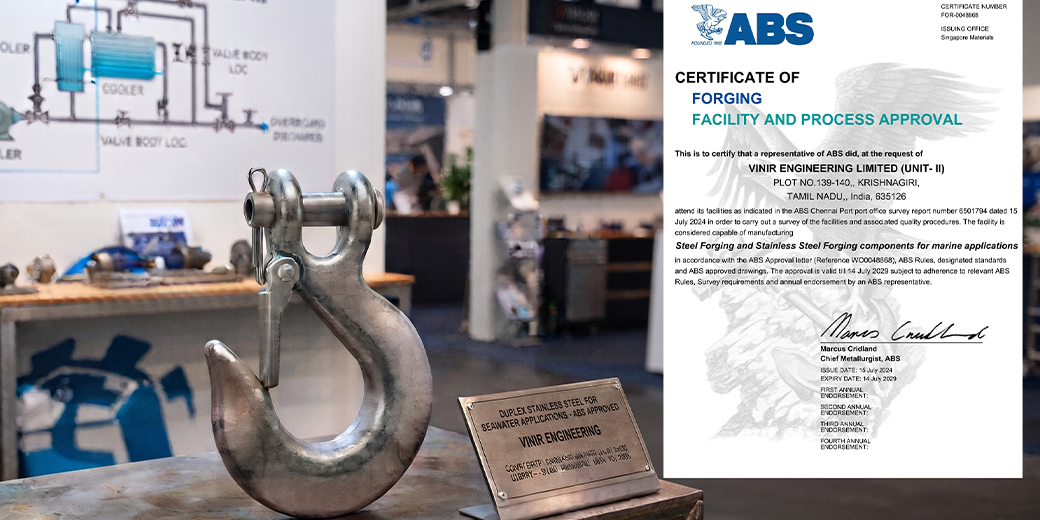
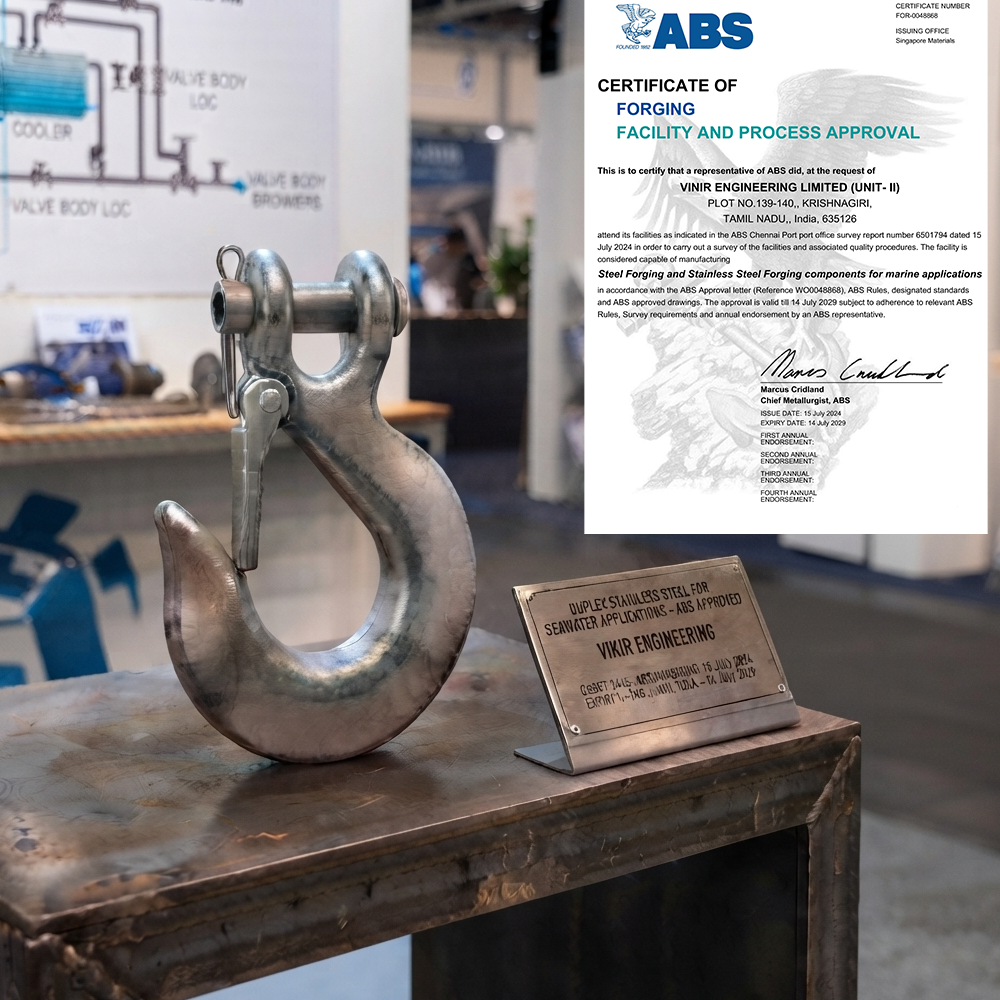
Marine forging is the manufacture of structurally critical forged metallic components for ships, offshore platforms, naval vessels, subsea systems, and port infrastructure — propulsion shafts, rudder stocks, anchor chain components, structural hull fittings, valve bodies for seawater systems, and offshore platform structural connections. Marine forgings must meet classification society requirements — ABS, Lloyd’s Register, Bureau Veritas, DNV, or Indian Register of Shipping — which impose independent material testing, heat treatment witness, and dimensional verification requirements on every certified lot. Vinir Engineering manufactures ABS approved marine forgings in Bangalore and Hosur since 1984, holding ABS, IBR, API 20B, and AS9100D certifications across four manufacturing units.
At a Glance: Marine Forging Requirements
| Parameter | Requirement |
| Classification society | ABS, Lloyd’s Register, BV, DNV, IRS |
| Survey type | Witness heat treatment + mechanical testing per lot |
| Primary standard | ABS Rules for Materials and Welding |
| Key materials | Carbon steel, alloy steel, duplex stainless, naval brass |
| Traceability | Heat number to finished component — mandatory |
| NDT | 100% UT for propulsion and structural forgings; MT all surfaces |
| Pressure test | Mandatory for pressure-retaining marine forgings |
| Weight range (Vinir) | 10 kg – 15,000 kg |
| Certification issued | ABS Form C1 or equivalent per class society |
Why Marine Forgings Require Classification Society Approval
Classification societies — ABS, Lloyd’s Register, Bureau Veritas, DNV GL, and Indian Register of Shipping — provide independent technical oversight of ship and offshore platform construction to ensure structural safety and seaworthiness. For forged components that are part of a vessel’s structural system, propulsion system, or pressure system, classification society certification is mandatory for the vessel to receive its class certificate and operate commercially.
The classification requirement exists because:
The consequences of failure are irreversible at sea.
A propulsion shaft that fails in open water disables the vessel. A rudder stock failure causes loss of steering control. A hull structural fitting that fails compromises watertight integrity. Unlike onshore industrial equipment where failed components can be isolated and replaced, marine structural failures at sea have immediate safety consequences for crew and cargo.
Independent verification protects the vessel owner.
The classification society audits the manufacturer independently of the shipyard and the vessel owner. An ABS certificate on a forging means ABS has witnessed the heat treatment, reviewed the MTR, and verified the mechanical test results — not just reviewed documents produced by the supplier.
Insurance and regulatory compliance require class certification.
Marine insurance underwriters require class certification for hull and machinery cover. Port state control inspections verify that vessels carry valid class certificates. Without classification society approval for structural and propulsion forgings, the vessel cannot be commercially operated.
Marine Forging Categories and Applications
Propulsion Shaft Forgings
Propulsion shafts — the shafts that transmit power from the main engine or gearbox to the propeller — are the most structurally demanding and highest-value marine forgings. A single propulsion shaft for a VLCC tanker or bulk carrier may be:
- 8–15 metres in length
- 8,000–15,000 kg in weight
- Forged from nickel-chromium-molybdenum alloy steel to ABS Grade 3 or Grade 4 specification
- Subjected to 100% ultrasonic testing across the full volume before machining begins
The manufacturing sequence for propulsion shaft forgings requires open die forging on a large hydraulic press — Vinir’s 3000T press with dango manipulators — followed by controlled heat treatment, comprehensive UT inspection, and then precision CNC machining of journals, flanges, and the propeller cone.
Dimensional straightness after forging is critical — excessive bow in the shaft requires correction by straightening, which introduces residual stresses that can reduce fatigue life if not properly stress-relieved.
Rudder Stock and Pintle Forgings
The rudder stock is the vertical shaft that connects the steering gear to the rudder blade, transmitting the torque required to turn the vessel. Rudder stocks are among the most highly loaded marine structural forgings — they must transmit full steering torque at maximum vessel speed while resisting the hydrodynamic loads on the rudder blade.
Rudder stocks are open die forgings in carbon or alloy steel — ABS Grade 2 or Grade 3 depending on vessel size and design loads. The flanged top of the rudder stock connects to the steering gear tiller or hydraulic ram. The lower section passes through the stern tube and terminates in the rudder blade pintle.
Pintles — the bearing pins at the lower trailing edge of the rudder — are smaller forgings that must be extremely wear-resistant. Naval brass or nickel-aluminium bronze forgings are used for pintles in many vessel types because of their combination of strength, corrosion resistance, and bearing properties.
Anchor and Mooring Forgings
Anchor shackles, connecting links, swivels, and mooring hardware are forged in high-strength steel or alloy steel and must meet breaking load and proof load requirements specified by the classification society. ABS and other societies publish grade specifications for anchor chain accessories — Grade U2 and Grade U3 steels for different strength levels.
These components are proof load tested — a physical load test to a specified fraction of the breaking load — and must deform without fracture. The proof load test is a mandatory class requirement and must be witnessed by the class surveyor for ABS-certified anchor hardware.
Structural Hull Fittings
Sea chests, keel plates, bilge keel connections, and structural penetration fittings that pass through the hull shell plating are forged components that must maintain watertight integrity throughout the vessel’s life. Sea chest forgings in particular — the seawater inlet chambers that supply cooling water to main engine, auxiliary systems, and fire suppression — must resist both external sea pressure and internal seawater corrosion.
Duplex stainless steel is increasingly specified for sea chest grating frames and structural seawater fittings where corrosion has been a maintenance problem with carbon steel alternatives.
Offshore Platform Structural Forgings
Fixed offshore platforms — jackets, topsides, and floating production units (FPSOs, semi-submersibles) — use large-diameter ring rolled forgings for structural node connections, riser clamp rings, and conductor casing structural transitions. These forgings carry the structural loads of the platform and must maintain integrity across the platform’s 25–30 year design life in the marine environment.
Ring rolling to Ø4,500mm on Vinir’s Wagner and Banning mill covers the diameter range required for most offshore structural ring applications.
Classification Society Certification: How ABS Approval Works
Initial Manufacturer Approval
Before any ABS-certified forgings can be produced, the forging manufacturer must obtain ABS manufacturer approval.
The approval process involves:
Facility assessment — an ABS marine surveyor visits the manufacturing facility and reviews the quality management system, heat treatment equipment and calibration records, NDT capability and operator qualifications, and test laboratory accreditation.
Approval test pieces — the manufacturer produces test forgings in representative materials to ABS-specified test piece dimensions. The ABS surveyor witnesses the heat treatment and mechanical testing. Chemical analysis is performed. Results are compared to ABS Grade requirements.
Approval certificate — upon satisfactory completion, ABS issues a manufacturer’s approval certificate covering the specific material grades, product types, and size ranges demonstrated. The approval is maintained through ongoing surveyor oversight.
Ongoing Survey for Each Production Lot
Once approved, every ABS-certified forging lot requires:
Advance notification — the manufacturer must notify ABS before each production lot begins, with sufficient lead time for the surveyor to be available.
Heat treatment witness — the ABS surveyor attends the facility and witnesses the heat treatment cycle. The surveyor reviews the furnace calibration records before charging, observes the cycle, and reviews the furnace chart at completion.
Mechanical testing witness — the surveyor witnesses tensile testing, Charpy impact testing, and hardness testing of specimens taken from witness pieces forged in the same heat as the production forgings.
ABS certificate issuance — on satisfactory results, the surveyor stamps and signs the ABS material test certificate (Form C1 or equivalent) for the production lot. This certificate must accompany the forgings to the shipyard.
Materials for Marine Forgings
Carbon and Alloy Steel — ABS Grades
ABS defines its own material grades for marine forgings:
ABS Grade 1 — carbon steel. Minimum tensile strength 400 MPa. For general marine structural fittings at ambient temperature.
ABS Grade 2 — carbon-manganese steel. Minimum tensile strength 490 MPa. For rudder stocks, propulsion shafts of smaller vessels, and structural forgings requiring higher strength than Grade 1.
ABS Grade 3 — alloy steel (typically carbon-manganese-molybdenum or chrome-molybdenum). Minimum tensile strength 590 MPa. For propulsion shafts, rudder stocks, and structural forgings of larger vessels. Quench and temper heat treatment.
ABS Grade 4 — high-strength alloy steel. Minimum tensile strength 690 MPa. For the most highly loaded propulsion shafts and structural connections on large vessels.
These ABS grades broadly correspond to ASTM carbon and alloy steel specifications — Grade 1 corresponds to A675, Grade 3 to A668 Class G or similar. The distinction is that ABS Grades have survey-specific mechanical property requirements and mandatory classification society witness.
Duplex and Super Duplex Stainless Steel
For marine seawater service components — sea chest fittings, seawater valve bodies, desalination plant structural fittings — duplex 2205 and super duplex 2507 are increasingly specified as corrosion-resistant alternatives to carbon steel that requires frequent maintenance coating and replacement.
Naval Brass and Bronze
Propeller shaft liners, stern tube bushings, pintles, and rudder bearing components are produced in copper alloys — naval brass (60-40 brass with 1% tin), nickel-aluminium bronze (NAB), and manganese bronze. These alloys provide the combination of seawater corrosion resistance, bearing properties, and strength required for rotating and sliding marine hardware.
NAB (Nickel-Aluminium Bronze, typically 81% copper, 9% aluminium, 5% nickel, 3% iron) is the standard material for propeller and pump impeller applications in seawater — it resists cavitation erosion better than any steel and has excellent biofouling resistance.
Indian Shipbuilding: The Domestic Demand for Marine Forgings
India’s shipbuilding sector — centred at Cochin Shipyard, Hindustan Shipyard, Mazagon Dock Shipbuilders, Goa Shipyard, and Garden Reach Shipbuilders — generates significant demand for ABS and IRS-certified marine forgings.
Cochin Shipyard — the largest commercial shipyard in India, building aircraft carriers (INS Vikrant), offshore vessels, and commercial shipping. Forging requirements span the full range from propulsion shafts to structural fittings.
Mazagon Dock Shipbuilders — building submarines and destroyers for the Indian Navy. Naval forging requirements include propulsion shaft forgings in high-strength alloy steel, structural hull fittings, and weapons system structural components.
Garden Reach Shipbuilders — frigates, landing craft, and fast patrol vessels. Diverse forging requirements across propulsion, structural, and weapons system categories.
Private shipyards — Chowgule and Company, Bharati Defence and Infrastructure, and others build offshore support vessels, dredgers, and coastal trading vessels. These yards source marine forgings for propulsion and structural applications.
Offshore vessel operators — the Indian offshore oil and gas support fleet (ONGC’s fleet, private offshore vessel operators) requires replacement propulsion shafts, rudder stocks, and structural fittings for vessel maintenance and repair.
Vinir Engineering’s Marine Forging Capability
Vinir Engineering holds ABS approval and IBR certification across four manufacturing units in Bangalore and Hosur. The marine forging capability covers the complete weight range required by Indian and international shipbuilding programmes.
Open die forging to 15,000 kg — propulsion shaft forgings for frigates, destroyers, and commercial vessels. The 3000T hydraulic press with dango manipulators handles the weight and length requirements of marine shaft forgings, including shafts up to 12 metres in length.
Closed die forging 10–1,400 kg — sea chest fittings, valve bodies, structural flanges, anchor hardware, and marine equipment components. The 1T–12T hammer bank and 3000T press cover the full range of marine fitting weights.
Ring rolling to Ø4,500mm — offshore platform structural ring forgings, large-diameter flange rings, and riser clamp rings on the Wagner and Banning radial-axial mill.
In-house heat treatment — quench and temper for alloy steel ABS Grade 3 and Grade 4 shaft and structural forgings. Solution annealing for duplex and stainless marine components. All furnaces calibrated to AMS 2750 equivalent pyrometry standards.
NABL-accredited mechanical testing — tensile, Charpy impact, Brinell and Vickers hardness, and chemical analysis — all in-house. ABS surveyor witness of testing is accommodated with dedicated lab and quality team support.
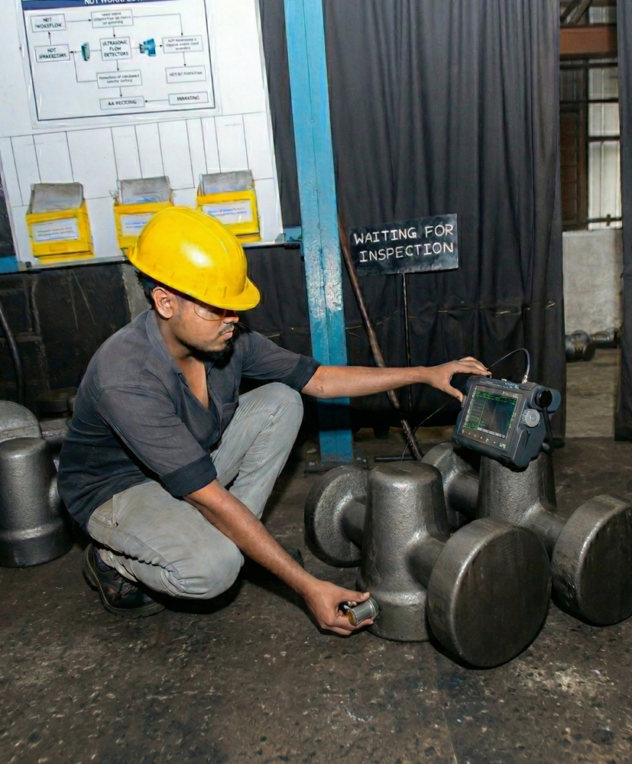
In-house UT and MT — 100% UT scanning of propulsion shaft and structural forgings before machining. MT of all surfaces after heat treatment. ASNT Level II certified operators.
ABS survey coordination — dedicated quality contact for ABS surveyor liaison. All furnace calibration records, travellers, and documentation prepared in advance of surveyor visits. Track record of single-visit lot releases without return visits.
Frequently Asked Questions — Marine Forging India
What is ABS certification for marine forgings and why is it required?
ABS (American Bureau of Shipping) certification for marine forgings means the manufacturer is approved by ABS to produce forgings under ongoing ABS surveyor oversight, with ABS witnessing heat treatment and mechanical testing for every certified lot. ABS certification is required for forged components in vessels classed by ABS — including the propulsion system, steering gear, structural hull fittings, and pressure-retaining components. Without ABS certification from the forging manufacturer, the shipyard cannot obtain ABS class certification for the vessel. Most major commercial and naval shipbuilding programmes in India specify ABS or IRS class certification for structural and propulsion forgings.
What is the difference between ABS, Lloyd’s Register, and IRS for Indian marine forging supply?
ABS (American Bureau of Shipping), Lloyd’s Register (LR), Bureau Veritas (BV), and DNV GL are international classification societies recognised worldwide for vessel classification. Indian Register of Shipping (IRS) is India’s national classification society. For vessels classed by IRS — many Indian coastal and inland vessels, and some vessels built for Indian owners — IRS certification from the forging manufacturer is required. For vessels built to international class (ABS, LR, BV, DNV) — most export vessels and naval platforms — the relevant international society’s certification is required. Vinir holds ABS approval which is the most widely recognised for international shipbuilding programmes.
What weight range of propulsion shaft forgings can Vinir manufacture?
Vinir Engineering manufactures propulsion shaft forgings from small vessel shafts at 200–500 kg through to destroyer-class shafts at 8,000–12,000 kg on the 3000T open die press with dango manipulators. This covers the full weight range required by Indian naval shipbuilding at MDL, GRSE, and GSL, and by commercial shipbuilding at Cochin Shipyard and private yards. Very large shafts above 12,000 kg for VLCC or bulk carrier class vessels approach the upper limit of the press capacity and are assessed on a case-by-case basis.
What NDT is required for marine propulsion shaft forgings?
100% volumetric ultrasonic testing is mandatory for all propulsion shaft forgings before machining begins. UT is performed to ABS or equivalent class society acceptance criteria — typically requiring complete volume coverage with specific maximum allowable indication sizes depending on shaft diameter and grade. Magnetic particle inspection of all surfaces after final heat treatment is additionally required. For shafts above a certain diameter, immersion UT or phased array UT may be specified to achieve the required sensitivity across the full cross-section. The ABS surveyor reviews UT calibration records and may witness UT inspection as part of the survey scope.
Can Indian marine forging manufacturers supply to international shipyards?
Yes. Indian ABS-approved forging manufacturers can supply to international shipyards building ABS-classed vessels anywhere in the world. The ABS certificate issued by Vinir is recognised by any ABS-classed shipyard — in South Korea, Japan, China, Europe, or elsewhere — without additional qualification. This is the commercial value of ABS approval: it is a globally recognised quality credential that opens export markets beyond the domestic Indian shipbuilding programme. Vinir exports marine forgings to international customers with ABS documentation that is accepted at the destination shipyard without further certification requirements.