
LNG Forging in India: Cryogenic Materials, Process Requirements, and Qualification
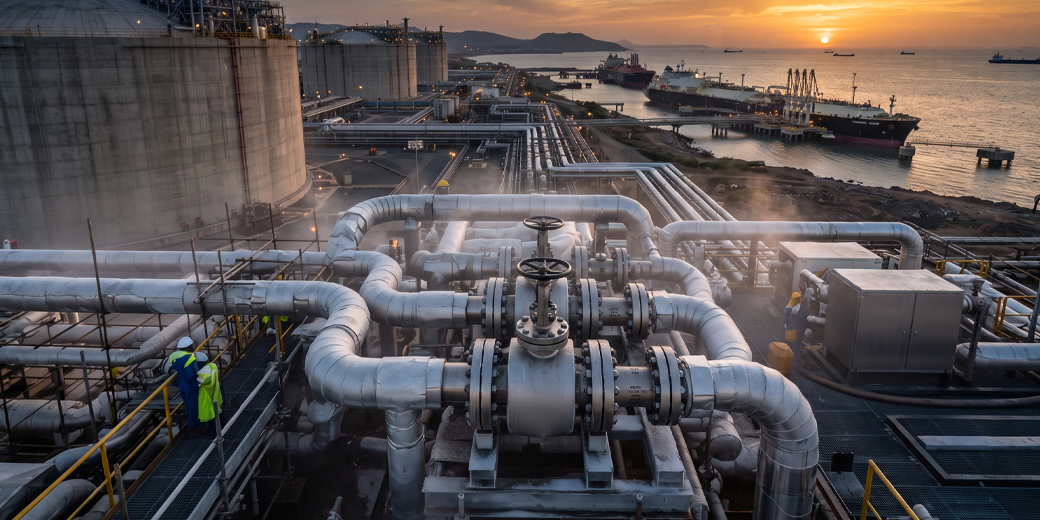
LNG forging covers the manufacture of forged components for liquefied natural gas production, storage, transportation, and regasification facilities — pressure vessels, pipeline flanges, valve bodies, pump casings, and structural fittings that must maintain structural integrity and leak-tight sealing at cryogenic temperatures down to -162°C (the boiling point of liquefied natural gas at atmospheric pressure). India’s rapidly expanding LNG infrastructure — import terminals, regasification plants, and the emerging LNG-as-fuel ecosystem — is creating growing domestic demand for cryogenic-grade forged components that meet international standards for cryogenic service.
At a Glance: LNG Forging Requirements
| Parameter | Requirement |
| Service temperature | -162°C (LNG) to -196°C (liquid nitrogen) |
| Critical property | Charpy impact toughness at design temperature |
| Primary carbon steel grade | ASTM A350 LF2 (tested to -46°C) |
| Low-temperature steel | ASTM A350 LF3 (tested to -101°C) |
| Austenitic stainless | ASTM A182 F304L / F316L (to -196°C) |
| 9% Nickel steel | ASTM A522 (to -196°C — primary LNG tank material) |
| Quality standard | AS9100D or equivalent QMS; ASME Section VIII Div 1/2 |
| NDT | 100% UT for pressure-retaining forgings; PT for austenitic |
| Design codes | ASME B31.3, EN 13480, BS 7777, BS PD 5500 |
| Pressure test | Mandatory hydrostatic or pneumatic per applicable code |
Why Cryogenic Service Creates Unique Forging Challenges
Standard carbon steels — ASTM A105, A106, common alloy steels — undergo a ductile-to-brittle transition as temperature decreases. Below the ductile-brittle transition temperature (DBTT), these steels lose the ability to absorb impact energy plastically before fracture. A component that is ductile and tough at room temperature can be completely brittle at cryogenic temperatures — fracturing under a sudden load or pressure transient without prior deformation or warning.
The consequence in LNG service is catastrophic. An LNG flange that fails in a brittle fracture mode at -162°C releases liquefied gas that rapidly vaporises, creating a flammable cloud with the potential for a vapour cloud explosion. This failure mode — cryogenic brittle fracture — has been the cause of several of the most serious LNG facility accidents in history.
This is why cryogenic forging specifications mandate Charpy impact testing at the design temperature, not at room temperature. Room-temperature tensile and hardness tests are still required, but it is the low-temperature Charpy impact result that determines whether a material is acceptable for cryogenic service.
India’s LNG Infrastructure: The Demand Driver
India is the world’s fourth-largest LNG importer and is rapidly expanding its LNG import and distribution infrastructure. The current and planned LNG facilities that drive cryogenic forging demand include:
Existing import terminals:
- Petronet LNG Dahej — 17.5 MMTPA, India’s largest LNG terminal. Ongoing maintenance and expansion require replacement and new cryogenic forged components.
- Petronet LNG Kochi — 5 MMTPA. Connected to the national gas grid and expanding utilisation.
- Shell Hazira — 5 MMTPA. Operated by Shell and Total Energies.
- Adani Dhamra — 5 MMTPA, operational since 2023.
- H-Energy Jaigarh — under development.
New terminals under development:
- Multiple FSRU (Floating Storage and Regasification Unit) projects along the Indian coastline, each requiring extensive cryogenic valve and piping forgings.
- Coastal regasification terminals in Gujarat, Maharashtra, Andhra Pradesh, and Tamil Nadu.
LNG-as-fuel infrastructure:
- LNG fuel stations for heavy road transport along national highways.
- LNG bunkering facilities for marine vessels.
- LNG fuel supply systems for industrial consumers switching from liquid fuels.
Each of these facilities requires cryogenic-grade forged flanges, valve bodies, pressure vessel nozzle forgings, and structural fittings — all of which must meet the low-temperature Charpy impact requirements of the applicable design code.
Materials for LNG and Cryogenic Forgings
ASTM A350 LF2 – The Standard Cryogenic Carbon Steel
ASTM A350 LF2 is the most widely used carbon steel forging specification for low-temperature service. The key difference from standard ASTM A105 is mandatory Charpy impact testing:
- A105: No mandatory Charpy impact testing. Not suitable for sustained low-temperature service.
- A350 LF1: Charpy impact tested at -20°F (-29°C). For moderate low-temperature applications.
- A350 LF2: Charpy impact tested at -50°F (-46°C). The standard for LNG import terminal piping and equipment operating at ambient temperatures typical of Indian coastal locations down to the vaporisation zone.
- A350 LF3: Charpy impact tested at -150°F (-101°C). For lower-temperature service — liquid ethylene, some LNG storage applications.
For Indian LNG import terminals where the LNG is at -162°C in the storage tanks but pipeline and equipment temperatures during normal operation may be -20°C to -60°C in the cold zones, A350 LF2 covers the majority of flanges and fittings away from the storage tank boundaries.
Minimum Charpy impact requirements for A350 LF2:
- Individual specimen minimum: 12 ft-lb (16 J) at -50°F (-46°C)
- Average of three specimens minimum: 20 ft-lb (27 J) at -50°F (-46°C)
These impact requirements are mandatory — a forging that meets all other A350 LF2 requirements but fails Charpy impact is rejected for low-temperature service regardless of tensile strength or hardness.
Austenitic Stainless Steels — 304L and 316L
Austenitic stainless steels do not exhibit a ductile-brittle transition — they remain ductile to the lowest cryogenic temperatures, including liquid nitrogen temperature (-196°C). This makes 304L and 316L the preferred materials for components directly in contact with LNG at -162°C:
- ASTM A182 F304L / F316L — valve bodies, flanges, and fittings in direct LNG contact at terminal cold boxes, LNG pumps, and send-out systems.
- The low carbon (L grade) designation minimises carbide precipitation during welding, maintaining corrosion resistance in welded assemblies.
- No mandatory Charpy impact testing is required for austenitic stainless at cryogenic temperatures because they do not undergo brittle transition — the ductility at cryogenic temperature is a characteristic of the austenitic microstructure.
However, austenitic stainless is susceptible to chloride stress corrosion cracking in certain environments — for LNG components exposed to marine atmospheres at coastal terminals, the salt air environment requires consideration in the surface treatment and insulation system design.
9% Nickel Steel — ASTM A522
9% nickel steel (9Ni steel) is the standard material for LNG storage tanks and cryogenic pressure vessels operating at -162°C. It achieves its cryogenic toughness through the nickel content, which stabilises the austenite phase and maintains high impact toughness at LNG temperatures.
For forgings — nozzle forgings on LNG storage tanks, structural connections, and pressure vessel closures — ASTM A522 covers forged 9% nickel steel components. The Charpy impact testing at -196°C (liquid nitrogen temperature) is the acceptance criterion.
9% nickel steel forging requires specific process knowledge:
- Forging temperature must be controlled to avoid overheating that degrades toughness
- Heat treatment is double normalise and temper or quench and temper — both must achieve the required cryogenic toughness
- Welding requires nickel-alloy filler metals (Inconel 82/182) — the welding procedure must be qualified for the cryogenic service conditions
Aluminium Alloys — 5083 and 6061 for Secondary LNG Applications
Aluminium alloys — particularly 5083 — are used for some LNG secondary containment systems, piping, and equipment where cryogenic temperature capability is required alongside low weight. 5083 aluminium maintains adequate strength and toughness at LNG temperatures and is widely used in LNG marine vessel cargo tank construction.
For forged aluminium components in LNG service — pump housing forgings, structural fittings, valve bodies in secondary service — 5083 or 6061 alloy is used. Not yet a significant category for Indian forging manufacturers but growing as LNG bunkering and marine applications expand.
Critical Process Controls for LNG Forgings
Charpy Impact Test – The Governing Quality Test
Unlike most industrial forgings where tensile strength and hardness govern acceptance, the Charpy impact test at the design temperature is the governing acceptance criterion for cryogenic forgings. Every heat of LNG forging raw material must be impact tested at the specified test temperature — not room temperature.
Witness coupon requirements — the Charpy specimens must be taken from a witness coupon that was forged from the same heat as the production forging and subjected to the same heat treatment cycle. This proves that the toughness achieved on the test specimen is representative of the actual forging — not a separately heat-treated specimen that may have different properties.
Test procedure — Charpy V-notch specimens (10mm × 10mm standard, or sub-size where section thickness limits full-size specimens) are tested in a calibrated impact testing machine cooled to the specified test temperature using liquid nitrogen or dry ice-alcohol bath. Temperature must be verified at the test specimen immediately before impact.
NABL accreditation for low-temperature testing — the test laboratory performing Charpy impact tests at -46°C, -101°C, or lower must be NABL-accredited for low-temperature impact testing. Standard Charpy impact testing at room temperature NABL accreditation does not cover low-temperature testing — the capability must be specifically listed in the NABL scope.
Heat Treatment for Cryogenic Toughness
Heat treatment for cryogenic forgings is designed to achieve the correct microstructure for maximum low-temperature toughness — not maximum strength. This sometimes creates an apparent tension with the minimum tensile strength requirement, which must be resolved by optimising the heat treatment to satisfy both.
For A350 LF2 carbon steel: Normalise and temper is the standard heat treatment. The normalising step refines grain structure — coarse grain significantly reduces low-temperature toughness. The tempering step relieves internal stresses and improves toughness at the expense of some strength. The tempering temperature must be above 593°C (1,100°F) per ASTM A350 — lower tempering temperatures do not achieve the required toughness.
For austenitic stainless (F304L, F316L): Solution annealing at 1,040–1,120°C followed by rapid quench. The rapid quench prevents carbide precipitation that would sensitise the steel and reduce toughness. The quench must be fast — for thick-section austenitic forgings, water quench is required.
For 9% nickel steel (A522): Double normalise and temper (most common) or quench and temper. The double normalising refines the grain structure twice — producing the very fine grain required for cryogenic toughness at -196°C. Tempering at 565–620°C after the second normalise develops the correct microstructure.
Weld Procedure Qualification for LNG Forgings
LNG forged components are invariably welded into assemblies — flanges welded into pipe spools, nozzles welded into pressure vessels, valve bodies butt-welded into pipeline systems. The weld procedure qualification for cryogenic service requires Charpy impact testing of the weld metal and heat-affected zone at the design temperature — not just the base material forging.
While weld procedure qualification is not the forging manufacturer’s primary responsibility, LNG facility engineers routinely ask forging suppliers whether their materials have been used in qualified weld procedures for cryogenic service. Suppliers with documented weld procedure history for their cryogenic grades are preferred because the EPC contractor can reference existing qualifications rather than re-qualifying from scratch.
Standards and Design Codes for LNG Forgings
ASME B31.3 Process Piping
The primary piping design code for LNG facilities in India. Chapter M covers Metal Temperature below -29°C and defines impact testing requirements by material type and design temperature. Forgings to A350 LF2 must be impact tested per ASME rules. Austenitic stainless steels are exempt from mandatory impact testing per ASME B31.3.
ASME Section VIII Division 1 – Unfired Pressure Vessels
For LNG pressure vessels and heat exchangers. UCS-66 defines the permitted materials and required impact testing for various design temperatures. A350 LF2 forgings are permitted down to -46°C with mandatory impact testing. 9Ni steel (A522) forgings are covered by the special low-temperature rules in UCS-66.
BS 7777 – Flat-Bottomed, Vertical, Cylindrical Storage Tanks for Low Temperature Service
The UK and widely adopted international standard for LNG storage tanks. References specific material requirements and Charpy impact testing requirements for tank nozzle forgings and structural connections. Many Indian LNG terminals have been designed to BS 7777 as the tank standard.
EN 13480 – Metallic Industrial Piping
The European piping standard, increasingly referenced in Indian LNG projects that involve European EPC contractors (Technip, Saipem, Worley). Impact testing requirements align closely with ASME B31.3 but reference European material standards (EN 10028-4 for low-temperature steels).
Indian LNG Industry: The Quality Standard Expectation
The specification standard for Indian LNG terminal forgings is set by the international LNG engineering community — not by domestic Indian standards. The reason is straightforward: Indian LNG terminals are designed by international EPC contractors (Bechtel, Technip, Saipem, Worley, Samsung), operated with process technology licensed from international technology providers (Air Products, Chart Industries, Shell), and insured by international underwriters who require compliance with recognised international standards.
This means Indian forging manufacturers supplying LNG terminals must demonstrate compliance with ASME, EN, or BS standards — not simply IS (Indian Standard) equivalents — and must provide Charpy impact test results performed at the specified test temperature by a NABL-accredited laboratory with specific low-temperature capability.
The quality documentation package for an LNG forging must satisfy the EPC contractor’s material review and the owner’s independent inspector — both of whom are technically sophisticated and will identify any gap between the actual test results and the specified requirements.
Vinir Engineering’s Capability for LNG and Cryogenic Forgings
Vinir Engineering manufactures cryogenic-grade forgings for LNG and low-temperature service applications in ASTM A350 LF2, ASTM A182 F316L, and ASTM A182 F304L from certified billet sourced from approved international mills.
Closed die forging — flanges, valve bodies, and fittings in A350 LF2 and austenitic stainless in the 10–1,400 kg range covering the majority of LNG piping and equipment forging requirements.
Open die forging — larger pressure vessel nozzle forgings and structural components in A350 LF2 and F316L in the 1,400–15,000 kg range.
Heat treatment — normalise and temper for A350 LF2 with tempering above 593°C as required by ASTM A350. Solution annealing with rapid quench for F316L and F304L. All furnaces calibrated to AMS 2750 equivalent pyrometry standards.
NABL-accredited low-temperature Charpy impact testing — tensile and Charpy impact testing at temperatures including -20°C, -29°C, -46°C, and -101°C in the NABL-accredited in-house test laboratory. The NABL scope specifically covers low-temperature impact testing — not only ambient temperature.
UT and PT NDE — 100% UT for pressure-retaining forgings. PT (fluorescent penetrant) for austenitic stainless components. ASNT Level II certified operators.
IBR certification — LNG send-out facilities with pressure above IBR threshold require IBR compliance for certain pressure-retaining components. Vinir’s IBR certification covers applicable LNG piping and equipment forgings.
AS9100D and API 20B certifications cover the complete forge-to-finish scope — from raw material incoming through forging, heat treatment, NDE, and final inspection — with full material traceability and complete documentation package.
Frequently Asked Questions — LNG and Cryogenic Forgings India
What is the difference between ASTM A105 and ASTM A350 LF2 for LNG applications?
ASTM A105 is standard carbon steel for ambient and moderately elevated temperature pressure forgings — no mandatory Charpy impact testing is required. ASTM A350 LF2 is specifically designed for low-temperature service — mandatory Charpy V-notch impact testing at -50°F (-46°C) is required for every heat, with minimum average impact energy of 27 J and minimum individual specimen energy of 16 J. For LNG terminal piping and equipment that will experience temperatures below -29°C, A350 LF2 is the minimum acceptable carbon steel specification. A105 is not acceptable for sustained low-temperature LNG service regardless of the chemical or tensile properties achieved.
Why do austenitic stainless steels not require Charpy impact testing for cryogenic service?
Austenitic stainless steels (304L, 316L) have a face-centred cubic (FCC) crystal structure that does not undergo the ductile-to-brittle transition that body-centred cubic (BCC) steels experience at low temperatures. The slip mechanisms in FCC metals remain active at cryogenic temperatures, maintaining ductility and toughness. This is why ASME B31.3 exempts austenitic stainless from mandatory impact testing for cryogenic service — the material does not become brittle at -162°C and no minimum impact energy needs to be verified. This makes F304L and F316L the preferred materials for components in direct LNG contact.
What NABL accreditation is required for cryogenic Charpy impact testing?
Standard NABL accreditation for mechanical testing typically covers Charpy impact at ambient temperature and at temperatures achievable with dry ice-acetone bath (to approximately -80°C). For testing at -101°C (A350 LF3) or -196°C (9Ni steel and liquid nitrogen service), the laboratory must have NABL accreditation specifically covering testing at those temperatures, requiring a cryogenic test chamber or liquid nitrogen bath with calibrated temperature measurement. Buyers should verify that the NABL scope certificate for the testing laboratory explicitly lists Charpy impact at the required test temperature — NABL accreditation for room-temperature impact testing does not extend to cryogenic testing.
What is 9% nickel steel and when is it used for LNG forgings?
9% nickel steel (ASTM A522 for forgings) contains approximately 9% nickel, which stabilises the austenite phase and maintains high impact toughness at -196°C — the temperature of liquid nitrogen and below the -162°C temperature of LNG. It is the standard material for LNG storage tank shells and for pressure vessel nozzle forgings and structural connections on LNG storage tanks operating at full cryogenic temperature. The 9% nickel content allows the steel to remain ductile at temperatures that would render standard carbon steel completely brittle, while achieving much higher strength than austenitic stainless steel for the same section thickness.
What documentation is required for LNG forging deliveries to Indian terminals?
LNG terminal forging deliveries require: mill test report certified to the applicable ASTM specification (A350 LF2, A182 F316L, A522) with all specified chemical and mechanical properties; low-temperature Charpy impact test report from a NABL-accredited laboratory at the specified test temperature with actual test results for all three specimens from each heat; heat treatment record with furnace charts and tempering temperature verification; UT and PT inspection reports; dimensional inspection report; and certificate of conformance to the applicable ASTM specification and design code. For IBR-applicable components, the IBR form III B is additionally required. EPC contractors may require additional documentation including positive material identification results and third-party inspection release certificates from an approved inspection company.