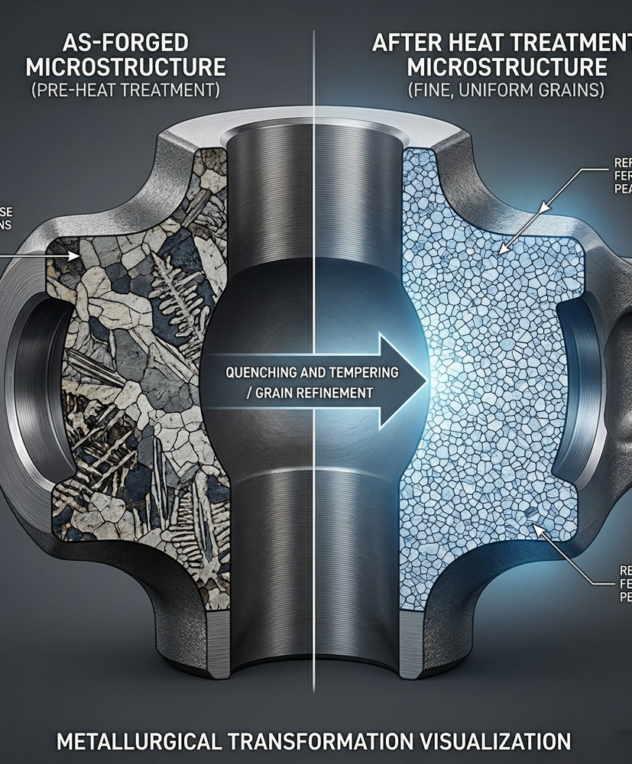
Super duplex 2507 (UNS S32750, ASTM A182 F53) — the most widely used super duplex stainless steel in offshore subsea, North Sea topside, and aggressive chemical process applications — presents unique forging process challenges that go beyond standard stainless steel forging. Sigma phase formation during slow cooling through 600–900°C, ferrite-austenite phase balance requirements (35–65% ferrite), the G48 corrosion test at 40°C as the definitive quality gate, and PREN ≥41 chemistry verification are the four technical pillars of super duplex 2507 forging quality. This technical blog explains each in depth for buyers and engineers evaluating super duplex forging suppliers.
Quality Parameter
Requirement
Test Method
Failure Consequence
Phase balance (ferrite %)
35–65% ferrite
Ferritescope, ASTM E562 point count
Low ferrite = SCC risk; high ferrite = low toughness
Sigma phase content
0% — none acceptable
ASTM E562 metallography + G48 test
Pitting corrosion at sigma-austenite interface
PREN (Pitting Resistance)
≥41 from actual heat chemistry
Calculate: %Cr + 3.3×%Mo + 16×%N
Low PREN = inadequate corrosion resistance
G48 corrosion test
≤10 mdd at 40°C, 72h, no pitting
ASTM G48 Method A
Failed G48 = inadequate solution annealing
Charpy impact at -46°C
≥45 J average (NORSOK M-630)
ASTM E23 per NORSOK M-650
Low toughness = brittle fracture in cold service
Super duplex 2507’s exceptional corrosion resistance — PREN typically 41–43 from the standard chemistry range — comes from its high alloy content: 25% chromium, 7% nickel, 4% molybdenum, 0.28% nitrogen. This high alloy content also makes it significantly more prone to secondary phase formation (sigma, chi, alpha-prime) during any thermal exposure in the 600–900°C range than standard duplex 2205. Where 2205 may tolerate 60–90 seconds of slow cooling through this range before sigma nucleation begins, 2507 begins sigma nucleation within 20–30 seconds of exposure above 850°C. This rapid sigma kinetics means that the quench from the solution annealing temperature must be completed with extreme speed — the component must reach below 300°C within 2–3 minutes from the annealing furnace exit.
The solution annealing heat treatment for super duplex 2507 — typically 1,060–1,120°C for 30 minutes minimum per 25mm of section thickness, followed by immediate rapid water quench — is the entire quality control intervention for the material’s final properties. Unlike steel Q&T where tempering allows correction of over-hardened microstructures, or austenitic 316L where solution annealing can be repeated if the first attempt is inadequate, super duplex 2507 has essentially only one opportunity for correct heat treatment — if the quench is too slow and sigma forms, no subsequent corrective heat treatment can fully restore the pre-sigma properties without re-annealing at the full solution temperature.
The G48 corrosion test at 40°C (ASTM G48 Method A, 10% FeCl₃·6H₂O solution, 72 hours) is the definitive super duplex 2507 quality test because sigma phase — even in amounts as small as 1–2% by volume (essentially undetectable by standard optical microscopy) — dramatically reduces pitting corrosion resistance at the sigma-austenite phase boundaries. The 40°C test temperature is calibrated specifically for super duplex: at this temperature, properly annealed 2507 shows negligible corrosion; 2507 with even traces of sigma shows aggressive pitting attack. The test is not gradual — it is essentially a pass/fail outcome, which is why it is the definitive quality gate.
PREN (Pitting Resistance Equivalent Number = %Cr + 3.3×%Mo + 16×%N) must be calculated from the actual heat chemistry of each production lot — not from the nominal minimum composition. The ASTM A182 F53 specification requires PREN ≥41 from the actual heat chemistry. A heat at the specification minimum for Mo (3.8%) and N (0.24%) calculates PREN = 25 + 3.3×3.8 + 16×0.24 = 25 + 12.54 + 3.84 = 41.38 — marginally passing. A heat where Mo is at the lower end of analytical uncertainty (3.7%) and N is at the low end (0.22%) calculates PREN = 25 + 12.21 + 3.52 = 40.73 — failing the ≥41 requirement despite being within the specification composition range. This is why PREN must be calculated from the actual OES chemistry of the specific heat and verified before the heat is accepted for critical super duplex applications.
API 20B PSL 1–3. Super duplex 2507 (A182 F53, UNS S32750) forgings 1–5,000 kg, closed die and open die. Solution annealing at 1,060–1,120°C with immediate rapid water quench (component reaches below 300°C within 3 minutes). Ferritescope measurement at minimum 8 locations per forging — records maintained per lot. G48 corrosion test at 40°C in NABL accredited or NABL-verified subcontract laboratory — 72-hour test with weight loss measurement and 20× visual inspection. PREN calculation from NABL OES heat chemistry — verified ≥41 before acceptance of each heat. NABL Charpy at -46°C minimum 45 J average. PMI on 100% of deliveries. NORSOK M-630 documentation package. TPI by Bureau Veritas and DNV.
Frequently Asked Questions
1.What is sigma phase and why is it so damaging to super duplex 2507 corrosion resistance?+–
Sigma phase (σ) is a brittle intermetallic compound with approximate composition FeCr — it forms when duplex stainless steel is held at 600–900°C, precipitating primarily at ferrite-austenite grain boundaries. In super duplex 2507, sigma formation is particularly rapid because the high chromium content (25%) provides abundant chromium for sigma nucleation. Sigma phase is damaging for two reasons: it depletes the adjacent matrix of chromium (which is incorporated into the sigma phase’s Cr-rich composition), dramatically reducing local pitting corrosion resistance; and it is intrinsically brittle, with near-zero ductility at ambient temperature. As little as 1–2 volume percent sigma phase (essentially undetectable by eye or low-magnification optical microscopy) can cause complete failure of the G48 corrosion test — which is why G48 is the mandatory quality gate rather than optical metallography alone.
2.What is the maximum section thickness that can be adequately quenched for super duplex 2507 without sigma formation?+–
The maximum section thickness that can be adequately quenched to prevent sigma phase depends on the quench rate required — for super duplex 2507, the centre of the section must cool below 850°C within approximately 30–60 seconds from the quench start. The cooling rate at the centre of a water-quenched component is slower than at the surface — for a 100mm diameter bar section, the centre cooling rate in water is adequate; for a 300mm diameter section, the centre cooling rate in still water may be insufficient and forced convection (agitated water quench) is required. The practical maximum section thickness for super duplex 2507 with adequate centre quench rate (without forced convection) is approximately 150–200mm diameter round or 100–150mm thick plate. For larger sections, forced convection quenching or spray quenching is required — and even then, very large sections (above 400mm) may not achieve adequate quench rates at the centre for reliable sigma-free microstructure.
3.How should a buyer interpret the ferritescope measurement requirement for super duplex 2507 forgings?+–
The ferritescope measures the magnetic response of the duplex forging surface — ferrite is ferromagnetic (attracted by magnets) while austenite is paramagnetic (weakly attracted). By measuring the magnetic attraction at multiple surface locations, the ferritescope estimates the ferrite content percentage. The required ferrite range (35–65%) means: below 35% ferrite (austenite-dominant), the stress corrosion cracking resistance and tensile strength of the duplex are reduced; above 65% ferrite (ferrite-dominant), the toughness and corrosion resistance are reduced. Buyers should verify that: ferritescope measurements are taken at a minimum of 8 locations per forging (not just 2–3 representative spots); the calibration standard used for ferritescope calibration is a certified duplex stainless reference block (not a carbon steel or austenitic stainless block); and any measurement outside 35–65% triggers metallographic investigation rather than automatic rejection or acceptance.
4.What is the NORSOK M-630 documentation package for super duplex forging supply and what does it contain?+–
NORSOK M-630 (Material Requirements for Piping and Valve Components) is the Norwegian offshore standard specifying material requirements for duplex and super duplex stainless forgings used in North Sea oil and gas applications. The NORSOK M-630 documentation package for a super duplex 2507 forging lot contains: (1) Mill MTR (Material Test Report) from the billet/bar producer — showing heat chemistry, mechanical properties, and melt process (VAR or ESR required for critical applications); (2) NABL-accredited OES chemistry report from the forging manufacturer; (3) NABL-accredited mechanical test report (tensile, Charpy at -46°C); (4) Heat treatment record (furnace chart showing solution annealing cycle with time and temperature trace); (5) Ferritescope measurement report (8+ locations per forging, within 35–65% range); (6) G48 corrosion test report (ASTM G48 Method A at 40°C, 72h — showing weight loss calculation and corrosion rate in mdd, and photograph or description of inspected surfaces); (7) PMI (XRF) report confirming CRA identity; (8) Certificate of Conformance referencing NORSOK M-630 compliance.
5.Why is 40°C the specified test temperature for G48 corrosion testing of super duplex 2507, and how is it different from duplex 2205?+–
The G48 test temperature is calibrated to produce a clear pass/fail discrimination between properly annealed and improperly annealed (sigma-containing) material for each specific alloy grade. For duplex 2205 (PREN ~34), 22°C is the calibrated temperature — properly annealed 2205 barely passes at 22°C, and sigma-containing 2205 fails clearly. If 40°C were used for 2205, even properly annealed material might show borderline corrosion, making the test useless as a discriminating test. For super duplex 2507 (PREN ~41), properly annealed material is so corrosion-resistant that it passes the 22°C test easily regardless of sigma content — the 40°C temperature provides the discrimination needed to detect even small amounts of sigma in a high-PREN alloy. Hyper duplex and Zeron 100 (PREN ~48) may use even higher test temperatures (50°C) to maintain the same discriminating capability. The test temperature is chosen to make the test ‘fair’ — neither too easy nor too difficult for a correctly processed alloy.