
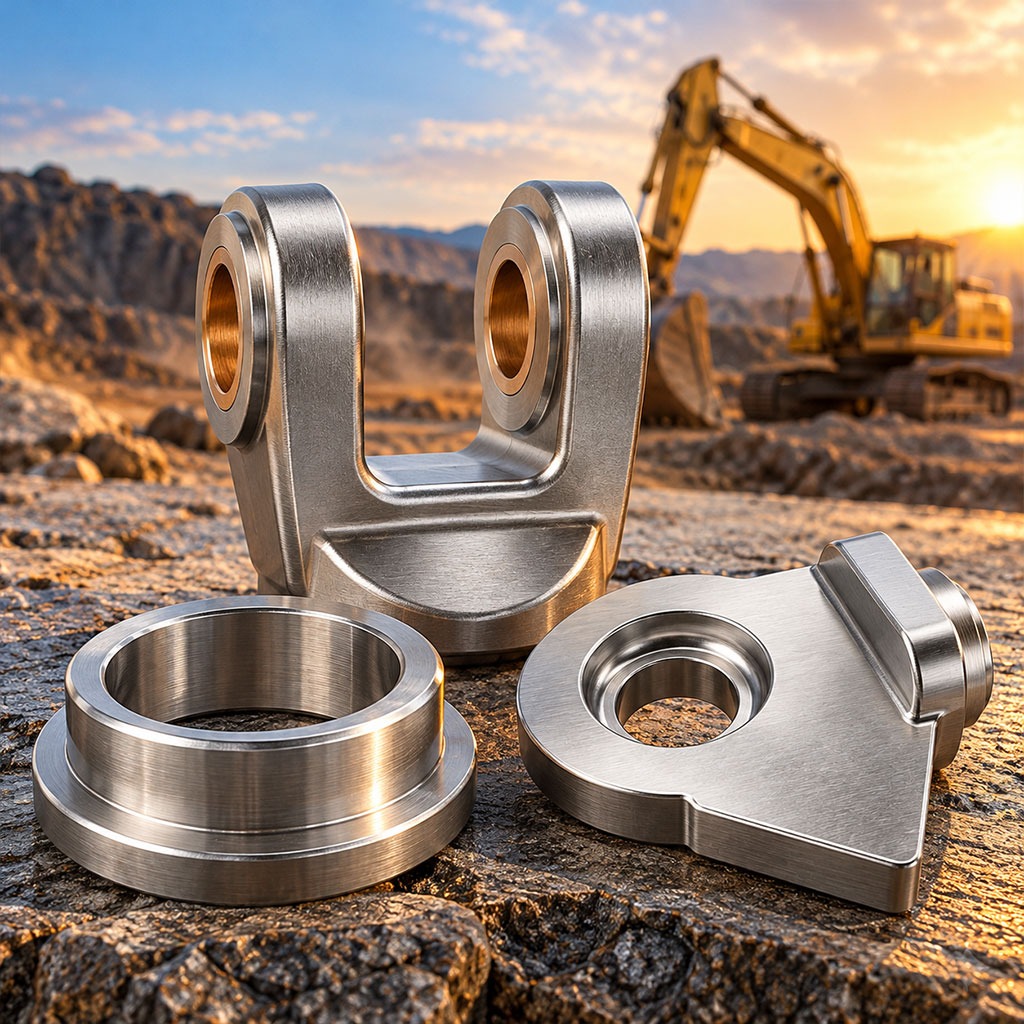
Forged Hydraulic Cylinder Components for Earthmoving OEMs
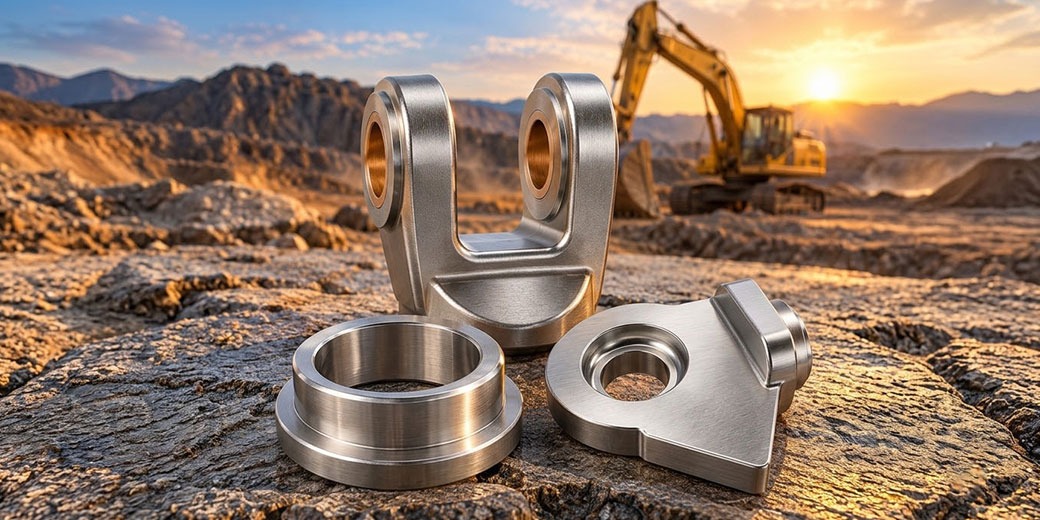
Forged hydraulic cylinder components — rod eyes, clevises, piston heads, cylinder end caps, glands and trunnions — carry the full load and shock of earthmoving and construction equipment. Excavators, loaders, dozers and dump trucks subject these parts to high cyclic loads, impact and pressure. Forging gives them the toughness and fatigue strength that castings and fabricated parts struggle to match, which is why leading earthmoving OEMs specify forged cylinder components.
At a Glance: Forged Hydraulic Cylinder Components
Component | Typical Process | Common Material |
| Rod eye / rod end | Closed die or open die | EN8, EN19, 42CrMo4 |
| Clevis and cylinder base | Closed die | EN8, EN19 |
| Piston head | Closed die or open die | EN8, EN19 |
| Gland / end cap | Ring rolling or open die | EN8, EN19 |
| Trunnion | Open die or closed die | EN19, EN24 |
| Piston rod blanks | Radial forging | EN19, 42CrMo4 |
Why Forging Suits Hydraulic Cylinder Parts
Earthmoving equipment sees repeated impact and fatigue loading, often in cold or abrasive conditions. Forged parts:
- Resist fatigue cracking at eyes, bores and weld preps
- Have dense structure for pressure tightness in end caps and glands
- Weld reliably to tubes and rods when grade and carbon equivalent are controlled
- Give consistent properties batch to batch
Weldability Matters
Rod eyes, clevises and bases are usually welded to the rod or tube. Material selection must balance strength with weldability — carbon equivalent, preheat requirements and post-weld treatment should be agreed with the OEM. Carbon steels such as EN8 weld easily; higher-strength alloy steels need controlled welding procedures.
Process Choice by Volume
- Closed die forging for high-volume rod eyes, clevises and piston heads, giving near-net shape and low machining
- Open die forging for large or low-volume parts
- Ring rolling for glands and end caps
- Radial forging for rod blanks and long components
Quality Requirements
- Mechanical properties and hardness to drawing
- UT where specified for heavily loaded parts
- MT for surface cracks
- Dimensional inspection of bores and weld preparations
- PPAP-style documentation for series production
Why Earthmoving OEMs Choose Vinir Engineering
- Closed die, open die, ring rolling and radial forging in-house
- Forge-to-finish machining of bores, threads and weld preps
- In-house heat treatment and NABL-accredited testing
- AS9100D across all four units
- Plants in Bangalore and Hosur, close to major earthmoving OEM clusters in South India