
Gear Blank Forgings for Indian Gearbox OEMs: Materials and Process Choices
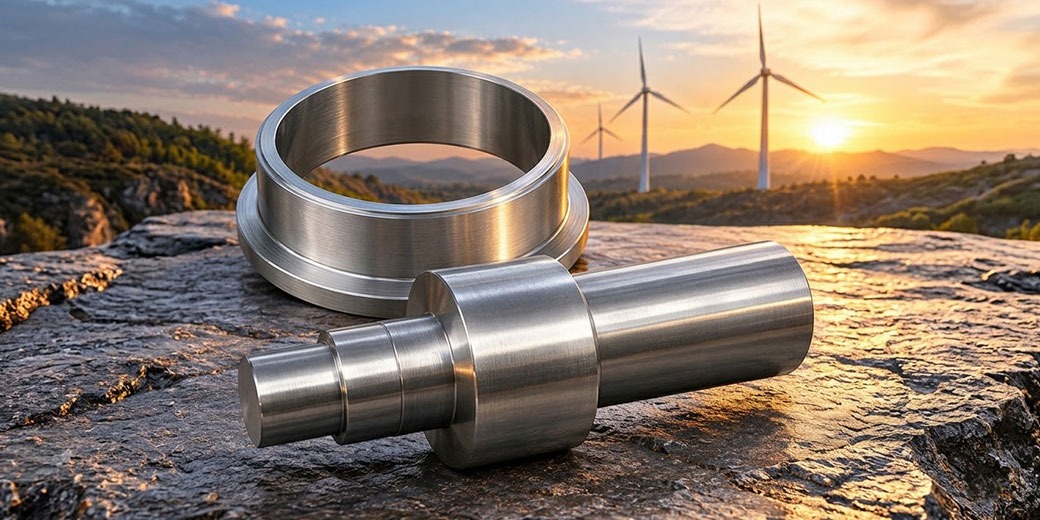
Gear blank forgings are the forged starting shapes — discs, rings, hubs and pinion blanks — from which gears are machined. Forging gives gear blanks dense structure and favourable grain flow under the teeth, improving bending fatigue and surface durability compared with blanks cut from bar or plate. Indian gearbox OEMs serving industrial, mining, wind, marine and rail sectors source forged gear blanks in carburising and through-hardening grades, supplied as-forged, normalised, or rough machined ready for gear cutting.
At a Glance: Gear Blank Forging Options
Gear Type | Typical Forging Route | Common Materials |
| Pinions and gear shafts | Open die, radial or closed die | 20MnCr5, 17CrNiMo6, EN36, EN24 |
| Spur and helical gear discs | Open die or closed die | EN19, EN24, 42CrMo4 |
| Ring gears and large gear rims | Ring rolling | 42CrMo4, 34CrNiMo6, 18CrNiMo7-6 |
| Bevel gear blanks | Closed die | Carburising grades |
Choosing Gear Steel: Carburising vs Through-Hardening
Carburising grades such as 20MnCr5, 17CrNiMo6 (18CrNiMo7-6) and EN36 have low carbon cores that are case-carburised after gear cutting, giving a hard, wear-resistant surface over a tough core. They are standard for highly loaded industrial and wind gearboxes.
Through-hardening grades such as EN19, EN24 and 42CrMo4 are quenched and tempered to a uniform hardness, sometimes followed by induction or nitriding. They suit moderately loaded gears and large gears where carburising is impractical.
Why Ring Rolling for Ring Gears
Ring Rolling vs Forging
Ring gears and large rims are ideally made by ring rolling. The seamless ring has circumferential grain flow aligned with the teeth, and ring rolling uses far less material than cutting a ring from a solid disc.
Pre-Machining Heat Treatment for Gear Blanks
Gear blanks are typically supplied normalised, isothermally annealed or quenched and tempered, depending on the gear manufacturing route. Isothermal annealing gives a uniform ferrite-pearlite structure that machines consistently and minimises distortion during later carburising. Specify the required condition and hardness range in the RFQ.
Quality Requirements for Gear Blanks
- Cleanliness and inclusion rating for high-fatigue gears
- Grain size control
- UT of the body to detect internal defects
- Hardness uniformity across the blank
- Hardenability (Jominy) band where specified
Alternatives When Supply Is Tight
If a specified grade is hard to source, alternatives with similar hardenability can sometimes be approved — for example substituting between 17CrNiMo6 and 18CrNiMo7-6, or between EN19 and 42CrMo4. Any substitution must be approved by the gear designer.
Why Gearbox OEMs Choose Vinir Engineering
- Ring rolling, open die, closed die and radial forging in-house
- Experience in carburising and through-hardening gear steels
- Normalising, annealing and Q&T in-house, with rough machining to gear-cutting stock
- UT and mechanical testing in an NABL-accredited lab
- AS9100D across all four units