

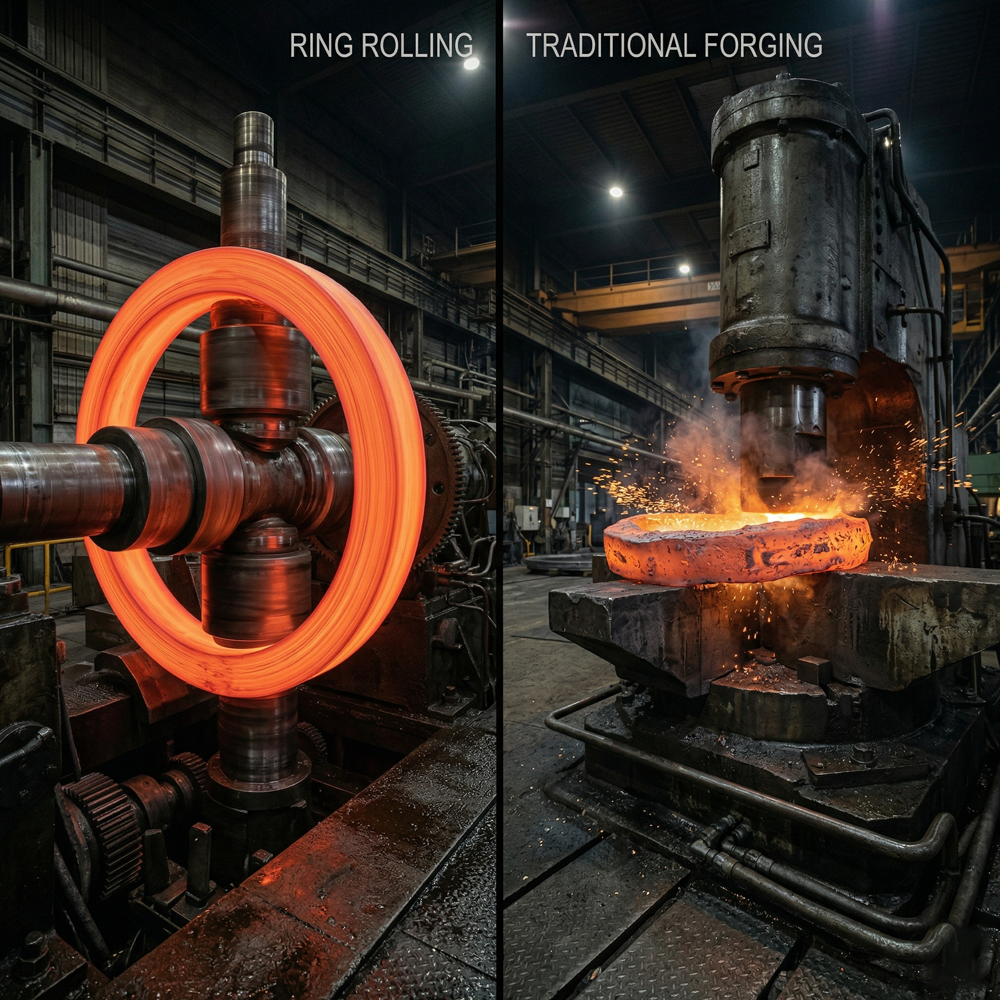
Ring rolling vs forging: which process produces better rings for critical applications?
Quick Comparison: Rolled Ring vs Forged Ring
| Factor | Ring Rolling | Forging (for ring shapes) |
| Best for | Seamless, large-diameter rings | Smaller/complex rings, near-net shapes |
| Grain Flow | Highly continuous circumferential flow | Strong, but depends on billet/preform |
| Dimensional Consistency | Very high for OD/ID uniformity | Moderate unless heavily machined |
| Material Efficiency | High (less scrap) | Lower (more machining loss possible) |
| Cost | Lower per ring at scale | Higher for custom + low volume |
| Lead Time | Faster when ring rolling setup exists | Faster for very small runs without ring tooling |
| Typical Uses | Bearings, flanges, gear rings, turbines | Special profiles, thick sections, custom features |
What is Ring Rolling
Explain simply: material is shaped between flat/simple dies, ideal for heavy reductions & custom sizes.
Include:
- Starts as a “donut” preform
- Heated and expanded under rollers
- Seamless ring with controlled geometry
- Excellent for uniform wall thickness and grain flow
Examples of parts:
- Slew bearing rings
- Gear rings
- Wind tower flanges
- Turbine
- Large diameter flanges
What Does “Forging a Ring” Mean?
Clarify:
- Rings can also be made by open die / closed die forging + machining
- Works best when: the ring needs complex features, heavy thickness, or lower quantity
- Strong, but grain flow continuity can be less uniform than rolling (depends on preform)
When Ring Rolling Wins and why buyers prefer it
For large diameter rings
Ring rolling is naturally suited for rings above certain OD range with consistent wall thickness.
For fatigue-critical applications
Continuous grain flow = better resistance under cyclic loads (bearings, rotating systems).
For better yield and repeatability
Less material waste, lower machining, cleaner geometry.
When Forging Wins and why ring rolling is not enough
When the ring has complex profiles
If it needs integrated bosses, holes, stepped forms, or unusual geometry.
When you need heavy thickness / high section sizes
Very thick rings may be better forged and machined.
When the batch is extremely low volume
Sometimes forging is faster if ring rolling setup isn’t economical.
What Critical Industries Look for
This section is the differentiator for Vinir.
- Documentation & traceability (heat lot → forging → heat treatment → machining → inspection)
- Inspection depth: UT, MPI, dimensional, hardness, impact
- Certification alignment: API / AS9100D / PED / IBR / ABS
- Repeatability and audit-readiness
Common Failures
Add high-consequence insight:
Supplier can roll the ring but cannot certify it for international chain
Incorrect ring rolling reduction ratio
Improper heat treatment → grain growth / brittleness
Out-of-roundness and tolerance mismatch
Poor UT inspection leading to latent defects
Leave a Reply