

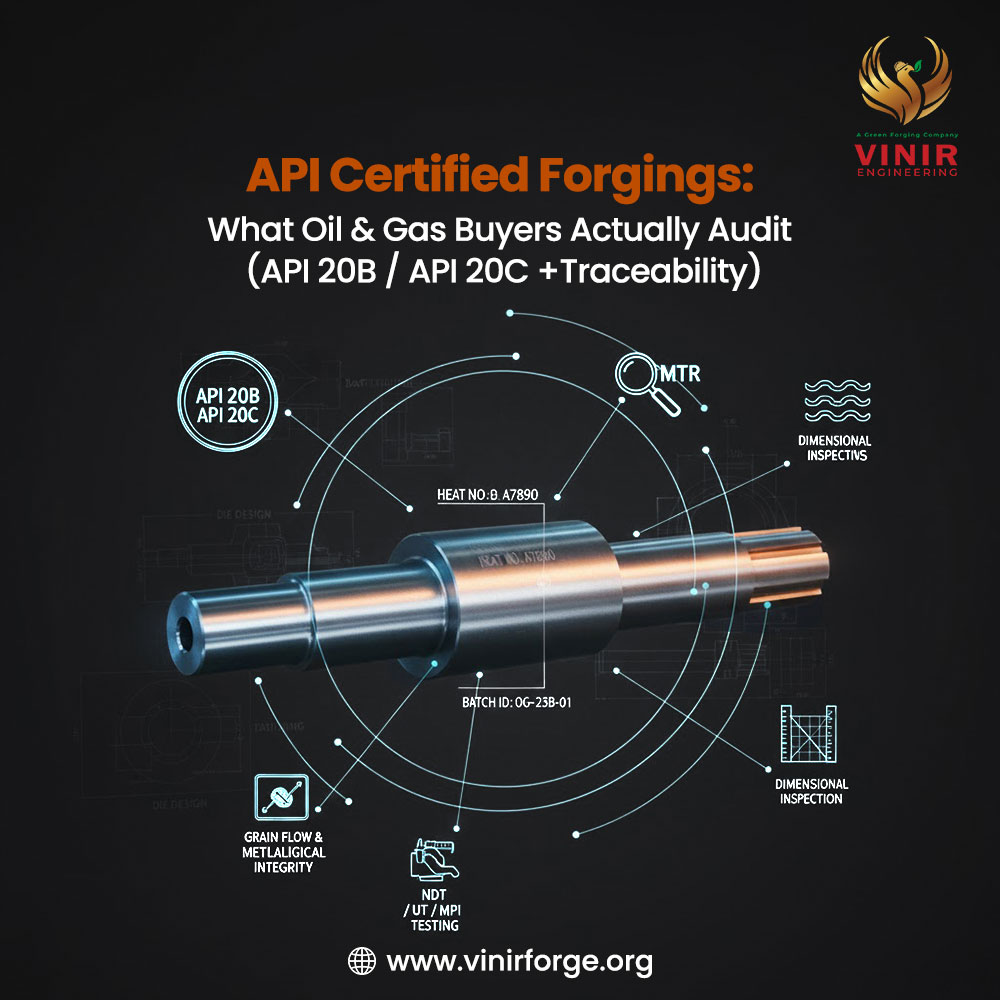
Api certified forgings: what oil & gas buyers actually audit (api 20b / api 20c + traceability)
If you supply forged components for Oil & Gas, being “API certified” is not just a checkbox.
Buyers don’t only audit what you make — they audit how you control risk across materials, process, documentation, and traceability.
This guide breaks down what Oil & Gas procurement, QA, and third-party inspectors actually look for when evaluating an API forging supplier under API 20B (Open Die + Closed Die Forgings) and API 20C (Rolled Rings).
1) What API 20B and API 20C really certify
Most buyers don’t treat API 20B/20C as “quality certifications.”
They treat them as risk-reduction certifications.
API 20B applies to:
- Open die forgings
- Closed die forgings
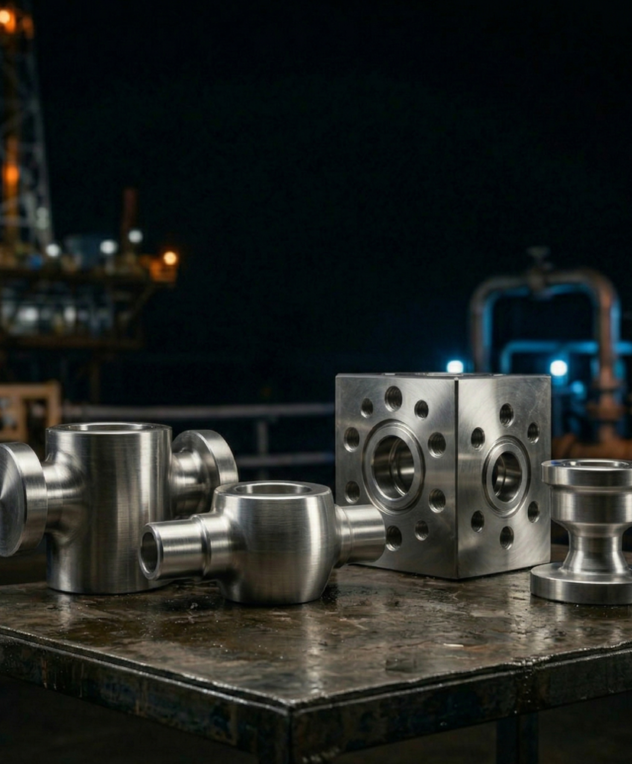
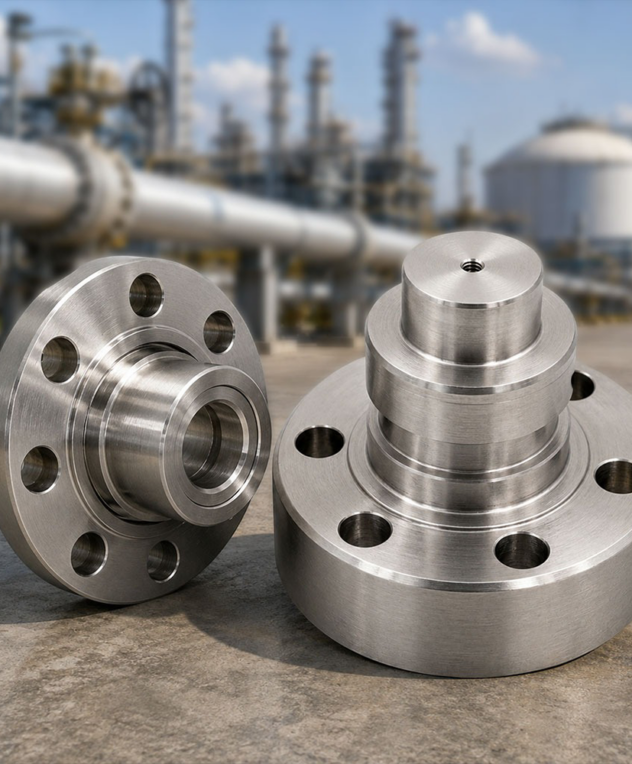
- Typical components: blocks, hubs, shafts, valve bodies, connectors, heavy forged parts.
API 20C applies to:
- Rolled rings
- Typical components: flanges, rings, bearing rings, pressure-containing rings.
In procurement terms, API certification signals:
- Your forging process is controlled
- Your documentation is auditable
- Your material traceability is strong
- Your inspection system is validated
- Your supplier is qualified for high-consequence failure environments
2) What Oil & Gas buyers audit
In a supplier audit, most Oil & Gas customers evaluate five critical areas:
A) Material Control + Traceability
This is always the first test.
Buyers check:
- Heat number linkage from raw material → forging → machining → dispatch
- Material Test Certificates (MTC) validation
- PMI (Positive Material Identification) process
- Batch segregation controls
- Traceability across mixed production
What they want to see:
No part should exist without a documented material chain.
If traceability breaks once, the supplier is considered high risk.
B) Process Discipline: Forging Controls
Here buyers want proof you can consistently produce defect-free forgings at scale.
They audit:
- Heating and forging temperature controls
- Furnace calibration records
- Deformation ratio controls
- Grain flow strategy and die design logic
- Controlled cooling and post-forge process control
- Process parameters documented by SOPs
What they want to see:
You are not dependent on “operator experience.”
The process must be system-led, repeatable, and trainable.
C) Heat Treatment Integrity
Heat treatment is where many suppliers fail audits because it’s easy to “claim” but hard to prove.
They audit:
- Heat treatment charts and records per batch
- Furnace uniformity surveys
- Quench process control
- Hardness verification protocols
- Mechanical property compliance vs standard
What they want to see:
Every heat cycle is documented and linked to the batch.
Zero missing charts.
D) Inspection + NDT System Strength
Oil & Gas buyers assume forgings will have defects — what matters is whether your inspection system can catch them.
They audit:
- NDT methods: UT, MT, PT, RT as applicable
- Calibration and reference blocks
- Inspector qualification (Level II/III)
- Rejection handling and corrective actions
- Dimensional inspection plans
What they want to see:
Inspection must be designed, not improvised.
Calibration and acceptance criteria must be documented.
E) Documentation Culture: Audit Readiness
This is the biggest differentiator between an API-certified supplier and an API-ready supplier.
They audit:
- Document retention discipline
- NCR / CAPA process maturity
- Supplier evaluation for raw materials and subcontractors
- Traceability documentation pack readiness
- Ability to generate the full dossier fast
What they want to see:
If they ask for the complete batch dossier, you should deliver it in hours — not weeks.
3) The “Traceability Pack” every Oil & Gas buyer expects
If Vinir wants to win oil & gas buyers internationally, this is what the website should showcase clearly.
Typical Buyer Pack includes:
- Material Test Certificate (MTC)
- Heat treatment charts + results
- Mechanical test report (tensile, impact, hardness)
- NDT reports (UT/MT/PT)
- Dimensional inspection report
- PMI records (where relevant)
- Manufacturing route sheet (process record)
- Final release note + compliance declaration
Critical insight:
Even if the forging is perfect —
the deal is lost if the documentation is not clean, consistent, and fast.
4) API Monogram vs API 20B / 20C: common confusion buyers test
Buyers often ask this to test supplier maturity:
- API Monogram Certification (like API 6A products) = product certification
- API 20B / 20C = forging process + quality system certification
If a supplier mixes these up, buyers assume weak understanding.
5) Why many “API suppliers” still fail buyer qualification
Most failures are not technical.
They are systems failures.
Common rejection reasons:
- Missing heat treatment charts
- No documented forging route sheet
- Traceability breaks when production is high-mix
- NDT done but inspector certification not updated
- Records scattered, no document control
- Audit response time too slow
So buyers choose suppliers who can prove:
- Process discipline
- Documentation discipline
- Traceability discipline
Final Thought: Why API certification matters for global Oil & Gas supply chains
Oil & gas projects don’t fail because suppliers can’t forge metal.
They fail because suppliers can’t manage quality risk under audit pressure.
That’s why the best API forging partners aren’t the biggest.
They’re the ones who are :certified + traceable + audit-ready + disciplined.

Leave a Reply