
300M Steel Forging Supplier for US Aerospace from India: Landing Gear & Structural Components
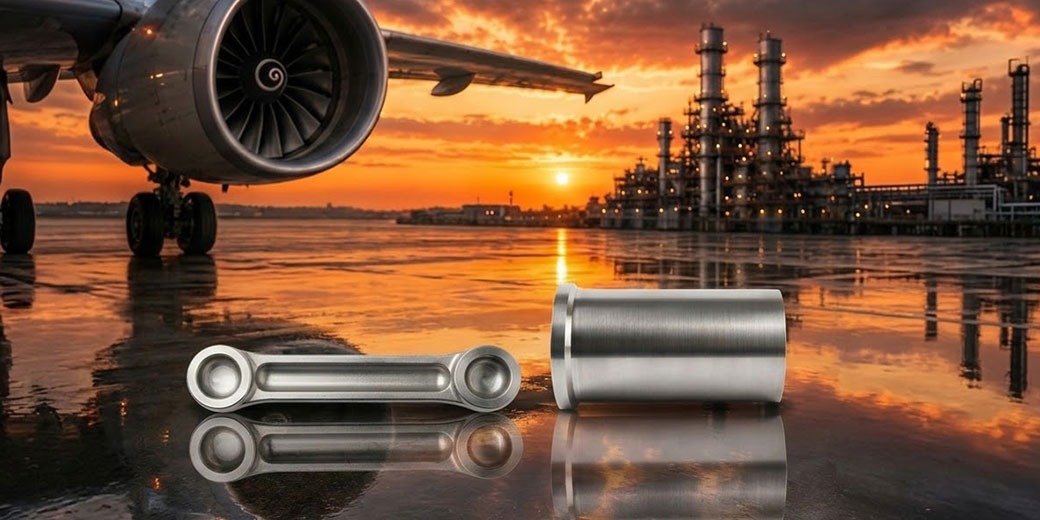
Landing gear components experience some of the highest mechanical loads found anywhere on an aircraft.
During touchdown they absorb extreme impact. During taxiing they experience repeated fatigue cycles. During manoeuvring they carry substantial bending, torsional and compressive loads.
These requirements explain why 300M ultra-high-strength steel is widely associated with demanding aerospace structural applications.
For a US aerospace procurement team evaluating a 300M steel forging supplier in India, supplier selection therefore requires aerospace-grade control across raw material, forging, heat treatment, NDT and documentation.
What Is 300M Steel?
300M is a modified version of 4340 designed for ultra-high-strength aerospace applications.
The alloy is engineered to provide exceptional strength while preserving the toughness required for flight-critical structures.
Its applications include:
- Landing gear beams
- Landing gear cylinders
- High-load structural members
- Actuation components
- Aerospace shafts
- Military aircraft structures
Your existing US aerospace material framework already identifies 300M as an important high-strength steel used in aircraft landing gear and military structural forgings.
Why Landing Gear Components Are Forged
Landing gear is a textbook example of why forging remains essential in aerospace.
Machining a landing gear component entirely from a large block may produce the correct geometry but does not provide the same directional grain-flow possibilities as a properly engineered forging.
Forging enables material flow to be developed around critical sections. Potential benefits include:
- Improved fatigue resistance
- Better fracture resistance
- Higher structural efficiency
- Reduced machining stock
- More reliable performance under cyclic loading
Aerospace Material Control
US aerospace programmes demand strict raw-material pedigree.
Buyers may require:
- Approved raw-material sources
- Complete mill certification
- Heat-number traceability
- Vacuum-melted material where specified
- Chemistry confirmation
- Material segregation
- Controlled storage
For high-strength aerospace steel, material cleanliness becomes especially important because inclusions can act as fatigue crack initiation sites.
Heat Treatment of 300M
300M derives its performance from carefully controlled heat treatment. The required process is highly specification-dependent and must produce:
- Very high tensile strength
- Controlled hardness
- Adequate fracture toughness
- Fatigue resistance
- Stable dimensional characteristics
Small deviations in temperature or soak conditions can materially affect performance.
Aerospace buyers therefore evaluate not only the furnace but also:
- Furnace calibration
- Temperature uniformity
- Thermocouple control
- Load placement
- Quench control
- Recording systems
- Pyrometry compliance
NADCAP and Special Process Control
For many US aerospace programmes, heat treatment and NDT are treated as special processes.
NADCAP accreditation may be required depending on the OEM, component and programme.
Existing US aerospace supplier requirements frequently place substantial emphasis on NADCAP-controlled heat treatment and NDT.
An Indian supplier must therefore clearly identify which processes are:
- Performed in-house
- Customer-approved
- NADCAP accredited
- Subcontracted
Ultrasonic Inspection
Landing gear and other flight-critical forgings frequently require extensive volumetric inspection.
UT is used to detect internal discontinuities that could become fatigue initiation points.
For aerospace applications, inspection may involve tighter calibration and acceptance criteria than general industrial UT.
Supplier capability should therefore be evaluated against the exact drawing and specification.
First Article Inspection
A new aerospace forging normally requires a formal qualification process before recurring production.
AS9102 First Article Inspection may be part of this process.
The FAIR demonstrates that the manufacturing route can produce a component conforming to every applicable drawing and specification requirement.
Your existing aerospace content correctly positions FAIR capability as a major US buyer qualification deliverable.
Machining Landing Gear Forgings
Landing gear forgings often contain:
- Precision bores
- Bearing interfaces
- Tight positional tolerances
- Controlled wall thicknesses
- Complex geometric relationships
The machining stage therefore needs to be treated as part of the structural manufacturing route, not as a commodity downstream operation.
An integrated forge-to-finish manufacturer can reduce the coordination burden between forging and machining suppliers.
What US Aerospace Buyers Should Evaluate
Before qualifying a 300M supplier, buyers should review:
- AS9100D certification
- Relevant aerospace production history
- Raw material sourcing controls
- Heat treatment capability
- Special-process approvals
- UT capability
- FPI/MPI capability as required
- Mechanical testing
- AS9102 FAIR experience
- CMM capability
- Traceability
- Configuration control
300M Forgings at Vinir Engineering
Vinir’s high-strength alloy steel capability includes aerospace and defence-oriented forging, heat treatment, machining and inspection.
Its manufacturing model is built around high-mix, low-volume components where engineering control and documentation are as important as production tonnage.
US aerospace buyers can submit drawings and applicable specifications for manufacturability and qualification review.